Tom Jones’ Praise & Blame

Tom Jones.jpgSir Tom Jones, 70, the legendary Welsh born musician known for “She’s a Lady” and “Sex Bomb” released a new album that can’t be missed. Jones was knighted by Queen Elizabeth II in 2006. His July 2010 album “Praise and Blame”, his 36th album, is strongly influenced by the genres of gospel, rock, country, and the blues and it has received a critical review.

The music reviewer of the LA Times put Jones’ album in the top 5. For me, Jones has a great voice that needs to be savored.

Praise & Blame.jpg

Some say that Sir Jones did his best work in recent decades with “Praise and Blame” and it as the singer’s “rebirth.” You can’t miss the remake of one of Bob Dylan’s songs, “Oh Mercy.”
“Praise and Blame” has gotten the attention of the media in Rome: watch a video clip on Tom Jones’s newest work.

Saint Stephen, the first killed for Christ

St Stephen Sermon Fra Angelico.jpgIn the blood of the holy Levite Stephen “the Church dedicates the first-fruits of martyrdom” to the King of martyrs.

The day following Christmas, December 26, is observed liturgically by the Church as Saint Stephen’s Day. Saint Stephen’s feast is located so close to Christmas because of his very close connection with the Lord. Stephen is the first martyr –the protomartyr– of the New Testament (See Acts 6-7).
Today in 2010, the liturgical observance of Sunday is maintained as the Lord’s Day and is not trumped by a saint’s feast. The overlaying of the Holy Family feast today –observed on the Sunday following Christmas– doesn’t replace the Sunday observance nor the Scripture readings but today is the feast of the Holy Family and it is a rich feast nonetheless. But we don’t forget Saint Stephen!
The Polish children would imitate the stoning of Stephen by throwing walnuts at each other. In agricultural countries horses and horse food (hay and oats, and salt) are blessed. In the UK, Saint Stephen’s day is also known as “boxing day” because priests in medieval times they gave alms collected in Church to the poor. All shared in the Lord’s blessings. This charitable gesture of the priests was adopted by the laity who also gave alms to the poor. What you see here is the beauty of the gospel preached by Jesus and the Apostles realized in concrete ways. Money is counted and given freely, hence the breaking of the alms boxes became known as “boxing day” because it was an invitation to be mindful of the less fortunate. German children had piggy banks made of clay taking on the same sensibility as the British children knew. The Germans sometimes call today the “pig’s feast” because the clay pig bank was broken to gain access to the monetary savings to be given to others in need.
Since the saints always and unreservedly point to Christ, theologically we’d say that the Christ Child, the Divine Child, gave His blessings. Latin Americans would call the infant Jesus as “el Niño Jesús” or the Germanic peoples would call Him the “Christkind” or the diminutive “Christkindel” (and you see the origins of the word Kris Kringle and Santa Claus).
Whether the customs of the UK or Germanic countries prevail, the connection to Saint Stephen is maintained: as a deacon of the nascent Church, Stephen cared for the widow, the orphan, the outcast –the needy. Indeed, deacons looked after the temporal needs of all people, and he preached Jesus’ Good News of Salvation. The gesture of giving is form of witness to the abundant blessings of God, it is also a sermon not in words, but in concrete actions. The diakonia of Saint Stephen is recognized in the medium of giving away what one has received for the well-being of another. So, today is traditional days to honor those ordained to the Order of Deacon.

Pope’s Christmas message to the City of Rome & and to the World 2010


Verbum
caro factum est – The Word became flesh
(Jn 1:14).

Pope waves Dec 25 2010.jpgDear
brothers and sisters listening to me here in Rome and throughout the world, I
joyfully proclaim the message of Christmas: God became man; he came to dwell
among us. God is not distant: he is “Emmanuel”, God-with-us. He is no
stranger: he has a face, the face of Jesus.

This message is ever new, ever
surprising, for it surpasses even our most daring hope. First of all, because
it is not merely a proclamation: it is an event, a happening, which credible
witnesses saw, heard and touched in the person of Jesus of Nazareth! Being in
his presence, observing his works and hearing his words, they recognized in
Jesus the Messiah; and seeing him risen, after his crucifixion, they were
certain that he was true man and true God, the only-begotten Son come from the
Father, full of grace and truth (cf. Jn 1:14).


Continue reading Pope’s Christmas message to the City of Rome & and to the World 2010

Christmas at Our Lady of Salvation Cathedral, Baghdad 2010

The commemoration of the Nativity of the Lord in all places of the world moves my heart as it does for all people of good will. More than ever the Christmas observance in Baghdad at the Cathedral of Our Lady of Salvation, the place of the brutal killings of Christians –laity and clergy alike– on October 31, 2010.

clergy at OL of Salvation.jpg
OL of Salvation Baghdad.jpg
Christmas observance OL of Salvation Baghdad 2010.jpg
May the newborn Savior, Jesus –Emmanuel– lead us more deeply into our humanity
and to perfect union with God the Father.

Pope Benedict’s homily for Christmas Eve Mass 2010

Christ draws us to Himself through beauty. Beauty in the sacred Liturgy, in music, words, human gesture, the human body, indeed, through His own birth. Here the Pope tells us again that the birth of the Savior, the Incarnation of the Word, i.e., God, really happened in history; it is a fact, not a legend or a pious myth. The birth of Jesus is not “a just nice” story and it is normative for all of humanity, all of history. The following is Pope Benedict XVI’s homily given tonight at Saint Peter’s Basilica, Vatican City State, Rome.

Dear Brothers and Sisters!


“You are my son, this
day I have begotten you” with this passage from Psalm 2 the Church begins
the liturgy of this holy night. She knows that this passage originally formed
part of the coronation rite of the kings of Israel.

The king, who in himself is
a man like others, becomes the “Son of God” through being called and
installed in his office. It is a kind of adoption by God, a decisive act by
which he grants a new existence to this man, drawing him into his own being.

The
reading from the prophet Isaiah that we have just heard presents the same
process even more clearly in a situation of hardship and danger for Israel:
“To us a child is born, to us a son is given. The government will be upon
his shoulder” (Is 9:6).

Installation in the office of king is like a
second birth. As one newly born through God’s personal choice, as a child born
of God, the king embodies hope. On his shoulders the future rests. He is the
bearer of the promise of peace.
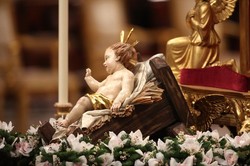
Baby Jesus, St Peter's.jpg

On that night in Bethlehem this prophetic
saying came true in a way that would still have been unimaginable at the time
of Isaiah. Yes indeed, now it really is a child on whose shoulders government
is laid. In him the new kingship appears that God establishes in the world. This
child is truly born of God.

Continue reading Pope Benedict’s homily for Christmas Eve Mass 2010

The miracle we all await, Jesus, Father Julián Carrón says


JCarron.jpg

Father Julián
Carrón, the head of the Fraternity of Communion and Liberation, gave this message for Christmas
. He writes from Milan, Italy.

In the mystery of the Incarnation, man and history

That Christianity
gives joy and breadth is also a thread that runs through my whole life.
Ultimately someone who is always only in opposition could probably not endure
life at all
” (Light of the World, part 1). These words of Benedict XVI
challenge us to ask ourselves what it means to be Christians today. Continuing
to believe simply out of devotion, habit, or tradition, withdrawing into one’s
shell, does not meet the challenge
. Similarly, reacting strongly and going on
the offensive in order to recover lost territory is insufficient
; the Pope even
says that it would be unendurable. 
Neither path -withdrawing from the world or opposing it- are capable of
arousing interest in Christianity, because neither respects what will always be
the canon of the Christian announcement: the Gospel. Jesus entered the world
with a capacity to attract that fascinated the people of His time
. As Péguy
said, “He did not waste His years groaning and demanding explanations of the
wickedness of the times. He cut through … making Christianity.” Christ
introduced into history a human presence so fascinating that anyone who ran
into it had to take it into consideration, had to reject it or accept it. No
one was left indifferent
.

Continue reading The miracle we all await, Jesus, Father Julián Carrón says

Toward clarifying the canonical status of Sr. Margaret McBride

Much discussion has surfaced about the excommunicated nun, Sr. Margaret McBride, for assisting in the 2009 abortion at St Joseph’s Hospital, Phoenix, AZ.

Canonist Edward N. Peter’s wrote a piece on his blog, In the Light of the Law, “Toward clarifying the canonical status of Sr. Margaret McBride.”
I think Dr. Peter’s is clear. Don’t you?

Father Savio Hon Tai-fai to work at the Holy See

Fr Savio Hon Tai-fai.jpgThe Pope named Father Savio Hon Tai-fai, a member of the Salesians of Don Bosco, 60, the Archbishop Secretary to the Congregation for the Evangelization of Peoples (the Vatican office responsible for missionary efforts). Archbishop-elect is a native of Hong Kong was ordained a priest 28 years ago. He’s well-regarded as a person, a good priest and an accomplished teacher and author; Hon has served on the International Theological Commission.

The Congregation for the Evangelization of Peoples was founded by Pope Gregory XV in 1622 with the decree (papal bull) Inscrutabili Divinae Providentiae and was known until 1982 as the Propaganda Fide

The new archbishop will assist His Eminence, Ivan Cardinal Dias, who serves as the Cardinal Prefect.