King Saint David, prophet

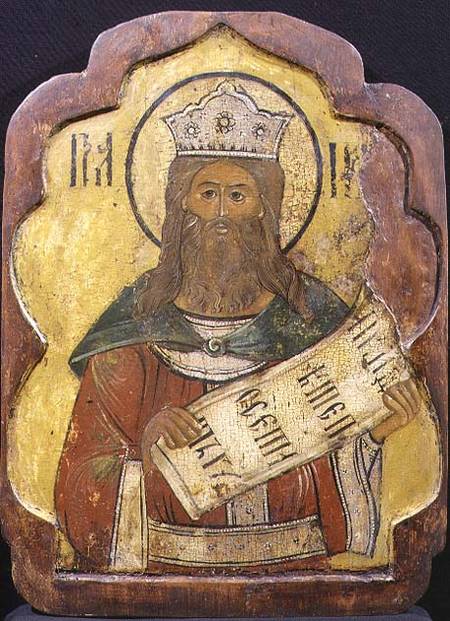
King David Ukrainian icon.jpg

Today is the feast of King David, the revered Old Testament king and prophet. The Orthodox Church remembers King David on December 26th. The Latin Church, however, does not typically commemorate David as a saint on the universal calendar but he is listed in the Roman Martyrology (2005)It is the Eastern Church that recalls and commemorates more seriously King David in the Liturgy than the Latin Liturgy does. In any event, the Roman Martyrology says:

Commemoratio sancti David, regis et prophetae, qu, filius Iesse Bethlehemitae, gratiam invenit ante Deum et oleo sancto a Samuele propheta unctus est, ut populum Israel regeret; in civitatem Ierusalem Arcam foederis Domini transtulit ac Dominus ipse mox ei iuravit semen eius in aeternum mansurum esse, eo quod ex ipso Iesus Christus secundum carnem nasciturus esset.

The translation:
The commemoration of Holy David, king and prophet, who, the son of Jesse of Bethlehem, found favor before God was anointed with holy oil by the prophet Samuel, so that he might rule the people of Israel; he brought the ark of the Lord’s covenant into the city of Jerusalem and the Lord vowed to him that his seed would endure forever; thus from it Jesus should be born according to the flesh.

We should recall what the Catechism says, “the shepherd who prays for his people and prays in their name” (2579), pointing to the figure of David at an OT figure of Jesus.

More on King Saint David can be found here.

New Heaven, New War

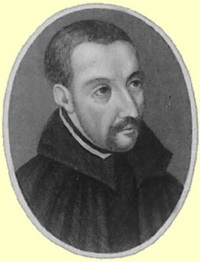
Robert Southwell SJ.jpgOne of my favorite 16th century recusant poets is Saint Robert Southwell, an English Jesuit who preached the gospel in very trying circumstances. Southwell chose the obedience to be a Catholic priest in a country that outright persecuted Catholics and their priests. Ordained a Jesuit priest in 1584, his personal, theological and ministerial imagination, his human and divine calling, was to respond positively to a letter of the Superior General of the Society of Jesus of February 20, 1585 looking for missionaries to England. Southwell knew that his positive response to his religious superior would very likely end in martyrdom. Saint Robert Southwell’s poetry is challenging for the 21st century ear but worth the work of coming to understand his art and message. One such poem is “New Heaven, New War” expressing the Mystery of the Incarnation of God in history, the birth of Jesus.

Come to your heaven, you heavenly quires!
Earth hath the heaven of your desires;
Remove your dwelling to your God,
A stall is now His best abode;
Sith men their homage do deny.
Come, angels, all their faults supply.
His chilling cold doth heat require,
Come, seraphim, in lieu of fire;
This little ark no cover hath,
Let cherubs’ wings his body swathe;
Come, Raphael, this babe must eat,
Provide our little Toby meat.

Continue reading New Heaven, New War

Cardinal Burke celebrates Mass for the Franciscans of the Immaculate, Rome

RL Burke in cappa2.JPG

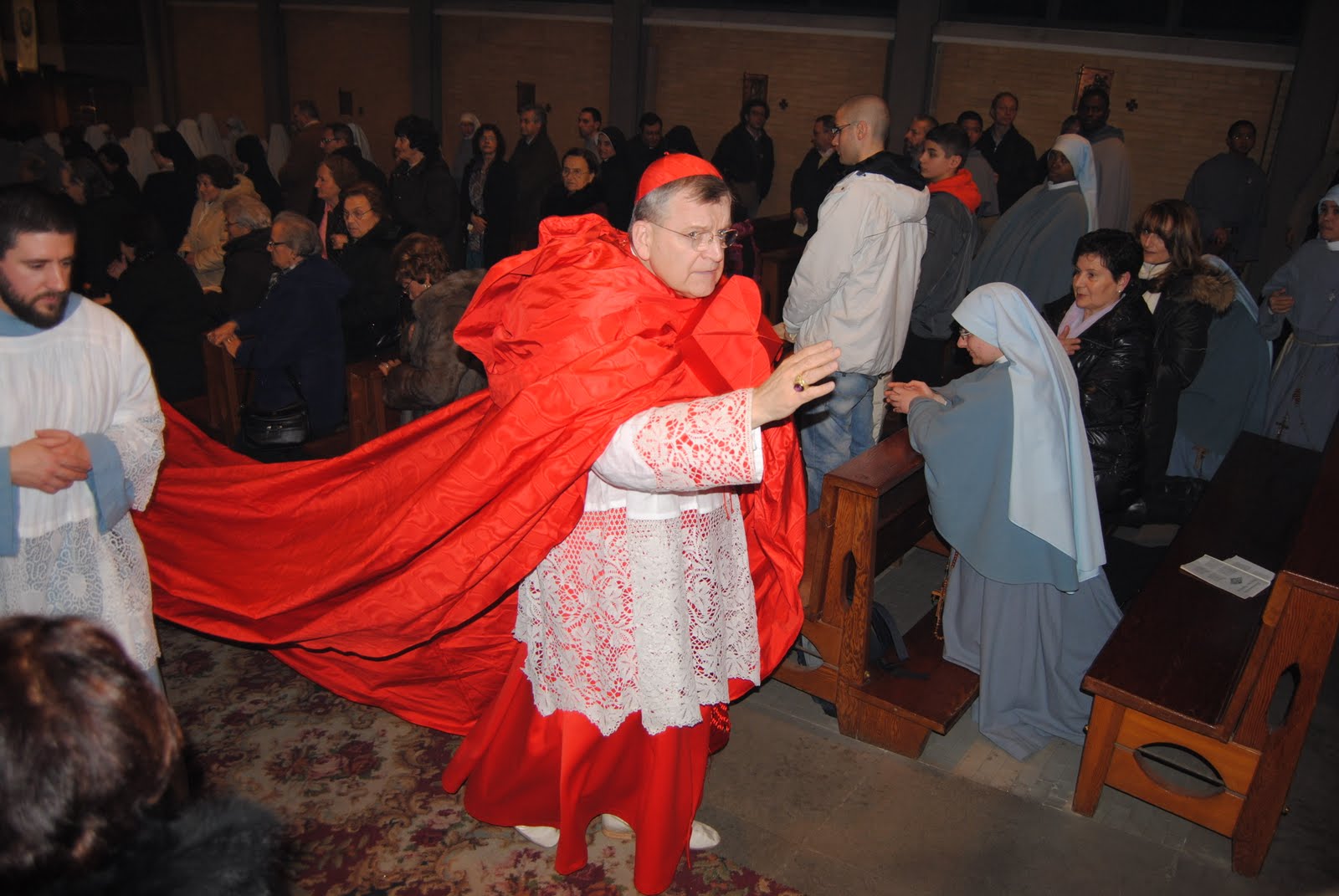
Thanks to JP Sonnen for this picture of His Eminence, Raymond Leo Cardinal Burke, JCD, following his singing the Pontifical Mass at the Church of St. Mary of Nazareth on Via di Boccea, Rome. The parish, staffed by the Franciscans of the Immaculate, is located west of Vatican City State in the Diocese of Porto-Sant Rufina, the historic suburbicarian diocese

Beautiful Liturgy is hard work, Monsignor Guido Marini reminds

Mons.Marini.jpg

The worship of the Triune God is our single most important work. No other work of the faithful, laity and clergy alike, is equal to praise of God through the sacred Liturgy and personal prayer. Jason Horowitz of The Washington Post published an article on December 25, 2010, “Pope’s master of liturgy helps Benedict restore traditions.” Very interesting indeed. I, for one, am very grateful to Monsignor Guido Marini for the hard work he’s done in helping the Church pray more authentically, particularly at the Liturgy celebrated by the Supreme Pontiff. A native of Genoa, born in 1965, Monsignor Marini is the Master of Pontifical Liturgical Celebrations, a position he’s had since October 1, 2007. In a previous incarnation Marini served Cardinal Dionigi Tettamanzi (now archbishop of Milan) and Cardinal Tarcisio Bertone, SDB, (now Secretary of State), both former archbishops of Genoa. He earned a doctorate in the psychology of communication and also holds the duel doctorate in canon and civil law.

In Rome on
a rainy Christmas Eve, Pope Benedict XVI followed a procession of Swiss guards,
bishops and priests down the central nave of St. Peter’s Basilica to celebrate
midnight Mass before dignitaries and a global television audience.

And
Monsignor Guido Marini, as always, followed the pope.

A tall,
reed-thin cleric with a receding hairline and wire-framed glasses, Marini, 45,
perched behind the pope’s left shoulder, bowed with him at the altar and
adjusted the pontiff’s lush robes. As Master of Pontifical Liturgical
Celebrations, he shadows the pope’s every move and makes sure that every
candle, Gregorian chant and gilded vestment is exactly as he, the pope and God
intended it to be.

Continue reading Beautiful Liturgy is hard work, Monsignor Guido Marini reminds

Cardinal Cañizares Llovera: Creativity in Mass has no place

Canizares.jpg
Andrea Tornielli published an interview with Antonio
Cardinal Cañizares Llovera, 65, from Spain, Prefect of the Congregation for
Divine Worship in Il Giornale, “Basta con la messa creativa, in chiesa
silenzio e preghiera” [“Enough with the Creative Mass, in Church
Silence and Prayer”].


You will want to read this very fascinating interview in
Italian here
. Shawn Tribe at the New Liturgical
Movement blog
has posted a translation of just a few paragraphs with
the hope of posting a translation of the full interview in due time.

Father Z
has provided what is likely the central point of the interview:
 

Andrea Tornielli: How do you judge the state of Catholic
liturgy in the world?

Cardinal Cañizares: “In view of a risk of the routine, in
view of some confusion, impoverishment, and banality in singing and in sacred
music, one can say that there is a certain crisis.  For this reason a new
liturgical movement is urgent.  Benedict XVI, pointing to the example of
St. Francis of Assisi, very devoted to the Most Holy Sacrament, explained that
the true reformed is someone who obey the Faith: he doesn’t act in an arbitrary
way and doesn’t claim for himself discretion over the rite.  He is not the
master but the custodian of the treasure instituted by the Lord and entrusted
to us.  The Pope asks, therefore, from our Congregation to promote a
renewal in conformity with Vatican II in harmony with the liturgical tradition
of the Church, without forgetting the Conciliare norm that orders not to
introduce innovations when the true and verified need of the Church requires
them, with the caution that new forms, in every case, must flow organically
from those already in existence.”

Saint John, Apostle & Evangelist

St John at Patmos HBaldung Grien.jpg

This is John who reclined on the Lord’s breast at the Supper. O blessed Apostle, to whom were revealed heavenly secrets! (Magnificat antiphon)
The Roman Martyrology speaks of John in this way: “Sixty-eight years after the passion and death of His Lord, he died at a ripe old age. He was buried near Ephesus.” He was the lone of the 12 Apostles to die of natural causes, though he did suffer for Christ.
Perhaps no other of the Twelve than John has anyone been so close, so well-attuned to the Lord’s life, love and mission. To John was given the responsibility to mind Mary, the Mother of Jesus and thus to guide the Church in her in abiding in the Lord. It is not lost on us that the symbol of Saint John the Evangelist is the eagle who scales the heights and keenly aware of all things. In John’s case, he so sharply looks into reality and sees with profound depth the meaning of things.
About Saint John’s self-giving sacrifice we read:

Continue reading Saint John, Apostle & Evangelist

Pope Benedict lunches with Rome’s poor, marks Mother Teresa’s 100th birthday


B16 having lunch with the poor.jpg

Earlier today
the Paul VI Audience Hall was the setting for lunch with 250 of Rome’s
economically and socially challenged people with Pope Benedict XVI. For him, it
was an opportunity to meet Christ in brothers and sisters. The world, of
course, is more interested in knowing what the papal guests ate. The newswires
report that lasagna, veal and cake were on the menu. The Pope’s friends for
lunch are people who interface on a daily basis with the Missionaries of
Charity, the group of sisters founded by Blessed Mother Teresa of Calcutta.
Blessed Teresa’s 100th birthday is this year and the Pope wanted to acknowledge
the greatness of the woman who focused our attention to those most loved by God
and despised by the world.

Dear friends,

I’m very happy to be here today with
you, and I extend warm greetings to the Reverend Mother General of the
Missionaries of Charity, to the priests, sisters, contemplative brothers and
all of you here to enjoy this brotherly moment together.

Continue reading Pope Benedict lunches with Rome’s poor, marks Mother Teresa’s 100th birthday

The Holy Family

Holy Family, Rupnik 2007.jpg

This mosaic
of the Holy Family is located in the Chapel at the Saint Peter Canisius, the
Jesuit House of Writers located on the Borgo Spirito Santo, Rome. The mosaic is by Father Mark Rupnik,
S.J. and the artisans of the Centro Alleti (Rome) December 23, 2007. Father
Rupnik inspiration were the Contemplations on the Incarnation and the Nativity
from Saint Ignatius of Loyola’s Spiritual Exercises.

In the Exercises we read about
the Nativity. “The first point is [for me] to see the persons, that is, to see our
Lady, and Joseph, and the servant girl (the ancilla, the handmaid), and the
infant Jesus after he is born, making myself a poor little fellow and unworthy
little slave boy, looking at them, contemplating them, and serving them in
their needs as if I were there present, with all possible respect and
reverence.” 

A version of Father Rupnik’s Holy Family mosaic is found in the Holy Family Chapel at the Knights of Columbus, Supreme Council, New Haven, Connecticut.