Saint Frances of Rome: Patroness of Benedictine Oblates


St Francesca Romana.jpgO God, who in Saint Frances of Rome, have given us a model of holiness in married life and of monastic conversion, make us serve you perseveringly, so that in all circumstances we may set our gaze upon you and follow you.

This prayer given by the Church calls to mind the fact that Saint Frances was both married and later lived a monastic vocation! This doesn’t happen too often but it shows that it can be done.

Saint Frances is depicted in this picture with an angel resembling her eight-year-old son, Evangelista, who died from the plague. After his death he appeared to her announcing the death of his sister, Agnes.


The trauma of losing one child is great and so imagining the loss of two children would be devasting for a parent but anyone with true humanity. The Lord gave Saint Frances an unusual grace as a result to her faithfulness: that of always seeing her guardian angel. Liturgical scholars will note that the angel is wearing a dalmatic like the deacon at Mass reminding us of the service the angels provide just for the asking. As Pope Benedict mentioned a week ago, the guardian angel is continuously with us, assuring us of the love of Jesus Christ, giving us counsel and providing us with that which is part of the Divine Will. For me and for countless others I think THE grace the guardian angels provide is a guiding light through the darkness of life.



SFR3.jpgThe first intention I am placing before Saint Frances of Rome, the patroness of Benedictine Oblates, is to petition the Lord that the vocation of the Benedictine Oblates be lived with seriousness so that it can be a witness to the Gospel before the world. The second intention is that as Saint Frances had the grace of actually seeing her angel visibly at every moment of every day, so may we come to rely on our guardian angel for living life with the integrity of the Gospel before our eyes.


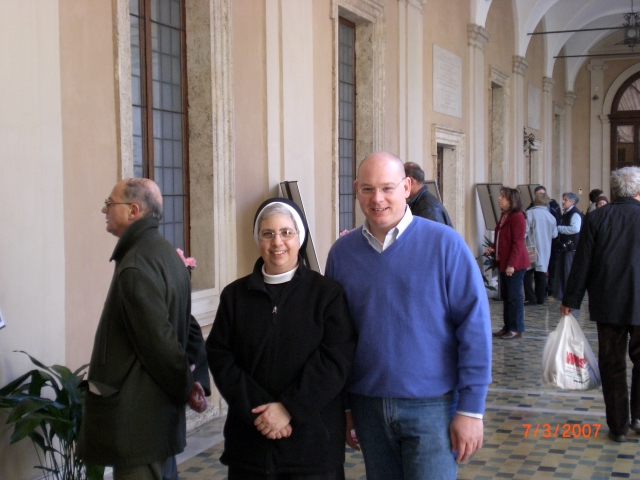
Sr Barbara & PAZ.jpgTwo years ago I had the privilege of visiting the monastery of Saint Frances of Rome on her feast day. Notice the lemon trees the nuns care for in the above photo. The visit to the monastery was with my friends Father Mark and Sister Barbara.

Read more on the saint.

Connecticut congressmen propose bill to regulate Catholic parishes

Last Thursday, March 5th, two Connecticut state congressmen introduced a bill that proposes to restructure Catholic parish life taking authority away from pastors, the bishop and the pope.

The bill VIOLATES the FIRST AMENDMENT of the US Constitution!!! Read the Bill 1098/2009.

This is a direct attack on the part of these congressmen on the Roman Catholic Church for the Church’s teaching the Gospel, especially regarding homosexuality and birth control.

More information to be had on the website of the Roman Catholic Diocese of Bridgeport here and a letter from the archbishop of Hartford.

From the Knights of Columbus

The story at Newstime.com

The patient monk

The truly patient monk is one who has trained his mind to look beyond present pain to ultimate realities. Patience is, accordingly, a work of faith. Without such a vision suffering is meaningless


There is no doubt that negative experience is the great challenge to faith and a source of temptation to abandon one’s commitment. It is also true that patience has a purifying effect on faith and commitment and leads to a more naked definition of selfhood.


One who has survived suffering knows that personal integrity is independent of goods and status and owes nothing to the attitudes and actions of others. It is the quality of a heart that has been hammered into humanity by this most universal of human experiences.


Michael Casey, OCSO

Truthful Living

Transfiguration of the Lord, 2nd Sunday of Lent

Transfiguration GBellini.jpg“What does it mean to say: He was transfigured?” asks the Golden-Mouthed Theologian (Chrysostom). He answers this by saying: “It revealed something of His Divinity to them, as much and insofar as they were able to apprehend it, and it showed the indwelling of God within Him.” The Evangelist Luke says: “And as He prayed, His countenance was altered” (Luke 9:29); and from the Evangelist Matthew we read: “And His face shone as the sun” (Matthew17:2). But the Evangelist said this, not in the context that this Light be thought of as subsistent for the senses (let us put aside the blindness of mind of those who can conceive of nothing higher than what is known through the senses). Rather, it is to show that Christ God, for those living and contemplating by the Spirit, is the same as the sun is for those living in the flesh and contemplating by the senses. Therefore, some other Light for the knowing the Divinity is not necessary for those who are enriched by Divine gifts. (Saint Gregory Palamas)

O God, You commanded us to listen to Your beloved Son, deign to nourish us interiorly by Your word, so that, with our spiritual view having been purified, we may rejoice in the Presence of Your glory.

Father Conall Coughlin reposes in the Lord

Your prayers are requested for the peaceful repose of Benedictine monk Father Conall R. Coughlin who fell asleep in the Lord on 1 March 2009.

Father Conall was a monk for 58 years and a priest for 51; he was given the obediences of being a teacher and a decorated Navy chaplain.

A Mass of Christian Burial was offered this morning with burial in the abbey cemetery at the Abbey of Saint Mary-Delbarton, Morristown, New Jersey.

Father Conall’s obit

Georgetown Univ Prof supports death with dignity

In 2008 Georgetown University Philosophy professor Tom L. Beauchamp coauthored Principles of Biomedical Ethics, a widely used book in bioethics courses, in which he sanctions and defends “physician-assisted dying.”


According to a Winter 2008 Fellowship of Catholic Scholars Quarterly article by J. Brian Benestad, Beauchamp and his coauthor pronounce unconvincing “some of the arguments against the legalization of ‘physician-assisted dying.'” Throughout the book the authors are redefining terms “that used to have nothing to do with administering death-producing drugs,” explains Benestad. For them, “Lethal pills are called medication; helping suffering patients to kill themselves is called virtuous (beneficent, just, etc.). Not helping these patients is a failure to respect their dignity.” In Principles, the authors state: “We maintain that physician assistance in hastening death is best viewed as part of a continuum of medical care.” Benestad counters the argument, citing “the medical profession’s devotion to heal and refuse to kill – its ethical center – will be permanently destroyed” by such a policy. (courtesy of the Cardinal Newman Society)


So much for professors at so-called Catholic universities either thinking with the Church or at least not publicly contradicting Catholic teaching. Is this beyond the exercise of academic freedom viz. faith and reason? It’s interesting Beauchamp received the Pellegrino Medal in 2004 which honors recipients for contributions made in healthcare ethics following the spirit of the father of the American bioethics movement, Dr. Edmund Pellegrino. Pellegrino is a practicing Catholic and on faculty of Georgetown.

John Paul’s influence on Archbishop Dolan’s ministry in NY

In a Wall Street Journal article Christopher Willcox explains why Archbishop Timothy Dolan will be received by the John Paul Generation. Read the article.


I have no doubt that the Servant of God Pope John Paul II is making his intercession before the Throne of Grace for the Church in New York, and for the effective, holy pastoral service of the new archbishop. AND I also think with Archbishop Dolan’s nomination to the See of New York we’ll be identifying key aspects of the current pope’s approach to theology and saying “Pope Benedict generation” is leading the charge in proclaiming Christ in the 21st century. Remembering that the faith is always proposed and never imposed the proclamation of the Gospel has little to with politics and much to do with the Truth and salvation. If we neglect the fact the Church is first a sacrament before it’s a sociology then we’ve lost a major piece in knowing Christ. The question is whether we believe in the promises of the hundred-fold of Jesus.

Saints Perpetua & Felicity


St Perpetua & Felicity.jpgTheirs is the kingdom of heaven who despising a worldly life have attained the rewards of the kingdom, and have washed their robes in the Blood of the Lamb.


We beseech You, O Lord our Savior, grant us to revere with unceasing devotion the glorious victories of Your holy Martyrs Perpetua and Felicity; may we at least honor with lowly homage those whose praises we can not sing worthily.


Read more on these third century Martyrs of North Africa. Today’s saints have been honored by the Church since the fourth century in Rome. History tells us that Saint Perpetua was of Carthaginian nobility and Saint Felicity was a slave girl but both were equal in their Christian faith. The Roman martyrology says that they were sent to their deaths because of their Christian faith in A.D. 203. Since the wild beasts would not eat them they were put to death by the sword. They are both mentioned in the Roman Canon of the Mass.

Washington State approves suicide as a “right”: Is it truly death with dignity?

Voters in the State of Washington approved Initiative 1000, the so-called Death with Dignity Act in November. According to the media it’s modeled closely the Oregon law allowing physicians to prescribe lethal doses of medication to terminally ill patients determined to have six months or less to live. Oregon‘s suicide law is now 10 years old and Washington has become the second American state to legalize assisted suicide.


As a result of last year’s state ballot Initiative 2000, terminally ill patients in Washington State can now obtain lethal medications from doctors in order to kill themselves. Washington‘s hospitals are now forming a suicide plan to facilitate this newly found “right.”


Suicide is a tragedy. People who elect to do this act are not thinking in a right manner and are looking for a way out of their pain, sometimes they say they want to ease the pain of loved ones who care for them. Whatever the reason for acting this way is, their desperation leads to a permanent self-inflicted act leading to their intended death. Suicide prematurely and violently leaves loved ones to pick up the pieces post-mortem. Many are physically, emotionally and spiritually exhausted from their health issues which is understandable: chronic illness can be painful but suicide is an inadequate way to deal with the harsh reality of life.


The Church’s teaching is: “Suicide contradicts the natural inclination of the human being to preserve and perpetuate his life. It is gravely contrary to the just love of self. It likewise offends love of neighbor because it unjustly breaks the ties of solidarity with family, nation, and other human societies to which we continue to have obligations. Suicide is contrary to love for the living God” (Catechism, 2281).


But quoting the Catechism is insufficient in dealing with the issue at hand. Let’s not be confused: we need to know and follow what the Church teaches. Her wisdom is immensely reliable and it ought to form our conscience. Here I want to raise the matter of dealing with the issue pastorally, lovingly with courage and strength. No statement of teaching is going to ease the pain of illness or feelings of desperation. Only the love and mercy of the one who made us can do that. The Lord loves and cherishes each one of us, and He gives the grace to sustain us until the moment of natural death. The Lord knows our pain and our human struggle because He is a man. What the Washington and Oregon state laws do is replace the love the Lord and family offer us with a cold mechanism releasing us from our human need. These laws replace the reality of humanity with a cold, shallow perfunctory “right” that gives a person the possibility of hurting themselves and family and friends deeply not to mention it wounds their relationship with the Lord (whether they know it or not).


Responding to the poignant human need of those who face the hard fact of someone taking their own life, the Catholic Information Service commissioned a booklet dealing with this subject. It was our effort to help those who are looking for truth and love and the assistance of the Church. You can order a copy of Coping with a Suicide: Catholic Teaching and Pastoral Practice by emailing or calling the office (cis@kofc.org or 203.752.4267and tell them you saw the ad here) The feelings of sadness which result from the violence of suicide are never removed from the hearts and minds of the survivors even if they try to believe that Auntie is in a better place (a saccharine nosegay that whitewashes the pain temporarily). While the deceased is in the hands of God and clearly live in His mercy, we can never be presumptuous to believe that it is “alright” because “God will deal with it”: the reality life is far more important than me and my own needs. The act of suicide is an act of desperation; the person who does (or thinks of committing the act) acts from feelings of exhaustion, fear, and a false sense of security. Our human response needs to be love. Our response as Christians needs to be one of faithfulness to the Lord who made us and it is He who will call us home, and it is our responsibility to be agents of reconciliation showing mercy and forgiveness.