The English blogging priest who writes the blog Valle Adurni translated for us a rather interesting article from the recent issue of Paix Liturgique on the state of the Church in France. It is a devastating manifestation of the problem we all face. Of course, who are the ones standing in the way of change? Guess….
20 years since the Fall of the Berlin Wall

Marking the end of Communism with the Fall of the Berlin Wall on November 9, 1989.
H2O News on the Fall of the Wall
See a collection of photos of the Wall
CNN on the Fall of the Berlin Wall
Archbishop Dolan’s “Not Fit To Print” NYTimes Editorial
One assumes that The New York Times would have been glad to receive an Op-Ed article from the new Archbishop of New York. The Archdiocese of New York is responsible for a very important part of the city’s educational, medical, and charitable life. The newspaper refused to print it. Such censorship only whets the appetite to know what was thought not fit to print. There are many items that the Times, which claims to publish everything that’s fit to print, has printed although they were not fit. There were, for instance, its mockery in 1920 of Goddard’s hypothesis that rocket propulsion can take place in a vacuum, a denial of Stalin’s forced famine in Ukraine and a whitewash of his show trials by its Moscow bureau chief Walter Duranty, its advocacy of Fidel Castro, and its benign regard for the Soviet spy Alger Hiss. So there had to be some journalistic equivalent of a cerebral stroke to make the editors of the Times unable to print Archbishop Dolan’s words.
The cause of the apoplexy was the Archbishop’s imputation of bigotry to the newspaper. His charge was not self-indulgent whining. He did not have to go back farther than a couple of weeks for examples. First, in reporting widespread child abuse in Brooklyn’s community of Orthodox Jews, there was not the “selective outrage” which animates The New York Times against criminous Catholic clerics, whose numbers are in fact proportionally much smaller than other religious and professional groups.
Then there was the sensational front-page publicity of a paternity suit involving a Franciscan friar, going back twenty-five years, and getting more space than the war in Afghanistan and genocide in Sudan. Headlines also claimed that the Pope was seeking to “lure” Anglicans into his fold, when in fact he was responding to a petition. Then a columnist invoked the Inquisition, portrayed the theology of priesthood as neurotic sexism, and even mocked the Pope’s haberdashery. The Archbishop said that her prejudice, “while maybe appropriate for the Know-Nothing newspaper of the 1850’s, the Menace, has no place in a major publication today.” While a free press is free to criticize, said the Archbishop, such criticism should be “fair, rational, and accurate.”
Hostility raised to such a pitch that journalistic standards are abandoned, is provoked by an awareness that the Catholic Church continues to be the substantial voice for classical moral standards and supernatural confidence amid the noise of a disintegrating behaviorist culture. A tabloid is still a tabloid even if its editors dress in tweeds. Churchill said, “No folly is more costly than the folly of intolerant idealism.” Not to worry. Christ promised that the gates of Hell will not prevail against his Church. He did not include The New York Times, 30% of whose work force has been laid off in the last year and a half.
Fr. Rutler’s Weekly Column as Pastor of the Church of Our Savior in New York City. This is from the November 8, 2009 bulletin
Anglicanorum Coetibus: the Apostolic Constitution as a new avenue for Full Communion of the Anglicans with Rome
This morning the Holy See published the Apostolic Constitution Anglicanorum Coetibus which provides a structure for Anglicans coming into full, visible communion with the Bishop of Rome.
Dedication of the Archbasilica of Saint John Lateran
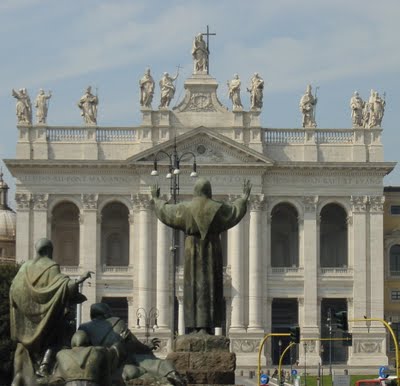 O God, who out of living and chosen stones builds up an everlasting dwelling-place for Thy majesty: help Thy people, who humbly pray to Thee, and whatever material room Thy Church may set apart for Thy worship, let it bring also spiritual increase.
(Post-Communion prayer)
We celebrate the dedication of this Church as the seat of the Bishop of Rome from which all other pastoral authority is derived. We honor the anniversary of a church’s dedication because a church gives full voice to the sacred Liturgy. The feast of the dedication gives full acceptance and capacity to live the ancient theological principle, legem credendi lex statuat supplicandi (the law of belief given through the law of prayer, or even more of short-hand, the law of prayer is the law of belief).
Dolan’s Catholic Crusade
I would not have used the word “crusade” to describe responsible Catholic leadership but it does grab one’s attention. The recent interchange between Archbishop Dolan and Maureen Dowd (and the NY Times) is not all that interesting: most with-it Catholics know and understand the archbishop to be correct in his assessment. The thesis is not original to the Archbishop. A book length exposition on anti-Catholic bias was done by Philip Jenkins in The New Anti-Catholicism: The Last Acceptable Prejudice (OUP, 2003). Jenkins explores the liberal anti-Catholic bias and the reasons why many just accept it while the same can’t be said in the Jewish and Muslim communities.
So, one can barely say that Dolan’s criticism is newsworthy. EXCEPT to say that his pointing out in a rather public way (thanks be to God!) that Dowd and the Times is in fact, anti-Catholic, and this type public engagement with the press hasn’t been done too much in since Cardinal O’Connor died in 2000. Remember, O’Connor regularly spoke to the press, especially following the 10:15 Sunday Mass at the Cathedral of Saint Patrick. His successor, Cardinal Egan, didn’t much engage the media when he was the archbishop of the Capital of the World.
Take a look at Joseph Bottom’s piece in the NY Post today.
Read Archbishop Dolan’s comments on his blog, The Gospel in the Digital Age
The essence and undivided nature of charity by John Duns Scotus

The second reading in the Office of Readings from today’s liturgical memorial [even though it is Sunday in 2009 and Sunday takes precedence over saints’ memorials] of Blessed John Duns Scotus bears posting here. What appears to be vague really is dead-on in thinking about charity and justice. Emphasis mine.
Charity is defined as the habit by which God becomes the object of our love. However, God could become the object of a kind of private love, such as that of a lover intolerant of any other lovers besides himself (as for example in the case of a jealous man in love with a woman). But a habit of this kind would be both inordinate and imperfect.
It would be inordinate because God, the good of all, does not want to be the private good of any one person, not does right reason allow one person to appropriate to himself this common good. It follows that a love that tends to regard this common good exclusively as its own property, neither to be loved nor possessed by any other, is an inordinate love.
It would also be imperfect because a person who loves perfectly wants his beloved to be loved. Therefore God, in infusing the habit of charity by which the soul tends towards Him in an orderly and perfect way, gives a habit by which He is loved as the common good to be co-loved by others as well. And thus this habit which is of God, leads an individual to want God to be held dear and to be loved also by others.
Therefore, just as this habit leads a person to love God in Himself in an orderly and perfect way, so also it leads him to want God to be loved not only by the person himself but also by anyone else whose friendship is pleasing to Him.
It is clear from this how the habit of charity must be single and undivided, because it does not concern itself in the first instance with a plurality of objects, but with God alone as the primary object and as the first good. Secondarily it then wants God to be loved and to possessed in love by everyone else to the utmost of his power, because it is in this that a perfect and orderly love of God consists. And in willing this, I love both myself and my neighbor in charity, willing, that is, for both of us the desire and the possession of God in Himself through love.
Hence it is evident that it is by one and the same act that I want God and that I want you to want God. And in this my love is a love of charity, because out this love I desire a good for you which is due to you in justice.
For this reason, my neighbor is not to be regarded as a second object of charity but rather as an object that is entirely incidental, because he is someone who is capable of co-loving the Beloved with me in a perfect and orderly way; and I love him precisely so that he can become a co-lover. In this I love him as it were incidentally, not for himself, but because of the object which I want to be co-loved by him. And in wanting that object to be co-loved by him, I implicitly want what is good for him because it is due to him in justice.
Coping with a Suicide: 2 events bring to mind the need for love
A friend of mine in Utah asked for prayers for the soul of a young woman, wife, and mother of 2, who took her own life after struggling with depression. Today, Bishop Walsh mentioned the New York University student who leaped to his death on Tuesday. Billie and Andrew are in need of prayers.
The NYU student’s mom started a blog to her process her unconsolable grief.
Pray for this tragedy to stop. Bring your petition to the BVM so that she can assist those considering such a deed, the grace to change their mind.
A handy resource may be of assistance for those who want to help people understand suicide:
Coping with a Suicide: Catholic Teaching and Pastoral Practice or you can listen to this booklet here.
Blessed John Duns Scotus
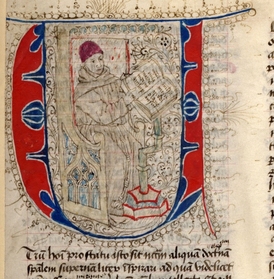
The learned will shine like the brilliance of the firmament, and those who train many in the way of justice will sparkle like the stars for all eternity. Heavenly Father, You filled John Duns Scotus with wisdom, and through his life and teaching gave us a witness of Your Incarnate love. May we come to understand more deeply what he taught so that we may live in ever growing charity.
Prayer for the Canonization of
Blessed John Duns Scotus
O Most High, Almightily and gracious Lord, Who exalts the humble and confounds the proud of heart, grant us the great joy of seeing Blessed John Duns Scotus canonized. He honored Your Son with the most sublime praises; he was the first to successfully defend the Immaculate Conception of the Virgin Mary; he lived in heroic obedience to the Holy Father, to the Church and to the Seraphic Order. O most holy Father, God of infinite love, hear, we beseech You, our humble prayer, thorough the merits of Your Only-Begotten Son and His Mother, the Gate of Heaven and Spouse of the Holy Spirit.
The JOY of living…in Christ as a Poor Clare nun
Look at these beautiful young women following Christ as Poor Clare nuns of Lerma (Burgos), Spain! I can’t believe my eyes!!! They’re happy. They’re alive. They’re infectious.
You’ve gotta read the CNA story (in English) here but the video in the story is in Italian with English subtitles. Also, watch another video about these same Poor Clares. Sorry, these videos are subtitled but watching them you get the point: the heart is attracted by love and joy.
I want to know: do we have anything like these nuns in the USA?