Solemnity of Mary, Mother of God


Mother & Child.jpg

God our Father, may we always profit by the prayers of the
Virgin Mother Mary, for You bring us life and salvation through Jesus Christ
her Son who lives and regins with You and the Holy Spirit, one God, for ever
and ever.

from Catechism of the Catholic:

Called in the Gospels “the Mother of
Jesus,” Mary is acclaimed by Elizabeth, at the prompting of the Spirit and
even before the birth of her son, as “the mother of my Lord.” In
fact, the One whom she conceived as man by the Holy Spirit, who truly became
her Son according to the flesh, was none other than the Father’s eternal Son,
the second person of the Holy Trinity. Hence the Church confesses that Mary is
truly “Mother of God.” (495).

from the Directory on Popular and the
Liturgy
: The Solemnity of the Holy Mother of God:

On New Year’s Day, the octave
day of Christmas, the Church celebrates the Solemnity of the Holy Mother of
God. The divine and virginal motherhood of the Blessed Virgin Mary is a
singular salvific event: for Our Lady it was the foretaste and cause of her
extraordinary glory; for us it is a source of grace and salvation because
“through her we have received the Author of life.”

The solemnity of the 1
January, an eminently Marian feast, presents an excellent opportunity for
liturgical piety to encounter popular piety: the first celebrates this event in
a manner proper to it; the second, when duly catechised, lends joy and
happiness to the various expressions of praise offered to Our Lady on the birth
of her divine Son, to deepen our understanding of many prayers, beginning with
that which says: “Holy Mary, Mother of God, pray for us, sinners”.

In
the West, 1 January is an inaugural day marking the beginning of the civil
year. The faithful are also involved in the celebrations for the beginning of
the new year and exchange “new year” greetings. However, they should
try to lend a Christian understanding to this custom making of these greetings
an expression of popular piety. The faithful, naturally, realize that the
“new year” is placed under the patronage of the Lord, and in
exchanging new year greetings they implicitly and explicitly place the New Year
under the Lord’s dominion, since to him belongs all time (cf. Ap 1, 8; 22,13)

A
connection between this consciousness and the popular custom of singing the Veni
Creator Spiritus can easily be made so that on 1 January the faithful can pray
that the Spirit may direct their thoughts and actions, and those of the
community during the course of the year.+New year greetings also include an
expression of hope for a peaceful New Year. This has profound biblical,
Christological and incarnational origins. The “quality of peace” has
always been invoked throughout history by all men, and especially during violent
and destructive times of war.

The Holy See shares the profound aspirations of
man for peace. Since 1967, 1 January has been designated “world day for
peace”. Popular piety has not been oblivious to this initiative of the
Holy See. In the light of the new born Prince of Peace, it reserves this day
for intense prayer for peace, education towards peace and those value
inextricably linked with it, such as liberty, fraternal solidarity, the dignity
of the human person, respect for nature, the right to work, the sacredness of
human life, and the denunciation of injustices which trouble the conscience of
man and threaten peace. (115-117)

Pope Benedict XVI’s monthly prayer intentions for January 2010

B16 & BI.jpgA new year, a new set of intentions given to us for our personal and communal prayer for the Pope and for the good of the Church. Saint Paul teaches to pray for the Church. And the Pope himself has reminded us that “He who prays does not waste time, even if the situation has all the markings of being an emergency and seems to push us toward action alone.”  The intentions given to us have the great importance for our Christian life in our local context and for thriving of the Christian Way. Please be attentive to these intentions!


The general intention


That young people may learn to
use modern means of social communication for their personal growth and to
better prepare themselves to serve society.


The missionary intention

That every
believer in Christ may be conscious that unity among all Christians is a condition
for more effective proclamation of the Gospel.

New Year: keeping Christ in our lives

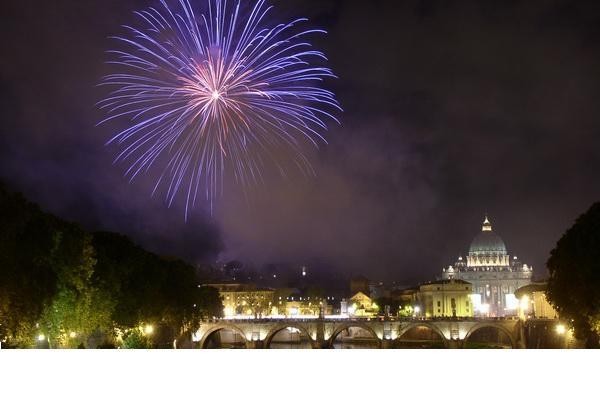
Vatican new year.jpgNow is the old year passed away.
Let us begin the new this day.
Praising our God, who here on earth
Kept us in quietness and mirth!
Oh, like the glad new year may we
Wholly renewed this day be,
Praising our God eternally!

Child of our love, O Jesus dear,
Thou who art still our Savior here,
Thee do we pray with all our heart:
Never more leave us, nor depart.
Save us from war, from hate, from fear;
Keep us in peace together here;
Grant us a tranquil, joyous year!

Gladly together then will we,
O highest God of heaven, to thee
Bring through the year our songs of praise,
And evermore through endless days
Here will on earth our time shall be,
And then, throughout eternity,
Singing with joyful hearts to Thee!

Pope Saint Sylvester I

Pope Sylvester and the dragon.jpg

The liturgical prayer for Saint Sylvester may be found here.
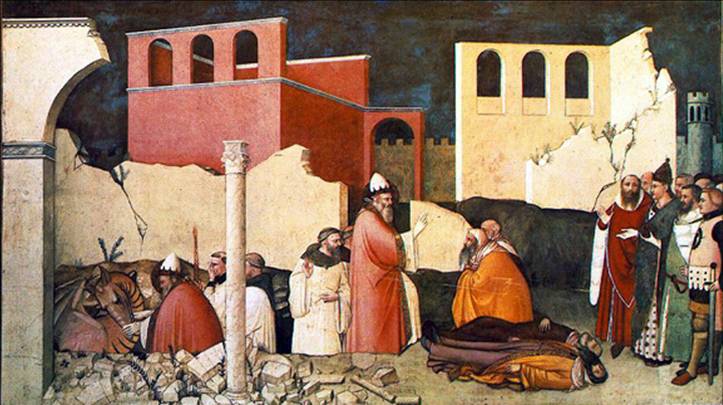
The Church’s Liturgy commemorates the death of Pope Saint Sylvester, a pope we rarely think about other than on the day of his memorial. Many of the hagiographical materials available seem to be more apocryphal narratives surrounding the saintly pope than factual occurrences: for example, the Sylvester’s slaying a dragon (note the image above) and raising the dragon’s victims

to life; or the curing of Constantine of leprosy; and the Donation of Constantine. It is recorded that Pope Sylvester baptized Constantine. The historical evidence for this pontificate for this era is sorely lacking for such an important time in Church history. What is known of Sylvester is given to us through the Vita beati Sylvestri.

The lack of historical record, however, does not mean the events of history did not happen, it just means we don’t have reliable sources. However, given that the narratives are recorded in ecclesiastical memory and the liturgical patrimony of the Church, means that their was a historical man who followed Christ, ordained priest and elected Pope, and worked for the good of the Christian faith given in Tradition. Post-modern people often place too much emphasis on the manuscript tradition (what is absolutely verifiable) and too little weight on hagiographical materials, including homilies and pious legends, to give  us a sense of Church history.

The son of Rufinus and Justa, Sylvester was ordained a priest by Pope Marcellinus and elected bishop of Rome in AD 314, after the death of Pope Saint Miltiades.

During his twenty-one year pontificate, in addition to the various churches honoring the martyrs, he oversaw with Constantine and Helena as patrons, the construction of three of the greatest

Roman churches: Saint John Lateran, Holy Cross of Jerusalem, and the first Saint Peter’s. Sylvester’s pontificate also saw the development of the Roman Liturgy, the foundation of a school of singers for the Liturgy and the publication of the first Martyrology. Further, Sylvester was instrumental in stemming the spread of Arianism throughout the Western church, as well as the promulgation of orthodox christology (homousion of the Son) in the wake of Nicea I (325).

Father Charles Dumont, Cistercian monk, priest, poet: RIP

On the solemnity of the Nativity of the Lord, a few
hours after the Midnight Mass (in which he participated from his room), Father
Charles Dumont was born into eternal life. Born in Ixelles (Brussels) on 26
September 1918, he entered Scourmont Abbey on 11 June 1941, he professed solemn
vows on 16 July 1946, and was ordained priest on 15 May 1950. He served
several times as chaplain at the abbey of Notre Dame de la Paix (Chimay), as
well as at Soleilmont. For several years he assisted at Caldey and he filled the
office of Novice Master at Scourmont from 1993 to 1996.


He introduced many
people, especially within the Order, to the knowledge and the love of the
Cistercian Fathers, in particular St Bernard. He was the editor of Collectanea
Cistercienia,
later Cisterciensia (1963-71) and assisted in the editing of Cistercian Studies Quarterly. Two of his
recent works are Pathways to Peace: Cistercian Wisdom According to St. Bernard
and Praying the Word of God. Cistercian Sister Elizabeth Connor wrote a book on
Father Charles entitled, Charles Dumont Monk-Poet: A Spiritual Biography. His
funeral took place at Scourmont on 28 December. May God grant Father Charles eternal light, peace and happiness.

Spencer Abbey & Lunch: a personal pilgrimage at Christmas

Abbey Church, Library, dorm 2009.jpgI spent a few hours today at Saint Joseph’s Abbey in Spencer, MA, and then later in the day had lunch with a friend, Msgr. Robert Johnson in Worcester. It was beautifully sunny but incredibly cold.

Spencer’s abbey has always held a special place in my heart because of the beauty of the location –on top of a hill with rolling fields and lakes– and because of friendship I share with some of the monks and the sacred Liturgy.
Saint Joseph’s Abbey is a monastic house of monks of the Order of Cistercians of the Strict Observance (OCSO), the Trappists.

Spencer Abbey, sanctuary 2009.jpg

I even stopped by the Holy Rood Guild and purchased an icon of Our Lady of Perpetual Help and a linen amice.
See the monks’ blog that’s periodically update, here.

Archbishop Job of the Orthodox Church in America: RIP at 63

Archbishop Job.jpgLast week the Lord called to Himself Orthodox
Church of America’s Archbishop Job. After a serious of religious services in Illinois, Ohio and Pennsylvania, where he was buried. Since hearing of the archbishop’s sudden death of pulmonary embolism, I’ve kept +Job in prayer, and I urge you to do the same.


Archbishop Job was a talented, spiritual
and a man of great humanity. His spiritual sons all testify to the beauty of
his person. Born of a bi-Church family (Catholic & Orthodox), young Richard John was baptized Catholic and later, for serious reasons, was received into the Orthodox Church. The Archbishop’s father rejected his son for many years but reconciled. Through the years he developed the skills of writing liturgical music and icons and was an acclaimed pastor of souls. Before returning to his home city of Chicago as bishop in 1992, Job served the Orthodox faithful of New England beginning in 1983 when he was ordained a bishop at 37 years old.

I was struck by the person and ministry of +Job a number of years ago and was saddened by
his death. The Archbishop’s bio can be read here and his obit here.

Let us pray.

O God of spirits and of all
flesh, Who has trampled down death; You have overthrown the devil and have
given Life to Your world: now give rest, Lord, to the soul of Your departed
servant Archbishop Job, in a place of light, a place of refreshment and a place
of repose, where there is no sickness, sighing nor sorrow.  As You are a
Good God, Who loves mankind, pardon every sin, which he has committed, whether
by word or by deed or by thought, for there is no man who lives and has not sinned. 
You alone are sinless, Your Righteousness is Eternal and Your Word is
Truth.  For You are the Resurrection, the Life and the Repose of your
newly presented servant, Archbishop Job, Christ our God and we give glory,
together with Your Father, Who is Eternal and Your All-Holy, Good and
Life-Creating Spirit, now and ever and unto the ages of ages. Amen!

May his memory be eternal!

Saint Thomas Becket

St Thomas Becket3.jpg

Our prayer today is one asking the Lord for the grace being a courageous witness to the Gospel of Jesus Christ.
The liturgical prayer (used at Mass) is found here.

Read Butler’s life of Becket and/or the Catholic Encyclopedia article on the martyred archbishop.

I’m multi-media here at Communio blog, so I found a montage of scenes from the movie “Becket” (1964) with Richard Burton and Peter O’Toole creatively put together. The acting is superb, dress is stunning and the drama insightful.
You like to read the piece on transferral of Becket’s relics here.

Holy Innocents

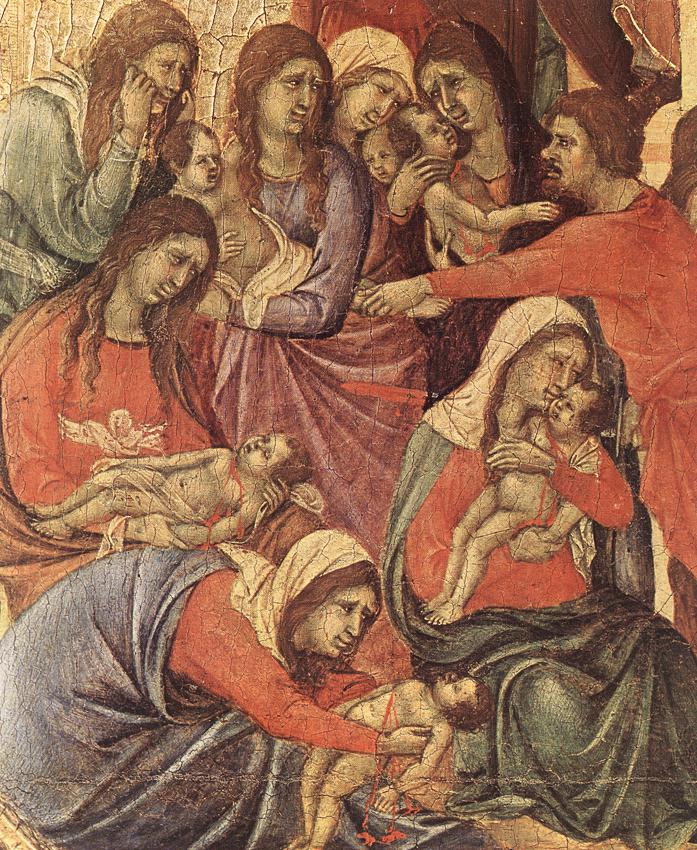
Massacre of the Innocents Duccio.jpgOur soul has been rescued like a bird from the fowler’s snare.


Father, the Holy Innocents offered you praise by the death they suffered for Christ. May our lives bear witness to the faith we profess with our lips.


from the Directory of Popular Piety and the Liturgy: The Feast of the Holy Innocents

Since the sixth century, on December 28, the Church has celebrated the memory of those children killed because of Herod’s rage against Christ (cf. Mt 2:16-17). Liturgical tradition refers to them as the “Holy Innocents” and regards them as martyrs. Throughout the centuries Christian art, poetry and popular piety have enfolded the memory of the “tender flock of lambs” with sentiments of tenderness and sympathy. These sentiments are also accompanied by a note of indignation against the violence with which they were taken from their mothers’ arms and killed.

In our own times, children suffer innumerable forms of violence which threaten their lives, dignity and right to education. On this day, it is appropriate to recall the vast host of children not yet born who have been killed under the cover of laws permitting abortion, which is an abominable crime. Mindful of these specific problems, popular piety in many places has inspired acts of worship as well as displays of charity which provide assistance to pregnant mothers, encourage adoption and the promotion of the education of children.

As recorded in the gospel of Matthew, after the visit of the Magi, Herod, in rage and jealousy, slaughtered all the baby boys in Bethlehem and surrounding countryside in an attempt to destroy his perceived rival, the infant Messiah. These “innocents” are honored by the Church as martyrs.

In countries where our own innocents are daily being slaughtered by abortion, this feast day is a special time to remember the unborn, to pray for their cause, and perhaps to picket or pray at facilities where unborn babies are killed through abortion. (113)