Saint John Neumann

sjnmosaic.jpgMerciful
Father, You have given me all that I have in this world, even life itself. In
all my daily needs, help me to remember the needs of others too. Make me aware
of the need to pray to You not just for myself but for the Church, the Pope,
for the clergy and for people who suffer any need.


Make me as selfless as Saint
John Neumann. Throughout my life, give me the grace to direct my first thoughts
to the service of You and of others. Make my prayer – “Your will be
done” knowing that in Your mercy and love, Your will for me is my
sanctification. I ask this through Jesus Christ, Our Lord. Amen. (Prayer to
Saint John Neumann)

The liturgical prayer, a brief chronology and a prayer for
the saint’s intercession may be found here.


Canonization
homily of Pope Paul VI, Sunday, 19 June 1977

Greetings to you, Brethren, and
sons and daughters of the United States of America! We welcome you in the name
of the Lord!

The entire Catholic Church, here, at the tomb of the Apostle
Peter, welcomes you with festive joy. And together with you, the entire
Catholic Church sings a hymn of heavenly victory to Saint John Nepomucene
Neumann
, [1811-1860] who receives the honor of one who lives in the glory of Christ.

In a
few brief words we shall describe for the other pilgrims some details of his
life, which are already known to you.

We ask ourselves today: what is the
meaning of this extraordinary event, the meaning of this canonization? It is
the celebration of holiness. And what is holiness? It is human perfection,
human love raised up to its highest level in Christ, in God.

At the time of
John Neumann, America represented new values and new hopes. Bishop Neumann saw
these in their relationship to the ultimate, supreme possession to which
humanity is destined. With Saint Paul he could testify that “all are yours, and
you are Christ’s, and Christ is God’s” (1 Cor. 3, 22). And with Augustine he
knew that our hearts are restless, until they rest in the Lord (St. Augustine,
Confessions, 1, 1).

His love for people was authentic brotherly love. It was
real charity: missionary and pastoral charity. It meant that he gave himself to
others. Like Jesus the Good Shepherd, he lay down his life for the sheep, for
Christ’s flock: to provide for their needs, to lead them to salvation. And
today, with the Evangelist, we solemnly proclaim: “There is no greater love
than this: to lay down one’s life for one’s friends” (Jn. 15, 13).

John
Neumann’s pastoral zeal was manifested in many ways. Through faithful and
persevering service, he brought to completion the generosity of his initial act
of missionary dedication. He helped children to satisfy their need for truth,
their need for Christian doctrine, for the teaching of Jesus in their lives
. He
did this both by catechetical instruction and by promoting, with relentless
energy, the Catholic school system in the United States. And we still remember
the words of our late Apostolic Delegate in Washington, the beloved Cardinal
Amleto Cicognani: “You Americans”, he said, “possess two great treasures: the
Catholic school and the Confraternity of Christian Doctrine. Guard them like
the apple of your eye
” (Cfr. Epistola 2 June 1963).

And who can fail to admire
all the loving concern that John Neumann showed for God’s people, through his
priestly ministry and his pastoral visitations as a Bishop? He deeply loved the
Sacramental of Reconciliation
: and like a worthy son of Saint Alphonsus he
transmitted the pardon and the healing power of the Redeemer into the lives of
innumerable sons and daughters of the Church. He was close to the sick; he was
at home with the poor; he was a friend to sinners. And today he is the honor of
all immigrants, and from the viewpoint of the Beatitudes the symbol of
Christian success.

John Neumann bore the image of Christ. He experienced, in
his innermost being, the need to proclaim by word and example the wisdom and
power of God, and to preach the crucified Christ. And in the Passion of the
Lord he found strength and the inspiration of his ministry: Passio Christi
conforta me
! (The Passion of Christ strengthens me)

The Eucharistic Sacrifice was the center of his life, and
constituted for him what the Second Vatican Council would later call “the
source and summit of all evangelization” (Presbiterorum Ordinis, 5). With great
effectiveness, through the Forty Hours Devotion he helped his parishes become
communities of faith and service.

But to accomplish his task, love was
necessary. And love meant giving; love meant effort; love meant sacrifice. And
in his sacrifice, Bishop Neumann’s service was complete. He led his people
along the paths of holiness. He was indeed an effective witness, in his
generation, to God’s love for his Church and the world.

There are many who have
lived and are still living the divine command of generous love. For love still
means giving oneself for others, because Love has come down to humanity; and
from humanity love goes back to its divine source! How many men and women make
this plan of God the program of their lives! Our praise goes to the clergy,
religious and Catholic laity of America who, in following the Gospel, live
according to this plan of sacrifice and service. Saint John Neumann is a true
example for all of us in this regard. It is not enough to acquire the good
things of the earth, for these can even be dangerous, if they stop or impede
our love from rising to its source and reaching its goal. Let us always
remember that the greatest and the first commandment is this: “You shall love
the Lord your God” (Matt. 22, 36).

True humanism in Christianity. True
Christianity
-we repeat –is the sacrifice of self for others, because of Christ,
because of God
. It is shown by signs; it is manifested in deeds. Christianity
is sensitive to the suffering and oppression and sorrow of others, to poverty,
to all human needs, the first of which is truth.

Our ceremony today is indeed
the celebration of holiness. At the same time, it is a prophetic
anticipation-for the Church, for the United States, for the world-of a renewal
in love: love for God, love for neighbor.

And in this vital charity, beloved
sons and daughters, let us go forward together, to build up a real civilization
of love.

Saint John Neumann, by the living power of your example and by the
intercession of your prayers, help us today and for ever.
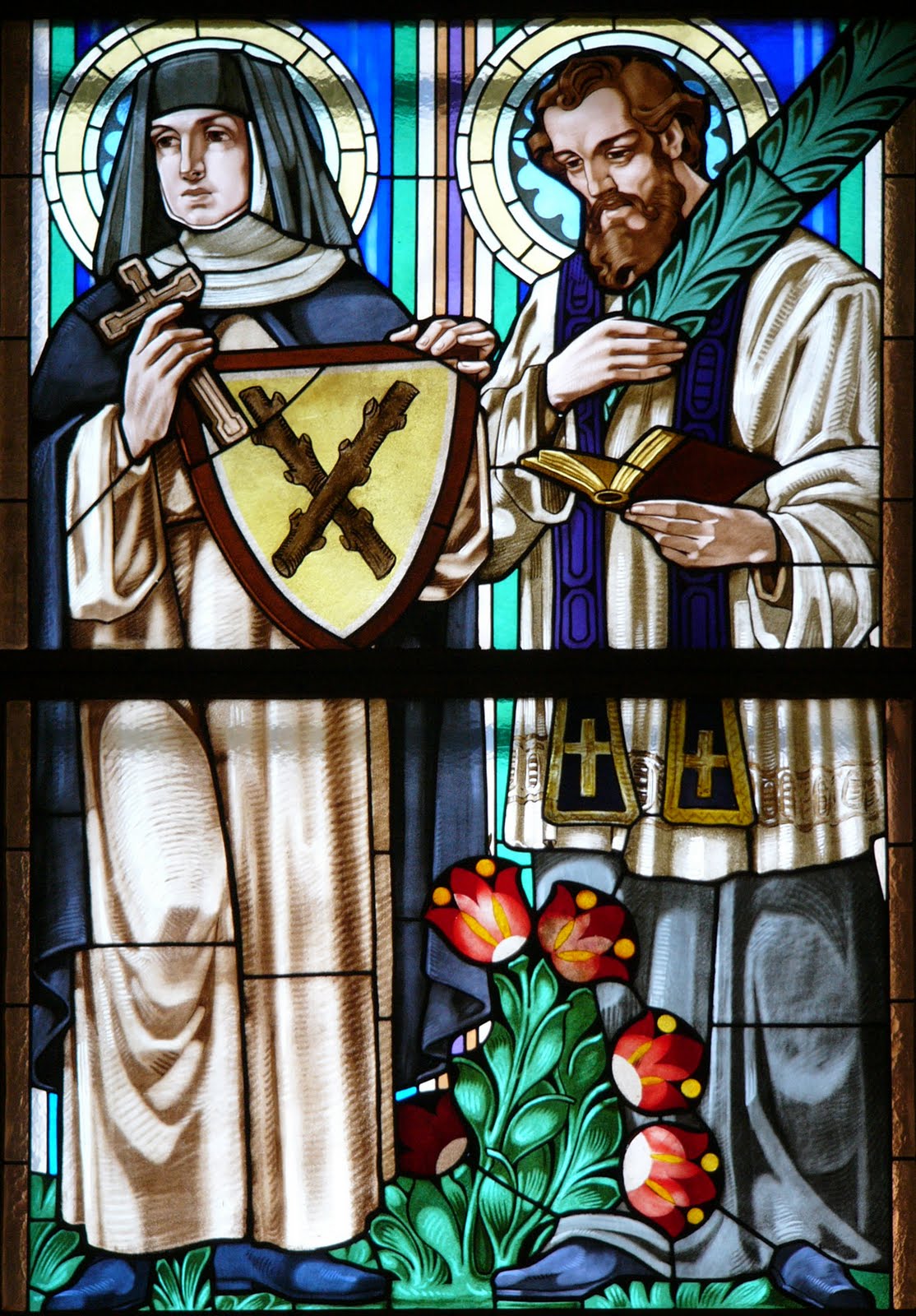
Saint Zedislava Berkiana

Sts Zedislava & John Sarkander.jpg

Faithful
God, by her married life and works of charity you taught Saint Zedislava to
pursue the way of perfection. By her prayers may family life be strengthened
and be a witness to Christian virtue.


Saint Zedislava is depicted as a third order Dominican
(in the Dominican habit on the left in the image) wearing a rosary wound with
roses, lying in the place of a sick person in bed. She is the patron saint of
difficult marriages and people who are ridiculed for their piety.

The condition of our Catholicism is unity among Christians

Lord, pour out upon us the fullness of your mercy, and
by the power of your Spirit remove divisions among Christians. Let your
Church rise more clearly as a sign for all the nations that the world may be
filled with the light of your Spirit and believe in Jesus Christ whom you have
sent, who lives and reigns with you and the Holy Spirit, one God, forever and
ever.
   (from the Mass for Unity of Christians)


The work of bringing about the unity among Christians is a supreme priority for all Catholics, indeed, all Christians. In the 26+ year ministry of Pope John Paul II we saw this work unfold and advance in many unimaginable ways, as we did with previous popes, but John Paul recognized Christian unity as a fruit of the Holy Spirit. We were reminded the Church’s priority for Christian unity at the beginning of Benedict’s pontificate. The month of January 2010 we are asked by the Pope to keep this work in our sacrifice of prayer not because it is a “nice thing to do,” but because it is a condition, that is, a premise, a stipulation, a prerequisite for Catholic faith and life. Let’s recall a portion of what Benedict said at his inaugural Mass as Supreme Pontiff:


…image of the shepherd and that of the fisherman issue
an explicit call to unity. “I have other sheep that are not of this fold; I
must lead them too, and they will heed my voice. So there shall be one flock,
one shepherd” (Jn 10:16); these are the words of Jesus at the end of his
discourse on the Good Shepherd. And the account of the 153 large fish ends with
the joyful statement: “although there were so many, the net was not torn” (Jn
21:11). Alas, beloved Lord, with sorrow we must now acknowledge that it has
been torn! But no – we must not be sad! Let us rejoice because of your promise,
which does not disappoint, and let us do all we can to pursue the path towards
the unity you have promised. Let us remember it in our prayer to the Lord, as
we plead with him: yes, Lord, remember your promise. Grant that we may be one
flock and one shepherd! Do not allow your net to be torn, help us to be
servants of unity! (Pope Benedict XVI, Homily for the Beginning of the Petrine
Ministry, 2005)

Saint Elizabeth Ann Seton

St Elizabeth Ann Seton3.jpg

Lord Jesus, Who was born for us in a stable, lived for us a life of pain and sorrow, and died for us upon a cross; say for us in the hour of death, Father, forgive, and to Your Mother, Behold your child. Say to us, This day you shall be with Me in paradise. Dear Savior, leave us not, forsake us not. We thirst for You, Fountain of Living Water. Our days pass quickly along, soon all will be consummated for us. To Your hands we commend our spirits, now and forever. Amen. (a prayer by Saint Elizabeth Seton)


Saint Elizabeth Ann Seton (1774-1821), a native of New
York was socialite, a wife, a mother, a convert to Catholicism and a foundress
of a religious community of women. Seton is the first native-born American
citizen to be canonized. She founded the Society for the Relief of Poor Widows
With Small Children, New York City’s first private charitable organization, and
founded the U.S. Sisters of Charity. Seton was responsible for the parochial
school system in the USA. 

A video was made of Seton and you can watch the trailer here.

Even more on Saint Elizabeth Ann Seton may be found here,
including the liturgical prayer for her.

Blessing of Homes on Epiphany

C+M+BRead the Gospel narrative of Zacchaeus (Luke 19:1-9) from the Family Bible.

Using chalk blessed by the priest, write above the entry way:

20 + C +M + B + 10

Let us pray.

Peace be to this house and all who live here. During these days of the Christmas season, we keep this feast of Epiphany. Through the guidance of a star, the coming of Jesus was made known to the Gentiles. We celebrate Christ made known to the Magi, to John in the River Jordan, and to the disciples at the wedding at Cana.

Today Christ is made known to us! Today this home is a holy place! The Magi came from the east to Bethlehem to adore the Lord.  “They went into the house, and when they saw the child with His mother Mary, they knelt down and worshipped him.They brought out their gifts of gold, frankincense and myrrh, and presented them to Him.” [Matthew 2:11]

Bow our heads and pray for God’s blessing . . .

Lord our God, bless our home and all who live here. May we be filled with health, goodness of heart, gentleness, obedience to Your law, and thanksgiving to the Father, and to the Son, and to the Holy Spirit. Help us love and respect one another and make your presence known by the way we care for others. May this blessing remain upon this house and upon all who live here. Through Christ our Lord. Amen. 

+++

The blessing of the home is an Epiphany custom. Chalk blessed by the priest on Epiphany is given to the faithful to mark their entrance door with the current year and with the inscription C+M+B, the initials of Caspar, Melchior and Balthasar, the traditional names of the Magi (as above). In addition to remembering the Magi, the inscription means for the Latin phrase Christus Mansionem Benedicat, which means “Christ, bless this home.”

The Epiphany Proclamation 2010

Epiphany PPerugino.jpgThe Epiphany Proclamation


Dear brothers and sisters, the glory of the Lord has shone upon us, and shall ever be manifest among us, until the day of his return. Through the rhythms of times and seasons let us celebrate the mysteries of salvation.


Let us recall the year’s culmination, the Easter Triduum of the Lord: his last supper, his crucifixion, his burial, and his rising celebrated between the evening of the 1st of April and the evening of the 3rd of April.


Each Easter – as on each Sunday – the Holy Church makes present the great and saving deed by which Christ has for ever conquered sin and death.


From Easter are reckoned all the days we keep holy:


Ash Wednesday, the beginning of Lent, will occur on the 17th of February.

The Ascension of the Lord will be commemorated on the 13th of May.

Pentecost, the joyful conclusion of the season of Easter, will be celebrated on the 23rd of May.

Corpus Christi will be celebrated on the 6th of June. 

The First Sunday of Advent will be celebrated on the 28th of November.


Likewise the pilgrim Church proclaims the passover of Christ in the feasts of the holy Mother of God, in the feasts of the Apostles and Saints, and in the commemoration of the faithful departed.


To Jesus Christ, who was, who is, and who is to come, Lord of time and history, be endless praise, for ever and ever.


R. Amen. 

God in Man is manifest (Epiphaniam Domino)

Epiphany Giotto.jpgLo, God in man is manifest!
tell out the joyous story:
tell how the Wise Men
worshipped the Son Incarnate.

Sages from furthermost Orient stream to bow before His boundless power. Who is the King whom the prophets foretold should come to save both Jew and Gentile?

Lo! He humbleth Himself from His throne of glory, taketh on Him the form of servant. He who is God before all ages now is born of the Virgin Mary.

See fulfilled is Balaam’s prophetcy:
Out of Jacob shall a star arise–
so ’twas promised! See the Wise Men offer Him their costliest presents:
Gold and myrrh and fragrant incense.

Rising up in power and majesty,
He shall strike with dread discomfiture
Moab’s princes.

Offerings significant: incense shows His Godhead;
gold, His kingdom; myrrh, His passion.
Join, then, in one solemn chorus and raise
the melody of praise and glory,
which may betoken oblations most rare
which to our Lord we fain would offer.

Praying that His true protection
over all nations be extended,
now and forever.  Amen.

from the Sarum Use of the Mass, Epiphaniam Domino

Saint Basil the Great & Saint Gregory Nazianzian


Sts Basil, John Gregory.jpg

Saint Basil the Great, bishop of Caesarea was one of the
most distinguished Doctors of the Church. He lived c. 329 to January 1, 379.
Theologians place Saint Basil after Saint Athanasius as a defender of the
Church against the heresies of the fourth century (the most destructive of the
faith was the Arian heresy).

Saint
Gregory of Nazianzus
(c. 325-389) was also from Cappadocia and a friend of Basil, followed
the monastic way of life for some years. Eventually the Church called Nazianzus to be a priest and later bishop of Constantinople (in 381). Saint
Gregory was given the title “The Theologian” because of his learning
and oratory.

Many icons of Saints Gregory of Nazianzus and Basil include
Nazianzus’ brother Saint Gregory of Nyssa. The group is known as “The
Three Cappadocians.” Some make the claim that Basil outshines Nazianzus and
Nyssa in practical genius and actual achievement. BTW, the icon presented here does not include Nyssan but Saint John Chrysostom.

The liturgical prayer for today’s memorial may be found here.

Saint Basil the Great writes on life’s journey:

We read in the Book of
Psalms: ‘Blessed is the one who walks not in the counsel of the wicked, nor
follows in the way of sinners.’ Life has been called a ‘way’ because everything
that has been created is on the way to its end. When people are on a sea
voyage, they can sleep while they are being transported without any effort of
their own to their port of call. The ship brings them closer to their goal
without their even knowing it. So we can be transported nearer to the end of
our life without our noticing it, as time flows by unceasingly. Time passes
while you are asleep. While you are awake time passes although you may not notice.

All
of us have a race to run towards our appointed end. So we are all ‘on the way’.
This is how you should think of the ‘way’. You are a traveller in this life.
Everything goes past you and is left behind. You notice a flower on the way, or
some grass, or a stream, or something worth looking at. You enjoy it for a
moment, then pass on. Maybe you come on stones or rocks or crags or cliffs or
fences, or perhaps you meet wild beasts or reptiles or thorn bushes or some
other obstacles. You suffer briefly then escape. That is what life is like.

Pleasures
do not last but pain is not permanent either.

The ‘way’ does not belong to you
nor is the present under your control. But as step succeeds step, enjoy each
moment as it comes and then continue on your ‘way’.

Commentary
on Psalm 1, 4
(PG 29, 220)

37 killed for being Christian

cross detail3.jpgLiving and dying in Christ in 2009 was way too common.
Especially the dying part.  Pope
Benedict’s Christmas homily notes that “The Church everywhere proclaims the
Gospel of Christ, despite persecutions, discriminations, attacks and at times hostile
indifference. These, in fact, enable her to share the lot of her Master and
Lord.” Many of the 37 people killed this past year met hostility for their
acceptance of Christ as Savior, others were easy targets because they were
priests or nuns or in some way connected with the Church. Being killed for
being Christian is not the same as saying the 37 were martyrs for the faith.
Some may be legitimate martyrs, but not all.


Those who died:

Fr Joseph
Bertaina, of the Consolata Missionaries, killed January 16, 2009, Langata,
Kenya

Fr Eduardo de la Fuente Serrano, 61, killed February 14, 2009, Havana,
Cuba

Fr Juan Gonzalo Aristizabal Isaza, 62, killed February 22, 2009, Medellin,
Colombia

Fr Daniel Matsela Mahula, 34, killed February 27, 2009, Jouberton,
South Africa

Fr Lionel Sham, 66, killed March 7, 2009, Mohlakeng, South Africa

Fr
Révocat Gahimbare, killed March 8, 2009, Karuzi, Burundi

Fr Gabriel Fernando
Montoya Tamayo, 40 & Fr Jesús Ariel Jiménez, 45, Redemptorists, killed
March 16, 2009, La Primavera, Colombia

Fr Ramiro Luden, 64, killed March 20,
2009, Recife, Brazil

Fr Lorenzo Rosebaugh, 74, Missionary Oblates of Mary
Immaculate, killed May 18, 2009, lta Verapaz, Guatemala

Fr Ernst Plöchl, 78,
Congregation of the Missionaries of Mariannhill, killed May 31, 2009 Cape
Province, South Africa

Mr Jorge Humberto Echeverri Garro, 40, killed June 11,
2009, Colonos, Panama Arauca, Colombia

Fr Habacuc Benítez Hernández, 39, and
Seminarians Oregon Eduardo Benitez, 19, and Silvestre Gonzalez Cambron, 21,
killed June 13, 2009, Tierra Caliente, Guerrero, Mexico

Fr Gisley Azevedo
Gomes, 31, Congregation of the Sacred Stigmata of Our Lord Jesus Christ, killed
June 15, 2009, Brazlandia, Brasilia

Fr Mariano Arroyo Merino, 74, killed July
13, 2009, Shrine of Our Lady of the Rule, Cuba

Mr Ricky Sukaka Agus, 27,
Caritas worker, killed July 15, 2009, Musezero, North Kivu, DR of Congo

Fr Mukalel James, 39, killed July 30, 2009, Mangalore, Karnataka,
India

Fr Leopoldo Cruz, Redemptorist, killed August 24, 2009, El Salvador

Fr
Cecilio Lucero, Filipino, 48, killed September 6, 2009, Northern Samar
province, Philippines

Fr Roger Ruvoletto, 52, Fidei Donum missionary, killed September
19, 2009, Manaus, Brazil

Fr Evaldo Martiol, 33, killed September 26, 2009,
Santa Caterina, Brazil

Fr Danilo Oscar Cardozo 57, killed September 27, 2009,
Villavicencio, Colombia


Mr William Quijano, 21, Community of St. Egidio in El
Salvador, September 28, 2009, Apopa, San Salvador

Fr Edward Hinds, 61, killed
October 24, 2009, Chatham, New Jersey


Fr Louis Jousseaume, 70, killed October
26, 2009, Tulle, France

Sr Marguerite Bartz, 64, Sisters of the Blessed
Sacrament, killed October 31/November 1, 2009, Navajo, New Mexico

Fr Hidalberto
Henrique Guimaraes, 48, killed November 7, 2009, Maceió, Brazil

Fr Miguel Angel
Hernandez, 45, Capuchin Franciscan, killed November 8, 2009, Ocotepeque
Honduras, and found dead in a province of eastern Guatemala

Fr Jean Gaston
Buli, killed on November9/10 2009, Bunia, DR of Congo

Fr
Daniel Cizimya Nakamaga, 51, killed December 6, 2009, Kabare, DR of Congo

Fr Louis Blondel, 70, Missionaries of Africa, killed December
6 /7, 2009, Pretoria, South Africa

Sr Denise Kahambu Muhayirwa, 44,
Trappistine, killed December 7, 2009, Murhesa, DR of Congo

Fr
Jeremiah Roche, Society of St. Patrick for Foreign Missions, killed December
10/11, 2009, Kericho, Kenya

Fr Alvino Broering, 46, killed December 14, 2009,
Santa Catarina, Brazil


Fr Emiro Jaramillo Cardenas, 73, killed on December 20,
2009, Santa Rosa de Osos, Columbia


We are never very far from offering our
lives for Christ. The day after Christmas we observe the feast of the first
martyr, Saint Stephen, a deacon and one of the seven chosen to serve the
Church. In his Angelus address Pope Benedict recalled for us that

Stephen’s
witness, like that of the Christian martyrs, shows our fellow men and women, so
often distracted and disoriented, in whom they must place their trust in order
to give meaning to life.
The martyr is, in fact, the person who dies in the
certainty of being loved by God and, placing nothing before love for Christ,
knows he has chosen the better part
. Fully identifying himself with the death
of Christ, he realizes that he is a life-giving seed that opens the way for
peace and hope in the world. Today, presenting us St. Stephen the Deacon as a
model,
the Church is also showing us that acceptance and love for the poor is
one of the privileged ways to live the Gospel and to bear credible witness
before the world of the Kingdom of God that is to come
. (Angelus, December 26,
2009)


Rome Reports filed this story.