Pope tells bishops of England and Wales to be united in teaching the faith and being a witness to Christ


UK Bishops arms.jpg

This last week the Pope has meeting individually and collectively with the bishops of England and Wales. As you know, a bishop is obliged to pray at the tombs of Saints Peter and Paul and to offer a review of the pastoral activities of the diocese he leads to the Pope and to his curia. It is a visit to “the threshold” (ad Limina) to the center of our faith. Over the past years the bishops of Britain have faced some serious challenges–much like the bishops of the USA and Canada– and have not responded effectively enough to certain matters of faith and morals. The British bishops are your typical “old boys” network, a closed group of men sitting on their laurels. Generally speaking the UK bishops are not very unified in their teaching the faith which was a hallmark of Cardinal Murphy-O’Connor; one clear indication of this is the work of Bishop O’Donoghue that was posted here calling for clear catechesis, witness and liturgical practice (read two things here and here). In the Pope’s address to the bishops at the end of their to visit Peter, you can see the matters that concern the pope and the Church at large. The papal address at the end of any visit of an episcopal conference is an interesting thing to read because Rome is a bit more objective in reading the tea leaves than those living in situ. General rule of thumb: if it finds its way into print, then it is important to recall. Plus, the Pope is rather subtle in his addresses such that you have to read between the lines. And you may ask why is this text important for North America. Catholics on both sides of the Atlantic face the very same issues when it comes to proposing the faith, moral living, ecumenism and sacramentality. What the Pope told the UK bishops is to be applied in the USA: the old way of doing things has ended. All but 2 paragraphs of the address are given here with my own emphasis on certain points.
Benedict XVI.jpg

I welcome all of you on your ad Limina visit to Rome, where you have come to venerate the tombs of the Apostles Peter and Paul. I thank you for the kind words that Archbishop Vincent Nichols has addressed to me on your behalf, and I offer you my warmest good wishes and prayers for yourselves and all the faithful of England and Wales entrusted to your pastoral care. Your visit to Rome strengthens the bonds of communion between the Catholic community in your country and the Apostolic See, a communion that sustained your people’s faith for centuries, and today provides fresh energies for renewal and evangelization. Even amid the pressures of a secular age, there are many signs of living faith and devotion among the Catholics of England and Wales. I am thinking, for example, of the enthusiasm generated by the visit of the relics of Saint Thérèse, the interest aroused by the prospect of Cardinal Newman’s beatification, and the eagerness of young people to take part in pilgrimages and World Youth Days. On the occasion of my forthcoming Apostolic Visit to Great Britain, I shall be able to witness that faith for myself and, as Successor of Peter, to strengthen and confirm it. During the months of preparation that lie ahead, be sure to encourage the Catholics of England and Wales in their devotion, and assure them that the Pope constantly remembers them in his prayers and holds them in his heart.

Your country is well known for its firm commitment to equality of opportunity for all members of society. Yet as you have rightly pointed out, the effect of some of the legislation designed to achieve this goal has been to impose unjust limitations on the freedom of religious communities to act in accordance with their beliefs. In some respects it actually violates the natural law upon which the equality of all human beings is grounded and by which it is guaranteed. I urge you as Pastors to ensure that the Church’s moral teaching be always presented in its entirety and convincingly defended. Fidelity to the Gospel in no way restricts the freedom of others – on the contrary, it serves their freedom by offering them the truth.

Continue to insist upon your right to participate in national debate through respectful dialogue with other elements in society. In doing so, you are not only maintaining long-standing British traditions of freedom of expression and honest exchange of opinion, but you are actually giving voice to the convictions of many people who lack the means to express them: when so many of the population claim to be Christian, how could anyone dispute the Gospel’s right to be heard?

If the full saving message of Christ is to be presented effectively and convincingly to the world, the Catholic community in your country needs to speak with a united voice. This requires not only you, the Bishops, but also priests, teachers, catechists, writers – in short all who are engaged in the task of communicating the Gospel – to be attentive to the promptings of the Spirit, who guides the whole Church into the truth, gathers her into unity and inspires her with missionary zeal.

Make it your concern, then, to draw on the considerable gifts of the lay faithful in England and Wales and see that they are equipped to hand on the faith to new generations comprehensively, accurately, and with a keen awareness that in so doing they are playing their part in the Church’s mission. In a social milieu that encourages the expression of a variety of opinions on every question that arises, it is important to recognize dissent for what it is, and not to mistake it for a mature contribution to a balanced and wide-ranging debate. It is the truth revealed through Scripture and Tradition and articulated by the Church’s Magisterium that sets us free. Cardinal Newman realized this, and he left us an outstanding example of faithfulness to revealed truth by following that “kindly light” wherever it led him, even at considerable personal cost. Great writers and communicators of his stature and integrity are needed in the Church today, and it is my hope that devotion to him will inspire many to follow in his footsteps.

Much attention has rightly been given to Newman’s scholarship and to his extensive writings, but it is important to remember that he saw himself first and foremost as a priest. In this Annus Sacerdotalis, I urge you to hold up to your priests his example of dedication to prayer, pastoral sensitivity towards the needs of his flock, and passion for preaching the Gospel. You yourselves should set a similar example. Be close to your priests, and rekindle their sense of the enormous privilege and joy of standing among the people of God as alter Christus. In Newman’s words, “Christ’s priests have no priesthood but His … what they do, He does; when they baptize, He is baptizing; when they bless, He is blessing” (Parochial and Plain Sermons, VI 242). Indeed, since the priest plays an irreplaceable role in the life of the Church, spare no effort in encouraging priestly vocations and emphasizing to the faithful the true meaning and necessity of the priesthood. Encourage the lay faithful to express their appreciation of the priests who serve them, and to recognize the difficulties they sometimes face on account of their declining numbers and increasing pressures. The support and understanding of the faithful is particularly necessary when parishes have to be merged or Mass times adjusted. Help them to avoid any temptation to view the clergy as mere functionaries but rather to rejoice in the gift of priestly ministry, a gift that can never be taken for granted.

Ecumenical and inter-religious dialogue assume great importance in England and Wales, given the varied demographic profile of the population. As well as encouraging you in your important work in these areas, I would ask you to be generous in implementing the provisions of the Apostolic Constitution Anglicanorum Coetibus, so as to assist those groups of Anglicans who wish to enter into full communion with the Catholic Church. I am convinced that, if given a warm and open-hearted welcome, such groups will be a blessing for the entire Church.

Pope Benedict XVI’s monthly prayer intentions for February 2010

Uber papa.jpgPope Benedict asks us to keep in mind the following
two intentions for the coming month of February. These intentions, as in our intentions offered in prayer show what Christ’s word means in all of its richness, the truth. He or she who prays understands, knows, does the will of God, as von Balthasar would say. So, pray for these intentions.


The general intention

That
scholars and intellectuals, by sincere search for the truth, may come to know
the one true God.

The missionary intention

That the Church, aware of its
missionary identity, may strive to follow Christ faithfully and to proclaim his
Gospel to all peoples.

Saint John Bosco

The kingdom of heaven is
like a mustard seed which a man took and sowed in his field. It is the smallest
of all the seeds but when it has grown it is the biggest shrub of all and
becomes a tree so that the birds of the air come and shelter in its branches.


St John Bosco.jpg

Because today is a Sunday, the Church does not observe the feast of Saint John Bosco, known also as Don Bosco. However, in the Salesian family, Don Bosco’s it is a feast day. My encounters with members of the Salesian family have been few so I’ve poked around their website to learn a little more of the spirit of Don Bosco. The
paragraphs are excerpts of a May 10, 1884 letter by Saint John Bosco,
considered by some to be the “Magna Carta” of Salesian Education. It
is included as an appendix to the Constitutions of the Salesian Society, and
given to members of the Salesian Family. In the USA the Salesians are not as
known as in other parts of the world. Here, their educational system was
perceived to be competing with the Jesuits, and Salesians could not compete.
The Jesuits have about 47 high schools in all the major cities. Be that as it
may, Saint John Bosco provides for us an insight into effective pastoral
ministry. The Salesians of Don Bosco are influential in various sectors of the
Church, primarily in education and with the youth. The reasons for this fact are evident in the letter below. If you are interested in the Salesian priests and sisters, visit their website.

From the letter of Don Bosco

By
a friendly informal relationship with the boys, especially in recreation
. You
cannot have love without this familiarity, and where this is not evident there
can be no confidence. If you want to be loved, you must make it clear that you
love
. Jesus Christ made himself little with the little ones and bore our
weaknesses. He is our master in the matter of the friendly approach. The
teacher who is seen only in the classroom is a teacher and nothing more; but if
he joins in the pupils’ recreation he becomes their brother. If someone is only
seen preaching from the pulpit it will be said that he is doing no more and no
less than his duty, whereas if he says a good word in recreation it is heard as
the word of one who loves.

How many conversions have been brought about by a
few words whispered in the ear of a youngster while he is playing
. One who
knows he is loved loves in return, and one who loves can obtain anything,
especially from the young. This confidence creates an electric current between
youngsters and their superiors. Hearts are opened, needs and weaknesses made
known. This love enables superiors to put up with the weariness, the annoyance,
the ingratitude, the troubles that youngsters cause. Jesus Christ did not crush
the bruised reed nor quench the smouldering flax. He is your model
. Then you
will no longer see anyone working for his own glory; you will no longer see
anyone punishing out of wounded self-love; you will not see anyone neglecting
the work of supervision through jealousy of another’s popularity; you won’t
hear people running others down so as to be looked up to by the boys: those who
exclude all other superiors and earn for themselves nothing but contempt and
hypocritical flattery; people who let their hearts be stolen by one individual
and neglect all the other boys to cultivate that particular one. No one will
neglect his strict duty of supervision for the sake of his own ease and
comfort; no one will fail through human respect to reprimand those who need
reprimanding. If we have this true love, we shall not seek anything other than
the glory of God and the good of souls. When this love languishes, things no
longer go well. Why do people want to replace love with cold rules? Why do the
superiors move away from the observance of the rules Don Bosco has given them?
Why the replacement little by little of loving and watchful prevention by a
system which consists in framing laws? Such laws either have to be sustained
through punishment and so create hatred and cause unhappiness or, if they are
not enforced, cause the superiors to be despised and bring about serious
disorders. This is sure to happen if there is no friendly relationship. So if
you want the Oratory to return to the happiness of old, then bring back the old
system: let the superior be all things to all, always ready to listen to any
boy’s complaints or doubts, always alert to keep a paternal eye on their
conduct, all heart to seek the spiritual and temporal good of those Divine
Providence has entrusted to him. Then hearts will no longer be closed and
deadly subterfuge will no longer hold sway
. The superiors should be unbending
only in the case of immoral conduct. It is better to run the risk of expelling
someone who is innocent than to keep someone who causes others to sin.
Assistants should make it a strict duty in conscience to refer to the superiors
whatever they know to be an offence against God.

Archbishop of Canterbury, Rowan Williams in NY this week

One of the world’s high profile Christian leaders, Rowan Williams, the Archbishop of Canterbury, always draws a crowd. For good reason. he’s a provocative Christian thinker, writer and quite engaging as a man of God with various theological interests. Regardless of your opinion about the state of affairs in the Anglican Church, Williams is not a disappointing public, Christian intellectual. Rowan Williams is the 104th archbishop of Canterbury, enthroned in 2002.

Wiliams honorary doctorate from St Vladimir's.jpg

Today, Archbishop Williams gave the 27th annual Father Alexander Schmemann Memorial Lecture at Saint Vladimir’s Orthodox Seminary (Crestwood, Yonkers, NY). Williams lectured masterfully on “Theology and Contemplative Calling: The Image of Humanity in the Philokalia.” Just prior to the lecture, the Seminary conferred on the Archbishop a Degree of Doctor of Divinity (honoris causa).
More than 200 people attended the lecture including a small delegation of seminarians from St Joseph’s Seminary, Orthodox and Catholic bishops and priests, students and friends.
Archbishop Williams’ talk will be made available shortly and will be published in the St Vladimir’s Theological Quarterly.

Yesterday, Dr Williams spoke to Wall Street executives, on their home turf, as the NY Times called it.
Earlier in the week Williams received from the Jesuits at America Magazine the Edmund Campion Award, for his sizable literary output. OK, the Campion Award is a literary award. But how odd that the English clergyman of high rank, such as Canterbury, should receive an award named for an English Jesuit martyr, put to death by the English government in the period of the post English revolt of the Catholic Church. Campion died a particularly painful death for Christ and the Catholic Church. Or, is it too odd to conceive? I will leave you to answer the question if Campion was truly smiling upon the event. I, for one, am not enthusiastic that the Jesuits gave an award to Williams named after Campion. I don’t see it as martyrial ecumenism. You see, it is an act of generosity on the part of the Jesuits to honor Williams (and for him to accept) but I do mind the Jesuits making too close a connection with the martyr Campion and Rowan Williams. Certainly, someone saw the irony in this event, regardless if Campion is liturgically remembered by the Church of England on May 4th (while we remember Campion on December 1. You can read Fr Drew Christiansen’s remarks and listen to the Archbishop’s remarks on the podcast.
A cursory review of Williams’ itinerary can be read here.

High winds cause damage to steeple, St Mary’s New Haven

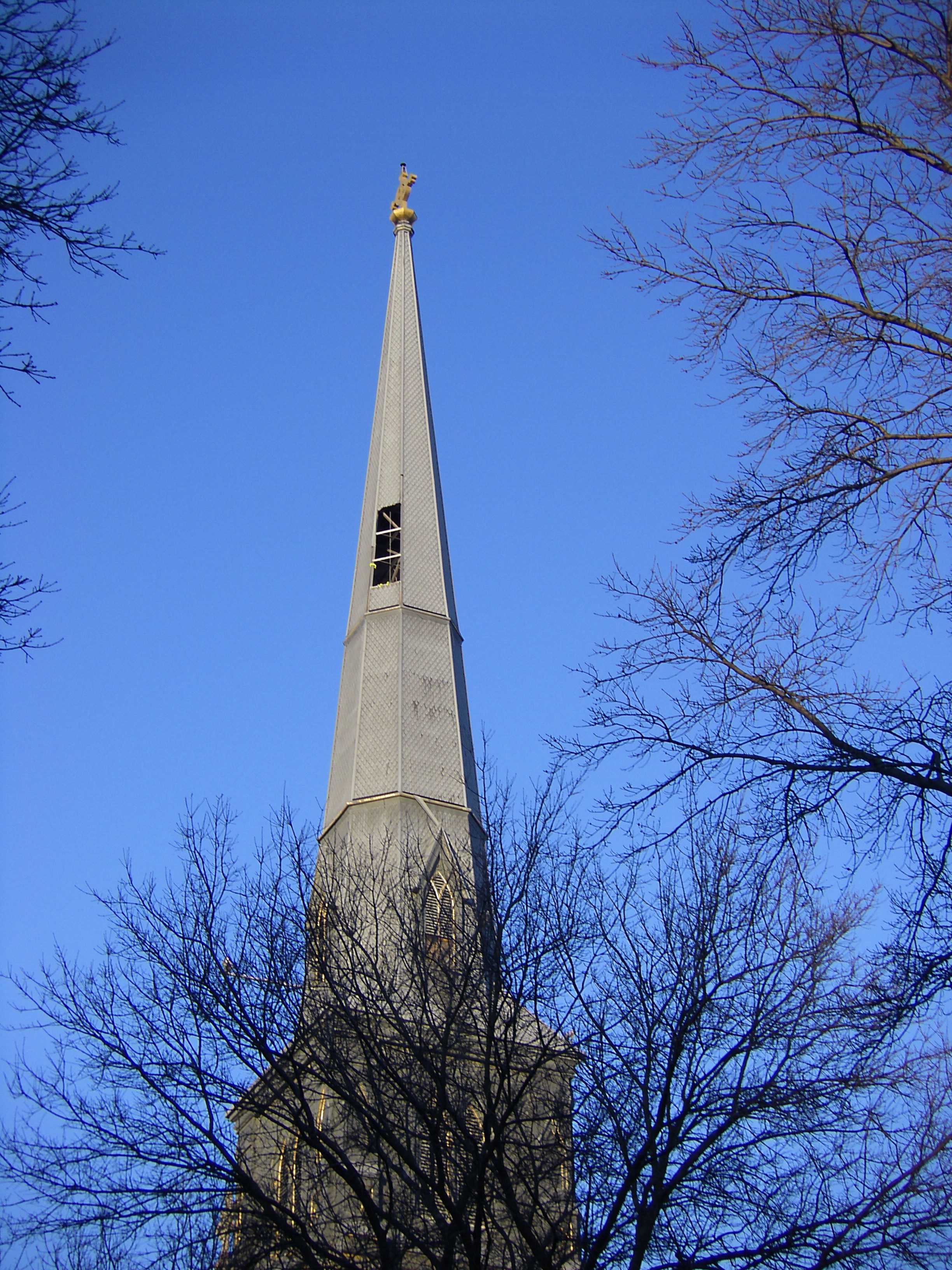
Steeple damage St Mary Church Jan 29 10.jpg

Some have bats, we’ve got holes! Big, dangerous holes!

The steeple on Saint Mary’s Church, New Haven, CT, was damaged earlier today by high winds and a weakened structure.
The steeple was placed on the church for the 100th anniversary of the founding of the Knights of Columbus in 1981/82. The addition of the steeple completed the overall design of the church which was halted at the time that original construction happened in the early 1870s. The Church was dedicated in 1874.
No one hurt with the pieces of flashing falling to the ground and Hillhouse Avenue was closed temporarily.
As a Catholic faith community in Protestant New Haven, Saint Mary’s was established in 1832.

Ralph McInerny (1929-2010)

mcinerny.jpg

Ralph McInerny died this morning. He was 80. McInerny for those not familiar with his name, was a prominent commentator on culture and a faithful Catholic. He was a Third Order Dominican (a member of the Dominican laity). Since 1955, McInerny was a professor of Philosophy at the University of Notre Dame and a prolific author. He was known for his studies in the thought of Saint Thomas Aquinas and the Father Dowling Mysteries. With Michael Novak he founded Crisis Magazine, now called InsideCatholic.


Over at First Things J. Bottum has pulled a few things together on Dr. McInerny.


May his memory be eternal.


Professor McInerny captured the voice of millions as he said:


By inviting Barack Obama as commencement speaker, Notre Dame is telling the nation that the teaching of the Catholic church on this fundamental matter can be ignored. Lip service may be paid to the teaching on abortion, but it is no impediment to upward mobility, to the truly vulgar lust to be welcomed into secular society, whether on the part of individuals or institutions.”

Dwindling pastoral care for the sick

Interesting issues regarding the pastoral care of the sick viz. the numbers of priests available to be sacramentally present. USA Today a story that deserves some attention. Catholics are sacramental people: no priesthood, no sacraments…

On the same page as the story noted above is a video clip of Father Denis Robinson, OSB, Rector of Saint Meinrad Seminary talking about the up-tick of vocations.

Praying for what God wants

We tend to pray with great intensity for the things we want, but do we ever think of praying for what God wants?

Usually, when our desire for something “cools off,” so does our prayer. It is very important, therefore, that when we pray, we move with the current of God’s will, and not against it.
This is true even when we are praying for someone we love tremendously. When my husband Eddie was in a car accident and I was on my way to be with him, I prayed fervently that he might be well.
But in my mind, every second I forced myself to add, “if it be thy will.” If God wanted to take Eddie home for whatever reason, I had to be willing to accept it. I had to mentally pronounce words to the effect that I was ready to do God’s will and to move in its stream.
A person’s greatest act is to do the will of God. You may ask me, “How do I know his will?” How do I know which ideas are mine, and which belong to God?
There is only one answer. To know his will, I must learn how to listen to him. This can happen only through prayer and under the guidance of a spiritual director.
Catherine Doherty
Grace in Every Season, pp. 34-5
Catherine de Hueck Doherty is the founder of the Madonna House Apostolate, Combermere, Ontario, a public association of the Christian faithful. More info on Madonna House can be found online here.

Blessed Roger of Todi, companion of Saint Francis

The Lord sealed a covenant of peace with him, bestowing the priestly dignity upon him forever. (Sir. 45:30)

Lord, through the wise counsel of blessed Roger You have gathered to Yourself many peoples. As we eagerly run the way of Your commandments, may his intercession obtain for us a firm faith and true peace of heart.

Known as being on fire for the salvation of souls, Saint Francis admitted Roger to his fraternity and later asked him to help guide a community of women under the leadership of Blessed Philippa Mareri, who became what is known today as Poor Clares. Pope Gregory IX knew Roger personally and gave witness to his holiness. Roger died in 1237.