Seeking Christ’s face and body, a foreign concept to many Catholics

The authority of sacred Scripture should be authoritative enough, but in case Scripture fails your logic, the Church also says that Truth is identified and lived through and with sacred Tradition and the Magisterium. More clearly: the believing Catholic holds that Truth is revealed in three inter-related pillars: sacred Scripture, Tradition and the Magisterium. One can’t have one of the pillars without the others. To do so would mean that you are Protestant.

Concerning many in the Church (catechist, laity and ordained) is the lack of understanding of who Jesus is, and His place in our lives today. Many Catholics are functional agnostics; they have no concept of who Jesus is, why He is important, and what he has to do with the Church. No surprise to me since I contend that many of the ordained can’t adequately explain matters of Christology or Sotierology (the study of Chist and the study of salvation respectively) as is evidence in their praying the Mass, preaching, their practice of the sacraments in their own lives, and their teaching in other venues. I would also contend that many of the ecclesial problems we face today are the direct result of not really knowing who Jesus is, and how to conform ourselves to His Way. The Pslams, as one example, tell us to seek the face of the Lord (the Christian would understand this to mean, seek the face of Christ). As one consequence of not knowing Jesus is the denial that we are already saved –that salvation has already happened, that the hundredfold promised by the Lord is already fulfilled. Do you know that you are saved? Do act as though you are saved or are still persisting in your sinful ways?

In the recent English edition of the L’Osservatore Romano (7 April 2010), Lucetta Scardaffia’s article “The Shroud and secularization” makes a few good points to think about when asking the questions about who Jesus is and what we face today:

“It seems incredible, but many young people do not even know that Jesus existed historically: in various countries, including Italy, today the history of Christianity no longer forms part of the school curriculum, and this leads to an ignorance that is also the result of tendencies geared to make Christianity a religion like others, with no specificity, hence leading to considering Christ as a mythical being, almost as if he were a Greek, Roman or Orienal divinity.

In international milieus — even in organizations such as the United Nations– propaganda for a mistaken concept of multiculturalism has been spreading for decades: this is proposed as a panacea for every conflict, providing that all religions be considered absolutely equal, in other words that each waives all claim to truth.

Remembering that Christianity is born from the existence in history of a man, Jesus, who said he was the Son of God, is an obstacle to the seemingly irenic fabrication because it highlights the difference of Christianity in comparison with other religions. A God who becomes incarnate to save human beings, in fact is an absolute unicum [absolutely unique], difficult to standardize.

The history of the birth of the individual is also interwoven with the history of the theological and sacramental significance of the Body of Christ –with the history of the sacrifice of the altar, for which the Body becomes a monstrance.

Knowing Christ not according to flesh alone, but in spirit

This is the day which the Lord has made, let us exult and rejoice in it. Let us exult in the hope it brings, that we may see and rejoice in its light. Abraham exults that he might see the day of Christ and by this token he saw and rejoiced.

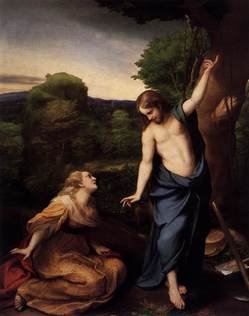
You too, if you keep watch daily at the doors of wisdom, steadfast at its threshold, if you stay awake through the night with Magdalen at the entrance of his tomb, if I am not mistaken you will experience with Mary how true are the words we read of the Wisdom which is Christ:

She is easily seen by those who love her and she is found by those who seek her. She anticipates those who desire her and shows herself to them first. He who, as soon as it is light keeps watch for her will not have to toil, for he will find her seated at his doors. (Wis. 6:13ff)

So did Christ, Wisdom himself, promise in the words: I love those who love me, and they who from early morning keep watch for me will find me. (Prov. 8:17) Mary found Jesus in the flesh. For this she was keeping watch. Over his tomb she had come to mount guard while it was still dark.

You, who no longer ought to know Jesus according to the flesh but according to the spirit, will be able to find him spiritually if you seek him with a like desire, if he finds you likewise vigilant in prayer.

Guerric of Igny
Liturgical Sermons
Third sermon for Easter

Blessed Peter Gonsalez

Almighty God, you bestowed the singular help of
Blessed Peter on those in peril from the sea. By the help of his prayers may
the light of your grace shine forth in all the storms of this life and enable
us to find the harbor of everlasting salvation.


Dominican friar and priest Blessed Peter was Spanish being born at the end of the 12th century. Ordained as a secular priest, Peter asked for the habit of the Friars Preachers and was known for his humility, prayer and service to his neighbor. Sailors call upon Blessed Peter as “Saint Elmo” and is invoked by travelers on difficult seas, especially missionaries traveling by such.

Blessed Margaret of Castello

Bl Margaret Castello.jpgCompassionate God, you gave your divine light to
Blessed Margaret who was blind from birth, that with the eye of her heart she
might contemplate you alone. Be the light of our eyes that we may turn from
what is evil and reach the home of never-ending light.


One of the great draws to Blessed Margaret is that holiness is not only found in those perceived to be “perfect” people. Quite the opposite. In Margaret, a lay Dominican sister, we a woman who gave her life to the Lord through the Dominican charism being particularly devoted to prayer and charitable work despite the fact that she was not like other people. God had blessed her in other ways. Blessed Margaret was born blind, lame, deformed and was a hunchback midget. She was abandoned by her parents after not getting their way with God. Blessed Margaret is incorrupt.

Among the things Blessed Margaret is vigilant against is poverty, destitution, and forms of injustice shown toward those living with physical handicaps. She is supportive of those people rejected by religious orders because of physical handicaps and works in favor of Pro-Life issues.

Vatican gives guidelines on sex abuse allegations

The Holy See has put in one spot on their webpage the numerous documents concerning the abuse of minors, and the Church’s response. Check it out. The documentation given here is crucial in understanding how the Church thinks and acts pastorally in view of sexual abuse of minors.

Of note is the “Guide to Understanding Basic CDF Procedures concerning Sexual Abuse Allegations.” The Congregation for the Doctrine of the Faith has listed for the average reader the basic nuts and bolts of how an allegation is handled today.

Conventual Franciscans meet in Chapter, prayers please

You may be wondering why I am asking you to send up some prayers for the Conventual Franciscans. This week two east coast Conventual Franciscan provinces are meeting in a provincial chapter to discuss matters pertaining to their life as Franciscans. A chapter meets every four years. This week the two provinces on the east coast of the USA are deciding by vote the merger of their provinces, no insignificant matter. May the Holy Spirit guide and protect the discussions!

The Conventual Franciscans arrived in the USA in the 19th century to work with the German and then Polish immigrant peoples You can read more their history here The Conventual Franciscans History.pdf. Fast forwarding through particular histories, about four years ago, the then Minister Provincial Father Canice Connors introduced the idea of merging the two east coast provinces, Immaculate Conception and Saint Anthony of Padua, into one; each province has about 100 men in each so we’re not talking about hugh numbers of men coming together like, for example, what the Jesuits are doing at the moment (they’re moving 10 provinces into 5). This merger will change the face of Conventual Franciscan life in the friaries and in the many dioceses where the friars serve in the East, especially in some New York and Connecticut dioceses.
You can also follow developments of the world-wide Conventual Franciscan movement on their website.
The witness of of the Franciscans is necessary for us today and we ought to sustain them by prayer and fraternal relations in their deliberations, today and in the days/years to come. As Pope Benedict mentioned in his Regina Caeli address of April 5, we need to be heralds to the world of God the Father’s great plan for the restoration of man: of God’s love for man and woman, our resurrection with Christ in glory. In baptism all Christian people are called to announce and to live the divine love; the charism passed down to us from Saint Francis through the Conventuals ought to do the same.

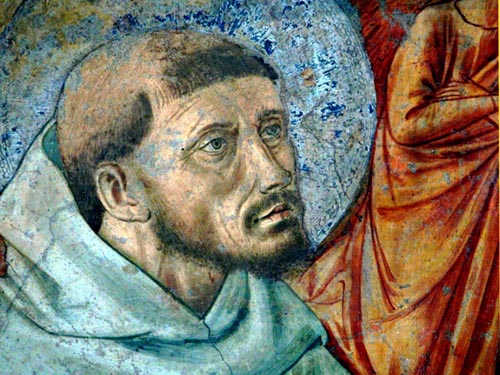
St Francis at table detail.jpg

Let me end but calling to mind Holy Father Saint Francis’ words to the Friars at the end of his Rule of life which I think may be appropriate for all of us to consider in for our prayer for the Conventuals (and for ourselves):
O most beloved brothers and sons forever blessed, hear me, hear the voice of your Father:
Great things we have promised;
greater have been promised us.
Let us observe the former;
let us aspire to the latter.
Pleasure is short;
punishment, everlasting.
Suffering is slight;
glory, infinite.
Many are called;
few are chosen.
Retribution for all.
Brethren, while we have time, let us do good.
May the Immaculate Virgin Mother of God, Saint Joseph, Saints Francis and Clare of Assisi, Saints Anthony of Padua and Maximilian Mary Kolbe, pray for a favorable outcome of this week’s chapter.

Yousif Habash as new bishop for Syrian Catholics elected

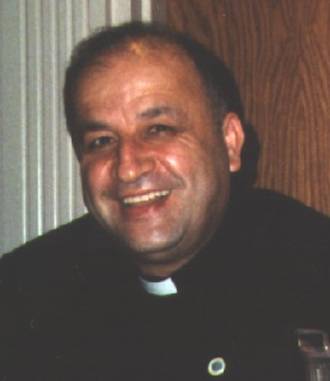
Habash.jpgThe Holy Father consented to the election of Chor-bishop Yousif (Joseph) Habash, pastor of the Church of the Sacred Heart of Jesus (Los Angeles) as 2nd bishop of the Eparchy of Our Lady of Deliverance (Newark) by the Patriarch and bishops of the Syrian Catholic Church.

Habash succeeds Bishop Joseph Younan (and read here) who was elected Patriarch of the Syrians in January 2009.

Bishop-elect Habash was born in Iraq in 1951 and ordained a priest in 1975. He’s served the US eparchy since 2001.
A 2004 census notes the Eparchy of Our Lady of Deliverance having 13,000 faithful.

Lombardi’s statement on clergy sex abuse


FLombardi.jpg

This past Friday (April 9) Jesuit Father Federico Lombardi, director
of the Vatican press office, spoke about the sexual abuse of minors. Remembering
that Father Lombardi is only the press director for the Vatican and not someone
who sets policy, this statement fine. It evokes some questions and it opens
conversation, in my opinion. I think it is necessary to read the address in its entirety because there are a number of points made therein that were not mentioned –no surprise– in the secular media. This is his statement as published by Vatican
Radio.

The debate concerning sexual abuse, and not only that committed by the
clergy, continues with news items and comments of various kinds. How can we
sail through these stormy waters while maintaining a secure course and
responding to the evangelical motto ‘Duc in altum’ — Put out into the deep?

In the first place, by continuing to seek truth, and peace
for the victims. One of the most striking things is that today so many inner
wounds are coming to light, wounds that also date to many years (sometimes
decades) ago, but evidently still open. Many victims do not seek financial
compensation but inner assistance, a judgment on their painful individual
experiences. There is something that we have yet to fully understand; perhaps
we need a more profound experience of events that have had such a negative
impact on the lives of individuals, of the Church and of society. One example
of this
, at the collective level, is the hatred and violence of conflicts
between peoples which are, as we see, so difficult to overcome in true
reconciliation
. Abuse opens wounds at a deep inner level. For this reason,
certain episcopates were right when they courageously resumed developing ways
and places in which victims could express themselves freely, listening to them
without taking it for granted that the problem had already been faced and
overcome by the workshops established sometime ago. For this reason also, other
episcopates and individual bishops were right to intervene paternally, showing
spiritual, liturgical and human concern for victims. It seems certain that the
number of new accusations of abuse is falling, as is happening in the United
States, but for many people the road to profound healing is only now beginning,
and for others it has yet to start
. In the context of this concern for victims,
the Pope has written of his readiness to hold new meetings with then, thus
sharing in the journey of the entire ecclesial community. But this journey, in
order to achieve profound effects, must take place in respect for people and
the search for peace.

Alongside concern for victims we must continue to
implement, decisively and truthfully, the correct procedures for the canonical
judgment of the guilty, and for collaborating with the civil authorities in
matters concerning their judicial and penal competencies, taking the specific
norms and situations of the various countries into account
. Only in this way
can we hope effectively to rebuild a climate of justice and complete trust in
the ecclesiastical institution. It has happened that a number of leaders of
communities and institutions, through inexperience or unpreparedness, have not
had a ready understanding of the protocols and criteria for intervention which
could have helped them intervene decisively even when this was very difficult or
painful for them, also because they were often surprised by the accusations.
But, while civil law intervenes through general norms, canon law must take
account of the specific moral gravity of an abuse of the trust placed in
persons who hold positions of responsibility within the ecclesial community
,
and of the flagrant contradiction with the conduct they should show. In this
sense, transparency and rigour are urgent requirements if the Church is to bear
witness to wise and just government.

The formation and selection of candidates
for the priesthood, and more generally of the staff of educational and pastoral
institutions, is the basis for an effective prevention of the risk of future
abuses. Achieving a healthy maturity of the personality, also from a sexual
point of view, has always been a difficult challenge, but today it is
particularly so, although the best psychological and medical knowledge is of
great help in spiritual and moral formation
. It has been observed that the
greatest frequency of abuses coincided with the most intense period of the
‘sexual revolution’ of past decades
. Formation must take account of this
context and of the more general context of secularisation. In the final
analysis, this means rediscovering and reaffirming the sense and importance of
sexuality, chastity and emotional relationships in today’s world, and doing so
in concrete, not just verbal or abstract, terms
. What a source of disorder and
suffering their violation or undervaluation can be! As the Pope observed in his
Letter to Irish Catholics, a Christian priestly life today can respond to the
requirements of its vocation only by truly nourishing itself at the wellspring
of faith and friendship with Christ.

People who love truth and the objective
evaluation of problems will know where to seek and find information for a more
overall comprehension of the problem of paedophilia and the sexual abuse of
minors in our time, in different countries, understanding its range and
pervasiveness. Thus they will be able to achieve a better understanding of the
degree to which the Catholic Church shares problems that are not only her own,
to what extent they have particular gravity for her and require specific
interventions, and, finally, the extent to which the experience the Church is going
through in this field may also be useful for other institutions or for society
as a whole. In this context, we truly feel that the communications media have
not yet worked sufficiently, especially in countries in which the Church has a
stronger presence and in which she is more easily subject to criticism
. Yet,
documents such as the national U.S. report on the mistreatment of children
deserve to be better known in order to understand what fields require urgent
social intervention, and the proportions of the problem. In the U.S.A. in 2008
alone
, 62,000 people were identified as having committed acts of abuse against
minors
, while the proportion of Catholic priests was so small as not to be
taken into consideration as a group.

The protection of minors and young people
is
, then, an immense and unlimited field, which goes well beyond the specific
problem concerning certain members of the clergy
. People who sensitively,
generously and attentively dedicate their efforts to this problem deserve
gratitude, respect and encouragement from everyone, especially from the
ecclesial and civil authorities. Theirs is an essential contribution for the
serenity and credibility of the education and formation of young people, both
inside and outside the Church. The Pope rightly expressed words of great
appreciation for them in his Letter to Irish Catholics, though naturally with a
view to a vaster horizon.

Finally, Pope Benedict XVI, a coherent guide along
the path of rigour and truth, merits all respect and support, testimony of
which is reaching him from all parts of the Church. He is a pastor well capable
of facing — with great rectitude and confidence — this difficult time in
which there is no lack of criticism and unfounded insinuations. It must be said
that he is a Pope who has spoken a lot about the Truth of God and about respect
for truth; and he has become a credible witness of this. We accompany him,
learning from him the constancy necessary to grow in truth and transparency,
continuing to open our horizons to the serious problems of the world and
responding patiently to the slow and gradual release of partial or presumed
‘revelations’ which seek to undermine his credibility, and that of other
institutions or individuals of the Church
.

This patient and solid love of truth
is necessary, in the Church, in the society in which we live, in communicating
and in writing, if we wish to serve rather than confuse our fellow men and
women.

Novena of Prayer for Pope Benedict

XVI and cross 19 Ap 05.jpgThe Knights of Columbus has begun a novena of prayer for Pope Benedict XVI beginning today, Divine Mercy Sunday, April 11, and ending on Monday, April 19, the anniversary of election as Supreme Pontiff. 2010 is the 5th anniversary of the Pope’s election.

Let us join in this time of prayer. The novena prayer is here.
Saints Joseph, Benedict, Peter and John Vianney, pray for us.