St Peter is the “absolute and reliable rock,” Fr Giussani told us


together with the pope.jpg

Today in Rome members of the various Catholic lay ecclesial movements
like Focolare, Sant’Egidio, Catholic Action and Communion and Liberation are
gathering in Rome as a sign of prayerful solidarity at the Regina Coeli address
of the Pope in Saint Peter’s Square. Indeed, in a sign of friendship and
obedience to the Successor of Saint Peter, Pope Benedict XVI. And as a sign of
this worldwide communion with the Pope, members of Communion and Liberation are
gathering in cities around the world in prayer for the Pope and the Church.

According to news about the event, about 150,000 people flooded Saint Peter’s Square. The Pope said that he was comforted by the “beautiful and spontaneous show of faith and solidarity.”

Here in New York, for example, CL is attending the Mass at Saint Patrick’s
Cathedral with Archbishop Timothy Dolan and will pray the rosary together.

To
understand these pious and fraternal gestures of CL, here are some thoughts of
Monsignor Luigi Giussani that may give a fuller appreciation of the
companionship of faith and brotherhood we all share.


father and daughter.jpg

Christianity is an
irreducible event, an objective presence that desires to reach man; until the
very end, it means to be a provocation to him, and to offer a judgment of him.
Jesus said to the Apostles after his Resurrection, “Behold, I am with you always,
even to the end of the world” (Mt 28:20).

Christianity will have a dramatic and
decisive bearing on man’s life only if it is understood in accordance with its
originality and its factual density, which, two thousand years ago, had the
form of a single man. Yet even when He was still living, he also had the face
of people whom he had brought together, and then sent out two by two, to do
what He had been doing, and what he had told them to do; they came back
together and returned to him. Later, united as one, this people went out to the
entire known world to present that Fact. The face of that single man today is
the unity of believers, who are the sign of him in the world, or as Saint Paul
says, who are his Body, his mysterious Body – also called “the people of God” –
guided and guaranteed by a living person, the Bishop of Rome.

If the Christian
fact is not recognized and grasped in its proper originality, it becomes
nothing more than a ponderous occasion for all sorts of interpretations and
opinions, or perhaps even for works; but then it lies alongside of or more
often subordinate to all of life’s other promptings.

(Religious Awareness in
Modern Man, Communio, vol. XXV, n.1, Spring 1998, pp. 134-135)

The supreme
authority is the one in which we find the meaning of all our experience. Jesus
Christ is this supreme authority, and it is His Spirit who makes us understand
this, opens us up to faith in Him and His person. “Just as the Father has sent
me so do I send you.” (See John 20:21) The apostles and their successors (the
Pope and the bishops) constitute, in history, the living continuation of the
authority who is Christ. In their dynamic succession in history and their
multiplication throughout the world, Christ’s mystery is proposed ceaselessly,
clarified without errors, defended without compromise. Therefore, they
constitute the place, like a reliable and effervescent spring, where humanity
can draw on the true meaning of its own existence, probing ever deeper. 
What
genius is to the cry of human need, what prophecy is to our cry of expectancy,
so the apostles and their successors are to announcing the response. But just
as the true answer is always perfectly specific and concrete with respect to
the expectancy which is inevitably vague and subject to illusions – so are
they, like an absolute and reliable rock, infallible: “You are Peter and on
this rock I shall build my Church.” (Matthew 16:17ff.)

B16 May 16 2010.jpg

Their authority not only
constitutes the sure criterion for that vision of the universe and history that
alone explains their (i.e., the universe’s and history’s) meaning; it is also
vital – it steadfastly stimulates a true culture and persistently points to a
total vision. It inexorably condemns any exaltation of the particular and
idealization of the contingent; that is, it condemns all error and idolatry.
The authority of the Pope and bishops, therefore, is the ultimate guide on the
pilgrimage towards a genuine sharing of our lives [convivenza], towards a true
civilization.

Where that authority is not vital and vigilant, or where it is
under attack, the human pathway becomes complicated, ambiguous, and unstable;
it veers towards disaster, even when on the exterior it seems powerful,
flourishing, and astute, as is the case today. Where that authority is active
and respected, the historic pilgrimage is confidently renewed with serenity; it
is deep, genuinely human, even when the expressive methods and dynamics of
sharing lives are roughshod and difficult.

Still today it is the gift of the
Spirit that allows us to discover the profound meaning of Ecclesiastical
Authority as a supreme directive on the human path. Here is the origin of that
ultimate abandonment and of that conscious obedience to it – this is why it is
not the locus of the Law but of Love. One cannot understand the experience of
that definitive devotion that binds the “faithful” to Authority without taking
into consideration the influence of the Spirit, and that devotion often affirms
itself on the Cross of a mortification of the drive of our own genius or our
plans for life.

(The Journey to Truth Is an Experience, Montreal:
McGill-Queen’s University Press 2006, pp. 73-75)

Saint Margaret of Cortona

St Margaret of Cortona.jpgHas God forgotten pity? Does he in his anger withold his compassion? This is my sorrow that the right hand of the Most High is changed, alleluia.


Heavenly Father, You take no pleasure in the death of the sinner but rather in the sinner’s conversion that he may live. As You mercifully drew Your servant Margaret from the path of damnation to the path of salvation, grant that we may serve You with pure hearts.


Read the story of this 13th century Third Order Franciscan penitent, Saint Margaret of Cortona, who sought to live in communion with Jesus, her Lord.

Christ’s new priests for NY and the CFRs

St Patrick's.jpg

Saint Patrick’s Cathedral was the setting of a beautiful Mass with the Rites of Ordination to the Priesthood for 10 men.
The cathedral was packed with people from the humble to the “great” to ask the Holy Spirit to come down upon the ordinandi making them priests.
New priests giving their blessings at Saint Joseph’s Seminary.
Fr TRoslak.jpg
The Reverend Father Thomas A. Roslak
Fr JFerreira & Eugene.jpg
The Reverend Father James H. Ferreira
Fr Fredy.jpg
The Reverend Father Fredy O. Patino Montoya
Fr Charles & Ransford.jpg
Father Charles-Benoit Reche, CFR
Eugene with Frs Sweeney & LaGrutta.jpg
Eugene with Father Luke Sweeney and
the new ordained The Reverend Father George La Grutta

Taking the Oath of Fidelity at St Joseph’s Seminary

Profession of Faith and Oath of Office.JPGThe Church asks those who are to be ordained and those who take an office of leadership to take an Oath of Fidelity. Pope John Paul II outlined the Church’s expectations her ministers in a 1998 motu proprio Ad Tuendam Fidem, and concretely expressed in the “Profession of Faith and The Oath of Fidelity on Assuming An Office to be Exercised in the Name of the Church.”

Cardinal Joseph Ratzinger’s commentary notes that the Church’s profession of faith has been received by the faithful, ordained and laity, as a P5130045[1].JPGline of continuity of what is authentically believed about the Blessed Trinity and the Church’s share in the life of the Trinity through the ages. The profession of faith and the propositions contained therein are testimonies of the Christian faith handed down through the millennia.

Essentially, the deacons who made their profession of faith and the oath of office tonight are witnesses of the truth of the resurrection of Christ not only as baptized Christians but very soon to be more closely connected to the work of Christ with their souls changed at the deepest part and signing the profession of faith and oath of office.JPGrecognized in heaven by the laying on of hands and the prayer of the bishop, as priests. The mandate of the profession and the oath recognizes that these deacons are called to serve humanity enlightened by Christ as missionaries of Christ to the City and the world for the express purpose of growth and life in Christ. Further, taking the oath tells us that they no longer teach their own word but THE Word, Jesus Christ.

Acknowledged this evening is the life-long desire to conform life to Christ crucified and risen guided by the teaching of the Church.All this is CFRs sign profession and oath.JPGmade possible by listening attentively to the Word of God and to tasting Him in the Eucharist, thus satisfying the sure yearnings of the human heart.

Here they begin to be more and more serious in preparing to make an account of the hope that they have known.


We are grateful for the photos taken by Esteban Sanchez, a second year theologian at Saint Joseph’s Seminary.

Consecration of a Paten and a Chalice at St Joseph’s Seminary

GT Walsh consecrating chalices2 May 14 2010.jpg

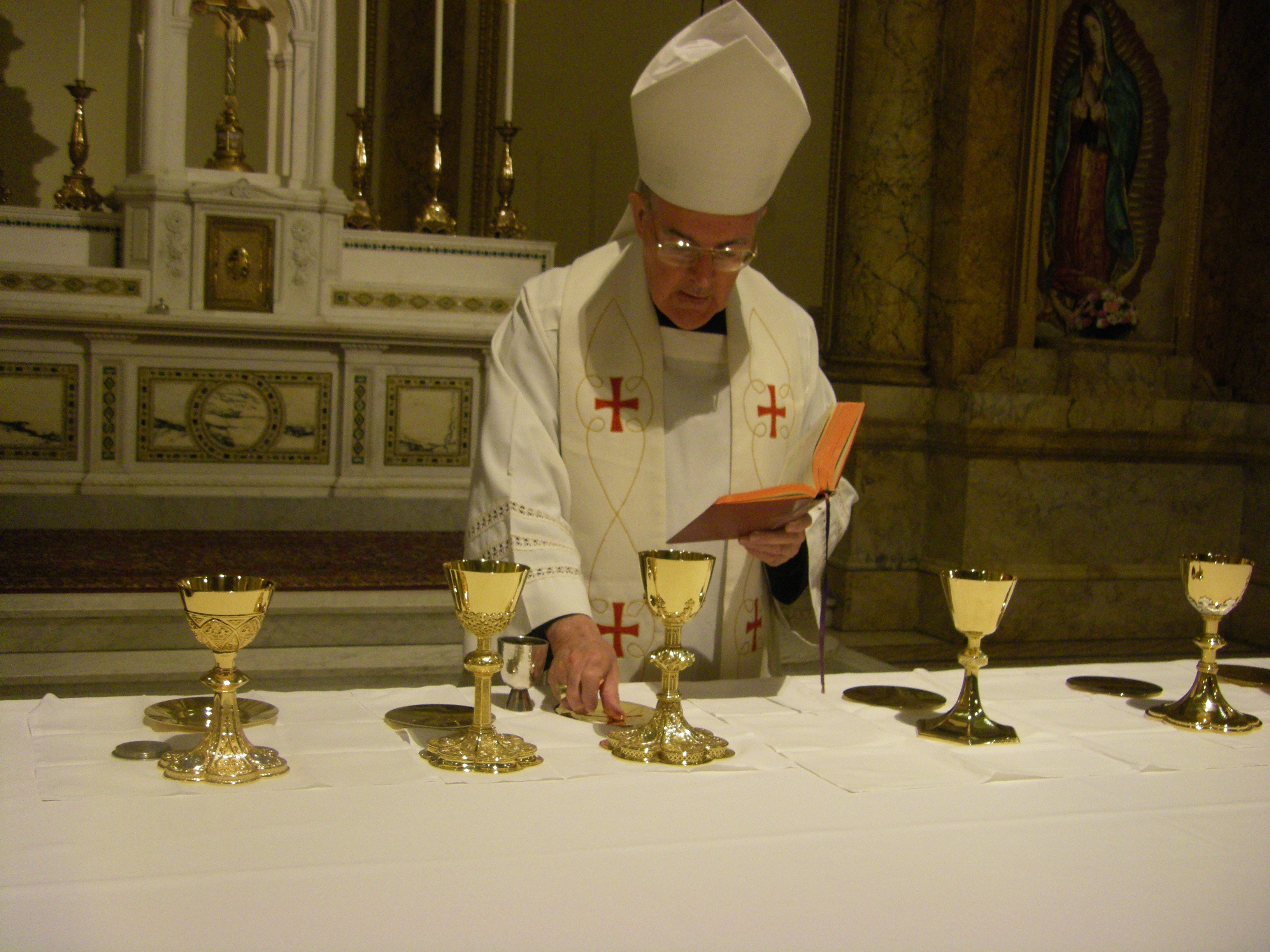
Today, following the last conference of our annual spiritual exercises, the Most Reverend Gerald T. Walsh, Rector of Saint Joseph’s Seminary, consecrated seven patens and chalices of those to be ordained priests tomorrow. That today is also the feast of Saint Matthias, an apostle, what a great day to consecrate chalices and patens.

It is important to note that while a priest can be delegated to consecrate these sacred items used for divine worship, the bishop, standing in the place of Christ with the fullness of priesthood, is the visible sign of unity with the Roman Pontiff. Moreover, the bishop is the chief liturgist and administrator of the sacraments in the diocese with all ministry, whether presbyteral or diaconal, oriented toward him for the salvation of God’s people. Hence, it is not merely a “nice” thing for the bishop to consecrate a priest’s paten and chalice, it is essential that he do it (if not impeded by some serious event) because of the nature of what is being done: living the sacramentality given to us by Christ himself. Catholics do not presume to do things on their own but they live in communion with the bishop, in harmony and order.

According to preparatory note, this consecration is typically done by a bishop but may be delegated to a priest. The consecration may take place on any day. The following are prepared: holy chrism and whatever materials necessary for cleansing and wiping the chalice and paten as well as the bishop’s hands. The chalice and paten should be placed on a table covered with a white-linen cloth or on the altar. It several chalices and patens are to be consecrated the bishop performs the anointings successively on each of them, but he says the orations only once and in the plural form. The bishop, standing and wearing the rochet, white stole, and gold-embroidered mitre, says:

Celebrant: Our help is in the name of the Lord.

All: Who made heaven and earth.

C: Let us pray, my dear brethren, that by the help of God’s grace this paten may be consecrated and hallowed for the purpose of breaking over the body of our Lord Jesus Christ, who suffered death on the cross for the salvation of us all.

Removing his mitre, says:

C: The Lord be with you.

All: May He also be with you.

C: Let us pray.

Almighty everlasting God, who instituted the laws of sacrifice, and ordered among other things that the sprinkled wheaten flour should be carried to the altar on plates of gold and silver; be pleased to bless, hallow, + and consecrate this paten, destined for the administration of the Eucharist of Jesus Christ, your Son, who for our salvation and that of all mankind chose to immolate Himself on the gibbet of the cross to you, God the Father, with whom He lives and reigns, forever and ever.

All: Amen.

Having put the mitre on, the bishop dips the thumb of his right hand into the holy chrism, anoints the paten from rim to rim in the form of a cross, then rubs the holy chrism all over the upper side of the paten saying:

GT Walsh consecrating chalices May 14 2010.jpg

Lord God, may you deign to consecrate and to hallow this paten by this anointing and our blessing, + in Christ Jesus our Lord, who lives and reigns with you forever and ever.

All: Amen.

Then he proceeds to the blessing of the chalice saying:

Let us pray, my dear brethren, that our Lord and God, by His heavenly grace and inspiration, may hallow this chalice, about to be consecrated for use in His ministry, and that He may add the fullness of His divine favor to the consecration performed by us; through Christ our Lord.

All: Amen.

Removing his mitre, says:

C: The Lord be with you.

All: May He also be with you.

GT Walsh consecrating chalices3 May 14 2010.jpgC: Let us pray.

O Lord our God, be pleased to bless + this chalice, made by your devout people for your holy service. Bestow that same blessing which you bestowed on the hallowed chalice of your servant, Melchisedech. And what we cannot make worthy of your altars by our craft and metals, do you nonetheless make worthy by your blessing; through Christ our Lord.

All: Amen.

With the mitre on, the bishop dips the thumb of his right hand into the holy chrism and anoints each chalice on the inside from rim to rim in the form of a cross saying:

Lord God, may it please you to consecrate and to hallow this chalice by this anointing and our blessing, + in Christ Jesus our Lord, who lives and reigns with you forever and ever.

All: Amen.

Removing his mitre, says:

C: The Lord be with you.

All: May He also be with you.

C: Let us pray.

Almighty everlasting God, we beg you to impart to our hands the virtue of your blessing, so that by our blessing + this vessel and paten may be hallowed and become, by the grace of the Holy Spirit, a new sepulchre for the body and blood of our Lord Jesus Christ; through Christ our Lord.

All: Amen.

The hands are now cleansed.

This rite is taken from the Roman Pontifical of 1962. It was published in Philip T. Weller’s 1964 The Roman Ritual: Complete Edition (the one volume). Thanks continuously goes to God for the fine work that Father Weller did for the Church is pulling together Roman Ritual in English.

Priest’s Prayer of Consecration to the Immaculate Heart of Mary

Today, the Holy Father who is making a pilgrimage to the Shrine of Our Lady of Fatima (Portugal) made this consecration of for himself and all priests to the Blessed Mother, Mother of God, Mother of Priests, Mother of the Blessed Sacrament. The Pope’s prayer is presented here for all priests to pray at the Mary Altar.

Immaculate Mother, in this place of grace, called together by the love of your Son Jesus
the Eternal High Priest, we, sons in the Son and his priests, consecrate ourselves to your maternal Heart, in order to carry out faithfully the Father’s Will.

B16 & BVM.jpg

We are mindful that, without Jesus, we can do nothing good (cf. Jn 15:5) and that only through him,with him and in him, will we be instruments of salvation for the world.

Bride of the Holy Spirit, obtain for us the inestimable gift of transformation in Christ. Through the same power of the Spirit that overshadowed you, making you the Mother of the Savior, help us to bring Christ your Son to birth in ourselves too. May the Church be thus renewed by priests who are holy, priests transfigured by the grace of him who makes all things new.

Mother of Mercy, it was your Son Jesus who called us to become like him: light of the world and salt of the earth (cf. Mt 5:13-14).

Help us, through your powerful intercession, never to fall short of this sublime vocation, nor to give way to our selfishness, to the allurements of the world and to the wiles of the Evil One.

Preserve us with your purity, guard us with your humility and enfold us with your maternal love that is reflected in so many souls consecrated to you, who have become for us true spiritual mothers.

Mother of the Church, we priests want to be pastors who do not feed themselves but rather give themselves to God for their brethren, finding their happiness in this. Not only with words, but with our lives, we want to repeat humbly, day after day, our “here I am.”

Guided by you, we want to be Apostles of Divine Mercy, glad to celebrate every day the Holy Sacrifice of the Altar and to offer to those who request it the sacrament of Reconciliation.

Advocate and Mediatrix of grace, you who are fully immersed in the one universal mediation of Christ, invoke upon us, from God, a heart completely renewed that loves God with all its strength and serves mankind as you did.

Repeat to the Lord your efficacious word: “They have no wine” (Jn 2:3), so that the Father and the Son will send upon us a new outpouring of the Holy Spirit. Full of wonder and gratitude at your continuing presence in our midst, in the name of all priests I too want to cry out: “Why is this granted me, that the mother of my Lord should come to me?” (Lk 1:43).

Our Mother for all time, do not tire of “visiting us”, consoling us, sustaining us.  Come to our aid and deliver us from every danger that threatens us.  With this act of entrustment and consecration, we wish to welcome you more deeply, more radically, for ever and totally into our human and priestly lives.

Let your presence cause new blooms to burst forth in the desert of our loneliness, let it cause the sun to shine on our darkness, let it restore calm after the tempest, so that all mankind shall see the salvation of the Lord, who has the name and the face of Jesus,
who is reflected in our hearts, for ever united to yours!

Amen.

My Mother Saint Gianna: an evening of conversation & prayer with a saint’s son


Gianna with children Pierluigi & Mariolina.jpg

This coming Monday,
May 17
, the Church of St Catherine of Siena in Manhattan will host a lecture by
Pierluigi Molla, the son of St Gianna Berretta Molla, as part of an evening of prayer
for couples struggling with infertility.

Please
join the physicians and staff of The Gianna Center
for Women
 this Monday, May 17 at 6:30 pm for a special Mass,
offered for the intentions of couples struggling with infertility and
pregnancy-related miscarriages.

The Mass will be
followed by a talk by Pierluigi Molla, the living son of St. Gianna Beretta Molla and
an opportunity to view and venerate her relics.

Location: St.
Catherine of Siena Church, 411 East 68th Street, NY (between 1st Ave and York)


Schedule of
Events


6:30 pm   Mass,
offered for the intentions of couples suffering from infertility, recurrent
miscarriage and difficult pregnancies

7:30 pm   Talk by
Pierluigi Molla, son of St. Gianna

8:15 pm   Blessing
with St. Gianna’s relics

8:30 pm Light
reception and book signing


Physicians from
The Gianna Center in midtown Manhattan, which offers a highly effective,
ethically-sound approach to treating infertility, will also be present to
answer questions and offer support.

Ascension Thursday: What is the Church’s teaching?


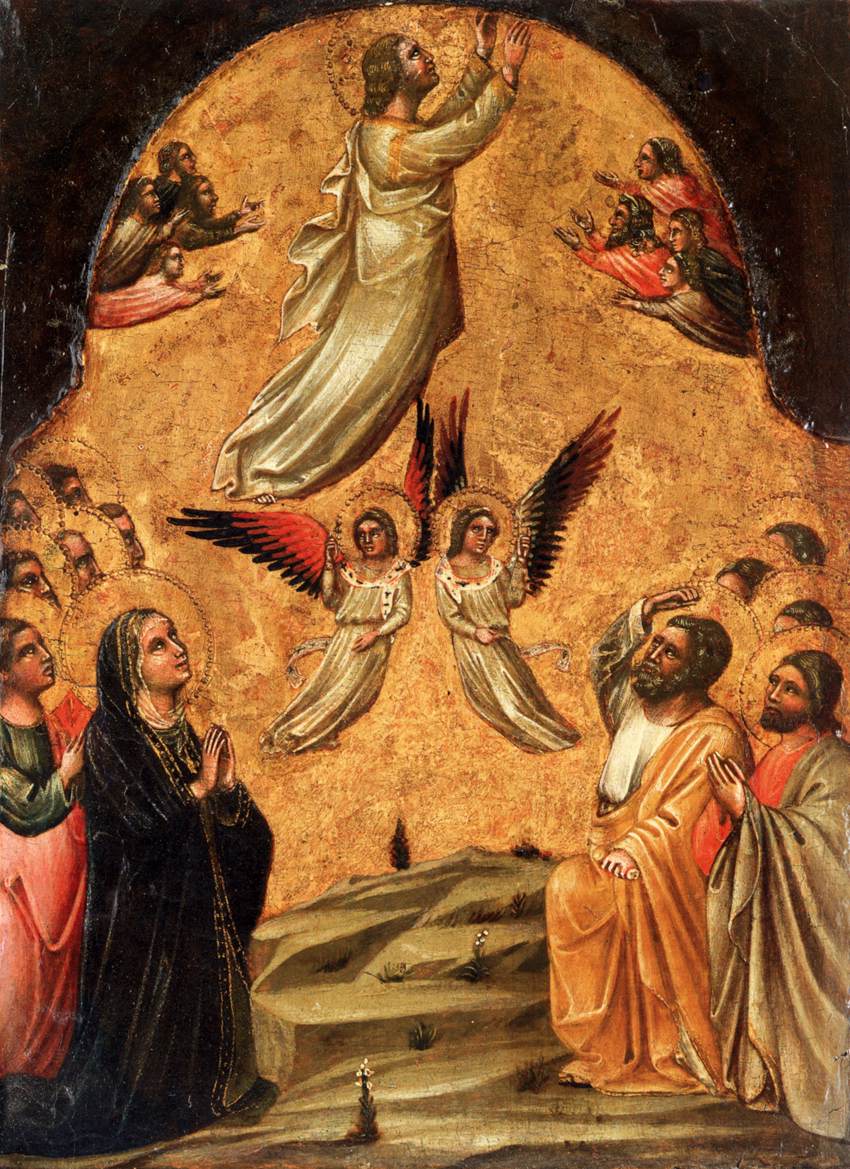
Ascension Gd'Arpo.jpg

What is the consistent, clear teaching of the Church, that
is, what has been taught down through the ages, about the Ascension of the Lord? What does it
mean for the Lord to “ascend” to the right hand of God the Father? Does he actually go up into the heavens? 

The Gospel
of Luke tells us that Jesus blessed his disciples and then “parted from them and
was taken up to heaven.” And the Acts of the Apostles tells us that the
disciples witnessed the Lord’s ascension. So, the Scripture relate to us that
Jesus’ ascension was a public act which we too, follow according the Father’s
will.

Let me be crystal clear about the teaching: the ascension of the Lord is
not only concerned with Christ’s humanity; the ascension of the Lord is also
about our humanity ascension to God’s right hand in glory.

You will want to read–NO, you must read and re-read Credo for Today by Joseph Cardinal Ratzinger (Benedict XVI) pp 90-94. It is the best of the Church’s contemporary theological reflections on this point of our faith.

Pope Saint Leo the Great (+461)
taught, “Truly it was a great and indescribable source of rejoicing when, in
the sight of the heavenly multitudes, the nature of our human race ascended over
the dignity of all heavenly creatures, to pass the angelic orders and to be
raised beyond the heights of archangels. In its ascension it did not stop at
any other height until this same nature was received at the seat of the eternal
Father, to be associated on the throne of the glory of that One to whose nature
it was joined in the Son” (from a homily on 1 June 444).

And just a year later Saint Leo says, “This Faith, reinforced by the Ascension of the Lord and
strengthened by the gift of the Holy Spirit, has not been terrified by chains,
by prison, by exile, by hunger, by fire, by the mangling of wild beasts, nor by
sharp suffering from the cruelty of persecutors. Throughout the world, not
only men but also women, not just immature boys but also tender virgins, have
struggled on behalf of this Faith even to the shedding of their blood. This
Faith has cast out demons, driven away sicknesses, and raised the dead” (from a homily on 17 May
445).

In the Catechism of the Catholic Church we read, “This final stage stays
closely linked to the first, that is, to his descent from heaven in the
Incarnation. Only the one who ‘came from the Father’ can return to the Father:
Christ Jesus. ‘No one has ascended into heaven but he who descended from
heaven, the Son of man.’ Left to its own natural powers humanity does not have
access to the ‘Father’s house’, to God’s life and happiness. Only Christ can
open to man such access that we, his members, might have confidence that we too
shall go where he, our Head and our Source, has preceded us” (661).

Blessed Imelda Lambertini

Blessed Imelda Lambertini.jpgLord Jesus Christ, you received into heaven Blessed Imelda who loved you in the eucharistic banquet. By her prayers may we learn to approach your holy table with that same fervent love and so fulfill our longing to be with you, who live and reign with the Holy Spirit, one God, for ever and ever.

Blessed Imelda (1322-1333) is the patroness of young people receiving their First Holy Communion. An apt saint to ask for intercession from during this time of the year when so many young people are receiving the eucharistic Lord. Imelda entered the convent at age 9 but couldn’t receive Holy Communion until see was 14, on the vigil of the Ascension; she died immediately thereafter in perfect communion with the Lord.