The task of science was AND remains a patient, passionate search for truth about the cosmos, nature, the constitution of the human being, Pope tells us
For those who think that the Catholic Church, orthodox Catholic theology, the Pope, or any right-thinking Catholic person in the 21st century is against science: think again. Take your head out of the sand; do some reading. Today, His Holiness address the distinguished members of the Pontifical Academy of Sciences meeting for their plenary assembly. The theme they’ve chosen to explore is “The Scientific Legacy of the Twentieth Century.”
Two papal hopes for future scientists: “the need for an interdisciplinary approach tied with philosophical reflection” and that the work of science “always be informed by the imperatives of fraternity and peace, helping to solve the great problems of humanity, and directing everyone’s efforts towards the true good of man and the integral development of the peoples of the world.”
Benedict addressed the following text to 80 scientists:
The history of science in the twentieth century is one of
undoubted achievement and major advances. Unfortunately, the popular image of
twentieth-century science is sometimes characterized otherwise, in two extreme
ways. On the one hand, science is posited by some as a panacea, proven by its
notable achievements in the last century. Its innumerable advances were in fact
so encompassing and so rapid that they seemed to confirm the point of view that
science might answer all the questions of man’s existence, and even of his
highest aspirations. On the other hand, there are those who fear science and
who distance themselves from it, because of sobering developments such as the
construction and terrifying use of nuclear weapons.
Science, of course, is not
defined by either of these extremes. Its task was and remains a patient yet
passionate search for the truth about the cosmos, about nature and about the
constitution of the human being. In this search, there have been many successes
and failures, triumphs and setbacks. The developments of science have been both
uplifting, as when the complexity of nature and its phenomena were discovered,
exceeding our expectations, and humbling, as when some of the theories we
thought might have explained those phenomena once and for all proved only
partial. Nonetheless, even provisional results constitute a real contribution
to unveiling the correspondence between the intellect and natural realities, on
which later generations may build further.
The progress made in scientific
knowledge in the twentieth century, in all its various disciplines, has led to
a greatly improved awareness of the place that man and this planet occupy in
the universe. In all sciences, the common denominator continues to be the notion
of experimentation as an organized method for observing nature. In the last
century, man certainly made more progress – if not always in his knowledge of
himself and of God, then certainly in his knowledge of the macro- and
microcosms – than in the entire previous history of humanity. Our meeting here
today, dear friends, is a proof of the Church’s esteem for ongoing scientific
research and of her gratitude for scientific endeavour, which she both
encourages and benefits from. In our own day, scientists themselves appreciate
more and more the need to be open to philosophy if they are to discover the
logical and epistemological foundation for their methodology and their
conclusions. For her part, the Church is convinced that scientific activity
ultimately benefits from the recognition of man’s spiritual dimension and his
quest for ultimate answers that allow for the acknowledgement of a world
existing independently from us, which we do not fully understand and which we
can only comprehend in so far as we grasp its inherent logic. Scientists do not
create the world; they learn about it and attempt to imitate it, following the
laws and intelligibility that nature manifests to us. The scientist’s
experience as a human being is therefore that of perceiving a constant, a law,
a logos that he has not created but that he has instead observed: in fact, it
leads us to admit the existence of an all-powerful Reason, which is other than
that of man, and which sustains the world. This is the meeting point between the
natural sciences and religion. As a result, science becomes a place of
dialogue, a meeting between man and nature and, potentially, even between man
and his Creator.
As we look to the twenty-first century, I would like to
propose two thoughts for further reflection. First, as increasing
accomplishments of the sciences deepen our wonder of the complexity of nature,
the need for an interdisciplinary approach tied with philosophical reflection
leading to a synthesis is more and more perceived. Secondly, scientific
achievement in this new century should always be informed by the imperatives of
fraternity and peace, helping to solve the great problems of humanity, and
directing everyone’s efforts towards the true good of man and the integral
development of the peoples of the world. The positive outcome of twenty-first
century science will surely depend in large measure on the scientist’s ability
to search for truth and apply discoveries in a way that goes hand in hand with
the search for what is just and good.
Subjected to the spirit, the body will be sexual in eternal life, according to Aquinas
The liturgical year of the Church brings to the front burner of the spiritual life a number of things at this time of year: questions about salvation, death, hell, heaven, purgatory, Christ’s kingship, conversion, and the like. In fact, a central piece of our spiritual work in the School of Community (of Communion and Liberation) right now is understanding what it means to convert, to live in spirit of conversion, to live as though we REALLY believe in Christ, turning away from sin, and turning toward the Lord. Father Julian Carron is hitting members of Communion and Liberation pretty hard with the call to conversion. However, if truth be told, Father Carron is taking his cue from Pope Benedict. Nevertheless, on the human level, for finite beings we have to be concerned with such things because we don’t live forever, just in case you didn’t know this fact; we are rightly concerned now because once we’re dead, there is no way of making a conversion (sorry, there is no reincarnation).
A professor at the Institute of Philosophy and Theology of Shkodër (Albania), Jesuit Father Mario Imperatori, wrote an essay that caught my eye, “Eschatology and Resurrection of the Body in St. Thomas Aquinas,” published in the current issue of La Civiltà Cattolica (issue # 3849; pp. 257-268). As you know, this periodical is reviewed by the Secretary of State of the Holy See prior to publication.
In the article, Father Imperatori argues, “St. Thomas’s doctrine regarding glorified bodies
is based on the resurrection of the flesh, interpreted in an
anti-spiritualistic manner. For him, in fact, the intellectual soul is the
unique and subsisting shape of the human being; after the resurrection carried
out by God, the body too will share with the soul the same incorruptibility and
bliss; it will be a spiritual body not because it becomes spirit, but because
everything will be subjected to the spirit. Aquinas adds that the human body,
because of its wholeness, will continue to be sexual, despite the absence of
procreation. The Eschatology of St. Thomas has proven controversial, but it has
the merit of asserting the bodily-spiritual reality of man as the ultimate
purpose of creation.”
So, the human body will relate as a sexual being in the eternal life. Interesting. Thanks for letting me know. What joy that will be, don’t you think? I wonder what relating sexually means for a glorified body.
Saints Simon and Jude
Faith in Christ’s Divine Merits
Some friends and I at the parish have been reading a series of Pope Benedict’s homilies on the Eucharist taken from his book, God is Near Us. I recommend paying attention to every page of this small collection of Benedict’s. Reading through some meditations of Blessed Columba Marmion, the famed Benedictine monk and spiritual master struck me. He wrote,
Synod of Bishops for the Middle East submit propositions to Pope for his consideration
The bishops at the Synod of Bishops for the Middle
East have given the Holy Father the following propositions for his
consideration and perhaps for him to act on when he issues a post-synodal
document. The Synod is now closed and the bishops are on their way home and now it’s time for the Pope and his consultors to do some heavy lifting. The publication of the propositions was approved by the Pope, though they remain unofficial. Some of the propositions are formal, pro-forma and many are so boring
that watching the grass grow is fun.
plate or what I take to be normal, e.g., financial transparency, providing
information in Arabic, being hospitable to immigrants, listening to youth, etc.
Also, what’ve given here you can get a sense of what the churches face in their
situation. What’s evident to a Westerner is that our context in North America is a bit
more advanced, dare I say, than the situation many Middle Eastern Christians face. We already have experience of good
education, dialogue, fruitful collaboration with other faiths, developed
canonical processes. The propositions do raise the point of concern for our sisters and brothers who are Christians in the Middle East.
consideration for a common date for Easter and a better awareness of the role
of the sacred Liturgy in the life of the churches.
Praying for the dead, All Souls
Dominican Sisters of Mary, Mother of the Eucharist to purchase JPII Cultural Center in DC
Mother Assumpta Long announced last evening that her new congregation of religious sisters, the Dominican Sisters of Mary, Mother of the Eucharist, are hoping to purchase the Pope John Paul II Cultural Center across the street from the Catholic University of America, Washington, DC and using the facility as a house of studies.
Talking about Saint Mary of the Cross MacKillop
A record number of Australians flocked to Rome last week to attend to the Mass and rites of canonization celebrated by Pope Benedict of 6 people, among them was Australia’s first saint, Sister Mary of the Cross MacKillop. While many will make her the patron saint of the former ex-communicate, she is for me an example of staying faithful to Christ even when ecclesiastics are unusually harsh in their pastoral judgment. For Saint Mary of the Cross for us too, Jesus told us that upon Peter is the Church built; and that’s how we follow Christ: by remaining on that Rock. As her own religious name indicates, “of the Cross,” we ought to carry our cross but with Christ helping us. We don’t go through life alone!!!! The Lord is there with us, right now.
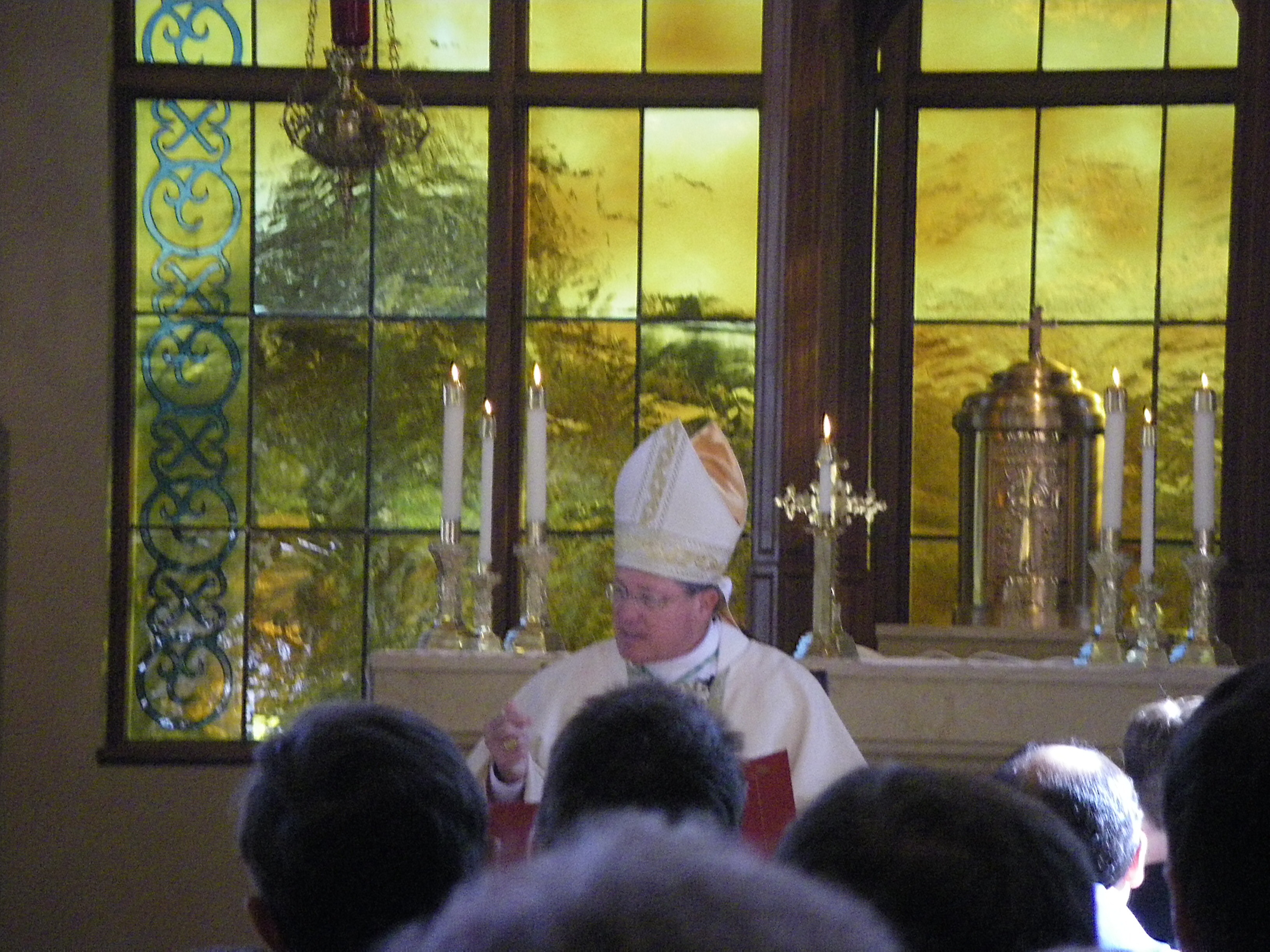
27 Holy Apostles Seminarians take steps toward priesthood
Jesus says to his disciples, ask the Lord to send workers into his harvest (MT 9:38).