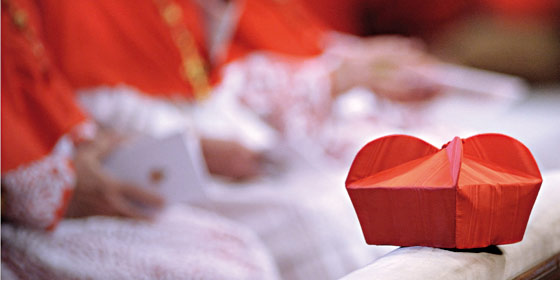
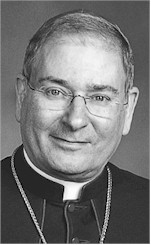
The tradition is that when a cardinal is made by the pope, the cardinal becomes a priest of the Diocese of Rome. As members of the Roman clergy, he receives a church, though now in title only, (which he vicarious takes care of by finding the funding for projects), and has the responsibility of entering a conclave to elect a new pope and when asked, to provide his consultation on certain topics.
Christian faith breaks myth that the totality of state gives hope & gives humanity a true and good world-view
Getting to the point of thinking more intelligently and from a Christian point of view about the feast of Christ the King and its relevance today, I think we ought to consider what Cardinal Joseph Ratzinger (now Pope Benedict) said about politics and human dignity viz. faith in Jesus Christ.
& the state:
encompass all human hope. Man and what he hopes for extend beyond the framework
of the state and beyond the sphere of political action. This is true not only
for a state like Babylon, but for every state. The state is not the totality;
this unburdens the politician and at the same time opens up for him the path of
reasonable politics. The Roman state was wrong and anti-Christian precisely
because it wanted to be the totality of human possibilities and hopes. A state
that makes such claims cannot fulfill its promises; it thereby falsifies and
diminishes man. Through the totalitarian lie it becomes demonic and
tyrannical.”
in being happy in this world:
earthly paradise or utopian state and of a society without rule. In its place
it put the objectivity of reason… True human objectivity involves humanity, and
humanity involves God. True human reason involves morality, which lives on
God’s commandments. This morality is not a private matter; it has public
significance. Without the good of being good and of good action, there can be
no good politics. What the persecuted Church prescribed for Christians as the
core of their political ethos must also be the core of an active Christian
politics: only where good is done and is recognized as good can people live
together well in a thriving community. Demonstrating the practical importance
of the moral dimension, the dimension of God’s commandments — publicly as well
— must be the center of responsible political action.”
NOW there’s 24 new cardinals of the Roman Church
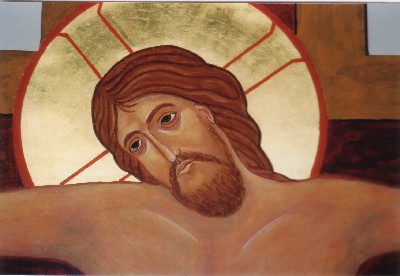
Christ the King
“If to Christ our Lord is given all power in heaven and
on earth; if all men, purchased by his precious blood, are by a new right
subjected to his dominion; if this power embraces all men, it must be clear
that not one of our faculties is exempt from his empire. He must reign in our
minds, which should assent with perfect submission and firm belief to revealed
truths and to the doctrines of Christ. He must reign in our wills, which should
obey the laws and precepts of God. He must reign in our hearts, which should
spurn natural desires and love God above all things, and cleave to him alone.
He must reign in our bodies and in our members, which should serve as
instruments for the interior sanctification of our souls, or to use the words
of the Apostle Paul, as instruments of justice unto God” (Romans 6:13).
The Pope & his cardinals met today
Billed my some as extra-ordinary, but likely seen by insiders as ordinary, Pope Benedict met with his cardinals and the new cardinals –24 of them– he intends to make tomorrow, in a forum where information is exchanged and consultation given. The meeting of Pope and cardinals was conducted in the context of prayer. Prayer and exchange, not the making of decisions was the format. It is estimated that about 150 of the worlds 203 cardinals met today. Topics ranged from the sacred Liturgy and religious freedom, but also the exercise of religion, secularism, conversion and entering into full communion with the Catholic Church to healthcare. Since this is also the 10th anniversary of Dominus Iesus, the document which recalls that salvation comes uniquely and universally through the person of Jesus Christ, the Pope and cardinals will reflect on the impact this document has made since its publication.
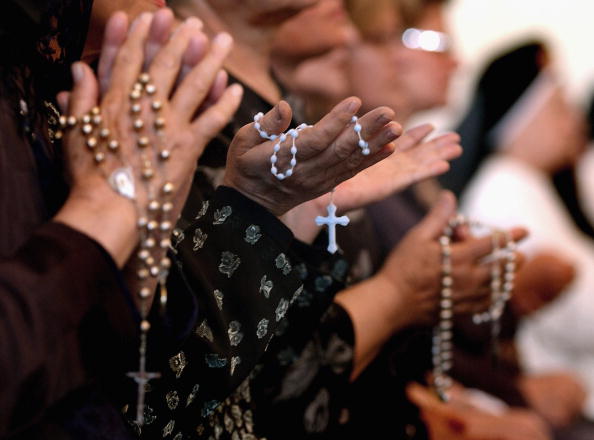
Communion & Liberation invites prayer for Iraqi Christians on Sunday
Communion and Liberation follows the call of the
Italian bishops to pray Sunday, November 21 for the Christians of Iraq, “who
are suffering the tremendous trial of blood witness to the faith” (Final
communiqué of the Assembly of the Italian Episcopal Conference, November 11, 2010).
Movement invites all its members to participate in Mass according to the
intentions of Benedict XVI, who the day after the grave attack in the Syrian
Catholic cathedral of Baghdad that left dozens dead and wounded, said, “I pray
for the victims of this absurd violence, all the more savage because it struck
defenseless people gathered in God’s house, which is a house of love and
reconciliation. I also express my affectionate closeness to the Christian
community, struck once again, and encourage the pastors and faithful to be
strong and steady in hope. In the face of the heinous episodes of violence that
continue tearing the populations of the Middle East to pieces, I renew my
grieved call for peace: it is the gift of God, but also the result of the
efforts of people of good will, of national and international institutions. May
everyone join their strengths to put an end to all violence! (Comments after
the Angelus, November 1, 2010).
Liberation, Fr. Julián Carrón said that “participation in Sunday Mass according
to the intentions of the Pope and the bishops is a gesture of real communion
and charity because we feel that the Christians of Iraq are our friends, even
if we do not know them directly.”
accepting the circumstances of life, as they happen, because they make us
correspondent, participants in the death of Christ, then sacrifice becomes the
keystone of all life […] but also the keystone for understanding the history of
man. The entire history of man depends on that man dead on the cross, and I can
influence the history of man – I can influence the people who live in Japan
now, the people in danger at sea now; I can intervene to help the pain of the
women who lose their children now, in this moment – if I accept the sacrifice
that this moment imposes.” (L. Giussani, Is It Possible to Live This Way? Book
3: Charity, McGill-Queen’s University Press, pp. 74-75.)
Carrón, “if a gesture of prayer can influence the change of people in Japan, it
can also change something in Iraq. May the sacrifice we make for the Christians
of Iraq and Sunday’s prayer be a gesture with which we invoke, implore from God
protection for them.”
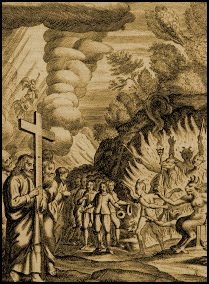
Confronting the Devil– one of the Church’s greatest needs
With last the announcement last week about a study session of the new Rite of Exorcism seemingly many peoples’ interest in the devil and evil soared. But I wonder if we all know the implications of having an interest in the “devil and evil” means. What it means is that we are in a spiritual battle with evil, a fact that is being spoken of more and more.
What are the Church’s greatest needs at the present time? Don’t be surprised at Our answer and don’t write it off as simplistic or even superstitious: one of the Church’s greatest needs is to be defended against the evil we call the Devil.
Continue reading Confronting the Devil– one of the Church’s greatest needs
Serratelli updates US Bishops on the translation of the new Roman Missal
The out-going chairman of the bishops’ Committee on Divine Worship, Bishop Arthur Serratelli of Paterson, gave the following update to the USCCB today. Bishop Serratelli is now succeeded by the Archbishop of New Orleans, the Most Reverend Gregory M. Aymond. The USCCB press release is here.
surfaced through some segments of the Catholic Press regarding the present
state of the text of the Roman Missal, Third Edition. A number of facts will
hopefully clarify the situation and, in so doing, give us the calm needed to
welcome and implement the new text.
genesis of the final text that is now being prepared for publication. The International
Commission on English in the Liturgy (ICEL) prepared for the English-speaking
Conferences of Bishops preliminary drafts (“green books”) of the 12 sections of
the Roman Missal. After incorporating the feedback and responses of the
individual Conferences of Bishops and the Vatican Congregation for Divine
Worship and the Discipline of the Sacraments, ICEL then prepared the final
drafts (“gray books”). These were approved by canonical vote by each of the
member Conferences. In approving the gray books, each conference also had the
opportunity to make further suggestions to the Congregation, as was done in
particular by our Conference. We submitted many amendments to the texts. The
Congregation, working with the Vox Clara Committee, carefully listened to what
the bishops said. The Congregation incorporated many of the suggestions of the
various Conferences (including our own), combined with their own review and
changes, and put forth the final text. The Congregation followed the principles
of Liturgiam Authenticam faithfully but not slavishly.
now being readied for publication. This process includes a final review and
copy edit which, given the size of the text, uncovers some minor questions of
consistency, typographical errors, and layout. Those questions are being
addressed by the Congregation for Divine Worship. This review has not dealt
with the translation itself. The critique that has circulated has necessarily
failed to take into account the final version of the text, which incorporates
some corrections issued by the Congregation since the transmittal of the full
text to the English-speaking Conferences of Bishops in August 2010.
there is a final text. It has received a recognitio. As the work of editing and
assembling nears completion, there is assurance that the published text will be
available in more than ample time for implementation in Advent 2011. It is good
to note also that the catechetical preparation for implementation is already
underway and has proceeded with much enthusiasm and wide acceptance by both
clergy and laity. It is clear at this point in time that there is an attitude
of openness and readiness to receive the new text. Let us pray in this time of
transition and change that the Roman Missal, Third Edition, will enable all to
understand more deeply the mysteries we celebrate.
Benedict and Rowan
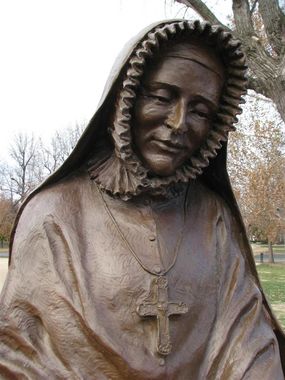
Saint Rose Philippine Duchesne
Saint Rose Philippine was called “the woman who is always praying.” Her singular focus on Christ and the mission won her esteem among those who found the Christian Gospel foreign. She is buried in St. Charles, MO, having died there on this date in 1852 at the age of 83. She lived the Lord’s parable of the Pearl of Great Price.
Beatified by Pope Pius XII in 1940 and canonized by Pope John Paul II in 1988, Duchesne is the US founder of the Society of the Sacred Heart, an order of religious women who were first founded in France by Saint Madeleine Sophie Barat.