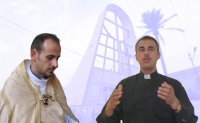
There is a movement afoot to investigate the sanctity of those Christians killed in Iraq just for being Christian, perhaps leading to having these Christians being canonized saints. Interesting question…
Obama’s new rules for Faith-Based Initiatives
President Obama revised 2001 faith based initiatives established by President George W. Bush with “Fundamental Principles and Policymaking Criteria for Partnerships with Faith-Based and Other Neighborhood Organizations” on November 17, 2010.
Continue reading Obama’s new rules for Faith-Based Initiatives
Bishop Richard Williamson given ultimatum by SSPX
The Superior General, Bishop Bernard Fellay, has
learnt by the press of Bishop Richard Williamson’s decision, just ten days
before his trial, to dismiss the lawyer charged with his defense, in favor of a
lawyer who is openly affiliated to the so-called neo-Nazi movement in Germany,
and to other such groups.![]()
order to go back on this decision and to not allow himself to become an
instrument of political theses that are completely foreign to his mission as a
Catholic bishop serving the Society of Saint Pius X.
would result in Bishop Williamson being expelled from the Society of Saint Pius
X.
UK Bishops speak on new Anglican Ordinariate
The events in Rome these past days have distracted some from mentioning the Bishops of England and Wales’ statement on the apostolic constitution of November 4, 2009, “Anglicanorum coetibus.” To date, this is the clearest statement of the UK Bishops’ intention to positively respond to the Pope’s generous gesture of working with Anglicans who themselves desire to respond more generously to Christ’s call to discipleship and mission.
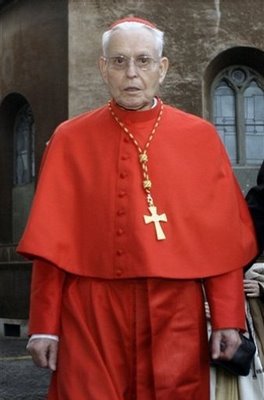
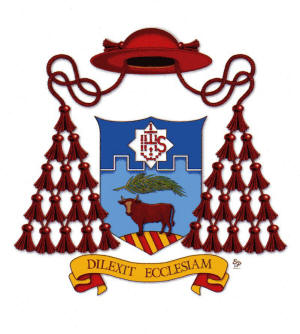
Urbano Cardinal Navarrete Cortés, SJ, RIP
Urbano Cardinal Navarrete Cortés, SJ, 90, died today. The Mass of Christian Burial is scheduled for November 24; the Dean of the College of Cardinals, Angelo Cardinal Sodano will celebrate the Sacrifice of the Mass and His Holiness will preside over the Final Commendation and give a valediction.
Saint Cecelia, Virgin & Martyr
The encounter with the beautiful can become the wound
of the arrow that strikes the heart and in this way opens our eyes, so that
later, from this experience, we take the criteria for judgment and can
correctly evaluate the arguments. For me an unforgettable experience was the
Bach concert that Leonard Bernstein conducted in Munich after the sudden death
of Karl Richter. I was sitting next to the Lutheran Bishop Hanselmann. When the
last note of one of the great Thomas-Kantor-Cantatas triumphantly faded away,
we looked at each other spontaneously and right then we said: “Anyone who
has heard this, knows that the faith is true.” The music had such an
extraordinary force of reality that we realized, no longer by deduction, but by
the impact on our hearts, that it could not have originated from nothingness,
but could only have come to be through the power of the Truth that became real in
the composer’s inspiration. (Message to Communion and Liberation, August 2002,
Rimini, Italy; text available May 2, 2005, Zenit.org)
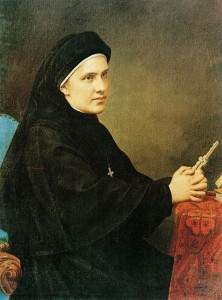
Blessed Mary of Jesus the Good Shepherd (Frances Siedliska)
Prayer to Christ the King
O Jesus Christ, I acknowledge Thee as universal King.
All that has been made, has been created for Thee. Exercise all Thy rights over
me. I renew my baptismal vows, renouncing Satan, his pomp and his works; and I
promise to live as a good Christian. In particular do I pledge myself to labor,
to the best of my ability, for the triumph of the rights of God and Thy Church.
Heart of Jesus, to Thee do I proffer my poor services, laboring that all hearts
may acknowledge Thy Sacred Kingship, and that thus the reign of Thy peace be
established throughout the whole universe. Amen.
Cardinals get a new sign of the fidelity to Mother Church –the ring
What the Pope really said about condoms…
If you want to know what Pope Benedict XVI really said about AIDS and condom use, you will want to read Chapter 11, of Peter Seewald’s interview of the Pope in Light of the World, “The Journeys of a Shepherd,” pages 117-119:
On the occasion of your trip to Africa in March 2009, the Vatican’s policy on AIDs once again became the target of media criticism. Twenty-five percent of all AIDs victims around the world today are treated in Catholic facilities. In some countries, such as Lesotho, for example, the statistic is 40 percent. In Africa you stated that the Church’s traditional teaching has proven to be the only sure way to stop the spread of HIV. Critics, including critics from the Church’s own ranks, object that it is madness to forbid a high-risk population to use condoms.
The media coverage completely ignored the rest of the trip to Africa on account of a single statement. Someone had asked me why the Catholic Church adopts an unrealistic and ineffective position on AIDs. At that point, I really felt that I was being provoked, because the Church does more than anyone else. And I stand by that claim. Because she is the only institution that assists people up close and concretely, with prevention, education, help, counsel, and accompaniment. And because she is second to none in treating so many AIDs victims, especially children with AIDs.
I had the chance to visit one of these wards and to speak with the patients. That was the real answer: The Church does more than anyone else, because she does not speak from the tribunal of the newspapers, but helps her brothers and sisters where they are actually suffering. In my remarks I was not making a general statement about the condom issue, but merely said, and this is what caused such great offense, that we cannot solve the problem by distributing condoms. Much more needs to be done. We must stand close to the people, we must guide and help them; and we must do this both before and after they contract the disease.
As a matter of fact, you know, people can get condoms when they want them anyway. But this just goes to show that condoms alone do not resolve the question itself. More needs to happen. Meanwhile, the secular realm itself has developed the so-called ABC Theory: Abstinence-Be Faithful-Condom, where the condom is understood only as a last resort, when the other two points fail to work. This means that the sheer fixation on the condom implies a banalization of sexuality, which, after all, is precisely the dangerous source of the attitude of no longer seeing sexuality as the expression of love, but only a sort of drug that people administer to themselves. This is why the fight against the banalization of sexuality is also a part of the struggle to ensure that sexuality is treated as a positive value and to enable it to have a positive effect on the whole of man’s being.
There may be a basis in the case of some individuals, as perhaps when a male prostitute uses a condom, where this can be a first step in the direction of a moralization, a first assumption of responsibility, on the way toward recovering an awareness that not everything is allowed and that one cannot do whatever one wants. But it is not really the way to deal with the evil of HIV infection. That can really lie only in a humanization of sexuality.
Are you saying, then, that the Catholic Church is actually not opposed in principle to the use of condoms?
She of course does not regard it as a real or moral solution, but, in this or that case, there can be nonetheless, in the intention of reducing the risk of infection, a first step in a movement toward a different way, a more human way, of living sexuality.