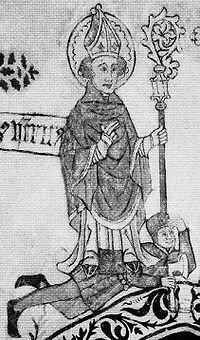
Let us keep the feast of blessed Agnes, and recall the kind of suffering she endured: in the full flower of her youth she died, and found life. She chose to love the Author of life alone; in the full flower of her youth she died, and found life. (the responsory)
The Church gives us a young woman martyr of the early 4th century. She is thought to be about 12 or 13 (records are sketchy) Agnes was martyred under the Emperor Diocletian.
 More often than not our remembrance of Agnes focuses less on her virginity and martyrdom —the supreme gesture of witness to the Lord– and more on the fact that wool is given to the Pope. Sad but true. Agnes’ witness to a life of virginity, possessing without possession, of a complete love for God. On this feast a tradition reaching back centuries lambs are raised by the Trappist monks of Tre Fountane in Rome bring to the Pope the wool that will be made into the pallia by the Benedictine nuns of the Abbey of Saint Cecelia (in Trastevere). The pallium is a white band of wool with six embroidered black crosses (the Pope’s pallium is slightly different with red crosses and wider). The pallium is worn by the metropolitan archbishop for significant ecclesial events, i.e., Masses of Ordination, consecration of churches, altars, bishops, and on certain feast days. Unfortunately, the pallium is worn too often and without proper distinction of festivity and ecclesial communion with the Pope. The Servant of God Pope Paul VI issued a 1978 document, Inter Eximia, limiting the use of the pallium to the pope and metropolitan archbishops. In 1984, John Paul determined the date of the conferral of the pallia.
Before given to the new metropolitan archbishops on June 29th, the feast of Saints Peter and Paul, the pallia rest for short time on the tomb of Saint Peter (the Confessio). You will recall that Saint Agnes is one of the seven women commemorated in the Roman Canon (the BVM would be the 8th).
When the Pope was invested with the pallium on April 25, 2005 by the cardinal proto-deacon Jorge Cardina Medina Estévez, it was prayed: Praise the Lord, who chose you as herdsman of the whole church and embraces you with the white stole of your office. May you act under its briliance for many years of your earthly life and enter his celestial realm vested in the stole of immortality once He calls you.
A poetic work worth noting for the feast is John Keats’ poem “The Eve of St. Agnes.” Written in 1819, this is an extensive poem with great literary accomplishment but of questionable understanding of Agnes’ witness. Keats was no doubt captivated by the life and martyrdom of Agnes, who wouldn’t be? Her brief life and dramatic death is very intriguing and it captivates the intellect.
The striking figure that the young Agnes was encouraged Roman Christians to build a the Church of Saint Agnes outside the Walls (i.e., outside the City) over the tomb of Agnes. It is the titular church of Camillo Ruini, the former Vicar of Rome.
Saint Agnes is the patron saint for chastity, gardeners, girls, engaged couples, rape victims and virgins.
Nevertheless, one can’t move away from the feast day without reading Saint Ambrose’s treatise On Virgins given in the Office of Readings:
 Today is the birthday of a virgin; let us imitate her purity. It is the birthday of a martyr; let us offer ourselves in sacrifice. It is the birthday of Saint Agnes, who is said to have suffered martyrdom at the age of twelve. The cruelty that did not spare her youth shows all the more clearly the power of faith in finding one so young to bear it witness.
There was little or no room in that small body for a wound. Though she could scarcely receive the blow, she could rise superior to it. Girls of her age cannot bear even their parents’ frowns and, pricked by a needle, weep as for a serious wound. Yet she shows no fear of the blood-stained hands of her executioners. She stands undaunted by heavy, clanking chains. She offers her whole body to be put to the sword by fierce soldiers. She is too young to know of death, yet is ready to face it. Dragged against her will to the altars, she stretches out her hands to the Lord in the midst of the flames, making the triumphant sign of Christ the victor on the altars of sacrilege. She puts her neck and hands in iron chains, but no chain can hold fast her tiny limbs.
A new kind of martyrdom! Too young to be punished, yet old enough for a martyr’s crown; unfitted for the contest, yet effortless in victory, she shows herself a master in valour despite the handicap of youth. As a bride she would not be hastening to join her husband with the same joy she shows as a virgin on her way to punishment, crowned not with flowers but with holiness of life, adorned not with braided hair but with Christ himself.
In the midst of tears, she sheds no tears herself. The crowds marvel at her recklessness in throwing away her life untasted, as if she had already lived life to the full. All are amazed that one not yet of legal age can give her testimony to God. So she succeeds in convincing others of her testimony about God, though her testimony in human affairs could not yet be accepted. What is beyond the power of nature, they argue, must come from its creator.
What menaces there were from the executioner, to frighten her; what promises made, to win her over; what influential people desired her in marriage! She answered: “To hope that any other will please me does wrong to my Spouse. I will be his who first chose me for himself. Executioner, why do you delay? If eyes that I do not want can desire this body, then let it perish.” She stood still, she prayed, she offered her neck.
You could see fear in the eyes of the executioner, as if he were the one condemned; his right hand trembled, his face grew pale as he saw the girl’s peril, while she had no fear for herself. One victim, but a twin martyrdom, to modesty and to religion; Agnes preserved her virginity, and gained a martyr’s crown.
Almighty, ever-living God, you choose what is weak in the world to shame what is strong. Grant that, as we celebrate the martyrdom of Saint Agnes, we may follow her example of steadfastness in faith.