Did you know that Pope Benedict is in the Termana soccer club?
Court of the Gentiles –Le Parvis des Gentils à Paris: a call to fraternity to believers and nonbelievers to live coherent in Christ, and for a new humanity
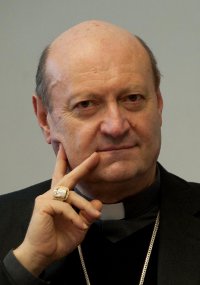
I know that at the invitation of Cardinal André Vingt-Trois, the Archbishop of Paris, and of Cardinal Gianfranco Ravasi (seen right), the President of the Pontifical Council for Culture, you are gathered in great numbers in front of the Cathedral of Notre Dame in Paris. I greet all of you, together with our brothers and friends from the Taizé Community. I am grateful to the Pontifical Council for having taken up and extended my invitation to open a number of “Courts of the Gentiles” within the Church. This image refers to the vast open space near the Temple of Jerusalem where all those who did not share the faith of Israel could approach the Temple and ask questions about religion. There they could meet the scribes, speak of faith and even pray to the unknown God. The Court was then an area of separation, since Gentiles did not have the right to enter the consecrated area, yet Jesus Christ came to “break down the dividing wall” between Jews and Gentiles, and to “reconcile both to God in one body through the cross, thus putting to death that hostility in himself”. In the words of Saint Paul, “He came and proclaimed peace…” (cf. Eph 2:14-17).
Pope Benedict a NY Times international bestseller
Pope Benedict’s book, Jesus of Nazareth, volume 2, internationally released on March 10 with 1.2 million copies in 8 languages.
St Shahbaz Bhatti? — Paul Bhatti fills brother’s shoes
Some people are
suggesting that the Catholic bishops of Pakistan may petition the Pope to say
that the recently murdered Shahbaz Bhatti is a martyr. More will be known
on or after the March 25th meeting of the bishops. Bhatti was gunned down on Marc in Islamabad. Pakistan has about 2.5 Christians.
Bishop Andrew Francis
of Multan: “Bhatti is a man who gave his life for his crystalline faith in
Jesus Christ. It is up to us, the bishops, to tell his story and
experience to the church in Rome, to call for official recognition of his
martyrdom.”
Archbishop Lawrence Saldanha of Lahore and president of the
Conference of Bishops said: “The murder of Shahbaz Bhatti means that we
have lost a great leader of our community who stood up for us and articulated
the concerns and fears of our people. We do not have a leader now. Our people
are quite down. They are fearful of the future.”
In the meantime, Paul Bhatti, MD, has been appointed by Pakistan’s Prime Minister to work with minorities, the same job his brother had.
Fr Corapi’s accusations are unsubstantiated
The truth is coming out…slowly, that is, about Fr John Corapi’s case. An angry former employee of Fr Corapi’s publishing house wanted to take-down her former employers, including Corapi.
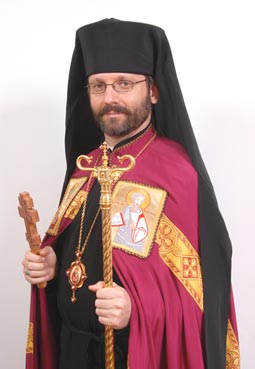
Sviatoslav Shevchuk’s challenge
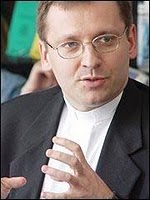
The Ukrainian Greek Catholic Church is facing new challenges in the coming years and the Church’s Synod of Bishops (the Sobor) has decided to meet the challenge head-on: the Synod elected and the Pope confirmed communion with, a 40 year bishop Sviatoslav Shevchuk, a man who’s been bishop for less than 2 years and a moral theologian.
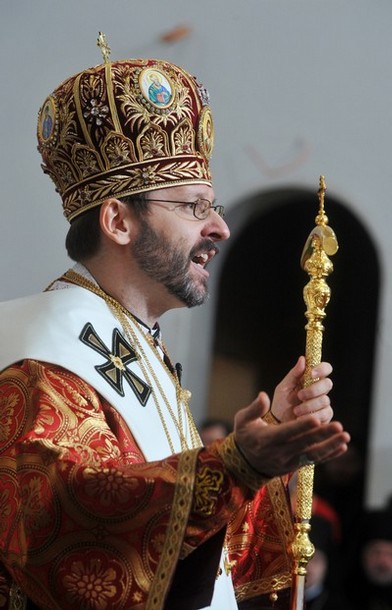
Sviatoslav Shevchuk, 40, new major archbishop (patriarch) of the Ukrainian Greek Catholic Church
Annunciation of the Lord
What happened
here in Nazareth, far from the gaze of the world, was a singular act of God, a
powerful intervention in history, through which a child was conceived who was
to bring salvation to the whole world. The wonder of the Incarnation continues
to challenge us to open up our understanding to the limitless possibilities of
God’s transforming power, of his love for us, his desire to be united with us.
Here the eternally begotten Son of God became man, and so made it possible for
us, his brothers and sisters, to share in his divine sonship. That downward
movement of self-emptying love made possible the upward movement of exaltation
in which we too are raised to share in the life of God himself (cf. Phil
2:6-11).
The Spirit who “came upon Mary” (cf. Lk 1:35) is the same
Spirit who hovered over the waters at the dawn of Creation (cf. Gen 1:2). We
are reminded that the Incarnation was a new creative act. When our Lord Jesus
Christ was conceived in Mary’s virginal womb through the power of the Holy
Spirit, God united himself with our created humanity, entering into a permanent
new relationship with us and ushering in a new Creation. The narrative of the
Annunciation illustrates God’s extraordinary courtesy (cf. Mother Julian of
Norwich, Revelations 77-79). He does not impose himself, he does not simply
pre-determine the part that Mary will play in his plan for our salvation: he
first seeks her consent. In the original Creation there was clearly no question
of God seeking the consent of his creatures, but in this new Creation he does so.
Mary stands in the place of all humanity. She speaks for us all when she
responds to the angel’s invitation. Saint Bernard describes how the whole court
of heaven was waiting with eager anticipation for her word of consent that
consummated the nuptial union between God and humanity. The attention of all
the choirs of angels was riveted on this spot, where a dialogue took place that
would launch a new and definitive chapter in world history. Mary said,
“Let it be done to me according to your word.” And the Word of God
became flesh.
When we reflect on this joyful mystery, it gives us hope, the
sure hope that God will continue to reach into our history, to act with
creative power so as to achieve goals which by human reckoning seem impossible.
It challenges us to open ourselves to the transforming action of the Creator
Spirit who makes us new, makes us one with him, and fills us with his life. It
invites us, with exquisite courtesy, to consent to his dwelling within us, to
welcome the Word of God into our hearts, enabling us to respond to him in love
and to reach out in love towards one another.
Pope Benedict XVI
14 May 2009
Basilica
of the Annunciation, Israel
As a way of deepening the Mystery of the Incarnation, here is “Beyond the Clash of Absolutes: Abortion” taken from Carl A. Anderson’s 2010 book, Beyond A House Divided.
Boston College Catholic students choose Gandhi over Catholic mystics for Lent
Lenten
observances are varied: you can fast, pray the Way of the Cross, do charitable
acts, give alms, spend time in contemplative prayer before the Blessed Sacrament, do
lectio divina, pray the rosary, and the like. The possibilities are limitless. You might know, Catholics have a lot in their own
mystical tradition to deepen a relationship with the Blessed Trinity. And some real good stuff, too. So much so, that a Catholic doesn’t have to stray far from orthodox Christianity for prayer.
Doubtful,
however, is the spending any kind of energy on “Gandhi, Peace and Nonviolence” an acceptable alternative for Catholics. Especially when knowledge of the Catholic tradition is relatively low, even among theology students. But that is what the Boston College School of Theology and Ministry’s Lenten
focus was today. The idea is OK. Wait. It was pretty mediocre. Why not reflect upon peace and nonviolence
using music and select readings? At a Catholic school of theology and ministry
where students are paying tuition in order to be trained to be better Catholics, superb lay Catholic
leaders and teachers, and perhaps even priests, Gandhi just doesn’t fit during
Lent.
I wonder if anyone at a Jesuit school of theology and ministry ever
thought of focusing on one of the great spiritual fathers and mothers of the Church –Augustine, Ephrem, Aquinas,
Bonaventure, Lawrence of Brindisi, Hilary of Poiters, Loyola, Gertrude, Tauler,
Marguerite d’Oingt, Catherine of Siena, Giussani, Lubich, Benedict XVI– for Lenten
prayer and readings? Then, I have to wonder if Gandhi is BC’s type of Catholic and the list above are too obscure for mainline believers. Are these people too Catholic? Perhaps Gandhi is the new patron
saint of the liberal-blue hairs and they haven’t told the rest of the Church yet? Curious to know what Sister Quinn was
thinking.
This is not only a question of Catholic identity at a supposed Catholic institution of higher education, but a question of formation for the proclamation of the Kingdom of God. It is a question of helping each other know their destiny in Jesus Christ.
Saint Turibius de Mongrovejo
We keep as our pattern the teaching here spoken: