
Benedict to women religious: testify to your personal encounter with Christ
Here are the central paragraphs the Pope addressed to women religious at the Escorial earlier today.

Dear Sisters, every charism is an evangelical word which the Holy Spirit recalls to the Church’s memory (cf. Jn 14:26). It is not by accident that consecrated life “is born from hearing the word of God and embracing the Gospel as its rule of life. A life devoted to following Christ in his chastity, poverty and obedience becomes a living ‘exegesis’ of God’s word… Every charism and every rule springs from it and seeks to be an expression of it, thus opening up new pathways of Christian living marked by the radicalism of the Gospel” (Verbum Domini, 83).
Continue reading Benedict to women religious: testify to your personal encounter with Christ
Pope Benedict speaks to journalists: there’s a universal bond of friendship, truth accessible in freedom, truth is dialogic
On the palne ride to Madrid for this year’s World Youth Day, Pope Benedict fielded several questions from journalists. Here are three of the Q&A that I found interesting.
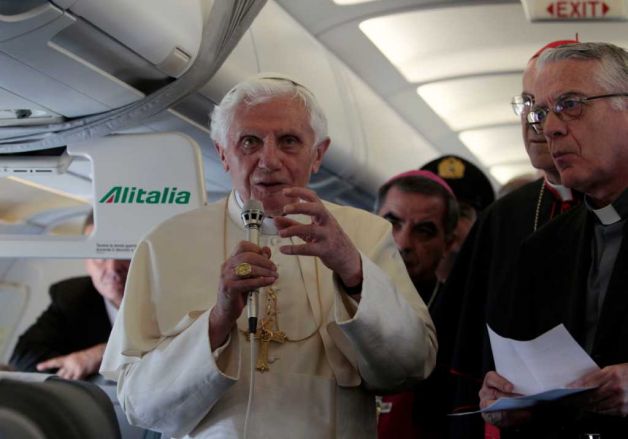
Question: What is the significance of these events in the pastoral “strategy” of the Universal Church in the third millennium?
Answer: Dear friends, greetings! I’m happy to go with you to Spain for this great event. After having personally experienced two WYD, I can only say that it was truly an inspiration that had been given to Pope John Paul II when he created the idea of a large gathering of young people and of the world with the Lord. I would say that these WYD are a signal, a cascade of light; they give visibility to the faith, of God’s presence in the world, and thus foster the courage to be a believer. Believers often feel isolated in this world, almost lost. Here they see that they are not alone, that there is a large network of faith, a great community of believers in the world, that it is nice to live in this universal bond of friendship. And it is thus that I think friendships are born, friendships across the boundaries of different cultures and different countries. It is this birth of a universal network of friendship, which links the world and God, and is an important reality for the future of humanity and for the life of humanity today. Of course, World Youth Day cannot be an isolated incident: it is part of a larger journey, which has been prepared by the way of the Cross which has travelled to different countries already uniting young people in the sign of the Cross and the wonderful sign of the Virgin Mary. And thus it is that the preparation for World Youth Day is much more than the logistics of planning an event which naturally has many technical problems. It is requires an inner preparation, a willingness to join a path that brings us to others so that we can journey together towards God. And then, later, following the establishment of groups of friends, keeping this universal contact opens the borders of cultures, of human and religious differences, and continues a path which then leads to a new arrival point in a new WYD. It seems to me that the World Youth Day should be considered in this sense, as a sign, a part of a great journey, which creates friendships, open borders and demonstrates that is good to be with God, and that God is with us. In this sense, we want to continue with this great idea of Blessed Pope John Paul II.
The good zeal is not just for monks but for all Christians…
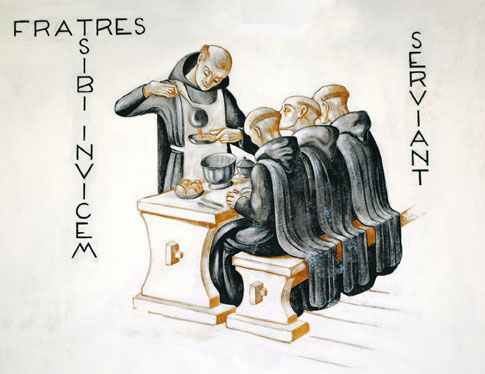
The daily grind makes us weary of the task at hand and sometimes we’re also weary of the “nonsense” of other people. There are times in which we are just ugly. Our own fragile and sinful lives can get in the way of things. Sadly, sometimes we get hurt, and we hurt others.
I was re-reading parts of Luigi Giussani’s Religious Sense this morning and then I saw that a friend made note of the Good zeal of monks (noted below) and I wondered… Why is it that we allow “wicked zeal of bitterness” to infiltrate our spirit and our relationships? Saint Benedict perceived a lack of coherence of what human beings say they believe and the lives lead. No doubt this same question/thought ought to concern every reasonable Christian if we are serious about faith in Jesus Christ and ultimate salvation. The tough thing about the Christian way of life is making sure that our faith informs our works and that we don’t replace faith with good works thinking that what we do will absolve our poor behavior. The good zeal Benedict exhorts his monks to have is really applicable to all baptized Christians and not merely the “professional Christians.”
Do we pay enough attention to reality? Am I too alienated from my own desires when I uncritically accept the ideas of others without doing the hard of work of verifying the truth of these ideas? Have I allowed wonder to take a back seat when looking at the reality I’ve been given by God? Have I sufficiently observed and understood what is in front of me? Have I love the Infinite, that is, the Triune God, to the best of my ability and without reservation? Where is my heart right now?
The Rule of Saint Benedict is insightful with regard to human nature: laziness, mediocrity, will not lead to ultimate happiness. That we have to put aside bitterness and that which does not build a deeper communion with God and neighbor. As Holy Father Saint Benedict and Father Luigi Giussani both said but in different ways: do we love?
Here is what the Rule of Saint Benedict says,
Just as there is a wicked zeal of bitterness which separates from God and leads to hell, so there is a good zeal which separates from evil and leads to God and everlasting life. This, then, is the good zeal which monks must foster with fervent love…. (72.1-3)
The Reoccurring Dream: Calculus is easy??!!!

Prayers for Bishop David M. O’Connell, CM
Prayers are requested for the Most Reverend David M. O’Connell, CM, Bishop of Trenton, 56, who is suffering the effects of an blood infection and clot in his foot made more complex due to diabetes.
The Vincentian Fathers and Brothers, the religious family to whom Bishop O’Connell belongs, sent a request for prayers the other day. We happily oblige.
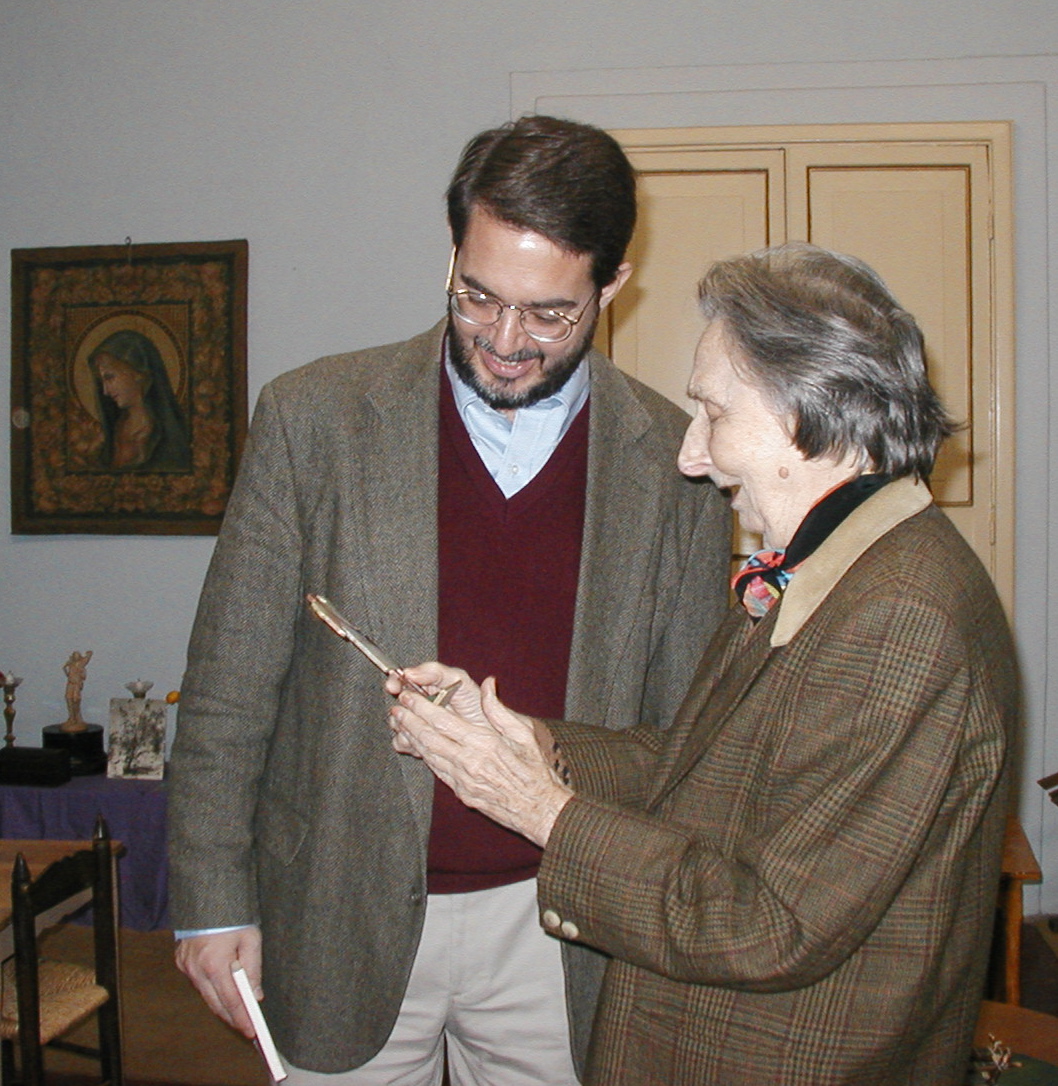
Sofia Cavalletti needs our prayerfilled support
My sheep listen to my voice; I know them, and they follow me. I give them eternal life, and they shall never perish.
~John 10:27, 28
Life is a passage from the less to the more.
~Sofia Cavalletti, The Religious Potential of the Child, page 43
We have heard from [friends with the Catechesis of the Good Shepherd] in Rome that she had spent yesterday with Sofia who is now too weak even to speak. We would like to ask that everyone who has loved Sofia would pray for her now that she may continue to experience, in her body and her spirit, the peace and joy she has so often found in the atrium with the children. We praise God for the treasure she is for us and has illuminated for us in the child. We stand together in vigil and prayer, silently and at peace. Together may we pray the prayer Sofia herself has prayed with us this last year:
Lord, now you let your servant go in peace;
Your word has been fulfilled.
My eyes have seen the salvation
You have prepared in the sight of every people,
A light to reveal you to the nations and the glory of your people, Israel.
Cistercian nun leaves monastery to visit Pope Benedict, first time in 84 years
 A Cistercian nun at 103 years, is leaving the monastery for the first time in 84 years to meet Pope Benedict while he’s in Spain for World Youth Day.
Sister Teresa entered the Monasterio de Buenafuente del Sistal on the very day of Benedict’s birth, 16 April 1927. Aside from a distraction of the Spanish Civil War (1936-39) that caused the nuns to flee fighting, Sister Teresa has lived her vocation as a cloister nun in that place.
A journalist for El Mundo, Jesús García, authored a book about 10 nuns, of whom Sister Teresa was included, titled, ¿Qué hace una chica como tú en una sitio como éste? (2011; What is a Girl Like You Doing In A Place Like This?)
Sister’s monastery was founded in the 13th century, and for 20 years was the religious superior.
Attention in Prayer
This morning on my train ride into the City, I was reading a monograph by Archabbot Lambert Reilly, OSB, the emeritus archabbot of St Meinrad Archabbey, “Prayer: A Conversation with God.” I recommend it. Why? Because I need to be reminded that prayer is not a monologue but a dialogue; it is the heart speaking to the Heart. I also have to remember it is not about me exclusively but about Him who is greater than I.
The Archabbot is conversational in his presentation; one would be tempted to think that there’s a lot of words but no content because he’s narrating his experience. On the contrary, this essay-turned-talk is full of good advice on prayer; it was prepared for Benedictine Oblates but is applicable to many others. Get the piece if you can.

Archabbot Lambert speaks of three types of attention in prayer:
1. “the attention by which we are lost in God.” A short-lived experience of God; a gift from Himself; no strings attached; +Lambert quotes Saint Teresa of Avila: “Don’t seek the consolations of God; seek the God of consolations.”
Saint Stephen of Hungary

On this feast of Saint Stephen of Hungary let us pray for civil leaders, especially for Hungary, for missionaries and for those who work with stone.
Saint Stephen of Hungary, pray for us.