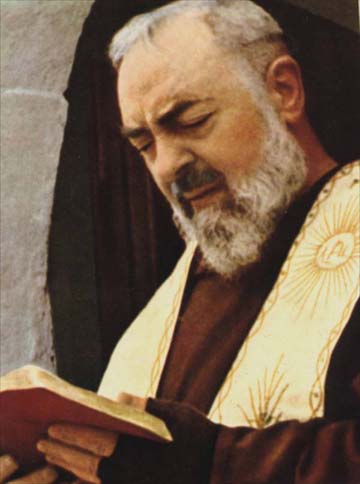
Saint Pio of Pietrelcina

The question I am asking myself: is it possible to follow this man? Alternately, Can I even think that it is possible to be a man like Padre Pio, and seek after God without reservation? What Padre Pio has left us is a clear model of holiness and a path to walk. Holiness here is not meant to be an artificial , showy display of piety (beating the breast, hours of Adoration of Eucharistic adoration, days of fasting, no bathing, etc) but it is a way of life where we shed everything that is not ourselves, living in the manner that is coresponds to the way God the Father has educated us through His Son, Jesus (read the NT). Padre Pio’s ministerial life as a priest and as a professed Franciscan Capuchin focussed on the sanctification of souls. No greater work needed his attention and energy. The path given us to walk by Padre Pio is one that leads us back to God hearing the words of Jesus: I love you, I have mercy on you no matter what. Three tools to use on this path: prayer, confession and charity. Beauty and joy will shine through our conversation with God and by our love. If you really want to know more about the path Pio gives us, read what the Pope spoke in 2009 when he made a pilgrimage to the relics of Saint Pio:
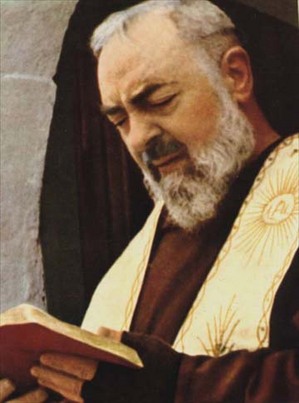
St Padre Pio with book.jpg

Some saints have lived intensely and personally this experience of Jesus. Padre Pio of Pietrelcina is one of them. A simple man of humble origins, “seized by Christ” (Phil. 3:12) — as the Apostle Paul writes of himself — to make of him an instrument chosen by the perennial power of his cross: power of love for souls, of forgiveness and of reconciliation, of spiritual paternity, of effective solidarity with those who suffer. The stigmata, which marked his body, united him closely to the Crucified and Risen One. A true follower of St. Francis of Assisi, he made his own, like the Poverello, the experience of the Apostle Paul which he describes in his letters: “I have been crucified with Christ and I no longer live, but Christ lives in me” (Gal 2:20), or: “in us death is at work, but in you life” (2 Cor 5, 12). This does not mean alienation, loss of personality: God never annuls that which is human, but he transforms it with his Spirit and he ordains it to the service of his plan of salvation. Padre Pio kept his natural gifts, and even his own temperament, but he offered everything to God, who has been able to freely use them to extend the work of Christ: to proclaim the Gospel, forgive sins and heal the sick in body and spirit.

As it was for Jesus, the real struggle, the radical combat Padre Pio had to sustain, was not against earthly enemies, but against the spirit of evil (cf. Ephesians 6, 12). The biggest “storms” that threatened him were the assaults of the devil, against which he defended himself with “the armor of God” with “the shield of faith” and “the sword of the Spirit, which is the word of God” (Ephesians 6:11,16,17). Remaining united to Jesus, he always kept in mind the depths of the human drama, and because of this he offered himself and offered his many sufferings, and he knew how to spend himself in the care and relief of the sick, a privileged sign of God’s mercy, of his kingdom which is coming, indeed, which is already in the world, of the victory of love and life over sin and death. Guide souls and relieve suffering: thus we can sum up the mission of St. Pio of Pietrelcina, as the servant of God, Pope Paul VI said about him: “He was a man of prayer and suffering” (To the Capuchin Chapter Fathers, 20 February 1971).


Pope Benedict XVI

Homily during the 2009 visit to the Shrine of Saint Pio
Cardinal Angelo Scola receives pallium today

Scola receives pallium.jpgThe Pope gave the pallium to the new archbishop of Milan, Angelo Cardinal Scola earlier today. The pallium is a symbol of communion between the wearer (normally metropolitan archbishops) the pope. Hence, it is more ecclesial in nature than liturgical, though the pallium is rarely worn outside of the celebration of the Mass. He can give it whenever and to whomever he wants. Custom of recent years is that the pope gives the pallium to those metropolitans who request it on the feast of Saints Peter and Paul. Nevertheless, this is a novel event that indicates a personal relationship between the cardinal and the pope.

Today is the 20th anniversary of episcopal ordination of Cardinal Scola and he’s due to be installed as the new archbishop of Milan on the 25th, moving from being the Patriarch of Venice.

Saint Matthew, apostle

San Matteo.jpg

Matthew was an accomplished scribe, well versed in the law of God. With all his heart he studied the law of the Lord, with whose help he lived as he taught. The gospel of the glory of God is Matthew’s. With all his heart he studied the law of the Lord, with whose help he lived as he taught.  (Responsory, Office of Readings)


The first reading from the New Testament for the feast of the Apostle Saint Matthew is stunningly beautiful Saint Paul’s letter to the Ephesians is a truly a love letter to the Church and this selection fittingly captures what it means to be an apostle of the Lord. Consider….


“I, the prisoner in the Lord, implore you to lead a life worthy of your vocation. Bear with one another charitably, in complete selflessness, gentleness and patience. Do all you can to preserve the unity of the Spirit by the peace that binds you together. There is one Body, one Spirit, just as you were all called into one and the same hope when you were called. There is one Lord, one faith, one baptism, and one God who is Father of all, over all, through all and within all.

Continue reading Saint Matthew, apostle

Daniel M. Buechlein, Archbishop of Indianapolis, retires

Daniel M. Buechlein.jpgThe Most Reverend Daniel Mark Buechlein, 73, has had his request for an early retirement from the Office of Archbishop of Indianapolis accepted by His Holiness, Pope Benedict XVI due increasing concerns of health. In recent months has been dealing with the effects of a mild stroke complicated by other issues like cancer.

The Archbishop has served the Archdiocese of of Indianapolis as the 5th Diocesan Ordinary since 1992. In 2003, the Pope appointed the Archbishop a consultor to the Congregation of Clergy.
Archbishop Daniel will return to the Archabbey of St. Meinrad, the Benedictine abbey of his profession of vows and the place where he served prior to becoming Bishop of Memphis in 1987.
Saint Benedict and Saint Maurus, pray for Archbishop Daniel, and for us.

Saints Andrew Kim Taegon and Paul Chong Hasang and companions

St Andrew Kim Taegon.jpgToday is the feast of the 19th century Saints Andrew Kim and Paul Hasang and their 103 companions. Kim is the first Korean born Catholic priest! He also followed his father as a martyr for the faith. Andrew was beheaded after being tortured in 1846. These saints were raised to the altars by Pope John Paul II in 1984.

Why ought we be concerned about this today? One reason is that these witnesses to the Gospel of Jesus Christ were mostly lay people. The faith in Korea is a Catholic faith that has its roots not primarily in the work of clergy but by the work of the laity. This is not a feast that proclaims the greatness of the laity over the clergy but it is a feast that speaks to the faithful and fruitful work of the Holy Spirit in priesthood of the all the baptized to make disciples of all nations. Surely, the ministerial priesthood was utilized in discrete ways because of the anti-Catholic sentiment of this geographic region. How else would the sacraments of Baptism and Eucharist be given? What the Church in her wisdom following the guidance of the Spirit has given us are models of holiness in serving the Lord in fullest sense possible: the correspondence of the ordained and lay priesthood.

Father Scott Hurd posted a brief piece on today’s feast.
Let us pray for the Church in Korea!

When true friendship effects change…

In June Dale Kuehne wrote a blog post “Change that believes in me” that speaks to the journey of taking a teaching position at Saint Anslem College (Manchester, NH) which is run by the Benedictine monks of the Abbey there. He doesn’t say it this way, but I do believe he points to something deeper than mere colleagueship: friendship. Perhaps all of us need to think more deeply what our friendships mean and how seriously we engage in them. I recommend this Dale Kuehne’s post….

Saint Robert Bellarmine

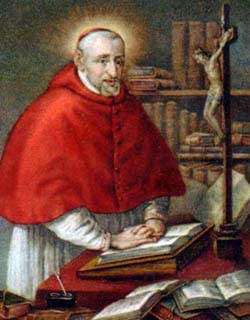
San Roberto Bellarmino.jpg

Today’s saint is special to me for many personal reasons, one of which is the fact that he gave himself to the Lord for his total and unreserved use. One can claim to like Bellarmine for his intellect, or the way he worked with controversial Catholic preachers and theologians and Protestants, or with Galileo, or his service to several popes, but what about his capacity to love the Lord and his neighbor, and what about his ability to know his limitations and his gifts, or his capacity to live the Beatitudes? 

Each time I am in Rome I make a path to St Ignatius’s Church where Bellarmine is buried in the third chapel on the right as you face the main altar, near to his dear friend, Saint Aloyius Gonzaga, to pray for several intentions, among them are: theologians, the pope, the Jesuits, +Avery Robert Dulles and of course, myself.


The Roman Martyrology (2005) has this entry for Robert Bellarmine (1542-1621): 

The feast of St. Robert Bellarmine, from the Society of Jesus, Doctor of the Church and bishop, who was outstanding at arguing the theological controversies of his day. He resigned his red hat, then gave himself wholeheartedly both to pastoral ministry in Capua, with great success, and took up very many challenges in defense of the doctrine of the faith at the Holy See in Rome.

Traces magazine: there’s an app for it on iPad

Traces.jpg

Great news with you: Traces is now available for iPad users and users of Apple’s latest OS, Lion. All that is necessary is to go to the App Store and enter “Traces” and you will find it.   


There are many, pretty obvious, advantages to this new form, including receiving Traces as soon as it’s published, paying less for a subscription and the ability to easily tell friends who have an iPad.


I hope all of you Apple and iPad users will sign up, immediately, and tell your friends! 

La Civiltà Cattolica has new leadership with Antonio Spadaro

Antonio Spadaro.jpgLa Civiltà Cattolica, THE prestigious journal of opinion in Italy, and perhaps in very many ecclesial circles, has new leadership in Jesuit Father Antonio Spadaro. La Civiltà Cattolica has been at the service of the Church 162 years.

Father Antonio, 45, takes the helm from Father GianPaolo Salvini, 75, who’s been the head of La Civiltà Cattolica since 1985, an apostolate of the Italian Jesuits in Rome.
While not an official organ of communication of the Holy See, La Civiltà Cattolica is reviewed by a ranking –though competent– official of the Secretariat of State. It is said that the Papal Palace, that is, the Pope himself, reviewed the pre-publicaiton draft of the journal; Pope Paul VI changed the process.

 La Civiltà Cattolica cover.jpg

The new director, Father Antonio, also the superior of the House of Writers (near to the Porta Pinciana) is trained in literary criticism and has been at the journal for a time since 1994. He’s from Messina and was ordained in 1996. All of his training was in Italy but he completed his Jesuit formation, tertianship, in Ohio. He earned a doctorate from the Gregorian University under the direction of the Australian Jesuit Gerald O’Collins. The new director has published some 15 books and he’s interested in the new social communications.
Don Antonio hosts two blogs: “Antonio Spadaro” and “Cyberteologia.”
He got a difficult road ahead of him: bringing La Civiltà Cattolica further into the new millennium with the use of English, social media and greater visibility. The voice of  La Civiltà Cattolica needs to be heard. A new broom sweeps clean.
May God grant Father Antonio many and rich blessings as he begins his new ministry.