Peter Kleponis has published a book dealing with pornography as a “major epidemic.” A well respected clinical therapist outside Philadelphia. He’s worked laity and clergy alike and has addressed groups of clergymen like the Archdiocese of New York on this issue in the past. He works for the Institute for Marital Healing.
To the roots of communion
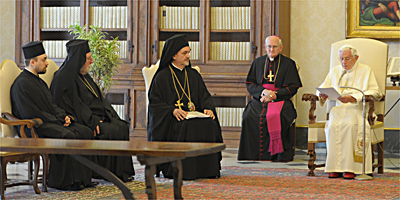
You can count on a delegation from the Ancient See of Constantinople visiting Rome and the Holy Father on the Solemnity of Saints Peter and Paul. Most years a small of group of bishops and archimandrites designated by the Ecumenical Patriarch descend on Rome to pray at the Tombs of Peter and Paul, to attend the Mass with the Pope and those receiving the pallium and to exchange ideas with the Pope. Lunch in the Apostolic Palace is regular. In an editorial by L’Osservatore Romano, Pope Benedict talks more openly about the goal of these ecumenical exchanges. Eucharistic sharing is still impossible, but the hope and identifiable goal is that one day –and one hopes it happens in the next 50 years– that we can be in full visible communion. The editorial is below with my emphasis.
The Second Vatican Council, the 50th anniversary of whose opening is to be celebrated next 11 October, has marked “a new and important phase in relations” between Catholics and Orthodox. In recognizing this the Pope expressed the hope that “progress may also be made in the current phase“, while waiting “to arrive soon at the blessed day when we will be able to share in the Eucharistic banquet“.
The traditional meeting with the Delegation of the Ecumenical Patriarchate of Constantinople, received in audience on Thursday morning, 28 June, on the eve of the Feast of Sts Peter and Paul, was an opportunity for Benedict XVI to recall the importance of the Council in the development of ecumenical dialogue. It was also an opportunity to remember, in particular, the “passion for the unity of the Church” which inspired the Ecumenical Patriarch Athenagoras and the Pontiffs, John XIII and Paul VI, who “made themselves champions of courageous projects that paved the way to renewed relations between the Ecumenical Patriarchate and the Catholic Church”.
Saints Peter and Paul
These are the ones who, living in the flesh, planted the Church with their blood; they drank the chalice of the Lord and became the friends of God.
O God, who on the Solemnity of the Apostles Peter and Paul give us the noble and joy of this day, grant we pray, that your Church may in all things follow the teaching of those through whom she received the beginnings of right religion.
The antiphon and Collect set the tone by noting our belief: the Church is built on the life, work and sacrifice of two men in collaboration with Christ. It is, as Benedict says, truth is one and symphonic (an idea taken from von Balthasar). How do we live this reality?
Today’s solemnity brings with it a wonderful remembrance of how God uses unsuspecting people to witness to his truth and power. The Pope has “traditionally” bestowed the pallium on the new archbishops as a sign of communion with him in serving the Church and a share in the Cross. North America has several new metropolitan archbishops who went to Rome to pray at the tombs of these Apostles and to receive from the Holy Father this beautiful symbol of office.
Two paragraphs below are taken from the Holy Father’s homily, but the entire text may be read here:
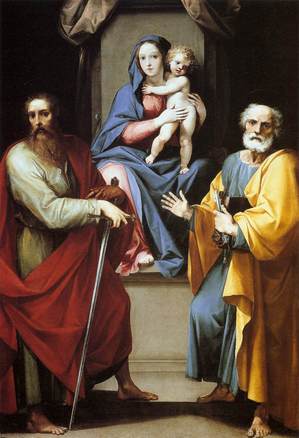
In front of Saint Peter’s Basilica, as is well known,
there are two imposing statues of Saint Peter and Saint Paul, easily
recognizable by their respective attributes: the keys in the hand of Peter and
the sword held by Paul. Likewise, at the main entrance to the Basilica of Saint
Paul Outside the Walls, there are depictions of scenes from the life and the
martyrdom of these two pillars of the Church. Christian tradition has always
considered Saint Peter and Saint Paul to be inseparable: indeed, together, they
represent the whole Gospel of Christ. In Rome, their bond as brothers in the
faith came to acquire a particular significance. Indeed, the Christian
community of this City considered them a kind of counterbalance to the mythical
Romulus and Remus, the two brothers held to be the founders of Rome. A further
parallel comes to mind, still on the theme of brothers: whereas the first
biblical pair of brothers demonstrate the effects of sin, as Cain kills Abel,
yet Peter and Paul, much as they differ from one another in human terms and
notwithstanding the conflicts that arose in their relationship, illustrate a
new way of being brothers, lived according to the Gospel, an authentic way made
possible by the grace of Christ’s Gospel working within them. Only by following
Jesus does one arrive at this new brotherhood: this is the first and
fundamental message that today’s solemnity presents to each one of us, the
importance of which is mirrored in the pursuit of full communion, so earnestly
desired by the ecumenical Patriarch and the Bishop of Rome, as indeed by all
Christians.
Saint Irenaeus of Lyons
O God, who called the Bishop Saint Irenaeus to confirm
true doctrine and the peace of the Church, grant, we pray, through his
intercession, that, being renewed in faith and charity, we may always be intent
on fostering unity and concord.
of one on another. To whom do you owe a deep sense of gratitude for showing you
the way to follow? With Irenaeus, his beloved master was Saint Polycarp (d. 155), from whom he learned about Christ, himself the disciple of Saint John the Apostle. From here we set out to revere
the person of a martyr who met his end in AD 202 after serving the Lord and the
Church for nearly 80 years.
Doctor of the Church from the Apostolic age. Being a doctor of the Church is given to few (most recently the Doctor’s honor was given to Saint Hildegard) because of his learning and publications, but much has been lost. What remains are significant fragments of the original text. His works are mainly in Greek, a few in Armenian but there are several texts that were given to us in Latin; He’s likely to
be most known for his famous Adversus Haereses (Against the Heresies), in which
he gives reasons for his hope, that is, an explanation of the Faith. This text is renown because he combated gnosticism, that is, false knowledge. Only truth triumphs.
almost the all of France to the Faith. One writer speaks of the Christians of
Lyons as models in Christian living because of their candor, rejection of
ambition, poverty, chastity and temperance.
Fulton J. Sheen, Mother Angeline Teresa advances another step toward sainthood
Two “New Yorkers” advance in the study of their sanctity: Fulton J. Sheen and Mother Angelina Teresa.
Today, Pope Benedict XVI gave his permission for the promulgation of the decree concerning the “heroic virtues” of now Venerable Servant of God Fulton J. Sheen (1895-1979). Sheen was a great communicator of the faith in the 20th century. His winning personality and sincerity drew people to Christ.
A wonderful development is the recognition that Brigida Teresa McCrory (1893-1984) known as Mother Angelina Teresa, foundress of the Carmelite Sisters of the Aged and Infirmed, lived a life of heroic virtue. This is good news because it highlights the good work these Carmelite sisters continue to do, notably around the corner from St Catherine of Siena Church (NYC).
Moreover, he did the same for the former Prelate of Opus Dei, the Servant of God Alvaro del Portillo y Diez de Sollano, Spanish prelate of the Personal Prelature of the Holy Cross and Opus Dei (1914-1994). He was the immediate successor to Saint Josemaria.
Angelo Cardinal Amato SDB, prefect of the Congregation for the Causes of Saints, presented these and other causes for sainthood.
UPDATE: Cardinal Dolan writes about the 2 New Yorkers…
How nice are you?
“Our Lord was crucified by the nice people who held that religion was all right in its place, so long as its place was not here, where it might demand of them a change of heart. The gravest error of the nice people in all ages is the denial of sin.”
The Servant of God Archbishop Fulton Sheen
h/t Fr Z
Gunnar, the U.S. Navy seal, dies at age 38
Yahoo News reports:
“He was a U.S. Navy seal best known for learning to use a screwdriver. And now Cold War veteran Gunnar has passed away on Monday. He was 38-years-old at the time of his death and enjoying some quiet living in Washington DC’s National Zoo.”
More here because you’re interested in the service of this seal.
What is a theologian? What purpose does the work of a theologian have? To be “In the Communion of the Church”
The public has been bombarded with the media’s assessment of nuns, church, the sexual abuse crisis, fidelity to the Lord, and the like. In some ways the media looks at the life of the Church and picks out the obvious problems of coherence. No doubt we have matters of concern that we have to work to correct; the adage: “the Church always needs renewal” is very true today. We rely on the Holy Spirit and the good work of Pope Benedict. The other day I found this review of a document written by members of the International Theological Commission (ITC), a group of theologians organized by the Pope to advise him on certain questions of theological questions of importance. Even the Pope needs advice! The ITC group is made up of a diversity of peoples from around the world. The ones I know personally are fine men and women, credible witnesses of the Lord. The review of Theology Today that follows is written by Father Paul McPartlan in which he synthesizes the document giving us the broad view of the work of Catholic theologian. What he highlights sits in contradistinction to what we’ve heard about the recent work of Sr Margaret Farley and other theologians who see themselves in a different light. I prefer to put my money the ITC and not on “envelop pushing, agenda driven” theologians. You?
Following its examination, in Chapter One, of the fundamental nature of theology, as the rational exploration of that faith which is a response to the proclamation of the Word of God, and prior to its extended reflection, in Chapter Three, on significant aspects of the rationality of theology, the new International Theological Commission (ITC) text, Theology Today: Perspectives, Principles and Criteria, carefully considers the ecclesial context of theology in Chapter Two. “The ecclesiality of theology is a constitutive aspect of the theological task, because theology is based on faith, and faith itself is both personal and ecclesial”, it says, emphasising that “it is through the Church that theologians receive the object of their enquiry” (n.20). Theological enquiry is therefore properly conducted within the living and life-giving milieu of the leiturgia, martyria and diakonia of the Church (cf. n.7). In short, as the chapter’s title indicates, it is necessary for theologians to abide in the communion of the Church.
Hans Urs von Balthasar
Saint Josemaria Escriva
Don’t let your life be barren. Be useful. Make yourself felt. Shine forth with the torch of your faith and your love…Don’t flutter around like a hen, when you can soar to the heights of an eagle!
Saint Josemaría Escrivá, The Way