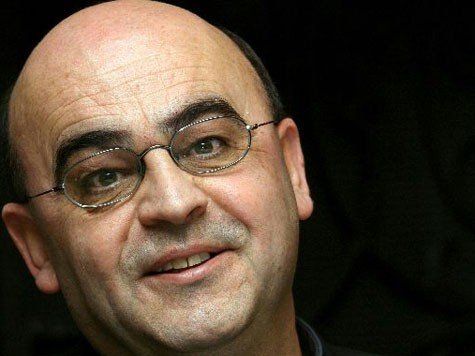
Julián Carrón says the Evangelization Synod was a “most decisive about the experience”
We need to keep a close eye on what happened at the Evangelization Synod just finished in Rome. A judgment, that is, an assessment of meaning, needs to be made so that we can derive a deeper call to conversion and New Life offered by Christ. Far from being a matter of strategy, the work done at the Synod by the bishops and experts and in time by the Pope, will prove, I think, to be historic.
Among the people appointed to the Synod was Father Julián Carrón, President of the Fraternity of Communion and Liberation. He addressed a letter to CL in which he said, in part:
Hearing the call to conversion that came from the synod hall, I could not help but remember the call that Fr. Giussani issued many years ago in Viterbo, inviting us to “recover the truth of our vocation and our commitment.” Because we, too, he told us, run the risk of “reducing our commitment too a kind of theorization of a socio-pedagogical method, reducing it to a kind of activism that follows upon this theorization, and then a commitment to the political defense of it. Instead, our task is to reaffirm and to propose to man, our brother, a fact of life.
The text of the letter: Father Julian Carron on Synod.pdf
Significant remarks from the Evangelization Synod: on interreligious dialogue
In the time following the Synod of Bishops on the New Evangelization I think we need to review what was said. So often we move on so fast when an event is finished. A judgment, that is, an assessment, is required to understand with clarity and charity.
Jean-Louis Cardinal Tauran, president of the Pontifical Council for Interreligious Dialogue, challenged a trend in the work of interreligious dialogue at the recent Synod of Bishops:
Christians often ignorant of the content of their own faith and incapable because of this of living of and for it, are not capable of interreligious dialogue that always begins with the assertion of one’s own convictions: there is no room for syncretism or relativism! Faced with adepts from other religions with a strong religious identity, it is necessary to present motivated and doctrinally equipped Christians. This makes the new evangelization a priority to form coherent Christians, capable of demonstrating their faith, with simple words and without fear.
As with the married couple, so with the Church: love and forgiveness given and received
Being really Catholic
opens one’s point of view to a great richness of the entire Church, East and West; being Catholic as John Paul II reminded us, is to breath with both lungs to invigorate the whole body. Most often Latin Catholics are too skeptical, too closed-minded to look beyond their parochial understanding of God and Church.
Each Sunday Jesuit Father Steve Bonian, a
Maronite Catholic American priest reflects on the liturgical theology of his
church. If you done a little reading in the liturgical history of the Church you will recall with joy that the Maronites have an incredibly rich liturgical tradition that ought to be appreciated more. For one thing the Maronite Liturgy is wonderfully Semitic in its pattern of prayer.
The Maronite Church, the majority of Catholics from Lebanon, celebrated
yesterday the Sunday of the Consecration of the Church. The Roman Church does
not have an equivalent liturgical observance, unless you make a connection with
the Christ the King Sunday, the final Sunday of the Roman Church’s year. The Maronite liturgical theology for the Sunday of the Consecration of the Church you note that “the Bride-Church re-consecrates herself and her children, the faithful, to Christ.”
Father Bonian writes,
The
letter to the Hebrews reminds us that the Temple in Jerusalem and it’s rituals
was only a temporal preparation for the “new order” that would be established
between Christ and his Church and her children.
From now on the Children of God
would worship him in Spirit and Truth on earth as in the Heavenly Jerusalem.
For it is not God’s will to dwell among stones, but in the caring hearts of his
faithful people, and among them to establish his Kingdom. Our Church Community
is this New Temple!
All Saints and All Souls Days in religious orders
The Church is not liturgically monolithic: let’s consider the various observances of feasts of All Saints and the Commemoration of the Faithful Departed (All Souls) in various religious orders:
- November 5: the Society of Jesus
- November 7: the Order of Preachers
- November 13: the Order of St Benedict; Order of St Augustine; the Trinitarian Order
- November 29: the Franciscan Families
- October 5: the Capuchin Order
- November 5: the Franciscan Families
- November 8: the Order of Preachers
- November 13: the Carthusians
- November 14: the Order of St Benedict; the Trinitarian Order
- November 15: the Order of Carmel
- November 16: the Servite Order
Communion and Liberation following the closely the Pope’s teaching
Those of us who follow Communion and Liberation already know what is ahead of us for the Year of Faith: we will closely follow the teachings of Pope Benedict for the Year of Faith.
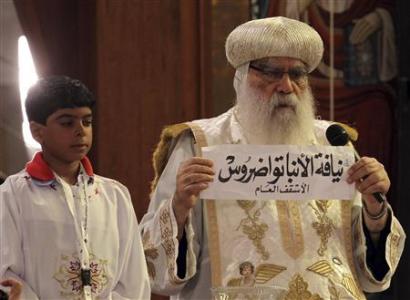
New pope elected … for the Coptic Orthodox Church
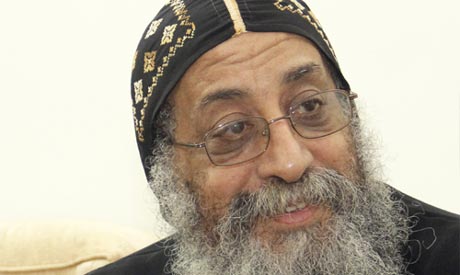
The electors, nearly 2,406 people, in the Coptic Orthodox Church selected the 118th successor to Saint Mark, Tawadros II. The new pope is the head of the Coptic Orthodox Church of Alexandria and Patriarch of All Africa. Until now, Tawadros has been an auxiliary bishop to the Archbishop Pachomius who’s been serving as the acting pope. Tawadros studied pharmaceutical sciences and was ordained a bishop in 1997.
Souls in Purgatory and our obligation
Is it a matter of saying the Lord’s Prayer, Hail Mary and the Glory Be with the Eternal Rest prayers around the time of a person’s death, or only on the anniversary of death of a loved one or friend? Somehow I doubt it.
The law of charity that I think Christians are called to live with certainty makes a claim on us to pray for the dead and dedicate some portion of prayer, fasting and almsgiving for the Church Suffering (the Holy Souls) so that one day they become part of the Church Triumphant. Being Friends in the Lord (disciples of Christ) can’t be indifferent to those who have died. We believe that the bonds of love don’t unravel with the death of the body. We promise the dying that we won’t forget them. If this is true, then why do we so often forget to have a Mass offered for their intentions, or say a rosary for our loved ones, or absent ourselves from visiting the cemetery? Mass, the rosary and a visit are concrete acts of love that have a real consequence for real people we knew and loved in this life.
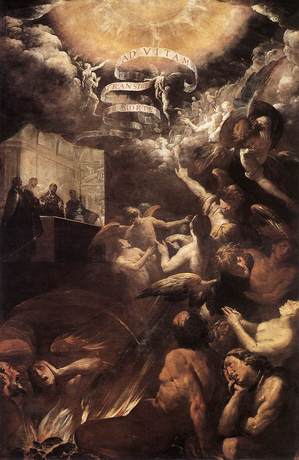
Consider the image of posted above is a example of spiritual works effecting the soul of another. Here the Baroque Master Giovanni Battista Crespi, “Il Cerano” (1573-1632) paints in 1617 Saint Gregory the Great “delivering the soul of a monk.” The deliverance is the result of the monk and pope Gregory offering Mass for the soul of a monk. The depths of mercy and love are mined by the devotion of the Mass for another.
What does the Church teach about Purgatory?
In the Catechism of the Catholic Church states:
Paragraph 1030: All who die in God’s grace and friendship, but still imperfectly purified, are indeed assured of their eternal salvation; but after death they undergo purification, so as to achieve the holiness necessary to enter the joy of heaven.
Paragraph 1031: The Church gives the name Purgatory to this final purification of the elect, which is entirely different from the punishment of the damned. The Church formulated her doctrine of faith on Purgatory especially at the Councils of Florence and Trent. The tradition of the Church, by reference to certain texts of Scripture, speaks of cleansing fire. As for certain lesser faults, we must believe that, before the Final Judgment, there is a purifying fire. He who is truth says that whoever utters blasphemy against the Holy Spirit will be pardoned neither in this age nor in the age to come. From this sentence we understand that certain offenses can be forgiven in this age but certain others in the age to come.
Paragraph 1472 excerpted: This purification frees one from what is called the “temporal punishment” of sin.
For more on purgatory you can read here.
The Holy Souls in Purgatory. Purgatory has been described, as a “cleansing fire” that burns away the dross of sins on our souls. Saint Paul wrote those of being saved “yet so as through fire” and whether or not the soul endures a literal fire, its purification does involve suffering. The time each soul spends there, and the severity of the pains it experiences, varies. However, our prayers for these souls can help alleviate their sufferings and help them reach heaven more quickly. Although they can no longer pray for themselves, they can and do pray for us as well out of gratitude! In addition we can help them by having masses said for the departed and by engaging in works of cha
rity and sacrifice on their behalf.
All Souls
For more than a 1000 years Holy Church has remembered all the dead on one day and reminding the faithful what we believe in the death and resurrection of Jesus and thus for those who die in grace. Spend some time with the Mass Collect below. It is not merely remembering the dead, as good as it is, but also to hold fast to the faith we are Baptized into: Christ’s death and resurrection.
As a way of entering into what the Lord desires, the Church formed the All Souls Indulgence. Read about it here. You have until November 8 to observe the conditions of the Indulgence.
God, who has raised Jesus from the dead, will give life also to your mortal bodies, through his Spirit that dwells in you.
With the Church we pray,
O God, who willed that your Only Begotten Son, having conquered death, should pass over into the realm of heaven, grant, we pray, to your departed servants that, with the mortality of this life overcome, they may gaze eternally on you, their Creator and Redeemer.
Francis Arinze, Nigerian cardinal, turns 80
His Eminence, Francis Cardinal Arinze, turns 80 today.
- Ordained priest: 23 November 1958 (54 yrs)
- Ordained bishop: 29 August 1965 (47 yrs)
- Created cardinal: 25 May 1985 (27 yrs).
Continue reading Francis Arinze, Nigerian cardinal, turns 80