Hopefulness, openness to God, living in joy: three simple attitudes for us to have

Three paragraphs excerpted from the Pope’s homily earlier today bear our reflection if we desire to be true disciples of the Lord Jesus. He sets up for us a structure of holiness that unites a totality of life: faith, work, learning, culture. Francis’ homily is clearly Jesuit and clearly marked by an integrated spiritual life. He echoes what we’ve come to appreciate about the guidance in the spiritual life through the Servant of God Father Luigi Giussani. Of course, you can say Francis is showing us anew what the Church believes to be true. Consider His Holiness’ three points:

1. Hopefulness. The second reading of the Mass presents a dramatic scene: a woman – an image of Mary and the Church – is being pursued by a Dragon – the devil – who wants to devour her child. But the scene is not one of death but of life, because God intervenes and saves the child (cf. Rev 12:13a, 15-16a). How many difficulties are present in the life of every individual, among our people, in our communities; yet as great as these may seem, God never allows us to be overwhelmed by them. In the face of those moments of discouragement we experience in life, in our efforts to evangelize or to embody our faith as parents within the family, I would like to say forcefully: Always know in your heart that God is by your side; he never abandons you! Let us never lose hope! Let us never allow it to die in our hearts! The “dragon”, evil, is present in our history, but it does not have the upper hand. The one with the upper hand is God, and God is our hope! It is true that nowadays, to some extent, everyone, including our young people, feels attracted by the many idols which take the place of God and appear to offer hope: money, success, power, pleasure. Often a growing sense of loneliness and emptiness in the hearts of many people leads them to seek satisfaction in these ephemeral idols. Dear brothers and sisters, let us be lights of hope! Let us maintain a positive outlook on reality. Let us encourage the generosity which is typical of the young and help them to work actively in building a better world. Young people are a powerful engine for the Church and for society. They do not need material things alone; also and above all, they need to have held up to them those non-material values which are the spiritual heart of a people, the memory of a people. In this Shrine, which is part of the memory of Brazil, we can almost read those values: spirituality, generosity, solidarity, perseverance, fraternity, joy; they are values whose deepest root is in the Christian faith.

2. The second attitude: openness to being surprised by God. Anyone who is a man or a woman of hope – the great hope which faith gives us – knows that even in the midst of difficulties God acts and he surprises us. The history of this Shrine is a good example: three fishermen, after a day of catching no fish, found something unexpected in the waters of the Parnaíba River: an image of Our Lady of the Immaculate Conception. Whoever would have thought that the site of a fruitless fishing expedition would become the place where all Brazilians can feel that they are children of one Mother? God always surprises us, like the new wine in the Gospel we have just heard. God always saves the best for us. But he asks us to let ourselves be surprised by his love, to accept his surprises. Let us trust God! Cut off from him, the wine of joy, the wine of hope, runs out. If we draw near to him, if we stay with him, what seems to be cold water, difficulty, sin, is changed into the new wine of friendship with him.

3. The third attitude: living in joy. Dear friends, if we walk in hope, allowing ourselves to be surprised by the new wine which Jesus offers us, we have joy in our hearts and we cannot fail to be witnesses of this joy. Christians are joyful, they are never gloomy. God is at our side. We have a Mother who always intercedes for the life of her children, for us, as Queen Esther did in the first reading (cf Est 5:3). Jesus has shown us that the face of God is that of a loving Father. Sin and death have been defeated. Christians cannot be pessimists! They do not look like someone in constant mourning. If we are truly in love with Christ and if we sense how much he loves us, our heart will “light up” with a joy that spreads to everyone around us. As Benedict XVI said here, in this Shrine: “the disciple knows that without Christ, there is no light, no hope, no love, no future” (Inaugural Address, Fifth General Conference of the Bishops of Latin America and the Caribbean, Aparecida, 13 May 2007, 3).

Pope Francis
The Shrine of Our Lady of the Immaculate Conception of Aparecida
24 July 2013

Communio updates

For the first time since the Communio blog was started, it is in the process of changing the mechanics. There is a new look and I hope it enhances your reading experience. Let me know.

The Communio blog aims at bridging the gap between faith & reason with efforts at faith formation through the lens of the beauty and gift of Catholic faith. It attempts to do all this by giving the highlights of several charisma: Benedictines, the Fraternity of Communion and Liberation, the saints, sacred Liturgy and sacred Scripture and all other aspects of Catholic life.

To quote Father Julián Carrón: we need to have an affection for Christ. Hence, we all need and want to build a friendship with Christ and His Church in joy.

I am grateful for my technician and friend Richard who makes the work of the Communio blog possible.

Prophet Ezekiel

Thumbnail image for Ezekiel-icon.jpg

The Church commemorates the Prophet Ezekiel (born c. 622 BC) today. His name means “God will strengthen.”  God’s strength will be explained by the prophet’s persistent and clear call for repentance, purity and holiness.

The Prophet is remembered on various dates among others:

  • Latin Catholics 23 July
  • Byzantine Catholics and Orthodox and some Lutherans on 21 July
  • Armenian Apostolic Church on 28 August
  • It must be noted that Ezekiel, though not named in the Islamic holy Book, is honored.

Ezekiel is said to have been a great teacher and that his lessons were about the renewal and reform of the whole nation through the renewal and reform of each person. But more than a great teacher he was born into a born into a priestly family, meaning that his family was a family of priests in the line of Levi. Ezekiel was a priest who offered sacrifice on behalf of others.

He is remembered for many important things but many will say they are drawn to the miracle he performed of the resuscitation of the dead found in Book of Ezekiel 37. Dry bones are reassembled and live again. An evident foretelling of the Lord’s own resurrection from the dead. But aside from brilliant miracles the prophet utterances of Ezekiel’s book speak of a vision of God’s glory  (the heavens opening) and the restoration of that glory will happen in a dramatic way even though Jerusalem would fall, unbelief of the people in the one God would lead to their destruction (the Jews would understand the abandoned faith was akin to committing national suicide), and that God required the people to do penance for their wandering away from His truth, beauty and goodness.

Continue reading Prophet Ezekiel

Saint Mary Magdalen

Magdalen raised by Angels GLanfranco.jpgThe day dawns, Mary, bright with joy,

The Lord is victor over death;
You hasten to anoint the Christ,
The truth, thought cold and void of breath.
You come in haste but ’tis to hear
A white-robed angel gladly tell,
“The one you’re seeking rose again,
He broke apart the gates of Hell.”
Your love requires a greater joy,
You ask the gard’ner where He lay,
A “Mary!” turning see the Lord
Your teacher, Jesus Christ, the Way.
The tearful Virgin you upheld,
Beneath the cruel gallows tree
And so Christ chose you first of all
As witness of his victory.
O lovely flow’r of Magdala,
Whose love of Christ earned such apart,
Pray we may also have this gift,
The flame of love within our heart.
Lord Jesus, give us such a love,
To olive like Mary all our days,
And so with her in heaven’s life
To sing your ever-lasting praise.
Text trans. Kenneth Tomkins, OSB, 1992, Quarr Abbey, Ryde, Isle of Wight

Jesus is united to the whole of humanity

A little significant theological reflection is needed. What actually is the point of the Incarnation of Jesus? What difference does it make? Why is what happened to Jesus in the Paschal Mystery important for my redemption and salvation? One of my favorite Orthodox theologians/historians of theology, Father Georges Florovsky points to the fact Christ is not for one person, but for all people, and that all people are to become divine. Make sense to you?

Christ Pantocrator, detail of the Deesis mosaic

The Word became man so that we could “become divine,” “in order to deify us in Himself.” Deification is adoption by God, and “humans sons have become the sons of God.” We are “received by the Word and are deified through His flesh” by virtue of the Incarnation. Born from the Virgin, the Word was not united with only one man, but with the whole of human nature. Therefore everything that was achieved in the human nature of Christ is immediately extended to all men because they have a body in common with Him. There is no coercion involved here. Men are more than similar to Christ; they are truly participants in the human nature of the Word. Christ is a vine and we are the branches, “united with Him by our humanity.” In the same way that the tendrils which grow from a grapevine are consubstantial with it, so are our bodies consubstantial with the body of the Lord, and we receive what He has accomplished. His body is the “root of our resurrection and salvation.” Everyone is renewed, anointed, healed, and exalted in Christ, for “He has taken everyone on Himself.” This is not merely similarity or substitution, but actual unity. Therefore all humanity is anointed by the Spirit in the Jordan, dies on the cross, and is resurrected to immortality in Christ because “He Himself bears our body.”

Father Georges Florovsky, discussing the theology of Saint Athanasius the Great, in chapter two of Florovsky’s patrology.

Enhanced by Zemanta

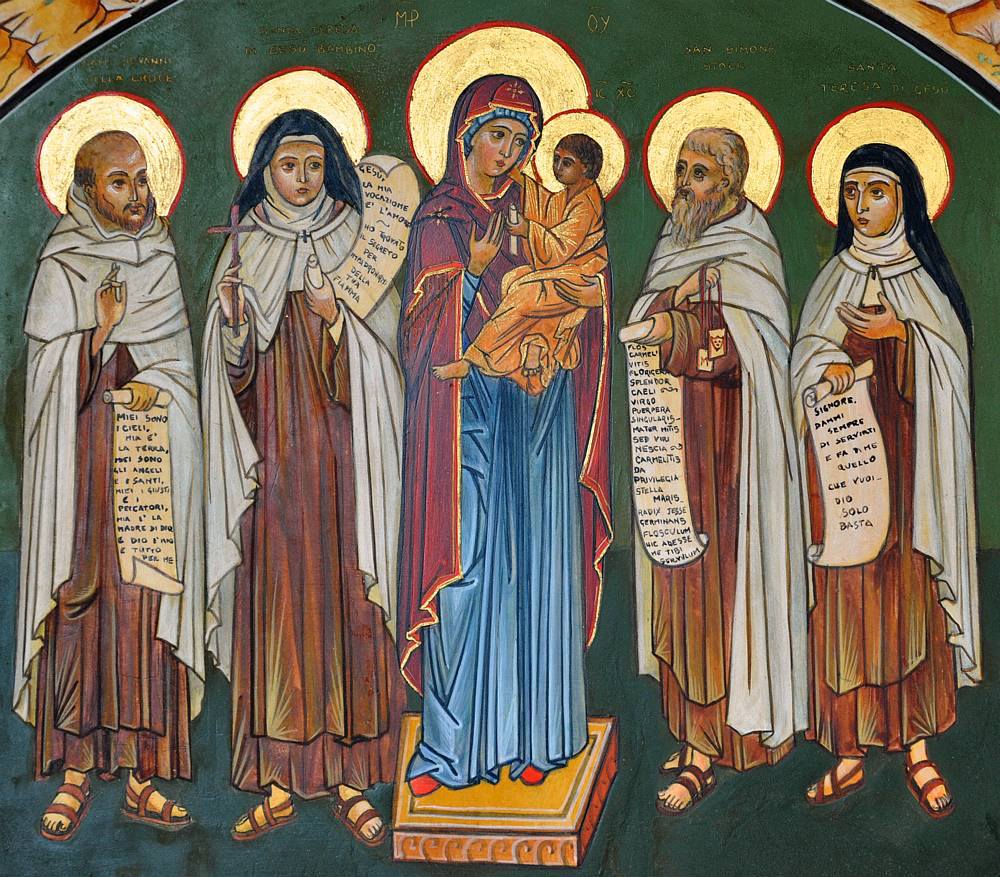
Our Lady of Mount Carmel

OL of Mt Carmel and Carmelites.jpg

I was asking myself why today’s feast of Our Lady of Mount Carmel is a universal feast of the Church. But, why, then, is the feast of Our Lady of the Rosary a widespread feast? Because of the popularity of the devotion is a good approximate answer. Go to Mary for help is a certain gesture of dependence.


The feast recalls a 1226 victory over enemies of the Church and the Carmelite friars, and it also recalls the reception of the scapular by Saint Simon Stock on this date in 1251.


By the 14th century the proposed feast received approval of the Roman Pontiffs Honorius III and later by Sixtus V; over the years it has been questioned by ecclesiastical figures and found to be appropriate for the Carmelite order with a proper vigil Mass and a privileged octave.


Our Lady of Mount Carmel’s feast is another feast of the Virgin Mary that focuses our eyes on the Lord. And, we can never have a enough of that.


You may be interested in reading this piece on scapulars.

Shakespeare’s Sonnet 116

Let me not to the marriage of true minds
Admit impediments. Love is not love
Which alters when it alteration finds,
Or bends with the remover to remove:
O no! it is an ever-fixed mark
That looks on tempests and is never shaken;
It is the star to every wandering bark,
Whose worth’s unknown, although his height be taken.
Love’s not Time’s fool, though rosy lips and cheeks
Within his bending sickle’s compass come:
Love alters not with his brief hours and weeks,
But bears it out even to the edge of doom.
If this be error and upon me proved,
I never writ, nor no man ever loved. 

William Shakespeare

Saint Bonaventure on mystical prayer

Bon4.jpg

One of the famous works of Saint Bonaventure’s is his Journey of the Mind to God. You see it in many places for those wanting a glimpse into this significant medieval thinker. It was in the Roman Divine Office of Readings. We always need an insight or two into contemplation, what it means, how it exists, and so forth. There is no exhausting one’s search into understanding mystical prayer.

I want you to listen to Veronica Scarisbrick’s interview with Franciscan Father Rick S. Martignetti who works in Rome and has authored of Saint Bonaventure’s Tree of Life: Theology of the Mystical Journey (Grottaferrata, 2004). It is a study of Bonaventure’s understanding on prayer and life in the paschal mystery. I found Scarisbrick’s interview both delightful and helpful.

Christ is both the way and the door. Christ is the staircase and the vehicle, like the throne of mercy over the Ark of the Covenant, and the mystery hidden from the ages. A man should turn his full attention to this throne of mercy, and should gaze at him hanging on the cross, full of faith, hope and charity, devoted, full of wonder and joy, marked by gratitude, and open to praise and jubilation. Then such a man will make with Christ a pasch, that is, a passing-over. Through the branches of the cross he will pass over the Red Sea, leaving Egypt and entering the desert. There he will taste the hidden manna, and rest with Christ in the sepulchre, as if he were dead to things outside. He will experience, as much as is possible for one who is still living, what was promised to the thief who hung beside Christ: Today you will be with me in paradise.

For this passover to be perfect, we must suspend all the operations of the mind and we must transform the peak of our affections, directing them to God alone. This is a sacred mystical experience. It cannot be comprehended by anyone unless he surrenders himself to it; nor can he surrender himself to it unless he longs for it; nor can he long for it unless the Holy Spirit, whom Christ sent into the world, should come and inflame his innermost soul. Hence the Apostle says that this mystical wisdom is revealed by the Holy Spirit.

If you ask how such things can occur, seek the answer in God’s grace, not in doctrine; in the longing of the will, not in the understanding; in the sighs of prayer, not in research; seek the bridegroom not the teacher; God and not man; darkness not daylight; and look not to the light but rather to the raging fire that carries the soul to God with intense fervour and glowing love. The fir is God, and the furnace is in Jerusalem, fired by Christ in the ardour of his loving passion. Only he understood this who said: My soul chose hanging and my bones death. Anyone who cherishes this kind of death can see God, for it is certainly true that: No man can look upon me and live.

Let us die, then, and enter into the darkness, silencing our anxieties, our passions and all the fantasies of our imagination. Let us pass over with the crucified Christ from this world to the Father, so that, when the Father has shown himself to us, we can say with Philip: It is enough. We may hear with Paul: My grace is sufficient for you; and we can rejoice with David, saying: My flesh and my heart fail me, but God is the strength of my heart and my heritage for ever. Blessed be the Lord for ever, and let all the people say: Amen. Amen!

(Cap. 7,1 2.4.6: Opera Omnia, 5, 312-313)

Distinguishing religion and theology

Subconsciously we are still studying the history of doctrine as a history of philosophy, and therefore we are bound to miss the very thing. For both theology and doctrine are not philosophy. It is not a speculation on religious topics or problems, even as it does not exclude the theological use of reasons. But it begins, earnestly and emphatically, with revelation — not with an innate “revelation” of the truth in the human mind, but with a concrete Revelation in history, with a true encounter. It is a personal datum — not because it is a private business of human personalities, but because it is a self-disclosure and challenge of a Divine Person of the Personal God.

Father Georges Florovsky

Religion and Theological Tensions