Defender of the Bond is an icon of the Good Shepherd

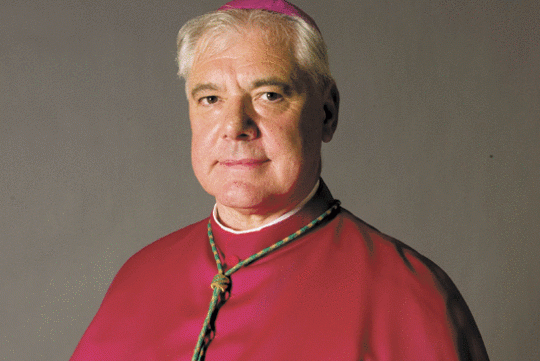
Cardinal BurkeOn November 8, the Holy Father Francis received in audience participants in the Plenary Assembly of the Supreme Tribunal of the Apostolic Signature with the Prefect, Raymond Leo Cardinal Burke (he’s one of our American Prelates in service to the Holy Father at the Curia). A plenary session allows for the consulters and those assigned to a particular office to meet to discuss business but also to meet with the Pope so as to hear what he has to say on a  particular theme of his choosing. A plenary session is held once a year.

The Wisconsin native, Raymond Leo Cardinal Burke is a brilliant noteworthy churchman. His Eminence  earned his doctorate in Canon Law from the Gregorian University in 1984. John Paul named Burke to be the Defender of the Bond of the same tribunal he now leads. He was previously the bishop of La Crosse and archbishop of St Louis. Pope Benedict appointed him to the present work in 2008 and a cardinal in 2010.

Supreme Tribunal of the Apostolic Signature, one of three ecclesiastical tribunals of the Holy See, is the highest judicial authority of the Church; the Prefect, acting in the name of the Pope, is the minister of justice. The decree of justice is sent under a signature, hence, “signature,” administering the justice asked for by the people of God. There are 25 prelates who assist the Prefect and his staff. You can learn more about the ministry of the Apostolic Signature by reading the articles in Pastor Bonus.

Here, the Pope focuses on truth and justice in the work of the Defender of the Bond with regard to the sacrament of Marriage. The Defender of the Bond and the judge of martial cases work together to ascertain the truth and are not in competition with each other but is the point of communion between what is revealed in scripture, lived in the sacraments and lived in the world. You can see to what extent Mother Church tries to care for her married children in a time of hurt and discouragement.

The following his Francis’ talk with my emphasis.

This, your Plenary Session, gives me the opportunity to receive all of you who work in the Supreme Tribunal of the Apostolic Signature, expressing to each one my gratitude for the promotion of the correct administration of justice in the Church. I greet you cordially and I thank the Cardinal Prefect for the words with which he introduced our meeting.

Your activity is geared to fostering the work of the ecclesiastical tribunals, called to respond adequately to the faithful who turn to the justice of the Church to obtain a correct decision. You do your utmost so that they function well, and you support the responsibility of bishops in forming suitable ministers of justice. Among these, the Defender of the Bond carries out an important function, especially in the process of matrimonial nullity. It is necessary, in fact, that he be able to fulfill his own part with efficacy, to facilitate the attainment of truth in the definitive sentence, in favor of the pastoral good of the parties in question.

In this regard, the Apostolic Signature has offered significant contributions. I am thinking in particular of the collaboration in the preparation of the Instruction Dignitas connubii, which explains the applicable trial norms. Placed in this line also is the present Plenary Session, which has put at the center of its works the promotion of an effective defense of the matrimonial bond in the canonical processes of nullity.

The attention given to the ministry of the Defender of the Bond is without a doubt opportune, because his presence and his intervention are obligatory for the whole development of the process (cf. Dignitas connubii, 56, 1-2; 279, 1). Foreseen in the same way is that he must propose all sorts of proofs, exceptions, recourses and appeals that, in respect of the truth, foster the defense of the bond.

The mentioned Instruction describes, in particular, the role of the Defender of the Bond in the causes of nullity for psychic incapacity, which in some Tribunals constitute the sole reason for nullity. It underlines the diligence that he must put in assessing the questions addressed to the experts, as well as the results of the opinions themselves (cf. 56, 4). Therefore, the Defender of the Bond who wishes to render a good service cannot limit himself to a hasty reading of the acts, or to bureaucratic and generic answers. In his delicate task, he is called to try to harmonize the prescriptions of the Code of Canon Law with the concrete situations of the Church and of society.

The faithful and complete fulfillment of the task of the Defender of the Bond does not constitute a pretension damaging of the prerogatives of the ecclesiastical judge, to whom corresponds solely the definition of the cause. When the Defender of the Bond exercises the duty to appeal, also to the Roman Rota, against a decision which he holds damaging to the truth of the bond, his task does not abuse that of the judge. In fact, the judges can find, in the careful work of him who defends the matrimonial bond, a help to their own activity.

The Second Ecumenical Vatican Council defined the Church as communion. Seen in this perspective are the service of the Defender of the Bond and the consideration that is reserved to him, in a respectful and attentive dialogue.

A final, very important annotation as regards the workers committed in the ministry of ecclesial justice. They act in the name of the Church; they are part of the Church. Therefore, it is necessary to always keep alive the connection between the action of the Church that evangelizes and the action of the Church that administers justice. The service to justice is a commitment of apostolic life: it requires to be exercised by keeping one’s gaze fixed on the icon of the Good Shepherd, who bends down to the lost and wounded sheep.

At the conclusion of this meeting, I encourage you all to persevere in the search for a limpid and correct exercise of justice in the Church, in response to the legitimate desires that the faithful address to Pastors, especially when, confidently, they ask to have their own status authoritatively clarified. May Mary Most Holy, who we invoke with the title Speculum iustitiae, help you and the whole Church to walk on the path of justice, which is the first form of charity. Thank you and good work!

Saint Rose Philippine Duchesne and the basilicas

St Rose DuchesneToday we have two feasts that may not immediately be perceived as connected: the Dedication of the Basilicas of Saint Peter and Saint Paul and the liturgical memorial of Saint Rose Philippine Duchesne (1769-1852), who had the desire to live a life of contemplation.

To make a little sense of what we have today let’s step back nearly ten days ago to the liturgical memorial of the Dedication of Lateran Basilica.  On that feast we noted that the church was dedicated to Saint John the Baptist and it recalls for us the ministry of the bishop of Rome to lead, teach and sanctify. Key in that feast is not the praise of architecture but what John the Baptist said: I must decrease and He [Jesus] must increase. If we forget these words then we’re lost. The petition in the Prayer after Communion asked God to use the earthly sign of the Church as an instrument of sacramentality that would transform us into a new temple bestowing a new humanity upon for the purpose of being in glory with the Trinity.

With the liturgical memorial of the two basilicas of Peter and Paul —another liturgical day on which we do not merely honor bricks and mortar— we have  another aspect of the Christian life being brought forward: having knowledge of divine things which lead to a life of grace. The feast, therefore, is a reminder that our faith has a genealogy —it is rooted in the apostolic witness of Peter and Paul. We follow an experience; we are lead to Jesus by those who knew Him.

The anniversary of the dedication of the two basilicas keeps our hearts on the source of our Christian life: the proclamation of the Word and the consumption of the Eucharistic Sacrifice for our eventual life in heaven but also to do what Jesus did. What the Apostles did for us so long ago continues to happen today. From the dual altars of the ambo and altar we are nourished and in turn we are sent out, like Peter and Paul, to cooperate with the action of the Holy Spirit.

Pope Leo the Great on the Memorial of the Dedication of the Basilicas of Saint Peter and Saint Paul once said:

“From this field [the Church] those two famous shoots of the divine seed burst forth into a great progeny, witnessed by thousands of blessed martyrs. To emulate the apostles’ triumph, these martyrs have adorned our city far and wide with people clothed in purple and shining brilliantly, and they have crowned it with a diadem fashioned by the glory of many precious stones….

 Our experience has shown, as our predecessors have proved, that we may believe and hope that in all the labors of the present life, by the mercy of God, we shall always be helped by the prayers of our special patrons. Just as we are humbled by our own sins, so we shall be raised up by the merits of these apostles.”

Where does Saint Rose Philippine fit? This wise virgin who, while waiting for Jesus lit the lamp by a life of charity and missionary zeal making her Bridegroom known to a world unfamiliar with His word of Life. She was a light in darkness.

Remember, Saint Rose is an American saint buried in Saint Charles, Missouri. She is known for her devotion to the Blessed Sacrament, an intense prayer life, and being a missionary. If you are listening to the talks being given in Mexico these days by the bishops and the Pope (via satellite) being a person of prayer and being missionary is the existential vocation of the Church as she is living and proposing what has been left to us by Jesus.

Hence, our Christian lives in the American context is framed by the Baptist’s exhortation to mature in the Paschal Mystery all the while being formed by the Cross and following the Jesus, and living what’s been given: mercy in the world in which we find ourselves AND by the missionary zeal of an American nun.


Oratorians of Brooklyn

Oratory Church of St BonifaceSaint Philip Neri and his ability to connect with the common person is seen in the ministry of his sons at the Oratory of Saint Boniface in Brooklyn, NY. Saint Philip’s charism is alive and bringing Jesus the people and people to Jesus.

The Oratorians took a dead parish community and by cooperating with Grace revitalized the parish making it a place of prayer now called the The Oratory Church of Saint Boniface. They’ve renovated their church, provide an excellent sacred music ministry, an intellectual outreach as well as a myriad of ways of responding to the needs of those in need.

In a real way these urban and contemporary religious men are making being Catholic interesting, and dare I say, captivating, by making what the 16th century layman-turn-priest and saint said and did. very concrete. The Oratorian priests and brothers  are a different type of religious congregation say from the Benedictines, Jesuits and Dominicans. The men live permanently in one place, take no religious vows yet they promise to live in charity with each other serving in whatever need is identified: parish work, spiritual ministries, work with the poor and marginalized, teaching catechism and the like. The Provost is the religious superior of the local group –the point of unity– and the diocesan bishop gives the priestly faculties. Mutual obedience, concern for one another and joy are hallmarks of the Oratorian life. Each Oratorian is respected for his relationship with the Lord and the gift of self to the Church. Neri was an evangelizer, and so are his sons.

NET TV –a media ministry of the Brooklyn Diocese– interviewed the Fathers and Brothers of the Oratory  recently giving an insight into their life and work among the people of God.

Visit The Brooklyn Oratory.

Saint John Chrysostom

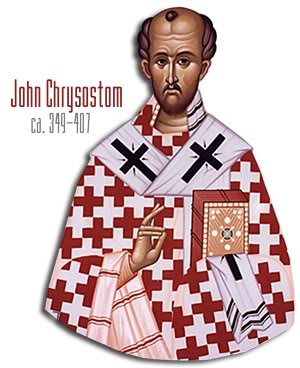
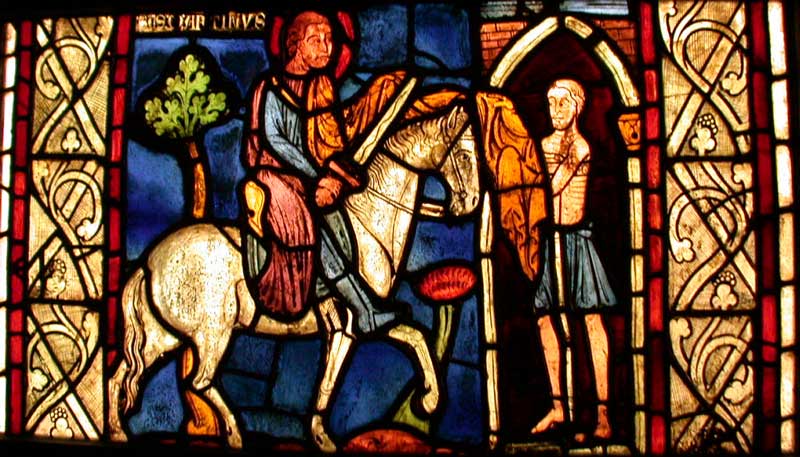
John ChrysostomOn the Byzantine liturgical calendar, today is the feast of John, patriarch of Constantinople, called “Chrysostom” (which is Greek for  “the golden-tongued,” in reference to his amazing gift for preaching the Word of God).

The Latin Church observes the liturgical memorial of Saint John Chrysostom on 14 September. He is revered as our holy father and for that reason he bears mention again. One of the Divine Liturgies of the Byzantine Church, the one used most days, is ascribed to him.

It is hard to overstate the importance of Saint John Chrysostom for Christians due to the intensity of his person, the force of his preaching and the reasonableness of his teaching.

The “Cherubic Hymn,” a chant, is taken his Divine Liturgy, is sung at the time of the Great Entrance. (For Latin Catholics, the Cherubic Hymn is a hymn sung at the presentation of the gifts, a text which is fixed for all but a few days of the liturgical year).

The Cherubic hymn ought to form part of our daily prayer.

We who mystically represent the Cherubim,
and who sing to the Life-Giving Trinity the thrice-holy hymn,
let us now lay aside all earthly cares
that we may receive the King of all,
escorted invisibly by the angelic orders. Alleluia

Relics of St Peter, Apostle and First Pope, to be exposed

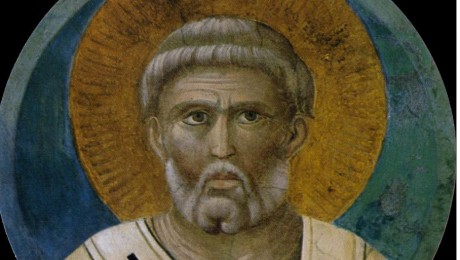
Giotto di bondone St PeterThe relics of St. Peter, Apostle and the First Pope, will be exposed in Rome for the conclusion of the Year of the Faith.

Archbishop Rino Fisichella, head of the Council for the New Evangelization, announced that in anticipation of the close of the Year of Faith on the Solemnity of Christ the King 2013, the relics of the first Bishop of Rome will be exposed.

“A final culminating sign will consist in the exposition for the first time of the relics that tradition recognizes as those of the apostle that gave his life for the Lord,” stated L’Osservatore Romano, the Vatican newspaper (Nov 8, 2013).

Pope Benedict XVI instituted the Year of Faith, running from October 11, 2012 until November 24, 2013.

Exposing the remains of St. Peter will be a unique “epilogue” to the Year of Faith, insisted Archbishop Fisichella, because it “has been marked in particular by the profession of faith that millions of pilgrims have made to the tomb of Peter.”

“It will be a moment of grace and commitment to a more complete conversion to God, to strengthen our faith in Him and proclaim Him with joy to the people of our time,” the retired pontiff stated in the Fall of 2011 upon the announcement of the event.

Here is an interesting guide of St Peter’s tomb.

Pope Francis meets Orthodox Metropolitan Hilarion

The meeting of Pope Francis with Metropolitan Hilarion –the not first– ran concurrent today with Cardinal Angelo Scola of Milan meeting in Moscow with Patriarch Kirill, leader of the Russian Orthodox Church. Francis like Benedict, and with Hilarion and Kirill  there is a substantial commitment to good fraternal relations with various members of the Orthodox Church which is really fantastic.

Vatican Radio’s Philippa Hitchen spoke with one of the editors of the journal, Irenikon, Benedictine Father Thaddeus Barnas of Chevetogne Abbey, whose founding by the famed Dom Lambert Beauduin following the 1924 encourage of Pope Pius XI which focussed on the Orthodox spirituality and promoting reconciliation between Catholics and Orthodox. The Benedictines monks seek the face of God, and they work for ecumenical connections from the standpoint of prayer, study and fraternal relations. Listen to the interview with Father Thaddeus.

John Tavener dead 69

TavenerSir John Tavener, 69, died today. Much of his was spent in ill health, but he was not constrained by limitations of health.  Thanks be to God.

John Tavener is regarded as a “leading light” of our times. Encountering Tavener was surely a gift of God that allowed the soul to soar to new heights.

John Tavener was an Orthodox Christian who wrote a piece at the death of Diana, Princess of Wales.

Tavener was knighted in 2000.

The Telegraph has a brief report and the BBC files this report.

Eternal memory!

Joseph Kurtz and Daniel DiNardo to lead US Catholics

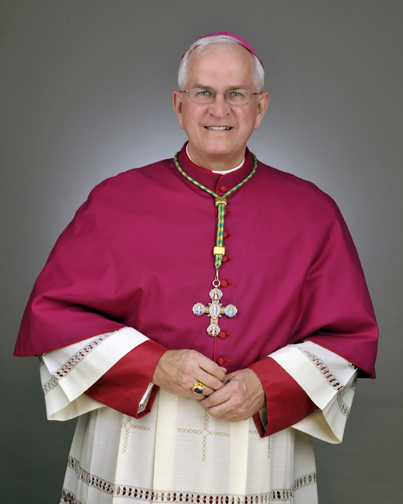
Today, the US bishops gathered in Baltimore for the their annual meeting, elected Louisville Archbishop Joseph Edward Kurtz, 67. Kurtz has been a bishop for the last 14 years. He has been the VP of the US Conference of Catholic Bishops under the presidency of Cardinal Timothy M. Dolan whose 3 year term ended.

In 2010, the bishops elected Cardinal Dolan of New York as president after the bishops failed to have support Bishop Kicanas who was the VP of the Conference but was embroiled in controversy.

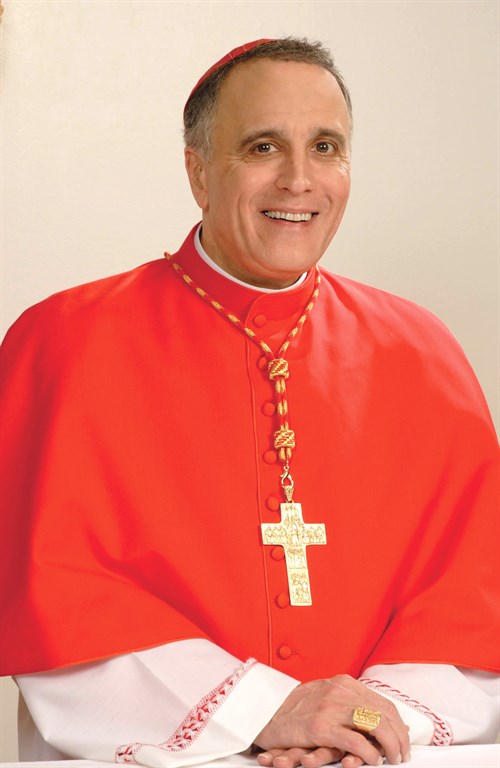
The bishops elected Galveston-Houston Cardinal Daniel Nicholas DiNardo, 64, to be the VP. He has been a bishop for 16 years and a cardinal for 6. The cardinal defeated Archbishop Charles J. Chaput of Philadelphia. With the election of Archbishop Kurtz to presidency of the USCCB the body of bishops returned to an earlier practice of electing a sitting vice president to the conference presidency.

Both Kurtz and DiNardo are well-regarded churchmen. This slate of leaders is not mind-blowing. What each man brings is good experience and competence and both have a congenial personality.

Kurtz has been the archbishop of Louisville since 2007. Daniel Cardinal DiNardo has led the Archdiocese of Galveston-Houston since 2006; he was created a cardinal in 2007, the first from Texas. He is twice a coadjutor bishop, the only US bishop to be so distinguished.

The bishops also elected chairmen committees assuming their chairmanships at the conclusion of the meeting:

  • Bishop Arthur J. Serratelli of Paterson: Committee on Divine Worship
  • Archbishop George J. Lucas of Omaha: Committee on Education
  • Archbishop Bernard A. Hebda of Newark: Committee on Canonical Affairs and Church Governance
  • Bishop Mitchell T. Rozanski of Baltimore: Committee on Ecumenical and Interreligious Affairs
  • Archbishop Leonard P. Blair of Hartford: Committee on Evangelization and Catechesis
  • Bishop Oscar Cantú of Las Cruces: Committee on International Justice and Peace
  • Bishop Edward J. Burns of Juneau: Committee on Child and Youth Protection

Communion given to divorced and remarried Catholics?

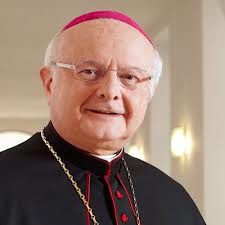
Robert ZollitschThe former archbishop Freiburg im Breisgau Archbishop Robert Zollitsch, 75, tried to legislate a change in pastoral practice to allow remarried Catholics who have not received the required annulment from a previous marriage bond to receive Holy Communion. His resignation was accepted by the Holy Father on 17 September 2013. Archbishop Zollitsch, as the emeritus archbishop, has no authority to make such an allowance due to his canonical status but also because the proposal he was hoping to enact contradicted the theology of the Church. 

The several at the Holy See were clearly unhappy at Zollitsch’s bold (wreckless?) attempt to change a practice without thinking through the theology. Not that the happiness of the authorities Church is the goal of anything. Heaven is the goal and we get there by correct teaching, sacraments and compassionate leadership. The chief shepherd of a diocese, even he is the former shepherd, cannot on his own authority, make a change in theology. The transcentals (the beautiful, the good, the true and the one) can’t be ignored; neither can clear teaching based on Scripture.

Does something need to be done? Very likely. We do have a problem that needs sensitive guidance. But there we have to see to it that a few things are done: First, start giving good human, spiritual and catechetical formation to couples engaged to be married. Second, seek to walk with all married couples. Third, help to bring reconciliation to couples whose marriages are no longer sacramental. But Zollitsch created a chaos.

Recently, Archbishop Müller wrote an article outlining the Church’s  teaching about marriage, divorce and the sacraments in L’Osservatore Romano.

Today, the Prefect of the Congregation for the Doctrine of the Faith wrote a letter to Archbishop Zollitsch, who now serves as the Apostolic Administrator of his former diocese. The following translation of Archbishop Müller is the work of Mark de Vries.

Archbishop Müller’s letter:

MüllerWith the Document Prot. N. 2922/13, of 8 October 2013, the Apostolic Nuncio has communicated the draft of the guidelines for the pastoral care of separated, divorced and civilly remarried people in the Archdiocese of Freiburg, as well as your newsletter to the members of the German Bishops’ Conference prior to the publication of this letter, to the Congregation for the Doctrine of the Faith. A careful reading of the draft text reveals that it does contain very correct and important pastoral teachings, but is unclear in its terminology and does not correspond with Church teaching in two points:

“Remarried divorced people themselves stand in the way of their access to the Eucharist”

1. Regarding the reception of the sacraments by divorced and remarried faithful the proposal from the bishops of the Oberrhein area is recommended anew as a pastoral direction: after a process of discussion with the parish priests, people concerned can either reach the conclusion to participate much in the life of the Church, but to deliberately refrain from receiving the Sacraments, while others can in their concrete situations achieve a “responsibly reached decision of conscience” and be able to receive the Sacraments of Baptism, Holy Communion, Confirmation, Reconciliation and Anointing of the Sick, and this decision is “to be respected” by the priest and the community.

Contrary to this assumption the Magisterium of the Church emphasises that the pastors must recognise the various situations well and must invite the affected faithful to participation in the life of the Church, but also “reaffirms her practice, which is based upon Sacred Scripture, of not admitting to Eucharistic Communion divorced persons who have  remarried” (cf. John Paul II, Apostolic Exhortation Familiaris Consortio, of 22 November 1981, N. 84; also compare the Letter of this Congregation of 14 September 1994 about the reception of Communion by remarried divorced faithful, which rejects the proposal from the Oberrhein bishops; and Benedict XVI, Apostolic Exhortation Sacramentum Caritatis of 22 February 2009, N. 29).

This position of the Magisterium is well-founded. Remarried divorcees stand in the way of their access to the Eucharist, insofar as their state of life is an objective contradiction to the relationship of love between Christ and the Church, which is made visible and present in the Eucharist (doctrinal reason). If these people were allowed to receive the Eucharist this would cause confusion among the faithful about the Church’s teaching about the indissolubility of marriage (pastoral reason).

2. In addition to this a prayer service is suggested for divorced faithful who enter into a new civil marriage. Although it is explicitly stated that this is not some “semi-marriage” and the ceremony should be simple. but it would still be a sort of “Rite” with an entrance, reading from the Word of God, blessing and giving of a candle, prayer and conclusion.

Such celebrations were expressly forbidden by John Paul II and Benedict XVI: “The respect due to the sacrament of Matrimony, to the couples  themselves and their families, and also to the community of the faithful,  forbids any pastor, for whatever reason or pretext even of a pastoral nature, to  perform ceremonies of any kind for divorced people who remarry. Such ceremonies  would give the impression of the celebration of a new sacramentally valid  marriage, and would thus lead people into error concerning the indissolubility  of a validly contracted marriage” (Familiaris Consortio, n. 84).

The affected faithful are to be offered support, but it must be avoided that “confusion arise among the faithful  concerning the value of marriage” (Sacramentum Caritatis, N. 29).

Due to the aforementioned discrepancies, the draft text is to be withdrawn and revised, so that no pastoral directions are sanctioned which are in opposition to Church teaching. Because the tekst has raised questions not only in Germany, but in many parts of the world as well, and has led to uncertainties in a delicate pastoral issue, I felt obliged to inform Pope Francis about it.

“Going paths which fully agree with the doctrine of the faith of the Church”

After consultation with the Holy Father, an article from my hand was published in L’Osservatore Romano on 23 October 2013, which sumarises the binding teaching of the Church on these questions. This contribution was also published in the weekly edition of the Vatican newspaper.

Since a number of bishops have turned to me and a working group of the German Bishops’ Conference is dealing with the topic, I would like to inform you that I will send a copy of this letter to all the diocesan bishops of Germany. Hoping that on this delicate issue we are going pastoral paths, which are in full agreement with the doctrine of the faith of the Church, I remain with heartfelt greeting and blessings in the Lord.

St Martin of Tours

St Martin of ToursToday, on the Church’s liturgical calendar is the memorial of Saint Martin of Tours, the first non-martyr that we have, and on the secular calendar is Veterans’ Day.

As a Catholic community of faith holy Mother Church sincerely prays for those who gave their lives in service of this country. May God grant them health, life, peace, and all good things and preserving them for many years.

May we take this opportunity to also remember the “veterans” of our Church, those men and women who have tirelessly supported their faith, who sustained their families and friends, who labored hard to build our churches when they arrived from their homelands, and who, in some cases, gave their lives to for their faith.

Personally, I pray and am grateful for the service of my father Edward who served in the US Air Force.

May Saint Martin of Tours, Saint George and all the saints sustain through holy intercession all Veterans before God the Father.