In Christ, we share we share a single journey, a single destiny, Francis teaches

The Year of Faith closes with the Pope embracing the relics, the bones, of the Apostles who answer their human need, who broke opened their hearts to see the face of God. Peter and Paul shared in the One they loved with the world, and they presented the world with gift of salvation with whom they desired to share an incomparable journey, a destiny, as Christians, desire to share in. Francis closes a year in which we all lived with intensity of living the faith, meeting the Lord and journeying to a new knowledge and new vigor in the promise of the Hundredfold. The following is the homily delivered today in Rome where he speaks about the essentials of the faith: baptism, the Encounter and centrality of the Christ in our life and the desire for heaven.
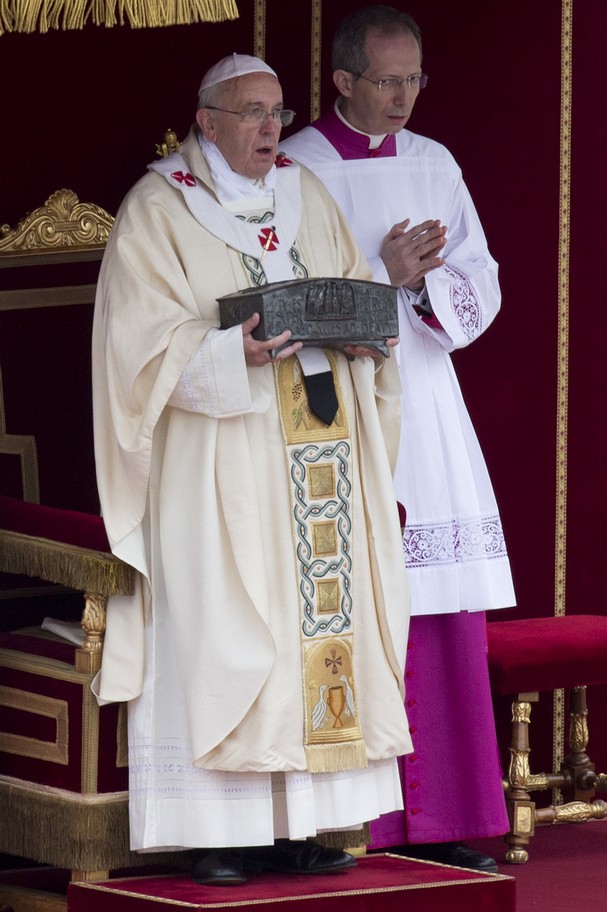
Pope Francis with Apostles relics 2013Today’s solemnity of Our Lord Jesus Christ, King of the Universe, the crowning of the liturgical year, also marks the conclusion of the Year of Faith opened by Pope Benedict XVI, to whom our thoughts now turn with affection and gratitude. By this providential initiative, he gave us an opportunity to rediscover the beauty of the journey of faith begun on the day of our Baptism, which made us children of God and brothers and sisters in the Church. A journey which has as its ultimate end our full encounter with God, and throughout which the Holy Spirit purifies us, lifts us up and sanctifies us, so that we may enter into the happiness for which our hearts long.

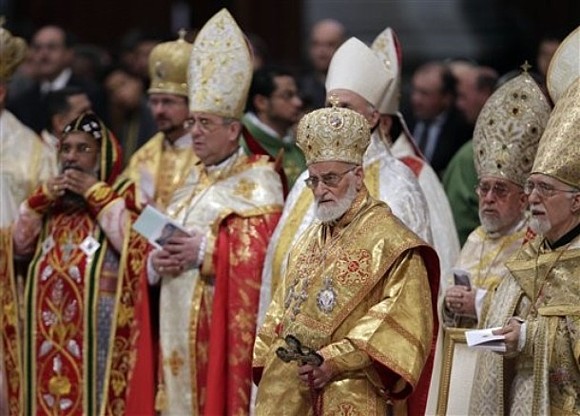
I offer a cordial greeting to the Patriarchs and Major Archbishops of the Eastern Catholic Churches present. The exchange of peace which I will share with them is above all a sign of the appreciation of the Bishop of Rome for these communities which have confessed the name of Christ with exemplary faithfulness, often at a high price.

With this gesture, through them, I would like to reach all those Christians living in the Holy Land, in Syria and in the entire East, and obtain for them the gift of peace and concord.

The Scripture readings proclaimed to us have as their common theme the centrality of Christ. Christ as the centre of creation, the centre of his people and the centre of history.

1. The apostle Paul, in the second reading, taken from the letter to the Colossians, offers us a profound vision of the centrality of Jesus. He presents Christ to us as the first-born of all creation: in him, through him and for him all things were created. He is the centre of all things, he is the beginning. God has given him the fullness, the totality, so that in him all things might be reconciled (cf. Col 1:12-20).

This image enables to see that Jesus is the centre of creation; and so the attitude demanded of us as true believers is that of recognizing and accepting in our lives the centrality of Jesus Christ, in our thoughts, in our words and in our works. When this centre is lost, when it is replaced by something else, only harm can result for everything around us and for ourselves.

2. Besides being the centre of creation, Christ is the centre of the people of God. We see this in the first reading which describes the time when the tribes of Israel came to look for David and anointed him king of Israel before the Lord (cf. 2 Sam 5:1-3). In searching for an ideal king, the people were seeking God himself: a God who would be close to them, who would accompany them on their journey, who would be a brother to them.

Christ, the descendant of King David, is the “brother” around whom God’s people come together. It is he who cares for his people, for all of us, even at the price of his life. In him we are all one; united with him, we share a single journey, a single destiny.

3. Finally, Christ is the centre of the history of the human race and of every man and woman. To him we can bring the joys and the hopes, the sorrows and troubles which are part of our lives. When Jesus is the centre, light shines even amid the darkest times of our lives; he gives us hope, as he does to the good thief in today’s Gospel.

While all the others treat Jesus with disdain – “If you are the Christ, the Messiah King, save yourself by coming down from the cross!” – the thief who went astray in his life but now repents, clinging to the crucified Jesus, begs him: “Remember me, when you come into your kingdom” (Lk 23:42). And Jesus promises him: “Today you will be with me in paradise” (v. 43). Jesus speaks only a word of forgiveness, not of condemnation; whenever anyone finds the courage to ask for this forgiveness, the Lord does not let such a petition go unheard.

Jesus’ promise to the good thief gives us great hope: it tells us that God’s grace is always greater than the prayer which sought it. The Lord always grants more than what he has been asked: you ask him to remember you, and he brings you into his Kingdom!

Let us ask the Lord to remember us, in the certainty that by his mercy we will be able to share his glory in paradise. Amen!

Christ the King

Cristo ReyThe Liturgy prayed today in the Ordinary Form of the Mass is that of Solemnity of Christ the King. (The Extraordinary Form offered this Mass on the last Sunday of October.)  How is it that Catholics and Americans speak of Christ as King? The secular analogue of kingship in the USA does not exist for us.  Yet, we are often fascinated by the activities of the British royal family and we often raise some political families to the rank of minor royalty.

For the Christian, our King is the Incarnate and Eternal Word of God who lived in history, not in a palace but in a humble setting. Jesus lived and work among the people; He taught forgiveness, justice, love, a life centered on God, modeled the work of building up His Father’s kingdom, exhorted us to be Eucharist for the Life of the Church, and He suffered, died on a cross, resurrected from the dead and ascended to life in the Trinity. The sole mission of Jesus was to show us the face of God the Father, that is, to bring us into communio with the Trinity. How is this possible? The feast of Christ the King ought to draw our attention and concrete activity to the sacraments of initiation whereby we are given our dignity as children of God; where we share by adoption where the Trinity lives by nature. From the the sacramental life of the Church we live.

I am reminded of our Catholic theology of Baptism we are given “The anointing with sacred chrism, perfumed oil consecrated by the bishop, signifies the gift of the Holy Spirit to the newly baptized, who has become a Christian, that is, one “anointed” by the Holy Spirit, incorporated into Christ who is anointed priest, prophet, and king” (CCC 1241).

And, “The baptized have become “living stones” to be “built into a spiritual house, to be a holy priesthood.” By Baptism they share in the priesthood of Christ, in his prophetic and royal mission. They are “a chosen race, a royal priesthood, a holy nation, God’s own people, that [they] may declare the wonderful deeds of him who called [them] out of darkness into his marvelous light.” Baptism gives a share in the common priesthood of all believers” (CCC 1268).

How is the royal mission and holy priesthood exercised? By living in grace; by living the Gospel, by attending to our conversion; by living the corporal and spiritual works of mercy. By personally being engaged in the building up of the  kingdom of God where we live: among family, friends, coworkers, in study, in prayer, and in work. This requires awareness. How awake are we in noticing the poor and those in genuine human need?

Yet, for this method to be effective, I think we have to ask ourselves, what and who is sovereign in our lives?  Sometimes, sin and dysfunction distract us.

Norbertine Father Andrew Ciferni of St Norbert Abbey and College preached this point today,

We celebrate this day with great solemnity. In some ways we mimic the rituals of the throne room. But the Scriptures will not let us rest too comfortably in solemn gesture and big sound – appropriate as they may be. The gospel we proclaim is that of the king whose throne is the tree of the Cross, a seat of forgiveness for the sinner. And what makes this king different from all others is that he enthrones and crowns all his subjects with him. We are a royal people. On the day of our baptism we are anointed as kings, priests and prophets. This means that sooner or later it will be revealed to us that we too reign from the Cross. That like King Jesus we can only bring reconciliation can only make peace in and through our own blood. As we read in the Letter to the Hebrews (9:22), “without blood there is no forgiveness.”

Ecumenism from the bottom up, Sviatoslav Shevchuk advocates

Svjatoslav ShevchukYou will think I am silly for saying this, but who cares: I think that Archbishop Sviatoslav Shevchuk is a good man for Christ’s Church.

Who is Archbishop Sviatoslav Shevchuk you ask? Please recall that he is the Major Archbishop of the Ukrainian Greek Catholic Church (a major archbishop is the equivalent of a patriarch in church law without the title of patriarch).

He’s now 43 and he’s been a priest for nearly 20 years, a bishop for nearly 5 years and he’s been the head of the largest Eastern Catholic Church for the since March 2011. Shevchuk is a man to watch. I just hope he’s not going to cave the to bourgeois mentality which afflicts many ecclesiastics.

The archbishop is in Rome now for a month for a series of meeting, not least was the recent meeting of the Plenary of the Congregation for Eastern Churches and a meeting with the Holy Father and other Eastern Catholic Patriarchs. Using his time wisely, the archbishop spoke with Andrea Tornielli of the Vatican Insider (who is a friend of Pope Francis); Tornielli’s interview, “Ecumenism from the bottom up: Now Vatican II is coming into effect.”

In the Tornielli interview you’ll read about his connection with Pope Francis, the desire of the faithful for a deeper unity (a ecumenism that’s full & visible) and note of contrast on marriage between the churches. Perhaps you’ll learn something. I did. You don’t have to agree with everything the interview reveals, but you would be wise to read carefully and between the lines.

To get a flavor of this young Father of the Church, please read and watch the following:

Cardinal Marx “consecrates” a dog cage for Mass

Cardinal Marx consecrating a dog cage

The Cardinal-archbishop of Munich, Reinhard Marx, 60, and a member of the Council of Cardinals, was motivated to “consecrate” this dog cage. I am using quotes because I really do not think this liturgical act is a true consecration of an altar upon which the eucharistic sacrifice may be offered. What the cardinal does is to offend a theological foundation of beauty, truth, goodness and unity. The sacramentality of the Church is wounded. Where is the lex orandi, lex credendi, lex agendi in this act? How would you explain this contraption to a child who wants to know about the Mass? Is this the fruit of the Second Vatican Council? Is this what we mean by a hermeneutic of continuity? My head hurts with this liturgical abuse…

All this silliness makes me think of J.R.R. Tolkien when he wrote,

“…the spirit of wickedness in high places is now so powerful and many-headed in its incarnations that there seems nothing more to do than personally refuse to worship any of the hydras’ heads.”

America’s longest-married couple!

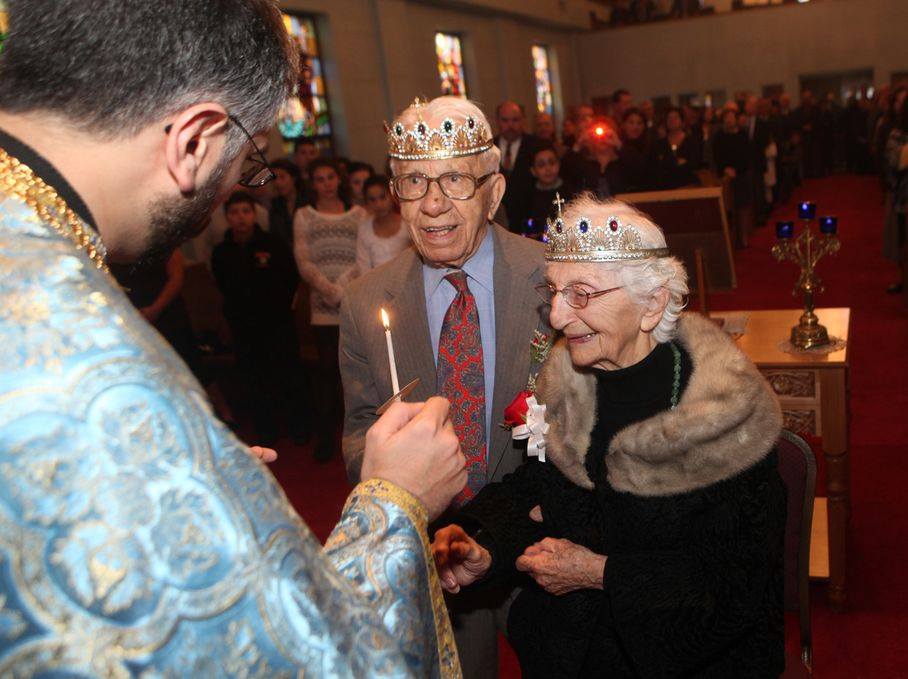
The Betars 81 years marriedJohn and Ann Betar eloped on November 25, 1932. Monday marks their 81st anniversary.

John is 102 and Ann is 98. They raised 5 children, the eldest is a daughter who’s 80 and are predeceased by a daughter and son who died from cancer. The Betars have 14 grandchildren and 16 great-grandchildren.

They left a close-knit Syrian neighborhood in Bridgeport, Connecticut, to marry; they’re now living in Fairfield.

Pope Francis to nuns: is this lamp still alight in convents?

As mentioned yesterday, Pope Francis went to the monastery of Saint Anthony the Abbot, the home of the Camaldolese Benedictine nuns on the Aventine (Rome). There he was welcomed by Sister Michela Porcellato, the religious superior of 21 nuns.

The occasion of his presence among these contemplative nuns was to honor the Day for Contemplative Life (instituted in 1953 by Pope Pius XII as the Pro Orantibus Day); it  also was one to the marks of the end of the Year of Faith.

Vespers was sung according to the Camaldolese tradition followed by a moment of Eucharistic Adoration. Francis gave the following meditation with some important points emphasized by me:

We contemplate Her who knew and loved Jesus as no other creature. The Gospel we heard shows the fundamental attitude with which Mary expressed her love for Jesus: to do the will of God. “Whoever does the will of my Father in Heaven is my brother, and sister, and mother” (Matthew 12:50). With these words, Jesus leaves an important message: the will of God is the supreme law that establishes true belonging to Him. Therefore, Mary established a bond of kinship with Jesus even before giving him birth: she became a disciple and Mother of her Son the moment she received the words of the Angel and said: “Behold, I am the handmaid of the Lord; let it be to me according to your word” (Luke 1:38). This “let it be” is not only acceptance, but also trustful openness to the future. This “let it be” is hope!

Mary is the Mother of hope, the most expressive icon of Christian hope. Her whole life is an ensemble of attitudes of hope, beginning with the “yes” at the moment of the Annunciation. Mary did not know how she could become a mother, but she entrusted herself totally to the mystery that was about to take place, and she became the woman of waiting and of hope. Then we see her at Bethlehem, where he who was announced as Savior of Israel and as Messiah is born in poverty. Then, while she is at Jerusalem to present him in the Temple, with the joy of the elderly Simeon and Anna, she hears the promise of a sword that will pierce her heart and the prophecy of a sign of contradiction. She realizes that the mission and the identity itself of that Son exceed her being Mother. We then arrive at the episode of Jesus who is lost in Jerusalem, and she asks: “Son, why have you treated us so?” (Luke 2:48), and Jesus’ answer, who moves away from the maternal concerns and turns to the things of the Heavenly Father.

Yet, in face of all these difficulties and surprises of God’s plan, the Virgin’s hope never hesitates! Woman of hope. This tells us that hope is nourished by listening, by contemplation, by patience, so that the times of the Lord will mature. Also at the Wedding of Cana, Mary is the Mother of hope, which makes her attentive and solicitous to human things. With the beginning of his public life, Jesus becomes the Teacher and the Messiah: Our Lady looks at her Son’s mission with exultation but also with apprehension, because Jesus becomes increasingly the sign of contradiction that the elderly Simeon had pre-announced to her. At the foot of the cross, she is the woman of sorrow and at the same time of vigilant waiting of a mystery, greater than the sorrow, which is about to take place. Everything seems truly finished; every hope it could be said was spent. At that moment, recalling the promises of the Annunciation, she also could have said: they have not come true, I was deceived. But she did not say it. Yet she, blessed because she believed, sees blossom from her faith the new future and waits with hope for God’s tomorrow. Sometimes I wonder: are we able to wait for God’s tomorrow? Or do we want it today? For her God’s tomorrow is the dawn of the Easter morning, of that first day of the week. It would do us good to contemplate the Son’s embrace with the Mother. The only lighted lamp at the entrance of Jesus’ sepulcher is his Mother’s hope, which at that moment is the hope of the whole of humanity. I ask myself and you: is this lamp still alight in convents? Is God’s tomorrow still awaited in convents?

We owe much to this Mother! In her, present in every moment of the history of salvation, we see a solid witness of hope. She, Mother of hope, supports us in moments of darkness, of difficulty, of distress, of apparent defeat or of real human defeats. May Mary, our hope, help us to make of our life a pleasing offering to the Heavenly Father, and a joyful gift for our brothers, an attitude that always looks to tomorrow.

Saint Cecilia, virgin and martyr

Artemisia Gentileschi Santa Cecilia1. O God of tune and rhyme,
Whose song the world has made,
Whose Word before all time
The universe displayed:
We praise in song this woman’s fame,
Who, in the face of death and shame,
Gave glory to her Savior’s name.

2. O Christ, who summoned all
To follow in your way,
That we might bear our cross
And live in endless day:
We thank you for Cecilia’s stand;
And trusting in your loving hand,
We too will sin and death withstand.

3. O Spirit, Lord of life,
Whose gifts all faith maintain,
Your leading through earth’s strife
Let us your heav’n attain.
Grant us firm faith that, as did she,
We follow you, O Wind most free,
That Christians true we e’er may be.

4. O Trinity, One God,
O Source of music’s art,
Guide us through ways untrod
Until, within your heart,
With all your saints and angels’ throng
We live with you, and there prolong
Our endless alleluia song.

J. Michael Thompson
Copyright © 2009, World Library Publications
66 66 888
RHOSYMEDRE

Pope visits where Connecticut nun and mystic lived

Sr Nazarena of JesusWhen Pope Francis went to the Sant’Antonio Abate Monastery for Vespers today, he made an unusual visit to the monastic cell of an American Mystic and anchoress. Sister Nazarena. The Camaldolese Benedictine nun is not well known; Sister Nazarena of Jesus, was known in history as Julia Crotta (October 15, 1907 – February 7, 1990). She made the honest claim that her vocation was the direct result of a vision she had of the Lord. She reports that the Lord called her name, “Julia, come to me in the desert, I will never leave you.” She would come to devote her life in love through music, according to the grace God gave her. A Jesuit sent her to Rome to find her vocation.

Monastery is located at the foot of the Aventine Hill, not far from Byzantine Church of Santa Maria in Cosmedin (one of my favorite churches in Rome) and not far from the Church of Santa Sabina and Sant’Anselmo –the Benedictine house of studies.

Crotta was from Glastonbury, Connecticut, a daughter of Italian immigrants, a gifted and trained musician who began her studies at Hartford Consevatory, then at the Yale School of Music in violin and composition, but left Yale to finish at Albertus Magnus College up the street run by the Dominican Sisters of St Mary’s of the Springs (now Dominican Sisters of Peace). She finished with a degree in French. She taught music in Manhattan before trying her vocation with the Carmelites in two different monasteries.

After meeting with Pope Pius XII, Julia Crotta became a Camaldolese Benedictine nun and later an anchoress, that is, living a hidden life for 45 years.  Her name in religion was Sister Nazarena of Jesus. The Camaldolese’s founder was an anchorite, Saint Romuald (who live around the AD 1000), and they honored the recluse vocation. Hers was a rare vocation yet a shining star in the Church. Pope Paul VI visited Sister Nazarena in 1966.

Benedictine Father Thomas Matus, an American monk and author of Nazarena: An American anchoress (Paulist Press 1998) spoke with Laura Ieraci of Vatican Radio about Sister Nazarena’s vocation, spiritual writings and the witness she offers today

The quick link to the interview is here with Vatican Radio.

Father Thomas is a monk of New Camaldoli Hermitage in Big Sur, California and an adjunct professor of Theology at Jesuit School of Theology at Santa Clara.

Here is an example of holiness springing up from Connecticut!!!

Pope meets Eastern Catholic Patriarchs and Major Archbishops

Eastern Catholic PatriarchsAs the Roman Pontiff, Bishop of Rome, the Pope meets with the Fathers of the Churches who are in communion with him to be updated on the life of particular churches. The Patriarchs and Major Archbishops from the Eastern Churches are in Rome this week for a plenary meeting of the Congregation for Eastern Churches.

Who are these bishops? The current (2013) patriarchs and major archbishops are:

  • Patriarch Gregory of the Melkites
  • Patriarch Bechara of the Maronites
  • Patriarch Ignatius of Syrians
  • Patriarch Louis of the Chaldeans
  • Patriarch Nerses of the Armenians
  • Patriarch Ibrahim of the Copts
  • Major Archbishop Sviatoslav of the Ukrainians
  • Major Archbishop Lucian of the Romanians
  • Major Archbishop George of the Syro-Malabars
  • Major Archbishop Baselios of the Syro-Malankars
  • Archbishop Fouad, Latin Patriarch of Jerusalem

This year’s meeting centered around the theme of religious liberty, an issue that is at crisis proportions around the world, even in the Western nations.

From Vatican Radio, “Citing the words of his predecessor, Pope emeritus Benedict XVI in the post-Synodal exhortation, Ecclesia in medio oriente (nn. 39-40), Pope Francis said, “[You are] watchful guardians of communion and servants of Ecclesial unity,” adding, “that union, which you are called to realize in your Churches, finds natural and full expression in the ‘indefectible union with the Bishop of Rome’.” Pope Francis went on to say, “In order that our witness be credible, we are called ever to seek justice, mercy, faith, charity, patience and meekness.”

As you know, the current Pope and the previous one has had a deep appreciation for the patrimony of Eastern Christianity. They are brothers.

The Vatican Radio report can be heard here.

Rome Reports has filed a report here.