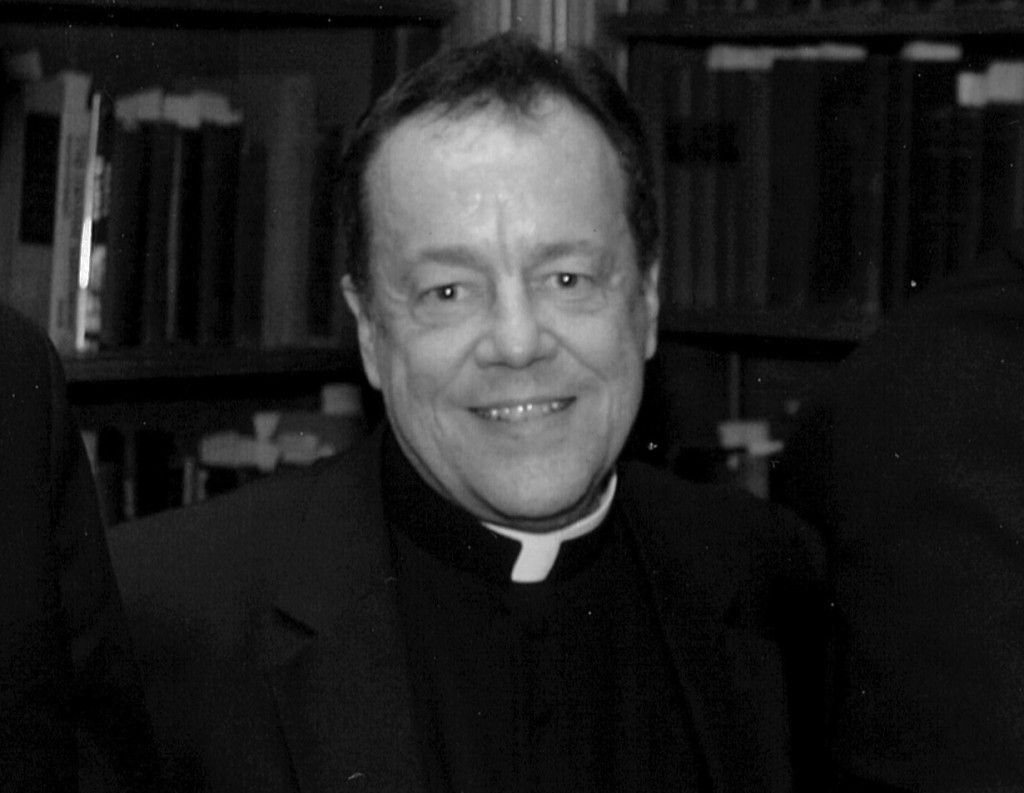
Edward T. Oakes, SJ –RIP

Edward T. Oakes FT picToday, one of the Church’s faithful sons died: Father Edward Talbot Oakes, S.J.  He was a true and dear friend to me for many years. Edward turned 65 in May and was diagnosed very shortly thereafter with stage 4 pancreatic and liver cancer; he, like his late brother, were a-symptomatic creating a crisis of health without knowing it until it was late.

One of his many God-given gifts Ed shared with us was his vocation to be a public intellectual, a calling he fully embraced. Just a few weeks ago the Catholic journal on faith and culture, Logos (16.4), published his “Lab Life: Vitalism, Promethean Science, and Mary Shelley’s Frankenstein.” But in the past year Ed also published these articles: “Pope Benedict XVI on Christ’s Descent into Hell,” Nova et Vetera (Volume 11, Number 1, Winter 2013) and “Reason Enraptured,” First Things,  (Number 232, April 2013).

Ed’s last significant work was on nature and grace that he finished in late summer and that I had the privilege of reading and acting as one his editors. It is titled, The Candle Within A Theology of Grace as Seen Through Six Controversies (expected from CUA Press).

While the world mourns Nelson Mandela, more locally –in various parts of the USA– many are mourning the loss of the person of Edward Talbot Oakes, a man who changed lives by revealing the face of Jesus Christ.

David Mills of First Things contributed this tribute to Ed.

Thank you, Ed, remember me (us) to the Lord of Life.

The following is the obituary published by the Socius of the Missouri Province of Jesuits. Much more can and will be said and appreciated.

… Father Edward T. Oakes, S.J. died this morning at the Fusz Pavilion in St. Louis, Missouri. He was 65 years old and a Jesuit for 47 years. Born in Kansas City, Missouri, on May 18, 1948, Ed entered the Society of Jesus at St. Stanislaus Seminary in Florissant, Missouri, on September 1, 1966. He completed a B.A. and an M.A. in Philosophy at Saint Louis University. After teaching English and Theater at St. Louis University High School from 1973 to 1976, Ed earned an M.Div. at Jesuit School of Theology at Berkeley. He was ordained to the priesthood at St. Francis Xavier (College) Church in St. Louis on June 15, 1979.

From 1980 to 1987, Ed studied at Union Theological Seminary in New York, where he earned a Ph.D. in Systematic Theology. Ed loved studies and pursued them with great eagerness. In 1987 he accepted a visiting professor position at New York University where he taught Theology and the History of Christianity until 1994.

After tertianship at Peter-Faver Kolleg in Berlin, Ed joined the Religious Studies faculty at Regis University in Denver, where he taught for six years. Ed’s enthusiasm for the intellectual life and his joyful personality were appreciated by members of the Jesuit community and his colleagues in the Religious Studies department.

Ed was a prolific writer. His works include Pattern of Redemption: The Theology of Hans Urs von Balthasar (New York: Continuum, 1994) and Infinity Dwindled to Infancy: A Catholic and Evangelical Christology (Grand Rapids: Eerdmans, 2011). The latter work, which provides a survey of doctrinal and historical issues in Christology, won the 2012 Book Prize from the Center for Catholic-Evangelical Dialogue. Ed contributed essays to numerous collections in Theology and regularly published articles in both refereed journals and Catholic periodicals.

In 2002, Ed became a professor of Theology at University of St. Mary of the Lake – Mundelein Seminary in Mundelein, Illinois. His colleagues on the faculty and the seminarians very much appreciated his presence there.

In May 2013, Ed was diagnosed with pancreatic cancer. At the time he wrote to his fellow Jesuits, spoke of his strong hope in God and quoted St. Paul: “Therefore we do not lose heart. Though outwardly we are wasting away, yet inwardly we are being renewed day by day.” For several months, Ed received chemotherapy to slow the growth of the cancer. He finished a writing project and returned to teaching for the fall semester. When his health began to worsen, Ed moved to St. Louis and joined the Pavilion community. He is survived by his sister, Elizabeth D. Oakes, and his sister-in-law, Joanne Oakes. May this joyful and dedicated man rest in peace.

Saint Saba

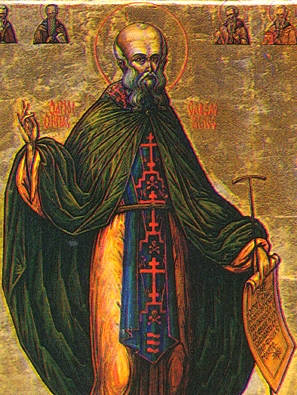
St SabaPrayer and simple living characterize the saint Mother Church offers to us today. Saint Saba (439-532) is known for simple things, died at 93 of natural causes, dedicated himself to God; it is said that his vocation was to the anchorite way of life; he’s not a well-educated man. The Byzantine Church calls Saba “the Sanctified.” In monastic circles Saba is honored as being one of the great Patriarchs of Eastern monasticism. Said before on these pages, saints beget saints, Saba was a spiritual son of Saint Euthymius the Great and a collaborator with Saint Theodosius.

Saint Saba was the founder of a now famous lavra named after him in the Kidron Valley, close to Jerusalem, and  Qumran (where the Dead Sea Scrolls were found). Saba’s lavra is the second oldest continually functioning monastery in the world, after that of Saint Catherine on Mount Sinai. Under Saba’s direction  several famous saints are counted, men like Saint John of Damascus.

He is an intercessor for rain, healings, and against temptations from the devil.

A previous post on Abbot Saint Saba is here.

Making a General Examination of Conscience

From time-to-time I need to be reminded what it means to enter into a holy and general examination of conscience. Over time if I don’t review the method of examination proposed in the Spiritual Exercises of Saint Ignatius of Loyola, I forget. These days I have to admit I am a crusade to make the idea and practice of personal conversion a priority. From what I am sensing in the Church and in secular society we all need a lot less sin in our life, and a lot more happy, healthy and fruitful appreciation of where God’s grace is operative.

Where should you always start, in examining yourself? Loyola makes this proposal:

There are five points in this method

1. The first point is to give thanks to God our Lord for the favors received.

2. The second point is to ask for grace to know my sins and to rid myself of them.

3. The third point is to demand an account of my soul from the time of rising up to the present examination. I should go over one hour after another, one period after another. The thoughts should be examined first, then the words, and finally, the deeds in the same order as was explained under the Particular Examination of Conscience.

4. The fourth point will be to ask pardon of God our Lord for my faults.

5. The fifth point will be to resolve to amend with the grace of God.

Close with an Our Father.

The mystical tradition of the Catholic Church keeps before us the ideal of living in a state of grace because in doing so we walk the path of being in communio (here I will say this means friendship) with God. But other implications of living in a state of grace is that our relationships with others get better, and deeper knowledge of ourselves in action keeps us grounded and less self-righteous.

If you want to know one of the key points of discernment for Pope Francis lived –this is it, an examination of conscience. Plus, the new evangelization that is so much part of our church-existence today revolves around our willingness to examine our mind, heart and actions with a firm desire to amend life. Discernment is key to all things Catholic. An alive, a mature Christian faith is known only to the extent that we give ourselves over to Grace. A certain path to conversion is this method of Loyola.

International Commission on Benedictine Education (ICBE) gets new president

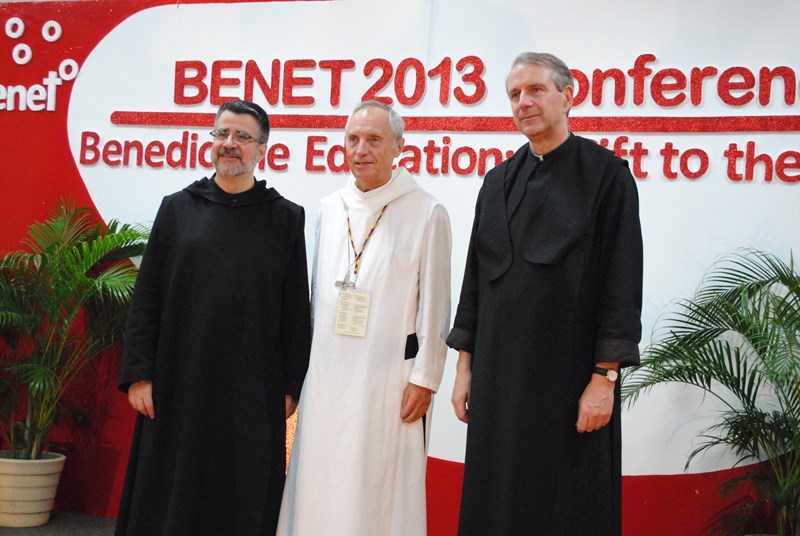
Benet 2013The International Commission on Benedictine Education (ICBE), a group of educators from Benedictine and Cistercians schools, met at the end of October (2013) in Manila. More than 150 educators assembled at the global conference (BeNET=Benedictine Educators Network).

One of the tasks of the Abbot Primate at the Manila meeting, Notker Wolf, OSB, was to appoint a new ICBE president to replace Father Christopher Jamieson, OSB, the founding president. Jamison served the ICBE for the last 10 years and he is a monk and former abbot of Worth Abbey, England. Abbot Notker elected Father Elias Lorenzo, OSB, a monk of Saint Mary’s Abbey (Morristown, NJ) and current prior at Sant’Anselmo (Rome); Father Elias is a co-founder of the ICBE, and experienced educator, administrator and insightful preacher.

The ICBE is an organization which works to gather educators from monastery schools who follow the Rule of Saint Benedict. According to the tradition of the Church, monasteries are independent entities and often have no network of collaboration, unlike the Salesians and the Jesuits who have international associations. These other religious orders are governed by a central body with regional provinces. They naturally have a built-in network that Benedictines and Cistercians do not have available. Hence, there has been a perceived need to assist Benedictine and Cistercian faculties in matters pertaining to a formation in the cultures of the intellect, spiritual, human, communal and work. The controlling idea is that the education is effective and fully catholic (think of the 4 marks of the Church) when not only information is shared, but real, concrete experience is shared shared. The formative process is done in the community. The ICBE is interested in wisdom, not merely knowledge.

The ICBE and the BeNET have been instrumental in advancing the formation of the laity who teach in schools where the numbers of Benedictines and Cistercians are on the decrease. But even in monastery schools with a sufficient number of monks and nuns there is a need for appropriate formation as an educator in the key of Jesus Christ through the lens and culture of Saint Benedict and Saint Scholastica, and the patrimony.

The next international meeting of the ICBE will be in Rome in 2016.

(in the picture, l-r, Fathers Elias, Notker, Christopher)

Questionnaire on Marriage for the Church

Pastoral Challenges to the Family in the Context of Evangelization

Pope Francis, our Holy Father, has called for an Extraordinary Meeting of the Synod of Bishops to discuss the Pastoral Challenges to the Family in the Context of Evangelization.

In preparation for the Extraordinary Synod of 2014, the Pope has requested widespread support from the laity through their input on challenges facing families within the context of faith.

Before completing the questionnaire, please read this Preparatory Document that includes a beautiful description of Marriage and Family.

Click here for the Preparatory Document

Click for the English questionnaire

Click for the Spanish questionnaire

All responses must be complete by December 11, 2013

Pope establishes commission for protection of minors, pastoral care of victims

Many in the world are watching the Church and how she is addressing the needs of a contemporary Church. The concerns of the College of Cardinals at the last papal election reflected the concerns of the faithful. With a good sense there a new things happening. One such innovation is Francis creating the Council of Cardinals to advise him on the administration of the Church. This work is being shared. Another innovation was announced today: a special commission will be set up to have oversight on matters pertaining to the protection of children and the pastoral care the victims. Clearly, this move of the Pope is a continuation of the good work of Pope Benedict regarding the sin and crime of sexual abuse. I pray that the commission will act decisively and with mercy and justice. 

Speaking for the Council of Cardinals, Sean Cardinal O’Malley gave this to the press at the Holy See:

At the briefing on Thursday morning, 5 December, at 1 p.m., alongside the Director of the Holy See Press Office, there participated Cardinal Sean Patrick O’Malley, archbishop of Boston, member of the Council of Cardinals, who gave the following Declaration:

“Continuing decisively along the lines undertaken by Pope Benedict XVI, and accepting a proposal presented by the Council of Cardinals, the Holy Father has decided to establish a specific Commission for the protection of minors, with the aim of advising Pope Francis on the Holy See’s commitment to the protection of children and in pastoral care for victims of abuse. Specifically, the Commission will:

1. study present programmes in place for the protection of children.

2. formulate suggestions for new initiatives on the part of the Curia, in collaboration with bishops, Episcopal conferences, religious superiors and conferences of religious superiors.

3. indicate the names of persons suited to the systematic implementation of these new initiatives, including lay persons, religious and priests with responsibilities for the safety of children, in relations with the victims, in mental health, in the application of the law, etc.

The composition and competences of the Commission will be indicated shortly, with more details from the Holy Father in an appropriate document.”

Cardinal O’Malley then quoted some of the lines of action proposed by the Commission under constitution.

* * *

The meetings will conclude tomorrow afternoon [Friday], completing the review of the different Congregations of the Roman Curia initiated during these recent days.

The next round of meetings is scheduled for the 17, 18 and 19 February, preceding the Consistory of the College of Cardinals due to take place on the 20 and 21 of the same month, and the Consistory for the Creation of new cardinals on 22 February, Feast of the Chair of St. Peter, and the solemn Concelebration of Sunday 23.
In addition, the meeting of the Secretariat of the Synod of Bishops is scheduled to take place in the days immediately after (24-25 February).

Saint John of Damascus

St John of DamascusGrant, we pray, O Lord, that we may be helped by the prayers of the Priest Saint John Damascene, so that the true faith, which he excelled in teaching, may always be our light and our strength.

Saint John of Damascus lived when the heresy of Iconoclasm prevailed, a scourge for the Church in the East (that also crept West later) during the eighth and ninth centuries. It was Saint John who fought vigorously against the decrees of Emperor Leo III which outlawed the use of icons by Christians  since they were interpreted as idols in the Old Testament.

Saint John argues in his Discourses against those who speak against the icons that man can progress from the knowledge of the senses to knowledge of the Divinity:

Since He is no longer physically present, we hear His words read from books and by hearing our souls are sanctified and filled with blessing, and so we worship, honoring the books from which we hear His words. So also, through the painting of images, we are able to contemplate the likeness of His bodily form, His miracles, and His passion, and thus are sanctified, blessed, and filled with joy. Reverently we honor and worship His bodily form, and by contemplating His bodily form, we form a notion, as far as is possible for us, of the glory of His divinity. Since we are fashioned of both soul and body…it is impossible for us to think without using physical images. Just as we physically listen to perceptible words in order to understand spiritual things, so also by using bodily sight we reach.

One of the gifts Pope Benedict XVI gave the Church was his weekly teachings on the Church Fathers. He explored the richness of the life and teachings of various Fathers of the Church. Saint John of Damascus is known to be “among the first to distinguish in the cult, both public and private, of the Christians, between worship (latreia) and veneration (proskynesis).” This distinction has been in use ever since.

The Damascene taught, more precisely, he distinguished, that our worship is due to God alone, while veneration, a lesser form of honor, but not worship, was to be given to Mary, the Mother of God, and to the saints. The Damascene, hence, taught that icons could be venerated because they were images of Christ (and the Theotokos and the saints) which called to mind and taught about the invisible God who loved humanity and entered in human history.

Bearing the wound the clergy inflict

MahoneyMother Church, the sacrament of Jesus Christ on earth bears the wounds inflected on her by her clergy.

I cannot say whether this story, “For Roger Mahoney, clergy abuse cases were a threat to agenda,” published by the LA Times is without bias, but if it is objective in reporting the facts, then we have even more opportunities to pray, and to offer sacrifice for the offenses of the Catholic clergy; our education on the matter is not over, and we ought not to be complacent.

That the reporters and not Church hierarchy has written about this subject is indeed amazing. Say what you will about the media, the Church does owe a debt of gratitude for shedding light on a dark point of our history. I don’t think it is an exaggeration to say that if the media didn’t write about the abuse and the attitude of the bishops toward the Church –a la what you see in Cardinal Mahoney– little change would have happened. It must be recognized with a clear voice that the Catholic Church is charting a path to resolution and healing, a path that many secular institutions have yet to walk.

Mercy is required –Jesus the Good Shepherd teaches us this. Pope Francis is the current face of God’s tenderness for the victims and victimizers. Mercy for the victims, law enforcement officials, healthcare professionals, the laity of who give lives to the following Jesus as faithful members of the Church, and the clergy.

In 2007, the then Prefect of the Congregation of the Clergy, Cardinal Claudio Hummes, wrote a letter to the bishops of the world asking for a spiritual work to aid concrete actions in assisting those affected by clergy sex abuse. To date, few cenacles of prayer have been established. Where I live, Cardinal Hummes’ letter is a dead letter, seemingly completely ignored by the bishops (at least in the USA). So that you know what the cardinal is looking for,

We are asking, therefore, all diocesan Ordinaries who perceive in a special way the specificity and irreplaceability of the ordained ministry in the life of the Church, together with the urgency of a common action in favour of the ministerial priesthood, to become an active part and promote – in the different portions of the People of God entrusted to them – , veritable cenacles in which clerics, religious and lay people – united among themselves in the spirit of true communion – devote themselves to prayer, in the form of continual eucharistic adoration, also in the spirit of genuine and real reparation and purification.

 May the horrible history of Roger Mahoney be an invitation for all of to make conversion a priority.

Pope calls for prayer for kidnapped Syrian nuns

As a follow-up to a blog I made the other day, “Islamist rebels control Monastery of St Thecla, Maaloula, Syria,” there is this call for spiritual closeness, prayer, for the plight of the Syrian nuns and some lay collaborators by Pope Francis.

Read the brief note here. Listen to the brief  Vatican Radio report is here.

Here is the perspective of Bishop Antoine Audo of Aleppo (Audo is the bishop for the Chaldeans).

A few other reports have been filed on AsiaNews.it: here and here.

Mary, Queen of Peace, pray for the nuns and all Christians in Syria.
Saint Ephrem the Syrian, pray for us.

Advent of the Heart

Alfred Delp Advent of the HeartIf you are looking for spiritual reading for Advent, but dare I say, for life, I would recommend a book by Jesuit Father Alfred Delp, Advent of the Heart: Season Sermons and Prison Writings, 1941-1944 (Ignatius Press, 2006).

Spiritual reading expands the mind and the heart; it challenges our sense of complacency and comfort; spiritual reading pushes back the boundaries of ignorance.

Born in 1907, Alfred Delp was a baptized Catholic and raised in the Lutheran community until he was 14 when he reverted to the practice of Catholic faith. He joined the Society of Jesus in 1926 and ordained a priest in 1937. The Society missioned Delp to work as an editor and then as a pastor of souls.

Father Delp was an outspoken critic of the Nazi regime and a leader in the Resistance movement. The powers that be accused Delp of conspiring against the Nazi party –he was tortured, imprisoned, and executed on February 2, 1945.

Advent of the Heart contains some his meditations from prison during the Advent season as well as his sermons he gave on the season of Advent at his parish in Munich.

The publisher writes,

His [Delp’s] approach to Advent, the season that prepares us for Christmas, is what Fr. Delp called an “Advent of the heart.” More than just preparing us for Christmas, it is a spiritual program, a way of life. He proclaimed that our personal, social and historical circumstances, even suffering, offer us entry into the true Advent, our personal journey toward a meeting and dialogue with God. Indeed, his own life, and great sufferings, illustrated the true Advent he preached and wrote about.

 From his very prison cell he presented a timeless spiritual message, and in an extreme situation, his deep faith gave him the courage to draw closer to God, and to witness to the truth even at the cost of his own life. These meditations will challenge and inspire all Christians to embark upon that same spiritual journey toward union with God, a journey that will transform our lives.