Category: Saints
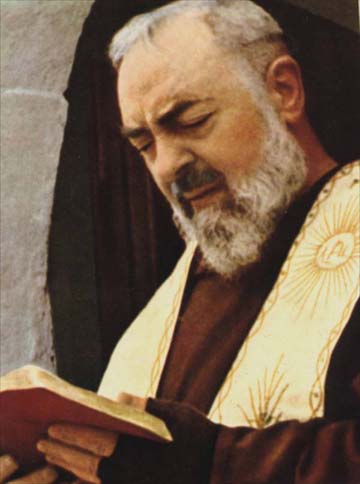
Saint Pio of Pietrelcina
The question I am asking myself: is it possible to follow this man? Alternately, Can I even think that it is possible to be a man like Padre Pio, and seek after God without reservation? What Padre Pio has left us is a clear model of holiness and a path to walk. Holiness here is not meant to be an artificial , showy display of piety (beating the breast, hours of Adoration of Eucharistic adoration, days of fasting, no bathing, etc) but it is a way of life where we shed everything that is not ourselves, living in the manner that is coresponds to the way God the Father has educated us through His Son, Jesus (read the NT). Padre Pio’s ministerial life as a priest and as a professed Franciscan Capuchin focussed on the sanctification of souls. No greater work needed his attention and energy. The path given us to walk by Padre Pio is one that leads us back to God hearing the words of Jesus: I love you, I have mercy on you no matter what. Three tools to use on this path: prayer, confession and charity. Beauty and joy will shine through our conversation with God and by our love. If you really want to know more about the path Pio gives us, read what the Pope spoke in 2009 when he made a pilgrimage to the relics of Saint Pio:
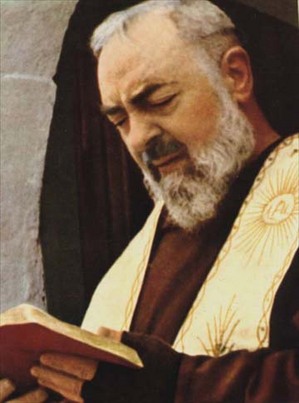
Some saints have lived intensely and personally this experience of Jesus. Padre Pio of Pietrelcina is one of them. A simple man of humble origins, “seized by Christ” (Phil. 3:12) — as the Apostle Paul writes of himself — to make of him an instrument chosen by the perennial power of his cross: power of love for souls, of forgiveness and of reconciliation, of spiritual paternity, of effective solidarity with those who suffer. The stigmata, which marked his body, united him closely to the Crucified and Risen One. A true follower of St. Francis of Assisi, he made his own, like the Poverello, the experience of the Apostle Paul which he describes in his letters: “I have been crucified with Christ and I no longer live, but Christ lives in me” (Gal 2:20), or: “in us death is at work, but in you life” (2 Cor 5, 12). This does not mean alienation, loss of personality: God never annuls that which is human, but he transforms it with his Spirit and he ordains it to the service of his plan of salvation. Padre Pio kept his natural gifts, and even his own temperament, but he offered everything to God, who has been able to freely use them to extend the work of Christ: to proclaim the Gospel, forgive sins and heal the sick in body and spirit.
As it was for Jesus, the real struggle, the radical combat Padre Pio had to sustain, was not against earthly enemies, but against the spirit of evil (cf. Ephesians 6, 12). The biggest “storms” that threatened him were the assaults of the devil, against which he defended himself with “the armor of God” with “the shield of faith” and “the sword of the Spirit, which is the word of God” (Ephesians 6:11,16,17). Remaining united to Jesus, he always kept in mind the depths of the human drama, and because of this he offered himself and offered his many sufferings, and he knew how to spend himself in the care and relief of the sick, a privileged sign of God’s mercy, of his kingdom which is coming, indeed, which is already in the world, of the victory of love and life over sin and death. Guide souls and relieve suffering: thus we can sum up the mission of St. Pio of Pietrelcina, as the servant of God, Pope Paul VI said about him: “He was a man of prayer and suffering” (To the Capuchin Chapter Fathers, 20 February 1971).
Pope Benedict XVI
Homily during the 2009 visit to the Shrine of Saint Pio
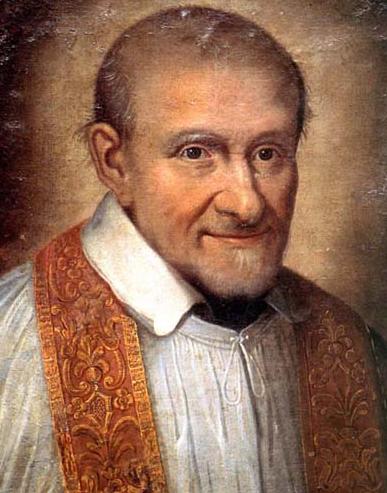
Saint Matthew, apostle
Matthew was an accomplished scribe, well versed in the law of God. With all his heart he studied the law of the Lord, with whose help he lived as he taught. The gospel of the glory of God is Matthew’s. With all his heart he studied the law of the Lord, with whose help he lived as he taught. (Responsory, Office of Readings)
The first reading from the New Testament for the feast of the Apostle Saint Matthew is stunningly beautiful Saint Paul’s letter to the Ephesians is a truly a love letter to the Church and this selection fittingly captures what it means to be an apostle of the Lord. Consider….
“I, the prisoner in the Lord, implore you to lead a life worthy of your vocation. Bear with one another charitably, in complete selflessness, gentleness and patience. Do all you can to preserve the unity of the Spirit by the peace that binds you together. There is one Body, one Spirit, just as you were all called into one and the same hope when you were called. There is one Lord, one faith, one baptism, and one God who is Father of all, over all, through all and within all.
Saints Andrew Kim Taegon and Paul Chong Hasang and companions
Today is the feast of the 19th century Saints Andrew Kim and Paul Hasang and their 103 companions. Kim is the first Korean born Catholic priest! He also followed his father as a martyr for the faith. Andrew was beheaded after being tortured in 1846. These saints were raised to the altars by Pope John Paul II in 1984.
Saint Moses
Commemoratio sancti Moysis, prophetae, quem Deus elegit, ut populum in Aegypto oppressum liberaret et in terram promissionis adduceret; cui etiam in monte Sina sese revelavit dicens: “Ego sum qui sum”, atque legem proposuit, quae vitam populi electi regeret. Ille servus Dei in monte Nebo terrae Moab coram terra promissionis plenus dierum obiit.
Saint Gregory the Great
For Gregory the Great, a hinge figure between the ancient world — the Senate of Rome last met while Gregory was the city’s bishop — a hinge between the ancient world and the grand experiment called Christendom, for Gregory this awareness that to look upon the face of Christ brought knowledge of God inspired an extensive exploration of Scripture to discern how God would have us live, how the Church and its leaders could best serve those seeking to know Christ Jesus and the Father. Since rightful authority comes from God, Gregory reasoned, its exercise must ever include a pastoral intent.
Father James Flint, OSB
Saint Procopius Abbey
3 September 2011
Let us pray for the Benedictine monks of Portsmouth Abbey, Portsmouth, Rhode Island, on this their abbey’s patronal feast day. May God prosper the work of their hands!
You may also be interested in the 2010 blog post that has a hymn to Saint Gregory the Great by J. Michael Thompson.
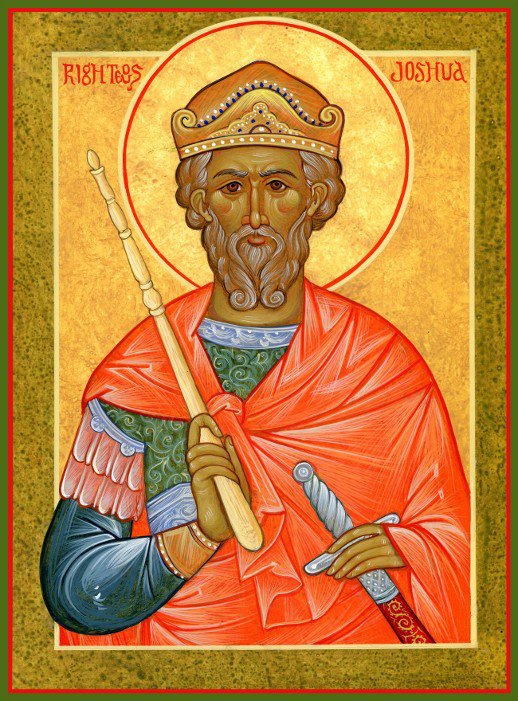
Saint Joshua
The Roman Martyrology notes Saint Joshua’s feast day today. You remember him, Joshua, son of Nun, servant of the Lord, who became inspired by the Holy Spirit after Moses laid hands on him and who led the Israelites into the Promised Land. The Righteous Joshua is said to have lived for a 110 years reposing c. 1440 BC.
Saint Jeanne Jugan
Today’s feast is probably of a little known saint, Saint Jeanne Jugan (1792-1879). Her’s a remarable life of grace and heroic virtue.
“…Jeanne Jugan was concerned with the dignity of her brothers and sisters in humanity whom age had made more vulnerable, recognizing in them the Person of Christ himself. “Look upon the poor with compassion,” she would say, “and Jesus will look kindly upon you on your last day.” Jeanne Jugan focused upon the elderly a compassionate gaze drawn from her profound communion with God in her joyful, disinterested service, which she carried out with gentleness and humility of heart, desiring herself to be poor among the poor. Jeanne lived the mystery of love, peacefully accepting obscurity and self-emptying until her death. Her charism is ever timely while so many elderly people are suffering from numerous forms of poverty and solitude and are sometimes also abandoned by their families. In the Beatitudes Jeanne Jugan found the source of the spirit of hospitality and fraternal love, founded on unlimited trust in Providence, which illuminated her whole life. This evangelical dynamism is continued today across the world in the Congregation of Little Sisters of the Poor, which she founded and which testifies, after her example, to the mercy of God and the compassionate love of the Heart of Jesus for the lowliest. May Saint Jeanne Jugan be for elderly people a living source of hope and for those who generously commit themselves to serving them, a powerful incentive to pursue and develop her work!
Pope Benedict XVI
Canonization homily
11 October 2009
A feast day slide show done by the Little Sisters of the Poor. You can read more about Saint Jeanne Jugan here.
Beheading of Saint John the Baptist
O God, who willed that Saint John the Baptist should
go ahead of your Son both in birth and in death, grant that as he died a Martyr
for truth and justice, we, too, may fight hard for the confession of what you
teach.
doubt that blessed John suffered imprisonment and chains as a witness to our
Redeemer, whose forerunner he was, and gave his life for him. His persecutor
had demanded not that he should deny Christ, but only that he should keep
silent about the truth. Nevertheless, he died for Christ. Does Christ not say:
“I am the truth”? Therefore, because John shed his blood for the truth,
he surely died for Christ.
witness to the coming birth, preaching and baptism of Christ, and by his own
suffering he showed that Christ also would suffer. Such was the quality and
strength of the man who accepted the end of this present life by shedding his
blood after the long imprisonment. He preached the freedom of heavenly peace,
yet was thrown into irons by ungodly men. He was locked away in the darkness of
prison, though he came bearing witness to the Light of life and deserved to be
called a bright and shining lamp by that Light itself, which is Christ.
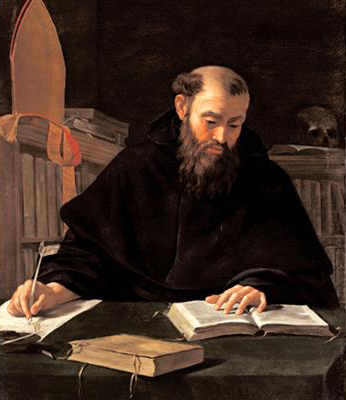
Saint Augustine of Hippo
Christ humbled himself, you have something, Christian,
to latch onto. Christ became obedient. Why do you behave proudly?
Augustine