Saint Peregrine Laziosi

St PeregrineOn this feast of Saint Peregrine, the Church prays:

Eternal Father, I wish to honor St. Peregrine, and I give Thee thanks for all the graces Thou hast bestowed upon him. I ask Thee to please increase grace in my soul through the merits of this saint, and I commit the end of my life to him by this special prayer, so that by virtue of Thy goodness and promise, St. Peregrine might be my advocate and provide whatever is needed at that hour. Amen

A biography of the Saint that asks God to cure cancer:

Today, May 16, we celebrate the feast of Saint Peregrine Laziosi (1260-1345), priest, and patron saint of those suffering with cancer, AIDS, and other serious diseases. Saint Peregrine was miraculously cured during his lifetime of cancer, through his devotion to the suffering Jesus on the Cross. Saint Peregrine is a reminder of the gracious love and healing of a personal relationship with Jesus. He is invoked today to intercede in the healing and comfort of those struggling against disease.

Peregrine Laziosi was born into a wealthy family at Forli, Italy. He spent a worldly youth active in politics, and was originally a member of the anti-papal party —a strongly anti-Catholic movement in Italy. During one uprising, Peregrine struck Saint Philip Benizi, who had been dispatched by the Pope to bring peace, in the face. When Philip offered the other cheek to his young attacker, Peregrine was so overcome that he repented and converted immediately to Catholicism.

Shortly thereafter, Peregrine received a miraculous vision from Our Blessed Mother, in which she instructed him to journey to Siena, Italy, and join the Servite Order there. He left his wealth and status and did as Mary instructed, joining the Servites. Once a Servite, Peregrine imposed strict penances on himself as reparation for his earlier actions, including the observation of strict silence and solitude, and refusal to sit down. It is believed that Peregrine stood for approximately 30 years, which eventually led to illness.

After his training and ordination, he was assigned to his hometown, Forli, and there founded a new house of the Servite Order. He was a gifted preacher, and brought many to the faith. He was similarly a patient, gentle, and respected confessor, and many traveled a great distance to meet with him in the confessional. When not interacting with others or preaching, he maintained his vow of silence.

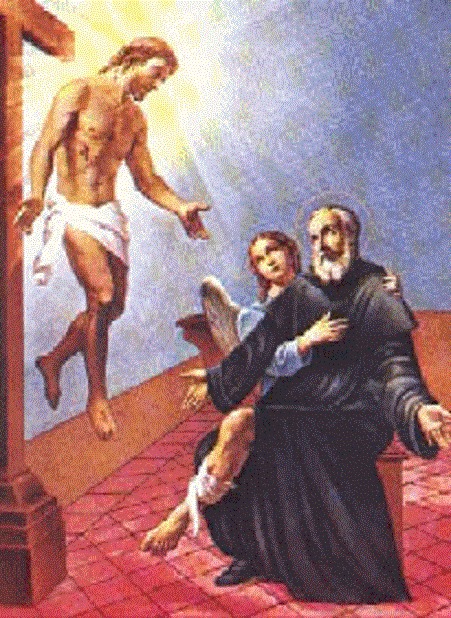
Saint Peregrine eventually developed difficulty with his circulation, likely due to his constant standing, which led to cancer of the foot. This aggressive cancer began spreading up his leg, and with no cure possible, his doctors scheduled an amputation of the limb. Saint Peregrine spent the night before his surgery in fervent prayer before the crucified Christ. As he drifted off to sleep while praying, he experienced a vision of Jesus, coming off the Cross, and touching the afflicted area. The next morning, when he awoke, his cancer had been completed cured. Saint Peregrine went on to live another 20 years, serving the Lord and his community.

Peregrine died at the age of 85, and was canonized by Pope Benedict XIII. He reminds us of the miraculous grace of conversion and healing that is possible through Our Lord. An adamant opponent to the Church, Saint Peregrine became a powerful preacher, leading many to the faith. He turned to the Lord, and was richly rewarded. How might we experience conversion today?

Saint Peregrine, thou hast given us an example to follow; as a Christian thou wert steadfast in love; as a Servite thou wert faithful in service; as a penitent thou humbly acknowledgedst thy sin; afflicted thou borest suffering with patience. Intercede for us, then, with our Heavenly Father so that we steadfast, humble and patient may receive from Christ Jesus the grace we ask.

Saint Mary of the Incarnation

St Mary of the IncarnationSaint Mary of the Incarnation was Widow, Ursuline nun (1599-1672). She was canonized on 2 April 2014 by Pope Francis. Born in Francis was purified in Canada and made a saint God for our redemption. Crucially, she reminds us of the question to whom do we belong. Hopefully we can say “we belong to Christ Jesus.”

Marie Guyart Martin, fourth child in a family of seven children, was born in Tours, France. When very young, she had a dream that moved her profoundly. I was about seven years old, she wrote. In my sleep one night, it seemed to me that I was in a schoolyard… Suddenly the skies opened, and Our Lord emerged, advancing toward me! When Jesus neared me, I stretched out my arms to embrace Him. Jesus embraced me affectionately and asked me: Do you want to belong to Me?’ I answered, Yes.’ She was unceasingly to repeat that yes, the key to her entire life, amid joys and afflictions.

When Mary was eighteen, her parents believed she was ready to get married. She obeyed and married Claude Martin, a master silk worker. In 1619 she gave birth to a son, who was one day to become Dom Claude Martin. Six months later, the Lord marked her with the seal of His predilection: she was visited by the cross of widowhood, with all its trials. Mary of the Incarnation felt strongly attracted to the religious life, be she realized that God’s hour had not yet struck.

Several very difficult years ensued. Having found employment in her sister’s house, she became the slave of the servants of the household. In this harsh situation, our Saint practiced the virtues of humility, charity, patience and total self-forgetfulness to the point of heroism. She remained constantly in the holy presence of God, even amid the most absorbing occupations.

At the age of twenty-one, though still in the lay state, she made the vows of poverty, chastity and obedience. In 1625, God gratified her with a vision of the Holy Trinity.

When Madame Martin was thirty-one, the call of God to leave everything echoed imperiously in her soul. On January 25, 1631, she bid farewell to her elderly father, and overcoming the pangs of her maternal heart, she entrusted her eleven-year-old son to her sister’s care. This absolute detachment, which makes her a model for parents, was one of the most heroic and sublime acts in the life of Saint Mary of the Incarnation. The courageous mother told her child, God wills it, my son. If we love Him, we should will it, too. It is up to Him to command, and up to us to obey. With a broken heart, she was finally able to enter the Ursuline Novitiate in Tours.

Eight years later, when she had reached the age of forty, Mary of the Incarnation embarked at Dieppe with some companions on a ship headed for Canada. She is among the very first nuns to have come to America. At the time, such a missionary adventure was regarded as an innovation. There was no room for anything less than heroism for these pioneers of the Church of New France, who united the cloistered life to the missionary life. Mary of the Incarnation wrote, Here we encounter a kind of necessity to become saints. We must either die or fully consent to it.

She studied the extremely difficult Indian languages and wrote an Algonquin-French dictionary, as well as an Iroquois dictionary and catechism. Her work of predilection consisted in teaching little Indian girls, whom she called the delight of my heart and the most beautiful jewels in my crown.

Sickness, humiliation and persecution arising from respectable persons, endless interior sufferings and crosses of all sorts abound in the life of our Saint. They bear a striking testimony to the spirit of holiness that reigned in her soul, which was totally surrendered to the love of God. The highest summits of contemplation to which the Holy Spirit drew her did not prevent Mary of the Incarnation from being an extraordinary woman of action, gifted with incomparable common sense.

She gave up her beautiful soul to God at the age of 72. As a result of the successive vocations to which God called her, this admirable soul remains a model for spouses, parents, lay apostles and religious alike. Mary of the Incarnation has very rightly been named the Teresa of New France. She is ranked among the greatest glories of Canada and regarded as the true Mother of the country.

O.D.M. article; bi-monthly magazine Univers, July-August 1980, No. 4, p. 6

St Gianna Beretta Molla

Saint Gianna Beretta Molla, whose feast day is today and who is widely considered one this century’s key saints.

She said, “The secret of happiness is to live moment by moment and to thank God for all that he, in his goodness, sends to us day after day.”

Blessings to you on Saint Gianna’s feast!

Blessed Cesar de Bus

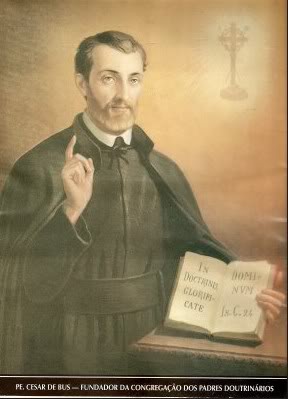
blessed cesar de busLast year I heard about a French Blessed, a modern patron of catechists, Father Cesar de Bus, beatified in 1975 by Pope Paul VI. This same pope recommended to the Church this witness for our following.

De Bus has an interest story for us to think about, and I think we in the USA ought to make the effort to allow his good name and missionary zeal flourish in our work of passing on the faith.  Connecting with de Bus in an real way is crucial for teaching the faith especially to children. We ought to invoke Blessed Cesar de Bus for those involved with the work of catechesis. A friend wrote, Father Ambrose, delivered the following homily on de Bus.

“…saintly man named César de Bus, who is a splendid patron and guide for all who seek to hand on the Catholic faith. He was born in Cavillon, France, on February 3, 1544, the seventh of thirteen children. Though he had a good Jesuit education, he was a worldly young man who couldn’t decide between the career of a soldier and that of a writer. In the end, he decided for the military. It was the time of the bloody Wars of Religion in France, when it hung in the balance whether France would remain Catholic or become Protestant. And yet, despite fighting in the Catholic cause, César himself led a life of dissipation: he was known as a party boy, as a dandy, as one who wanted to make his way at the royal court in Paris. He also still had literary ambitions.

Now César’s brother was a priest, a cathedral canon with a good income. When his brother died, César succeeded in gaining the income from his late brother’s position without himself actually being a priest or doing anything in return for the income. It was an abuse that often happened in Catholic France in those days: a layman would hold a clerical position simply as a source of revenue. Just in case you don’t know, the wasteful and worldly squandering of the Church’s goods is not exactly a new problem. It was well-known and widely criticized in the 16th century, too.

But then something unexpected happened. César had come to know an illiterate but very pious servant girl named Antoinette Reveillade. This young woman had persuaded César to read to her the lives of the saints, even while Antoinette fervently and in tears begged God that death would not find César in mortal sin. He at first shrugged off her concern. Then, one night, as César was on his way to a masked ball, he passed a shrine where a light burned before the image of Our Lady. Suddenly he remembered Antoinette, and was stricken with remorse and felt an overwhelming desire to repent and amend his life. He thought, “How can I recommend myself to God while I am on the way to offend Him?” In the words of one of César’s biographers, “One tempestuous night, the All-powerful God, the King of Glory, encountered the worldly chevalier César de Bus, obstinate in sin, and conquered him.” There and then, like St. Paul on the road to Damascus, he was converted to Christ.

César resumed at last his studies for the priesthood and was ordained a priest at last in 1582 at the age of thirty-eight. He read the life of the Catholic Reformer St. Charles Borromeo and became convinced that widespread religious ignorance was the cause of many scandals and failures among French Catholics. But César didn’t just complain or wring his hands: he did something about it. 

First, he converted his cousin Jean-Baptiste back to the Catholic faith. Jean-Baptiste had become a convinced Calvinist because of the impressive zeal and strictness shown by French Protestants, who so often put the Catholics to shame.  After Jean-Baptiste returned to the Church, he, too, was ordained a priest. César and his cousin then dedicated the rest of their lives to the work of catechesis, founding an order for that purpose called the Fathers of Christian Doctrine and also a similar order for women. After his conversion, Blessed César directed his energies to two things: penance for his earlier life and the teaching of doctrine. And yet, it was actually an unlettered servant girl’s prayers that had led to the grace of his conversion. This reminds us that it is only the love of God and of neighbor that can inspire the teaching of sound doctrine and make it fruitful in our lives. And yet, true charity cannot be content that those whom Christ has redeemed by his Most Precious Blood should be ignorant of divine truth. Ignorance is not bliss, in religion or in anything else.

Blessed César died on 15 April 1607 and was beatified in 1975. At the beatification, Pope Paul VI (who will himself soon be beatified) had this to say about the parallels between our age and that of Blessed César:

[Our time] is a period in which the world is in crisis, as formerly, and in which most values, even the most sacred ones, are rashly questioned in the name of freedom, so that many people have no longer any point of reference, in a period in which danger comes certainly not from an excess of dogmatism but rather from the dissolution of doctrine and the nebulousness of thought… It seems to Us that an additional effort should be courageously undertaken to give the Christian people, who are waiting for it more than is thought, a solid, exact catechetical base, easy to remember. We well understand that it is difficult today to adhere to the Faith, particularly for the young, a prey to so many uncertainties. They have the right at least to know precisely the message of Revelation, which is not the fruit of research, and to be the witnesses of a Church that lives by it.

César de Bus had seen how religious divisions and social upheaval had devastated the faith of many. Amid all the fighting about religion between Catholics and Protestants—and among French Catholics, too—, there was considerable neglect of the actual practice of the faith.

Surely, with the Venerable Servant of God Paul VI, we can see the parallels with the state of the Catholic Church after the Second Vatican Council. As in the 16th century, there are the vast multitudes of Catholics, here and in Latin America, who have become Protestants because of our weakness in catechesis and evangelization. Is it any wonder that so many Catholics respond to the evangelical preachers who still have the courage to proclaim without dilution that Christ alone is the Way, the Truth, and the Life?  Blessed César saw these very failings among Catholics in France four hundred years ago.

And, like that great saint, we can do something about the situation. Think of that amazing story of Blessed César’s conversion and ask his intercession for a renewed zeal for the teaching of sound doctrine in our pulpits, our schools, and our catechetical programs.

In the words of the Letter to the Hebrews, let us “lift up our drooping hands and strengthen our weak knees” (Heb 12.12), for the Lord himself is calling us to work in his vineyard.

Saint Casimir

St CasimirTwo saints in a row –Saint Katharine Drexel yesterday and Saint Casimir today–we hear in the opening prayer the theme of holiness and justice. On the surface this is nothing new, nor ought it be surprising. Lent is a time of conversion and a reorientation toward acts of charity. Scripture exhort us to live in this manner, and the saints give good example. How is your orientation toward the universal call to holiness and charity?

From the life of Saint Casimir written by an contemporary

By the power of the Holy Spirit, Casimir burned with a sincere and unpretentious love for almighty God that was almost unbelievable in its strength. So rich was his love and so abundantly did it fill his heart, that it flowed out from his inner spirit toward his fellow men. As a result nothing was more pleasant, nothing more desirable for him, than to share his belongings, and even to dedicate and give his entire self to Christ’s poor, to strangers, to the sick, to those in captivity and all who suffer. To widows, orphans and the afflicted, he was not only a guardian and patron but a father, son and brother. One would have to compose a long account to record here all his works of love and dedication for God and for mankind. Indeed, it is difficult to imagine or to express his passion for justice, his exercise of moderation, his gift of prudence, his fundamental spiritual courage and stability, especially in a most permissive age, when men tend to be headstrong and by their very natures inclined to sin.

Daily he urged his father to practice justice throughout his kingdom and in the governance of his people; and whenever anything in the country had been overlooked because of human weakness or simple neglect, he never failed to point it out quietly to the king.

He actively took up the cause of the needy and unfortunate and embraced it as his own; for this reason the people called him the patron of the poor. Though the son of a king and descendant of a noble line, he was never unapproachable in his conversation or dealings with anyone, no matter how humble or obscure.

He always preferred to be counted among the meek and poor of spirit, among those who are promised the kingdom of heaven, rather than among the famous and powerful men of this world. He had no ambition for the power that lies in human rank and he would never accept it from his father. He was afraid the barbs of wealth, which our Lord Jesus Christ spoke of as thorns, would wound his soul, or that he would be contaminated by contact with worldly goods.

Many who acted as his personal servants or secretaries are still alive today; these men, of the highest integrity, who had personal knowledge of his private life, testify that he preserved his chastity to the very end of his life.

Saint Katharine Drexel

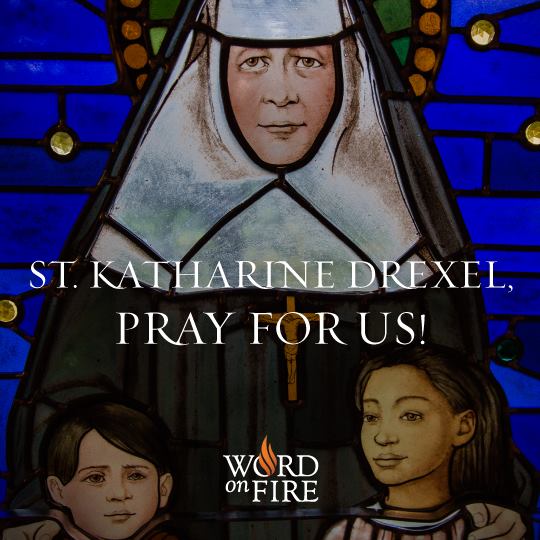
DrexelSaint Katharine Drexel (1858 – 1955) was born in Philadelphia to a rich banking family. In 1889, at the age of 33, with the desire burning in her heart, she founded the Sisters of the Blessed Sacrament, dedicated to mission work among Indians and black people. Drexel spent her entire life and her entire fortune to this work, opening schools, founding a university, and funding many chapels, convents and monasteries. Drexel travelled well in the USA.

She died on 3 March 1955, by which time there were more than 500 Sisters teaching in 63 schools throughout the United States.

“If we wish to serve God and love our neighbor well, we must manifest our joy in the service we render to Him and them. Let us open wide our hearts. It is joy which invites us. Press forward and fear nothing.”

Saint Gabriel of Our Lady of Sorrows

St Gabriel of Sorrows

There is something very special about Saint Gabriel of Our Lady of Sorrows that we ought to pay attention to today.

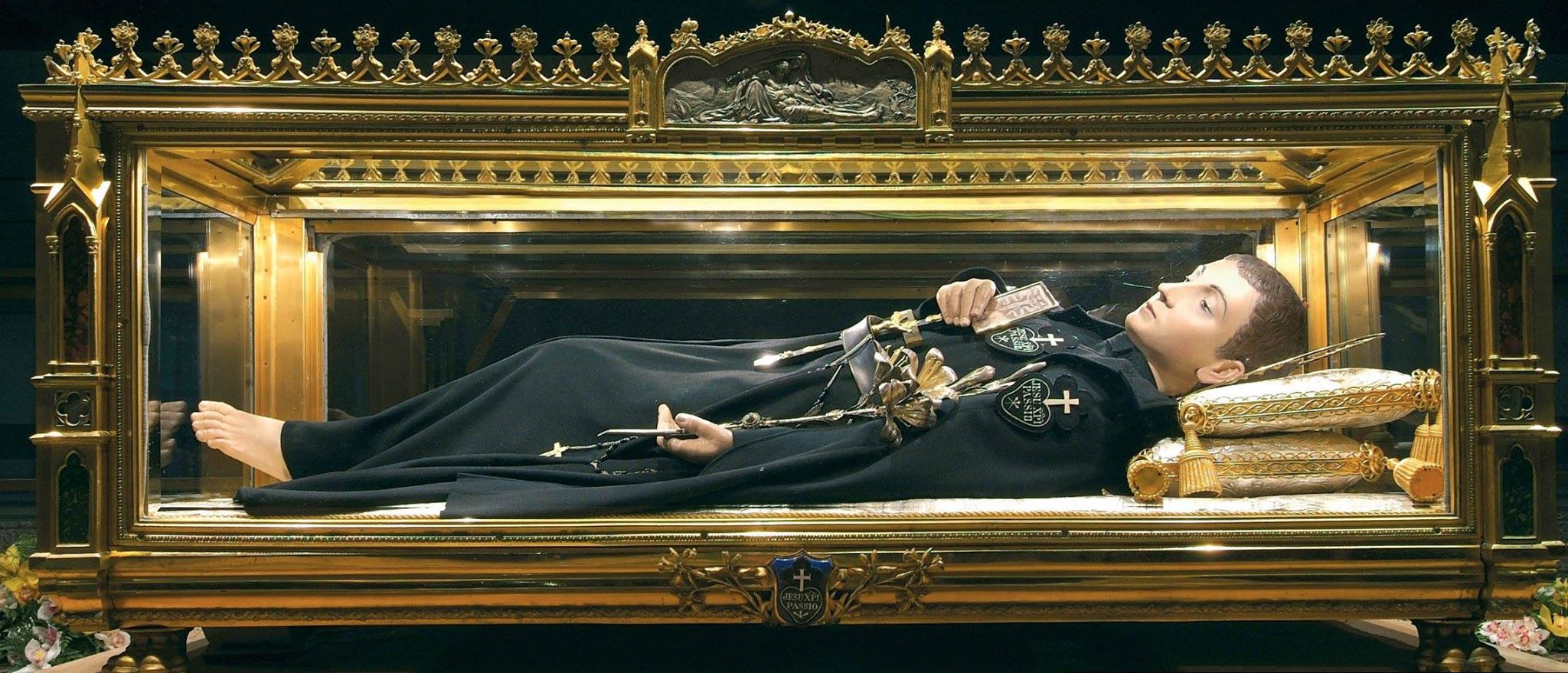
Saint Gabriel (1838-1862) was born at Assisi in 1838. He was guided by Our Lady into the Passionist Order founded by Saint Paul of the Cross, and became a veritable Apostle of Her Sorrows. He was a very great and truly contemplative soul, whose only preoccupation was to unite himself to God at all times. He allowed no distractions to enter his spirit, and even though Italy, his country, was in a state of ferment when he entered religion, he wanted to know nothing of it.

The way to attain union with our Savior and our God was, for Saint Gabriel, as for Saint Louis de Montfort, his Heavenly Mother. He wrote home to his father, from the first month of his noviciate, Believe your son, whose heart is speaking by his lips; no, I would not exchange one single quarter of an hour spent near the Most Blessed Virgin Mary, our consolatrix, our protectress and our hope, for a year or several years spent in the diversions and spectacles of the earth. Among his resolutions was that of visiting Jesus in the Most Blessed Sacrament each day, and praying for the gift of a tender and efficacious devotion to His Most Holy Mother. He wrote a beautiful Credo, worthy to be printed in letters of gold, expressing all that he believed of the Mother of God.

At twenty-four years of age Saint Gabriel died of tuberculosis, having already attained heroic sanctity by a life of self-denial and great devotion to our Lord’s Passion and the Compassion of His Mother.

Although his life was without any miraculous event, after his death in 1862 many miracles occurred at his tomb in Isola di Gran Sasso, Italy. He was canonized by Pope Benedict XV in 1920, and his feast was extended to the entire church by Pope Pius XI in 1932. He is the patron of youth, and especially of young religious.

***On leap years, the feast day of this Saint is celebrated on February 28.

Lives of the Saints for Every Day of the Year, edited by Rev. Hugo Hoever, S.O. Cist., Ph.D. (Catholic Book Publishing Co.: New York, 1951-1955)

Saint Polycarp

As a disciple of the Apostles especially Saint John the Beloved Disciple, and as bishop of Smyrna, and a friend of St Ignatius of Antioch, Saint Polycarp (+155) is a very interesting friend of Jesus. A very well-connected man.

At that Polycarp’s time among the many issues of the nascent Church was the date to celebrate the Resurrection. Polycarp travelled to Rome to confer with Pope Anicetus about the celebration of Easter. Polycarp’s importance in Church history is critical as his  writings is among the the earliest Church Fathers to survive. He bears witness to the beliefs of the early Christians and the early stages of the development of doctrine. He was martyred at the age of 86 in about 155 by being burnt to death in the stadium. The aroma of his burning flesh was that of baking bread. Some make the connection that his death was eucharistic. The blood from Polykarp’s body put the fire out. The account of his death became a new genre of writing which came to be known as Acts of the Martyrs encouraging Christians to live their lives with coherence with Christ Jesus.

21 Egyptian martyrs

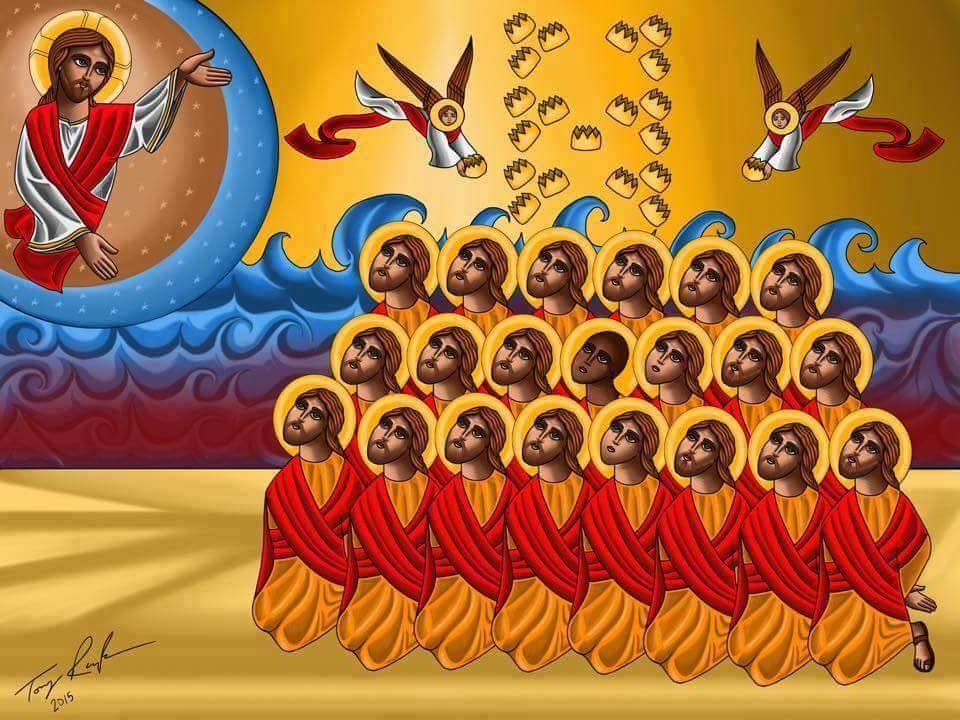
21 Egyptian Martyrs 2015The Coptic Orthodox Church announced that they recognize the 21 men killed last week in Libya by ISIS as martyrs and their have names have been inscribed into Coptic Synaxarium. This was an ecclesial act, similar to the Latin Church’s canonization, by Coptic Orthodox Pope Tawadros II.

A  Synaxarium is the equivalent to the Roman Martyrology for the Eastern Churches (each of the church has its own list of saints). As one commentator said, the 21 Egyptian martyrs are not merely for the Copts, but for all Christians. Their witness to the Christian faith is critical for all of us who find it difficult to bear the burden of Christ’s Paschal Mystery.

The Coptic Orthodox Pope stated that the martyrs will be commemorated on the 8th Amshir of the Coptic calendar, or February 15th of the Gregorian calendar. The commemoration falls on the feast day of the Presentation of Jesus at the Temple.

Something Tertullian said comes to mind:

“Kill us, torture us, condemn us, grind us to dust; your injustice is the proof that we are innocent. Therefore God suffers that we thus suffer…. a taint on our purity is considered among us something more terrible than any punishment and any death. Nor does your cruelty, however exquisite, avail you… The more often you mow us down, the more we grow in number; the blood of Christian martyrs is the seed of the Church.”

~ Tertullian in “Apologeticum (The Apology)” – writing in Carthage, North Africa c. 200 AD

The 21 martyrs are not vague group of men; each has a name and genealogy:

1. Milad Makeen Zaky
2. Abanub Ayad Atiya
3. Maged Solaiman Shehata
4. Yusuf Shukry Yunan
5. Kirollos Shokry Fawzy
6. Bishoy Astafanus Kamel
7. Somaily Astafanus Kamel
8. Malak Ibrahim Sinweet
9. Tawadros Yusuf Tawadros
10. Girgis Milad Sinweet
11. Mina Fayez Aziz
12. Hany Abdelmesih Salib
13. Bishoy Adel Khalaf
14. Samuel Alham Wilson
15. Worker from Awr village
16. Ezat Bishri Naseef
17. Loqa Nagaty
18. Gaber Munir Adly
19. Esam Badir Samir
20. Malak Farag Abram
21. Sameh Salah Faruq