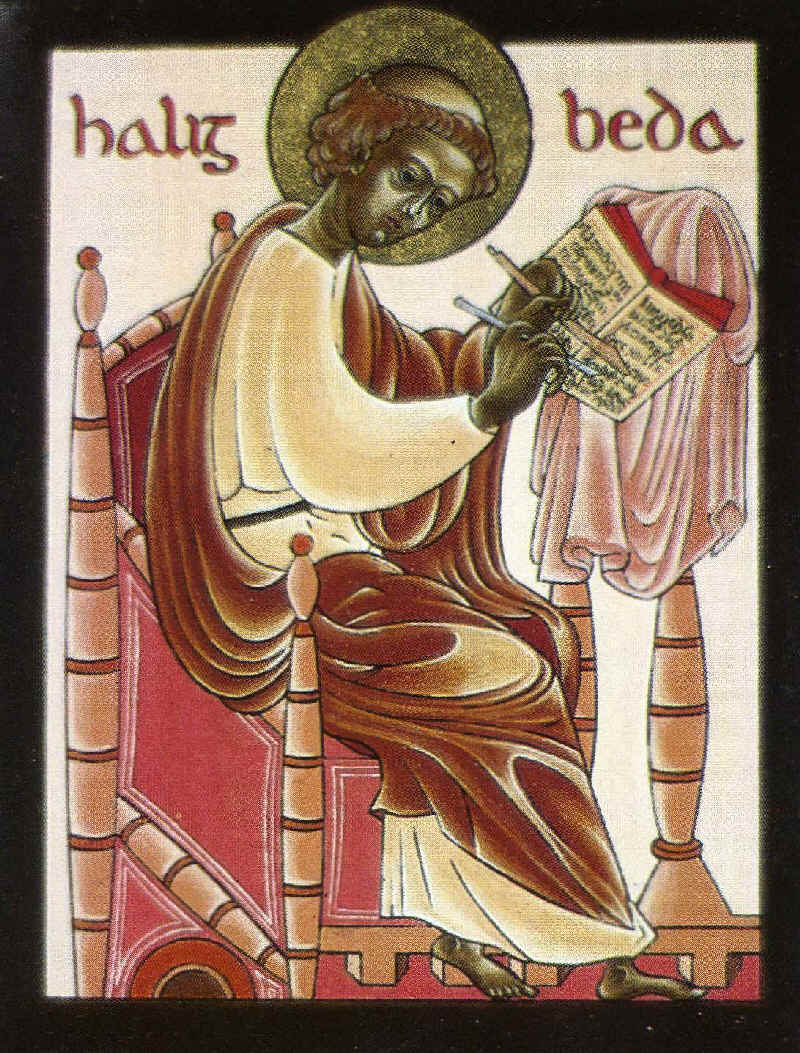
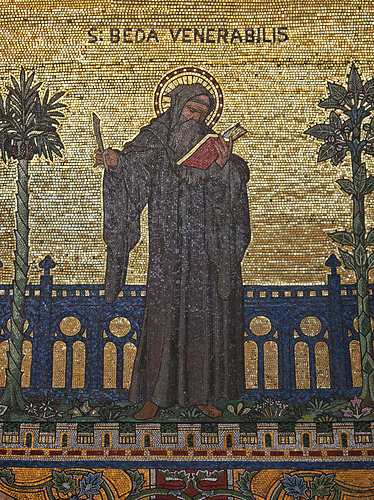
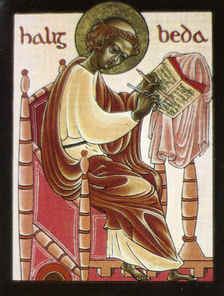
 The saint on whom we reflect today is called Bede. He was born in Northeast England, in fact in Northumbria, in the year 672/673. He himself narrates that, when he was seven years old his parents entrusted him to the abbot of the neighboring Benedictine monastery, to be educated. “In this monastery,” he recalls, “I lived from then on, dedicating myself intensely to the study of Scripture, while observing the discipline of the Rule and the daily effort to sing in church, I always found it pleasant to learn, teach and write” (Ecclesiastical History of the English People, V, 24). In fact, Bede was one of the most illustrious figures of erudition of the High Middle Ages because he was able to make use of many precious manuscripts that his abbots, who went on frequent trips to the Continent and to Rome, were able to bring back to him. His teaching and the fame of his writings enabled him to have many friendships with the principal personalities of his time, who encouraged him to continue in his work, from which so many benefited. Falling ill, he did not cease to work, always having an interior joy that was expressed in prayer and song. He concluded his most important work, The Ecclesiastical History of the English People, with this invocation: “I pray, O good Jesus, who benevolently has allowed me to draw from the sweet words of your wisdom, that I may reach you one day, source of all wisdom, and to always be before your face.” Death came to him on May 26, 735: It was Ascension day.
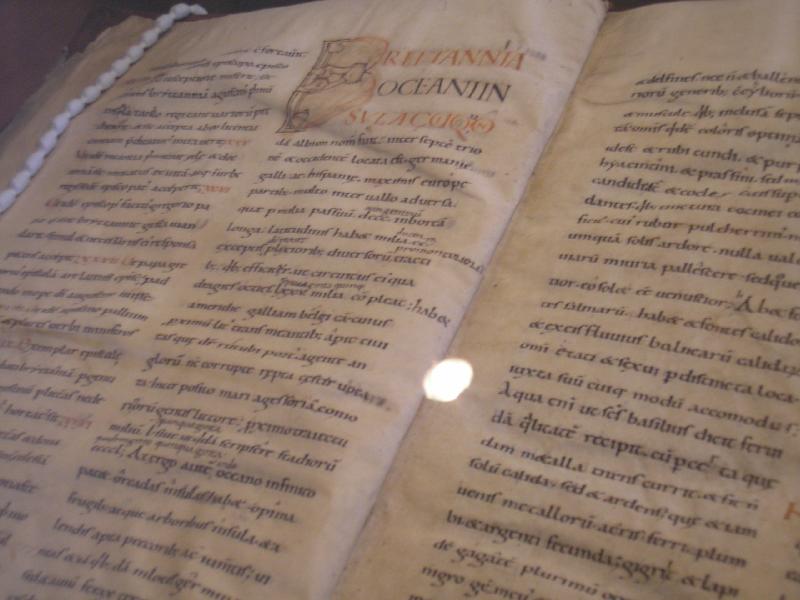
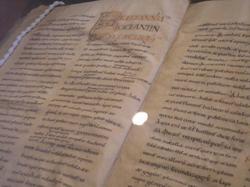
 Sacred Scriptures were the constant source of Bede’s theological reflection. Having made a careful critical study of the text (we have a copy of the monumental Codex Amiatinus of the Vulgate, on which Bede worked), he commented on the Bible, reading it in a Christological vein, namely, re-uniting two things: On one hand, he listened to what the text was saying exactly, he really wanted to listen and understand the text itself; on the other hand, he was convinced that the key to understanding sacred Scripture as the unique Word of God is Christ and with Christ, in his light, one understands the Old and the New Testament as “a” sacred Scripture.
The events of the Old and New Testament go together, they are together the path toward Christ, though expressed in different signs and institutions (it is what he calls “concordia sacramentorum”). For example, the tent of the covenant that Moses raised in the desert and the first and second temple of Jerusalem are images of the Church, new temple built on Christ and the Apostles with living stones, cemented by the charity of the Spirit. And, as was the case for the construction of the ancient temple of Jerusalem, even pagan people contributed, making available valuable materials and the technical experience of their master builders, thus apostles and masters not only from ancient Hebrew, Greek and Latin stock contributed to the building of the Church, but also new peoples, among which Bede is pleased to enumerate the Iro-Celts and the Anglo-Saxons. St. Bede witnessed the universality of the Church grow, which is not restricted to a certain culture, but is made up of all the cultures of the world which must open themselves to Christ and find in him their point of arrival.
 Another topic loved by Bede is the history of the Church. After having taken interest in the period described in the Acts of the Apostles, he reviewed the history of the Fathers of the Church and the councils, convinced that the work of the Holy Spirit continues in history. In the Cronica Maiora, Bede traces a chronology that would become the basis of the universal calendar “ab incarnatione Domini.” Up to then, time was calculated from the foundation of the city of Rome. Bede, seeing that the true point of reference, the center of history is the birth of Christ, gave us this calendar that reads history beginning with the Lord’s Incarnation. He registered the first six ecumenical councils and their development, presenting faithfully the Christian, Mariological and Soteriological doctrine, and denouncing the Monophysite and Monothelite, iconoclastic and neo-Pelagian heresies. Finally, he wrote with documentary rigor and literary expertise the already mentioned Ecclesiastical History of the English People, for which he is recognized as “the father of English historiography.” The characteristic traits of the Church that Bede loved to evidence are: a) its catholicity, as fidelity to tradition together with openness to historical developments, and as the pursuit of unity in multiplicity, in the diversity of history and cultures, according to the directives that Pope Gregory the Great gave to the apostle of England, Augustine of Canterbury; b) its apostolicity and Romanness: In this regard he considers of primary importance to convince the whole Iro-Celtic Churches and that of the Picts to celebrate Easter uniformly according to the Roman calendar. The calculation elaborated scientifically by him to establish the exact date of the Easter celebration, and thus of the entire cycle of the liturgical year, became the text of reference for the whole Catholic Church.
Bede was also an illustrious teacher of liturgical theology. In the homilies on the Sunday Gospels and those of feast days, he develops a true mystagogy, educating the faithful to celebrate joyfully the mysteries of the faith and to reproduce them consistently in life, while expecting their full manifestation of the return of Christ, when, with our glorified bodies, we will be admitted in offertory procession to the eternal liturgy of God in heaven. Following the “realism” of the catecheses of Cyril, Ambrose and Augustine, Bede teaches that the sacraments of Christian initiation make every faithful person “not only a Christian but Christ.” In fact, every time that a faithful soul receives and guards the Word of God with love, in imitation of Mary, he conceives and generates Christ again. And every time that a group of neophytes receives the Easter sacraments, the Church is “self-generated,” or to use a still more daring expression, the Church becomes “Mother of God,” participating in the generation of her children, by the work of the Holy Spirit.
Thanks to this way of making theology, interlacing the Bible, the liturgy and history, Bede has a timely message for the different “states of life”:
a) For scholars (doctores ac doctrices) he recalls two essential tasks: to scrutinize the wonders of the Word of God to present it in an attractive way to the faithful; to show the dogmatic truths avoiding the heretical complications and keeping to the “Catholic simplicity,” with attention to the small and humble to whom God is pleased to reveal the mysteries of the Kingdom.
b) For pastors, that for their part, must give priority to preaching, not only through the verbal or hagiographic language, but also valuing icons, processions and pilgrimages. Bede recommends to them the use of the vernacular, as he himself does, explaining in Northumbria the “Our Father,” and the “Creed” and carrying forward until the last day of his life, the commentary to John’s Gospel in the common language.
c) For consecrated people who are dedicated to the Divine Office, living in the joy of fraternal communion and progressing in the spiritual life through ascesis and contemplation, Bede recommends to take care of the apostolate — no one has the Gospel just for himself, but must regard it as a gift also for others — either by collaborating with the Bishops in pastoral activities of various types in favor of the young Christian communities, or being available to the evangelizing mission to the pagans, outside their own country, as “peregrini pro amore Dei.”
Placed in this perspective, in the commentary to the Canticle of Canticles, Bede presents the synagogue and the Church as collaborators in the propagation of the Word of God. Christ the Spouse desires an industrious Church, “bronzed by the fatigues of evangelization” — clear is the reference to the word of the Canticle of Canticles (1:5), where the Bride says: “Nigra sum sed formosa” (I am brown, but beautiful) — attempts to till other fields or vines and to establish among the new populations “not a provisional bell but a stable dwelling, namely, to insert the Gospel in the social fabric and the cultural institutions. In this perspective, the saintly Doctor exhorts the lay faithful to be assiduous to the religious instruction, imitating those “insatiable evangelical multitudes who did not even give the Apostles time to eat.” He teaches them how to pray constantly, “reproducing in life what they celebrate in the liturgy,” offering all actions as spiritual sacrifices in union with Christ. To parents he explains that also in their small domestic realm they can exercise “the priestly office of pastors and guides,” by giving Christian formation to the children and states that he knows many faithful (men and women, spouses and celibates) “capable of an irreproachable conduct that, if suitably pursued, could approach daily Eucharistic communion (“Epist. ad Ecgbertum,” ed. Plummer, p. 419).
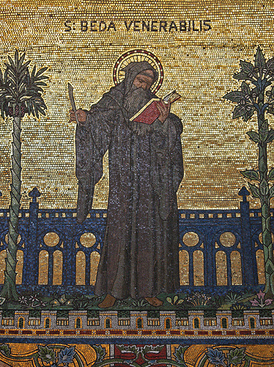 The fame of holiness and wisdom that Bede enjoyed already in life, served to merit him the title of “Venerable.” He is thus called also by Pope Sergius I, when he wrote his abbot in 701 requesting to make him come temporarily to Rome for consultation on questions of universal interest. The great missionary of Germany, Bishop St. Boniface (d. 754), requested the archbishop of York several times and the abbot of Wearmouth to have some of his works transcribed and to send him to them so that they and their companions could also enjoy the spiritual light he emanated. A century later Notkero Galbulo, abbot of St. Gall (d. 912), being aware of the extraordinary influence of Bede, equated him with a new sun that God had made arise not in the East but in the West to illumine the world. Apart from the rhetorical emphasis, it is a fact that, with his works, Bede contributed effectively to the making of a Christian Europe, in which the different populations and cultures amalgamated among themselves, conferring on them a uniform physiognomy, inspired by the Christian faith.
Let us pray that also today there be personalities of Bede’s stature, to keep the whole Continent united; let us pray so that all of us are willing to rediscover our common roots, to be builders of a profoundly human and genuinely Christian Europe.
(Wednesday General Audience, Rome, 18 February 2009)
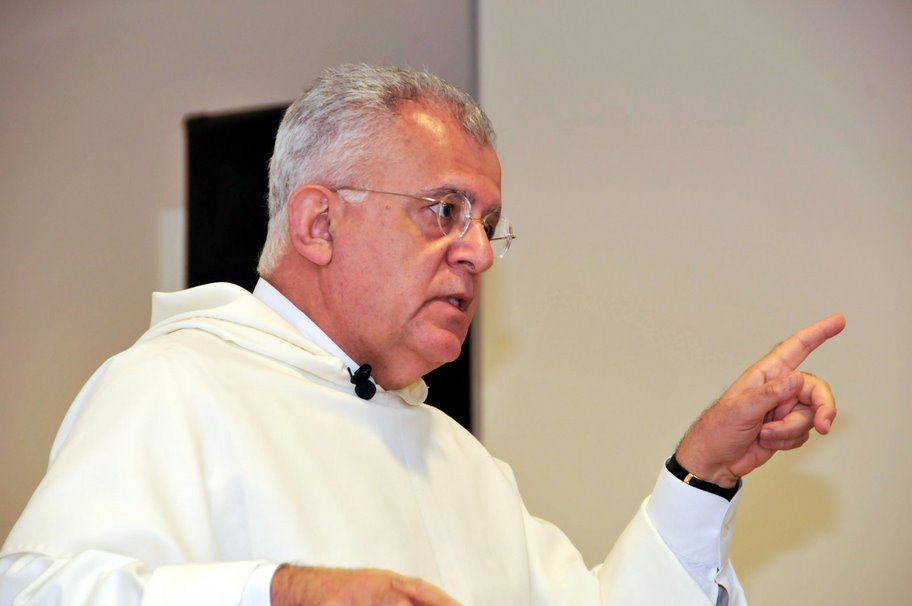 Today, the Holy Father nominated Dominican Father Joseph Augustine Di Noia, 66, as the archbishop secretary of the Congregation for Divine Worship and the Disciple of the Sacraments. He is given the archepiscopal dignity and is assigned the Titular See of Oregon City.