Christ our Light


Head of the Redeemer GBellini.jpg

In the days
since Christmastide mysteries of faith many theological matters come to mind in
knowing Jesus. All of the spiritual masters tell us that it’s crucially
important for us to come to personally know Jesus Christ, our Lord, in his true
light. The image of Christ as a light is reinforced in the baptismal rites
where we talk about the sacrament bringing us into inexpressible light. It is
also recalled in the Creed. Our enlightenment into the mystery of Jesus’
divinity continually needs our reflection, especially when the gospels of the
Transfiguration and the Resurrection are proclaimed. As Jesus is transfigured
and resurrected, so us: are Children of the Light. We know that Jesus really
lives in the light of the Trinity. There, the ultimate grace given by God the
Father is having Jesus revealed to us in his true Light. The recognition
(awareness) of this grace can only be given to those who are willing to ask for
it: “ask and it will be given to you,” the Lord says. 

The Maronite Church
proclaims the joy Christmas and the belief in Christ as Light of the Cosmos at
the Sedro for the Sundays of Epiphany: 

You have clothed us with your baptism:  the robe of glory and the seal of the
holy Spirit. You have called us to be spiritual children through our second
birth
in baptism.

May the Light of Christ, the Risen Lord, continue to be the Light
of our lives every day
;  May it
never leave any corners of darkness in us untouched; May the forgiveness and
healing his Light brings fully transform us; That we too, the children of the
Church, may truly become the Light of Christ for the world, as we pray before
the altar at the end of our Eucharistic Celebration.
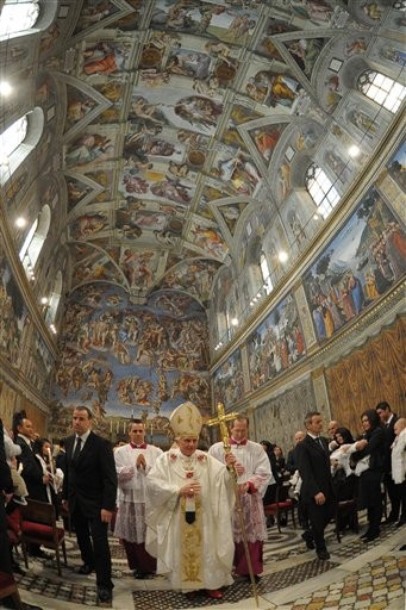
Benedict XVI baptizes 21: our destiny is full communion with God in eternal happiness


Pope in the Sistine Jan 9 2011.jpg

The papal
tradition of baptizing infants has been in place for some time. In addition to
baptizing converts at the Easter Vigil, Pope John Paul II annually popularized
the Rite of Baptism on the feast of the Baptism of the Lord, and since his
election 5 years ago, Benedict has continued it. The newly baptized typically
are newborn babies. Today, the Sistine Chapel was the magnificent setting for
21 infants ranging between four weeks to four months; all are children of
Vatican employees. May God grant the newly baptized the grace of forgiveness of
Original Sin, enlightenment, regeneration as a new person in Christ, and
adoption as a son or daughter of God. Pope speaks very clearly about today’s Scripture for Mass and the theology of the Liturgy we celebrated today. The Pope’s homily follows:

It is my
pleasure to warmly welcome you this morning, especially you parents and
godparents of the 21 infants upon whom, in a few moments time, I will have the
joy of administering the Sacrament of Baptism. As has become tradition, this
ritual takes place again this year as part of the Holy Eucharist during which
we celebrate the Baptism of the Lord. With this the Feast, on the first Sunday
after the Epiphany, the Christmas season concludes with the manifestation of
the Lord in the Jordan.

Continue reading Benedict XVI baptizes 21: our destiny is full communion with God in eternal happiness

Msgr. James Moroney talks about new Missal translation

James P. Moroney.jpgIn some corners of the church world the sacred Liturgy is a very neuralgic topic. But it does not need to be painful. There are those who will complain about anything and they doing just that over the forthcoming new translations of the 2002 Roman Missal due to be published on the First Sunday of Advent 2011. The 2002 Missal was published in Latin by Pope John Paul II and it needed to be translated. Today, the Worcester Telegram published a benign and positive with a few good details about the translations.

Monsignor James P. Moroney, is a wonderful man and a great priest. He’s a priest of the Diocese of Worcester, MA, and is currently the Rector of the Cathedral of Saint Paul; Moroney was the head of the US Bishops’ Committee on Divine Worship for several years and he continues to serve as the executive secretary of Vox Clara, the Vatican committee appointed to oversee the liturgical translations.
Today’s article on Monsignor Moroney is here.

Revised Grail Psalter text available online


The Revised Grail Psalter is now available
online
. This is version of the psalter that will be used in the sacred Liturgy at some point. These are the Psalms that were translated by Abbot Gregory Polan and his brother monks of Conception Abbey. Kudos to Abbot Gregory!


Holy Name of Jesus

In the Name of Jesus let every knee bow, of those that
are in heaven, on earth, and under the earth: and let every tongue confess that
the Lord Jesus Christ is in the glory of God the Father. (Ps.8. 2). O Lord
our Lord: how admirable is Thy Name in the whole earth!

O God, Who didst constitute Thine only-begotten Son
the Savior of Mankind, and didst bid Him to be called Jesus: mercifully grant,
that we who venerate His holy Name on earth, may fully enjoy also the vision of
Him in heaven.

Holy Name of Jesus.jpg

“If you ask the Father anything in my name he will
give it you.” (John 16:23)
 
By no other Name are we saved!

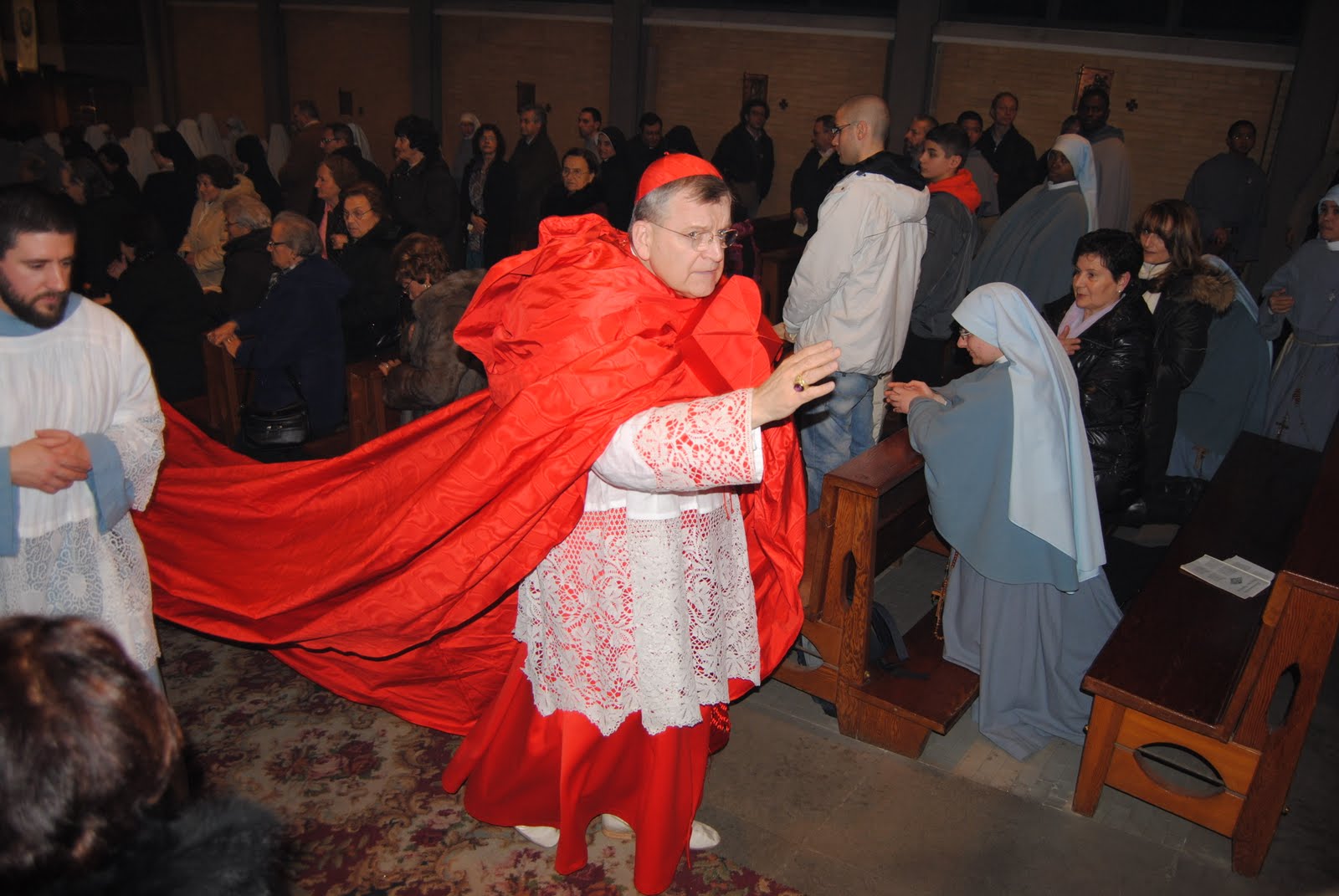
Cardinal Burke celebrates Mass for the Franciscans of the Immaculate, Rome

RL Burke in cappa2.JPG

Thanks to JP Sonnen for this picture of His Eminence, Raymond Leo Cardinal Burke, JCD, following his singing the Pontifical Mass at the Church of St. Mary of Nazareth on Via di Boccea, Rome. The parish, staffed by the Franciscans of the Immaculate, is located west of Vatican City State in the Diocese of Porto-Sant Rufina, the historic suburbicarian diocese

Beautiful Liturgy is hard work, Monsignor Guido Marini reminds

Mons.Marini.jpg

The worship of the Triune God is our single most important work. No other work of the faithful, laity and clergy alike, is equal to praise of God through the sacred Liturgy and personal prayer. Jason Horowitz of The Washington Post published an article on December 25, 2010, “Pope’s master of liturgy helps Benedict restore traditions.” Very interesting indeed. I, for one, am very grateful to Monsignor Guido Marini for the hard work he’s done in helping the Church pray more authentically, particularly at the Liturgy celebrated by the Supreme Pontiff. A native of Genoa, born in 1965, Monsignor Marini is the Master of Pontifical Liturgical Celebrations, a position he’s had since October 1, 2007. In a previous incarnation Marini served Cardinal Dionigi Tettamanzi (now archbishop of Milan) and Cardinal Tarcisio Bertone, SDB, (now Secretary of State), both former archbishops of Genoa. He earned a doctorate in the psychology of communication and also holds the duel doctorate in canon and civil law.

In Rome on
a rainy Christmas Eve, Pope Benedict XVI followed a procession of Swiss guards,
bishops and priests down the central nave of St. Peter’s Basilica to celebrate
midnight Mass before dignitaries and a global television audience.

And
Monsignor Guido Marini, as always, followed the pope.

A tall,
reed-thin cleric with a receding hairline and wire-framed glasses, Marini, 45,
perched behind the pope’s left shoulder, bowed with him at the altar and
adjusted the pontiff’s lush robes. As Master of Pontifical Liturgical
Celebrations, he shadows the pope’s every move and makes sure that every
candle, Gregorian chant and gilded vestment is exactly as he, the pope and God
intended it to be.

Continue reading Beautiful Liturgy is hard work, Monsignor Guido Marini reminds

Cardinal Cañizares Llovera: Creativity in Mass has no place

Canizares.jpg
Andrea Tornielli published an interview with Antonio
Cardinal Cañizares Llovera, 65, from Spain, Prefect of the Congregation for
Divine Worship in Il Giornale, “Basta con la messa creativa, in chiesa
silenzio e preghiera” [“Enough with the Creative Mass, in Church
Silence and Prayer”].


You will want to read this very fascinating interview in
Italian here
. Shawn Tribe at the New Liturgical
Movement blog
has posted a translation of just a few paragraphs with
the hope of posting a translation of the full interview in due time.

Father Z
has provided what is likely the central point of the interview:
 

Andrea Tornielli: How do you judge the state of Catholic
liturgy in the world?

Cardinal Cañizares: “In view of a risk of the routine, in
view of some confusion, impoverishment, and banality in singing and in sacred
music, one can say that there is a certain crisis.  For this reason a new
liturgical movement is urgent.  Benedict XVI, pointing to the example of
St. Francis of Assisi, very devoted to the Most Holy Sacrament, explained that
the true reformed is someone who obey the Faith: he doesn’t act in an arbitrary
way and doesn’t claim for himself discretion over the rite.  He is not the
master but the custodian of the treasure instituted by the Lord and entrusted
to us.  The Pope asks, therefore, from our Congregation to promote a
renewal in conformity with Vatican II in harmony with the liturgical tradition
of the Church, without forgetting the Conciliare norm that orders not to
introduce innovations when the true and verified need of the Church requires
them, with the caution that new forms, in every case, must flow organically
from those already in existence.”

The Holy Family

Holy Family, Rupnik 2007.jpg

This mosaic
of the Holy Family is located in the Chapel at the Saint Peter Canisius, the
Jesuit House of Writers located on the Borgo Spirito Santo, Rome. The mosaic is by Father Mark Rupnik,
S.J. and the artisans of the Centro Alleti (Rome) December 23, 2007. Father
Rupnik inspiration were the Contemplations on the Incarnation and the Nativity
from Saint Ignatius of Loyola’s Spiritual Exercises.

In the Exercises we read about
the Nativity. “The first point is [for me] to see the persons, that is, to see our
Lady, and Joseph, and the servant girl (the ancilla, the handmaid), and the
infant Jesus after he is born, making myself a poor little fellow and unworthy
little slave boy, looking at them, contemplating them, and serving them in
their needs as if I were there present, with all possible respect and
reverence.” 

A version of Father Rupnik’s Holy Family mosaic is found in the Holy Family Chapel at the Knights of Columbus, Supreme Council, New Haven, Connecticut. 

Mass Ad Orientem: 10 good reasons

ad orientem.jpgA friend started a few years ago, after doing the required study and catechesis, to celebrate the Sacrifice of the Mass facing East, or if you will, facing God. Father Kirby argues well his case for a priest to offer Mass suing the ad orientem gesture. And for goodness sake, don’t call it “Mass with the priest’s back to the congregation.” It only shows ignorance of a proper liturgical tradition to say such. This aspect praying the Mass is met with fear and anger from bishops and seminary professors, not to mention pastors and laity that has more to do with a lack of understanding of liturgical prayer and too often agenda-ladened.

Father Mark Daniel Kirby lists 10 good reasons why a priest ought to celebrate Mass in the more venerable and correct way of celebrating the Mass:

1. The Holy Sacrifice of the Mass is experienced as having a theocentric direction and focus.
2. The faithful are spared the tiresome clerocentrism that has so overtaken the celebration of Holy Mass in the past forty years.
3. It has once again become evident that the Canon of the Mass (Prex Eucharistica) is addressed to the Father, by the priest, in the name of all.

Continue reading Mass Ad Orientem: 10 good reasons