Saint Anselm

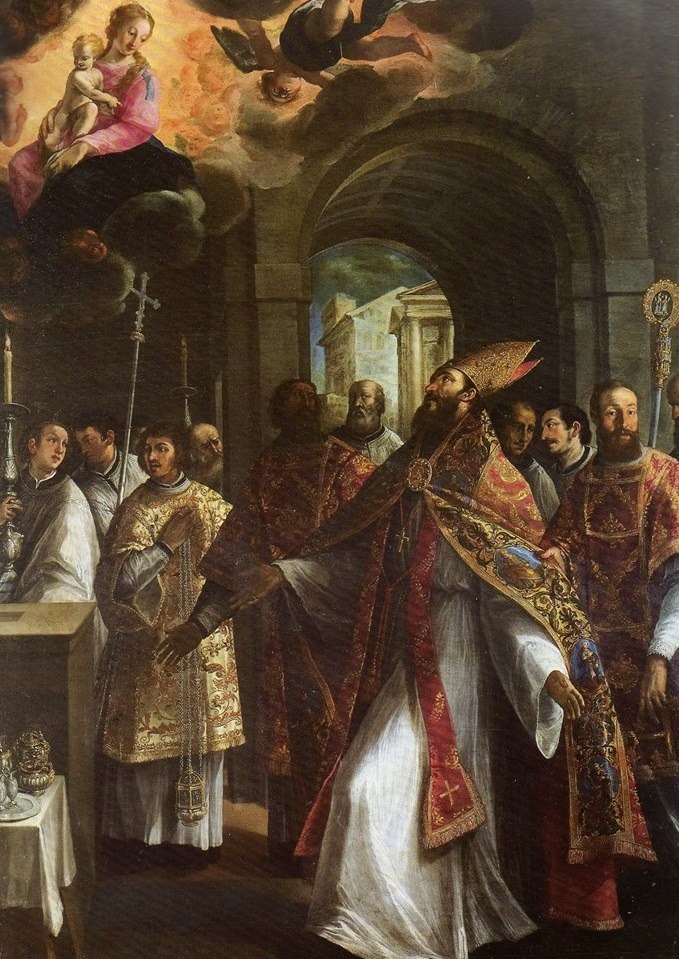
St AnselmThe Church, in particular the Benedictines, liturgically remember the great Saint Anselm, monk and Archbishop of Canterbury (1034-1109). He is known for his writings on the existence of God and the meaning of Christ’s atonement on the cross. Many outside of the world of theology and monasticism would not really know of Anselm in any significant way. In short, we can say that he was “a monk with an intense spiritual life, an excellent teacher of the young, a theologian with an extraordinary capacity for speculation, a wise man of governance and an intransigent defender of the Church’s freedom…. [and he is] one of the eminent figures of the Middle Ages who was able to harmonize all these qualities, thanks to the profound mystical experience that always guided his thought and his action” (Pope Benedict XVI, Sept. 23, 2009). So, his monastic formation speaks clearly and forcefully than his ability to engage in secular or religious politics. In 1720, Pope Clement XI names Saint Anselm a Doctor of the Church.

I think the reflections of Dame Catherine –the Digitalnun– gives me (and hopefully you) a keen sense of why Anselm is relevant for us today: that being a person of intense prayer forms and informs all things for God’s greater glory. You can be gifted in many ways but knowing the Lord through prayer and sacrament is the only way to lead the Christian life. Everything else is secondary. This is what Sister Catherine said today:

For Anselm, as for many before and since, the whole venture of faith implies a connectedness, a rootedness in Christian tradition. Professor Denys Turner, one of the most perceptive of contemporary writers, argued very persuasively in the last chapter of his The Darkness of God: Negativity in Christian Mysticism that what so many now think of as ‘an experience of God’ had a wider meaning in former times. I think Anselm would have agreed that it is a phenomenon rooted in prayer, both public and private, in liturgy, in the sacramental worship of the Church and in theological reflection and exploration — moments of perception, of affirmation and negation, intended for the whole Church, not some specially privileged part of it. That is why the concept of sentire cum ecclesia, of thinking with the Church, is so essential.

Learning to think with the Church requires effort and self-discipline, finding out rather than simply opining. It is an activity rooted in prayer but calling for hard work, too. St Anselm was a great theologian because he was a man of prayer but also because he read — widely, attentively, thoughtfully — and because he put what he read and prayed into practice. We are not all called to be monastics, but shouldn’t every Christian be, to some degree, a theologian?

A brief biography is helpful

Saint Anselm was a native of Piedmont. When as a boy of fifteen he was forbidden to enter religion after the death of his good Christian mother, for a time he lost the fervor she had imparted to him. He left home and went to study in various schools in France; at length his vocation revived, and he became a monk at Bec in Normandy, where he had been studying under the renowned Abbot Lanfranc.

The fame of his sanctity in this cloister led King William Rufus of England, when dangerously ill, to take him for his confessor and afterwards to name him to the vacant see of Canterbury to replace his own former master, Lanfranc, who had been appointed there before him. He was consecrated in December, 1093. Then began the strife which characterized Saint Anselm’s episcopate. The king, when restored to health, lapsed into his former sins, continued to plunder the Church lands, scorned the archbishop’s rebukes, and forbade him to go to Rome for the pallium.

Finally the king sent envoys to Rome for the pallium; a legate returned with them to England, bearing it. The Archbishop received the pallium not from the king’s hand, as William would have required, but from that of the papal legate. For Saint Anselm’s defense of the Pope’s supremacy in a Council at Rockingham, called in March of 1095, the worldly prelates did not scruple to call him a traitor. The Saint rose, and with calm dignity exclaimed, If any man pretends that I violate my faith to my king because I will not reject the authority of the Holy See of Rome, let him stand, and in the name of God I will answer him as I ought. No one took up the challenge; and to the disappointment of the king, the barons sided with the Saint, for they respected his courage and saw that his cause was their own. During a time he spent in Rome and France, canons were passed in Rome against the practice of lay investiture, and a decree of excommunication was issued against offenders.

When William Rufus died, another strife began with William’s successor, Henry I. This sovereign claimed the right of investing prelates with the ring and crozier, symbols of the spiritual jurisdiction which belongs to the Church alone. Rather than yield, the archbishop went into exile, until at last the king was obliged to submit to the aging but inflexible prelate.

In the midst of his harassing cares, Saint Anselm found time for writings which have made him celebrated as the father of scholastic theology, while in metaphysics and in science he had few equals. He is yet more famous for his devotion to our Blessed Mother, whose Feast of the Immaculate Conception he was the first to establish in the West. He died in 1109.

Little Pictorial Lives of the Saints, a compilation based on Butler’s Lives of the Saints and other sources by John Gilmary Shea (Benziger Brothers: New York, 1894).
Dorothy Day’s cause for sainthood advances

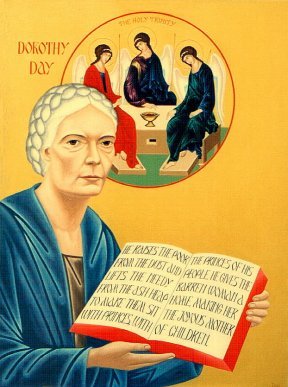
Today, Timothy Cardinal Dolan , Archbishop of New York, announced that he was setting up the various commissions to study and advance the canonization process for the Servant of God Dorothy Day. This part of the canonical process, the Inquiry on the life of Day needs to argue for the Chuch that she lived a life of “heroic virtue.” Dorothy Day was the founder of the Catholic Worker movement.

Dorothy Day is a convert to Catholicism (1927), a mother, and a Benedictine Oblate.

With Peter Maurin, Dorothy Day founded the Catholic Worker Movement in 1933 in New York City. The Movement places a high emphasis on the virtue of “hospitality”, a supreme Catholic virtue and one that is spoken of directly in the Rule of St. Benedict. Dorothy Day died in New York at the age of  83 in 1980.

In 2000, Cardinal John O’Connor requested from the Holy See the nihil obstat, naming Dorothy Day “Servant of God” and thus opening the canonization process. Msgr. Gregory Mustaciuolo was named “postulator” or chief advocate for the Cause of Canonization. In 2012, Cardinal Dolan asked the body of US Bishops to formally endorse Day’s cause in November 2012; they approved.Dorothy Day Nicholas Brian Tsai

The Cardinal will appoint a historical commission that will report on the relevance of Day’s life in historical context and review her unpublished writings. Likewise, there will be a group of theological experts appointed by Dolan to review her published writings to make sure her teachings are without error. The process includes two readers for each publication.

George B. Horton said, “Dorothy Day created or inspired dozens of houses of hospitality throughout the English-speaking world, but she was also a journalist who published The Catholic Worker newspaper. Her articles in that paper alone total over 3,000 pages. Add her books and other publications and we will probably surpass 8,000 pages of manuscripts.”

The New York Archdiocese is sponsoring Day’s cause. Dolan will see to it that the documentation will be properly given to Congregation for the Saints. It will be this Congregation that will examine the evidence making a recommendation to Pope Francis whether what is written of Day is authentic give the next determination, the title of “Venerable Servant of God,” which gives an eye toward beatification and canonization.

Visit the Dorothy Day Guild for more information.

Christian society diminishes

I am came across something the poet TS Eliot said that I am finding true when matched to experience:
 
In his 1940 work, “The idea of a Christian Society,” Eliot wrote, “…a society has ceased to be Christian when religious practices have been abandoned, when behavior ceases to be regulated by reference to Christian principle, and when in effect prosperity in the world for the individual or for the group has become the sole conscious aim.”
 
In1930 he was speaking about his fellow citizens of Great Britain (Eliot was English you will recall): from his vantage point they were “… becoming more and more de-Christianized by all sorts of unconscious pressure: paganism holds all the most valuable advertising space. Anything like Christian tradition transmitted from generation to generation within the family must disappear, and the small body of Christians will consist entirely of adult recruits.”
 
How do you live your life?

Benedictine Lay Movements and Communities to meet in the UK

Ealing Abbey to host conference on Benedictine Lay Movements and Communities

The monastic spirituality forum – Community of Nazareth – will be hosting a conference on contemporary Benedictine lay movements and communities at Ealing Abbey on the 11th of June 2016. The conference will explore the values, mission and outreach of Benedictine movements. A number of groups will be participating in the event: Manquehue Movement, Lay Community of St Benedict, Community of St Aelred, Subiaco Walsingham, Monos and NazarethW5. 

Talks and papers will be available via the website (www.communityofnazareth.com) SoundCloud (Community of Nazareth) and twitter (@NazarethW5).

Jerome Lejeune

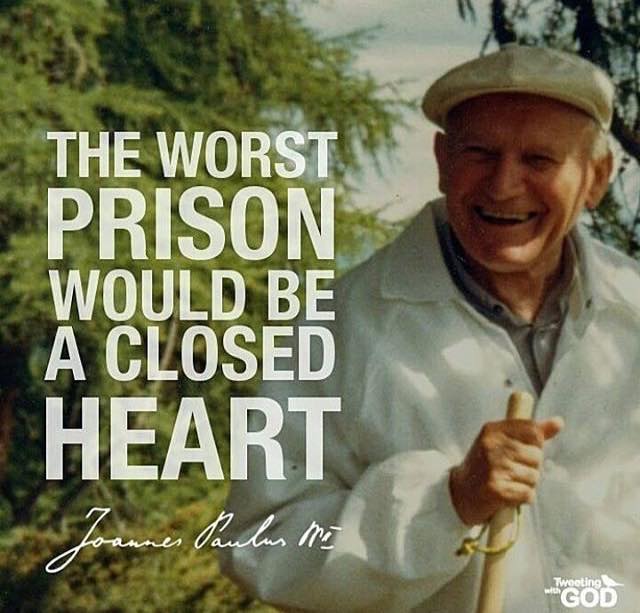
JPII and LejeunePope John Paul wrote on hearing of the death of Jerome Lejeune on April 3, 1994 in a Rome hospital:

We are faced today with the death of a great Christian of the twentieth century, of a man for whom the defense of life became an apostolate. It is clear that, in this present world situation, this form of lay apostolate is particularly necessary… [He] has left the truly brilliant witness of his life as a man and as a Christian.

May Jerome Lejeune intercede for the work of the Culture of Life.

Thomas doubt exists today

communion byzantineThe Second Sunday of Easter presents to us the gospel reading of the Thomas doubting the existence of the risen Lord. The day has many names.

This gospel is proclaimed in the Novus Ordo, the Traditional and Byzantine Liturgies. In the Novus Ordo Liturgy today’s Mass can be referred to as Divine Mercy Sunday. The Latin Mass calls today Low Sunday (after the great solemn feast of Easter), or today is called dominica in albis depositis or “the Sunday in which the white clothes are put away”.  Yet another way of referring to today is “Quasimodo Sunday”, because of the first words of the entrance antiphon sung for the Latin Mass which uses the words taken from Peter, Quasi modo geniti infantes, Halleluja, rationabile, sine dolo lac concupiscite (“yearn for the pure spiritual milk as if you were newborn children”).

In all these names, what can we say about this portion of the mystery of the faith in Christian today? If you think about the truth Jesus presented to the Apostles about Himself, it seems that truth is not as convincing as the doubt some put forward as reasonable. I am not quite sure I understand the penchant we have for doubting reasonableness of truth, but doubt exists and I have come to believe that God uses doubt to teach us the meaning of beauty, goodness and truth. Thomas, later revered as a saint and founder of the Church in India, tells us with certitude that the Lord is alive after death on the cross but only after verifying the physicality of the person Jesus when he says, My Lord and my God. He is said by Jesus that he blessed for what he has seen.

Doubting ThomasIn the Byzantine Liturgy the Troparion of St Thomas is sung: While the tomb was sealed You shone forth from it, O Christ our Life, and while the doors remained closed, You stood among your Disciples, O Resurrection of all, and through them You restored a new spirit in us according to your great Mercy.

Today, we are faced with some similar doubts about Jesus, the sacraments and Christian  life. Doubt is not new. And, perhaps Saint Thomas did us a favor in recognizing the concrete facts of our faith. Coming to Catholic faith means that we proclaim from whom salvation comes. It means that we are to be missionary so that all people come before the Lord.

One piece of our Catholic life is faith in the Holy Eucharist: faith in the Divine Presence here and now in the sacrament of the Eucharist. Teaching adults about First Holy Communion is difficult –think of the difficulty there is teaching third graders about the Presence of Jesus in Holy Communion. I recall what is called a Eucharistic miracle where a priest doubted the presence of Jesus in the sacred Host and the Lord gave the priest the a sign of Divine Presence by turing the host in heart muscle and the wine into blood.

The English theologian Monsignor Ronald Knox this about the Holy Eucharist: “We have never, as Christians, been truly faithful to Jesus, no matter our denomination. In the end none of us have truly followed those teachings which most characterize Jesus- We have not turned the other cheek. We have not forgiven our enemies. We have not purified our thoughts. We have not seen God in the poor. We have not kept our hearts pure and free from the things of this world. But we have been faithful in one very important way- we have kept the Eucharist going.”