Father, into your hands I commend my spirit

“I called to the Lord, out of my distress,

Crucifixion Velaquez.jpgand he answered me; out of the belly of Sheol I cried, and thou didst hear my voice. For thou didst cast me into the deep, into the heart of the seas, and the flood was round about me; all thy waves and thy billows passed over me. Then I said, ‘I am cast out from thy presence; how shall I again look upon thy holy temple?’

The waters closed in over me, the deep was round about me; weeds were wrapped about my head at the roots of the mountains. I went down to the land whose bars closed upon me for ever; yet thou didst bring up my life from the Pit, O Lord my God.

When my soul fainted within me, I remembered the Lord; and my prayer came to thee, into thy holy temple. Those who pay regard to vain idols forsake their true loyalty. But I with the voice of thanksgiving will sacrifice to thee; what I have vowed I will pay. Deliverance belongs to the Lord!”
(Jonah 2:1-9)

There was darkness over the whole land…while the sun’s light failed; and the curtain of the temple was torn in two. Then Jesus, crying with a loud voice, said, “Father, into your hands I commend my spirit.” [Luke 23:44b-46a]

Without the Cross & the Resurrection we have atheism in Christianity

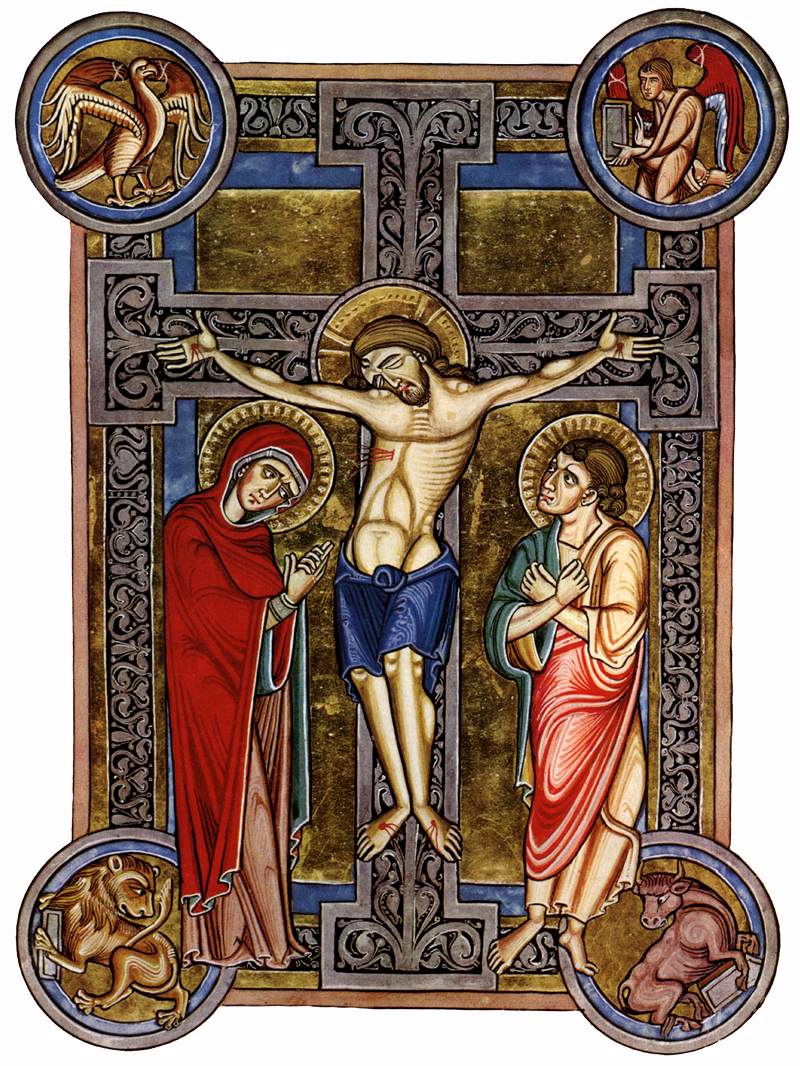
Crucifixion Weingarten Missal 13thc.jpgBut what Christ did on the Cross was in no way intended to spare us death but rather to revalue death completely. In place of the “going down into the pit” of the Old Testament, it became “being in paradise tomorrow”. Instead of fearing death as the final evil and begging God for a few more years of life, as the weeping king Hezekiah does, Paul would like most of all to die immediately in order “to be with the Lord” (Phil 1:23). Together with death, life is also revalued: “If we live, we live to the Lord; if we die, we die to the Lord” (Rom 14:8).

But the issue is not only life and death but our existence before God and our being judged by him. All of us were sinners before him and worthy of condemnation. But God “made the One who knew no sin to be sin, so that we might be justified through him in God’s eyes” (2 Cor 5:21).

Only God in his absolute freedom can take hold of our finite freedom from within in such a way as to give it a direction toward him, an exit to him, when it was closed in on itself. This happened in virtue of the “wonderful exchange” between Christ and us: he experiences instead of us what distance from God is, so that we may become beloved and loving children of God instead of being his “enemies” (Rom 5:10).

Continue reading Without the Cross & the Resurrection we have atheism in Christianity

“GOOD FRIDAY”

Am I a stone, and not a sheep,
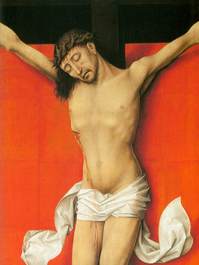
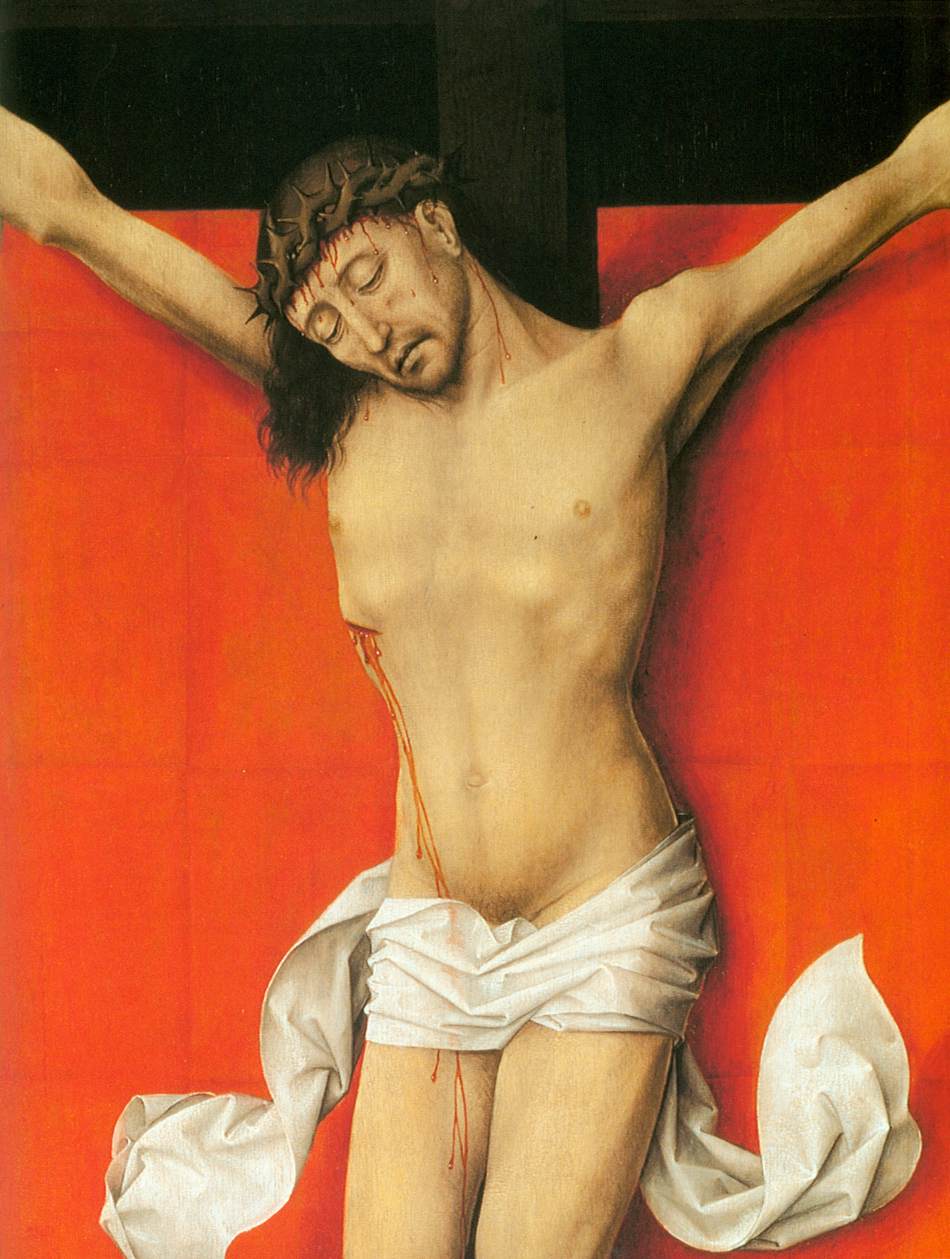
Thumbnail image for Crucifixion detail Weyden.jpgThat I can stand, O Christ, beneath Thy cross,
To number drop by drop Thy Blood’s slow loss,
And yet not weep?

Not so those women loved
Who with exceeding grief lamented Thee;
Not so fallen Peter weeping bitterly;
Not so the thief was moved;

Not so the Sun and Moon
Which hid their faces in a starless sky.
A horror of great darkness at broad noon –
I, only I.

Yet give not o’er
But seek Thy sheep, true Shepherd of the flock;
Greater than Moses, turn and look once more
And smite a rock.

Christina Rossetti

Church visits on Holy Thursday

Maundy Thursday icon.jpgIt is customary to visit the special altars created for the reserved Eucharist after the Holy Thursday Mass of the Lord’s Supper, the birth of the holy priesthood and the giving of the Eucharist as the supreme gift Love to the Church. There we spend time in prayer for ourselves and for those we’ve promised to pray. Keeping watch is an act of love and penance with the goal of remaining close to the Lord. From time immemorial we learn how to keep vigil by making visits to three or seven nearby churches as a “mini-pilgrimage.” Tradition tells us that Saint Philip Neri is credited with popularizing the Roman practice of a pilgrimage to seven churches to keep people attentive to the presence of the Lord in the Eucharist, plus to keep them out of trouble. The point of this pious and noble exercise is to keep vigil with the Lord as the disciples tried to do so in the Garden of Gethsemani before the Lord’s arrest. I will be visiting at least three perhaps seven churches. One can’t always find the churches open into the night even on Holy Thursday.

Pope Benedict’s homily for Holy Thursday 2009


Qui, pridie quam pro nostra omniumque salute pateretur, hoc est hodie, accepit panem: [Who, the day before he suffered for the salvation of us and of all — that is, today — he took the bread:] these words we shall pray today in the Canon of the Mass. “Hoc est hodie” [“That is, today”] – the Liturgy of Holy Thursday places the word “today” into the text of the prayer, thereby emphasizing the particular dignity of this day. It was “today” that He did this: he gave himself to us for ever in the Sacrament of his Body and Blood. This “today” is first and foremost the memorial of that first Paschal event. Yet it is something more. With the Canon, we enter into this “today”. Our today comes into contact with his today. He does this now. With the word “today”, the Church’s Liturgy wants us to give great inner attention to the mystery of this day, to the words in which it is expressed. We therefore seek to listen in a new way to the institution narrative, in the form in which the Church has formulated it, on the basis of Scripture and in contemplation of the Lord himself.
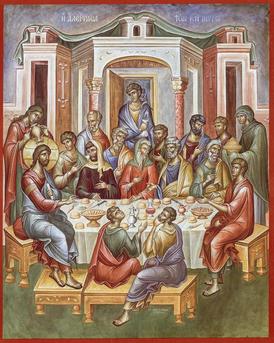
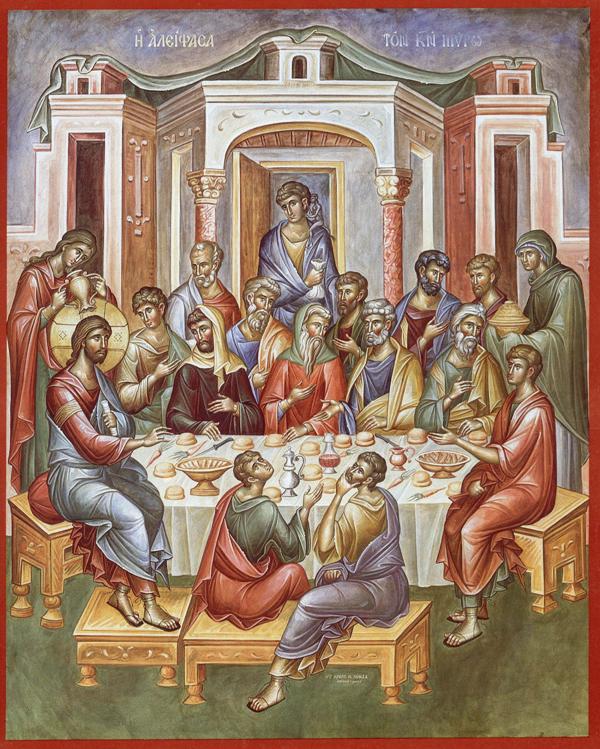
Last Supper.jpgThe first thing to strike us is that the institution narrative is not an independent phrase, but it starts with a relative pronoun: qui pridie. This “qui” connects the entire narrative to the preceding section of the prayer, “let it become for us the body and blood of Jesus Christ, your only Son, our Lord.” In this way, the institution narrative is linked to the preceding prayer, to the entire Canon, and it too becomes a prayer. By no means is it merely an interpolated narrative, nor is it a case of an authoritative self-standing text that actually interrupts the prayer. It is a prayer. And only in the course of the prayer is the priestly act of consecration accomplished, which becomes transformation, transubstantiation of our gifts of bread and wine into the Body and Blood of Christ. As she prays at this central moment, the Church is fully in tune with the event that took place in the Upper Room, when Jesus’ action is described in the words: “gratias agens benedixit – he gave you thanks and praise”. In this expression, the Roman liturgy has made two words out of the one Hebrew word berakha, which is rendered in Greek with the two terms eucharistía and eulogía. The Lord gives thanks. When we thank, we acknowledge that a certain thing is a gift that has come from another. The Lord gives thanks, and in so doing gives back to God the bread, “fruit of the earth and work of human hands”, so as to receive it anew from him. Thanksgiving becomes blessing. The offering that we have placed in God’s hands returns from him blessed and transformed. The Roman liturgy rightly interprets our praying at this sacred moment by means of the words: “through him, we ask you to accept and bless these gifts we offer you in sacrifice”. All this lies hidden within the word “eucharistia”.

Continue reading Pope Benedict’s homily for Holy Thursday 2009
…one must not sleep during this time…the sacred Triduum is upon us

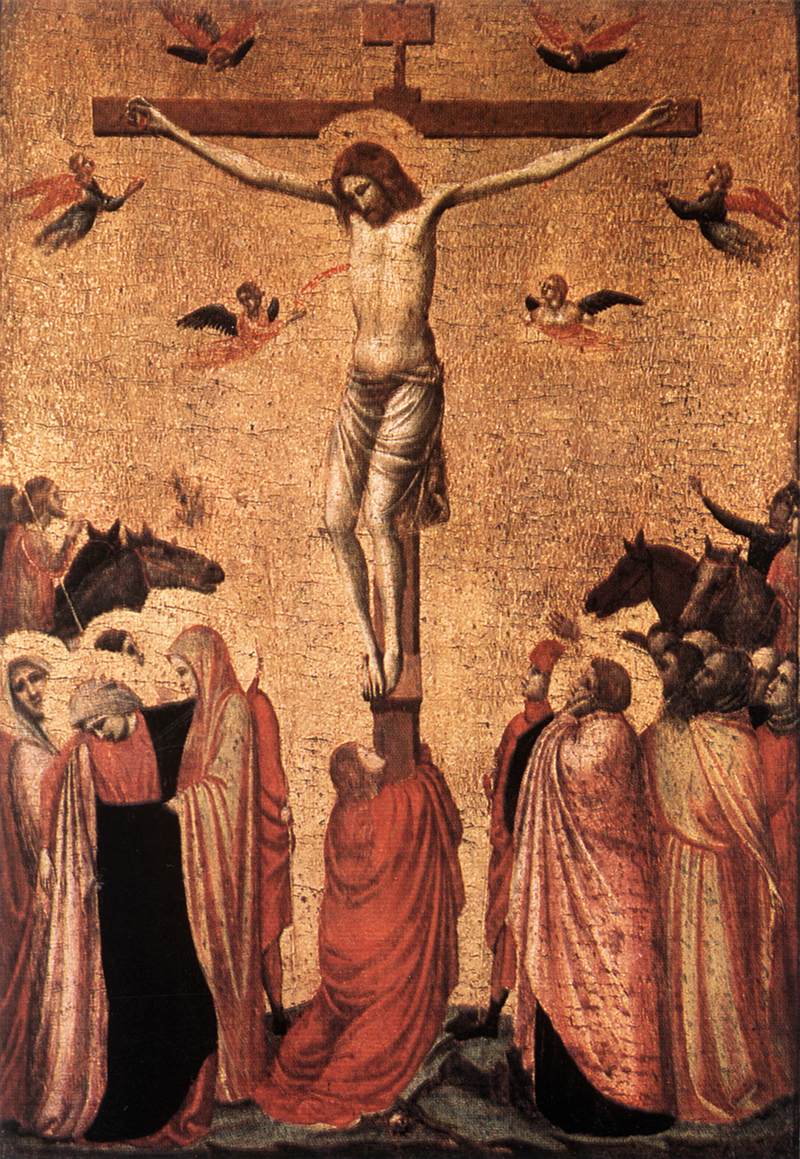
Crucifixion Giotto.jpgHow marvelous, and at the same time amazing, is this mystery! We can never meditate this reality sufficiently. Jesus, though being God, did not want to make of his divine prerogatives an exclusive possession; he did not want to use his being God, his glorious dignity and power, as an instrument of triumph and sign of distance from us. On the contrary, “he emptied himself” assuming our miserable and weak human condition –in this regard, Paul uses a quite meaningful Greek verb to indicate the kenosis, this descent of Jesus. The divine form (morphe) is hidden in Christ under the human form, namely, under our reality marked by suffering, poverty, human limitations and death. The radical and true sharing of our nature, a sharing in everything except sin, leads him to that frontier that is the sign of our finiteness  –death. But all this was not the fruit of a dark mechanism or a blind fatality: It was instead his free choice, by his generous adherence to the salvific plan of the Father. And the death which he went out to meet –adds Paul– was that of the cross, the most humiliating and degrading that one can imagine. The Lord of the universe did all this out of love for us: out of love he willed to “empty himself” and make himself our brother; out of love he shared our condition, that of every man and every woman. In this connection, Theodoret of Cyrus, a great witness of the Eastern tradition, writes: “Being God and God by nature and having equality with God, he did not retain this as something great, as do those who have received some honor beyond their merits, but concealing his merits, he chose the most profound humility and took the form of a human being” (Commentary on the Letter to the Philippians, 2:6-7).

Pope Benedict XVI, Wednesday General Audience, 8 April 2009, excerpt

Stanley L. Jaki, OSB, RIP

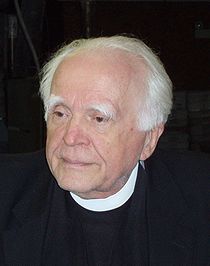
Stanley Jaki June 2007.jpgThe Reverend Dom Stanley L. Jaki, O.S.B., died April 7th, in Spain after suffering a heart attack in Rome without knowing it. After arriving in Madrid to visit friends he was taken to the hospital for treatment but died days later. He was a monk and priest of the Archabbey of Saint Martin, Pannonhalma, Hungary. He entered the archabbey in 1941, professing solemn vows in 1944 and was ordained a priest in 1948. Like many other Hungarian priests, Jaki immigrated to the USA during Soviet persecution.

Father Jaki trained as a physicist and devoted his life to the history and philosophy of science and theology rather than scientific research. His intellectual work was ground breaking in connecting Catholic theology and science, and the only one to do so for many years. Jaki earned a doctorate in theology from Sant’Anselmo (Rome) in 1950 and another doctorate in (astro)physics from Fordham University in 1957. Since 1965 he has taught at Seton Hall University and honored as Distinguished Professor of Physics in 1975. After retiring he kept active by holding court, giving lectures and writing, often cantankerously.

Father Jaki was well-known for his writings on science and religion. He delievered the prestigious Gifford Lectures from 1974-1976, later published under the title of The Road of Science and the Ways to God. In 1987 Dom Stanley was award the Templeton Prize. He is considered one of the best scholars on the thought of Cardinal John Henry Newman in the U.S. His publishing record show he published 7 books and numerous articles on Newman.

“Although the world was God’s creation and, as such, to be profoundly respected, the world itself possessed no intrinsic divinity,” Father Thomas G. Guarino, professor of theology at Seton Hall, stated. “Father Jaki’s work elucidated the notion that in understanding the very laws of the physical universe, science naturally opened out toward the affirmation of faith.”

A website devoted to Father Jaki

Not only the Passion but the Resurrection

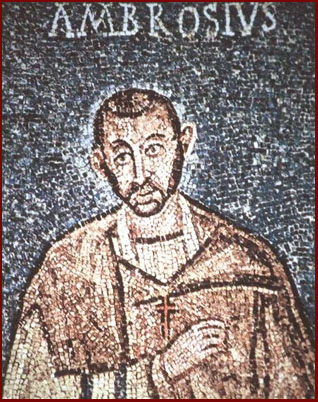
Ambrose.jpgSaint Ambrose, Bishop of Milan, reminds us of this: ‘We must observe not only the day of the Passion, but the day of the Resurrection as well. Thus, we will have a day of bitterness and a day of joy; on the one let us fast, on the other let us seek refreshment…During this Sacred Triduum…Christ suffered, rested and rose from the dead. Of that three day period he himself says: ‘Destroy this temple, and in three days I will raise it up” (Epistle 23).

Our Lenten observances, indeed our whole life of faith, have been a preparation for this celebration of the Lord’s Paschal Mystery, our redemption from sin. May all of us bear witness to this joy in our daily lives; not only now but all through the year. And may our celebration of the Triduum be a time to reflect on our redemption through Christ, the eternal gift to us sinners from God the Father.

Are we living in post-Christian America?

In the April 13, 2009 issue of Newsweek, Jon Meacham wrote the article, “The End of Christian America,” exploring the idea that we are living in a time where many of those who identified themselves as Christians are now saying that they are skeptical about religion. Some have gone beyond skepticism and rejected religion altogether. In his article Meacham points out something that I find startling indeed: since 1990 the percentage of Americans who no longer claim a religious affiliation as risen from 8 to 15%. Plus, this group of religious non-affiliated has risen in the Northeast. Is this trend pointing to a real crisis or is Meacham creating havoc for the Church? Are Americans accepting secularlity over salvation? Are Christians to blame?

Certainly, experience shows that in many places, including religious houses, the liturgical rites and preaching are often so bad that one can understand why people leave the Church. How often do we go to Church encountering an unprepared priest, altar servers with little dignity and training and the poorly proclaimed Scriptures? Never mind the foolishness that passes for adequate, never mind “superb,” catechetical formation and social outreach to the poor, the sick and the elderly. Where is the formation in the faith for the adults, teens and children based on Scripture and Tradition and not some minister’s ideology? Is Christ only a one-day-a week event? Let’s ask a question about the credibility of the witness: do the priests really believe in Christ, sin, grace, salvation, Mary, etc? What about those who take religious vows: are they really living according to the mind of the Church AND constitutions of their particular order? The Church in recent times is famous for answering questions that are not being asked by the faithful.

If the Church wants to slow down or reverse the secularization of our culture then it needs holy and competent men and women, clergy and laity alike, who will live the faith in a serious manner. The gospel needs to be preached in such a way that is faithfully and poignantly breaks open the word of the Word AND the lives the liturgical rites. Salvation is a question of content and beauty.

Spy Wednesday

Kiss Of Judas Giotto.jpgToday we recall the words Jesus spoke to Judas at the Last Supper, “The Son of man goes as it is written of him, but woe to that man by whom the Son of man is betrayed! It would have been better for that man if he had not been born.” (Matthew 26:24). Judas has become is synonymous with the act of betrayal. In the Inferno, Dante places Judas in the very lowest circle of Hell, being devoured eternally by a three-faced, bat-winged devil:


When we had gotten far enough along
that my master was pleased to let me see
the creature who was once so fair of face
he took a step aside, then brought me to a halt:
‘Look there at Dis! And see the place
where you must arm yourself with fortitude.’
Then how faint and frozen I became,
reader, do not ask, for I do not write it,
since any words would fail to be enough.
It was not death, nor could one call it life.
Imagine, if you have the wit,
what I became, deprived of both.
The emperor of the woeful kingdom
rose from the ice below his breast,
and I in size am closer to a giant
than giants are when measured to his arms.
Judge, then, what the whole must be
that is proportional to such a part.
If he was fair as he is hideous now,
and raised his brow in scorn of his creator,
he is fit to be the source of every sorrow.
Oh, what a wonder it appeared to me
when I perceived three faces on his head.
The first, in front, was red in color.
Another two he had, each joined with this,
above the midpoint of each shoulder,
and all the three united at the crest.
The one on the right was a whitish yellow,
while the left-hand one was tinted like the people
living at the sources of the Nile.

Judas Bottechelli.jpgBeneath each face two mighty wings emerged,
such as befit so vast a bird:
I never saw such massive sails at sea.
They were featherless and fashioned
like a bat’s wings. When he flapped them,
he sent forth three separate winds,
the sources of the ice upon Cocytus
.
Out of six eyes he wept and his three chins
dripped tears and drooled blood-red saliva.
With his teeth, just like a hackle
pounding flax, he champed a sinner
in each mouth, tormenting three at once.
For the one in front the gnawing was a trifle
to the clawing, for from time to time
his back was left with not a shred of skin.
‘That soul up there who bears the greatest pain,’
said the master, ‘is Judas Iscariot, who has
his head within and outside flails his legs
.
‘As for the other two, whose heads are dangling down,
Brutus is hanging from the swarthy snout —
see how he writhes and utters not a word! —
‘and from the other, Cassius, so large of limb.
But night is rising in the sky. It is time
for us to leave, for we have seen it all.’ (Canto XXXIV)

Judas tree.jpg 

According to the pious legend, the tree upon which Judas hanged himself was the Cercis siliquastrum, also called the “Judas Tree.” It is a beautiful tree, native to the Mediterranean region, which produces brilliant deep pink flowers in the spring; the flowers are said to have blushed in shame after Judas’s suicide.