Nativity of the Blessed Virgin Mary

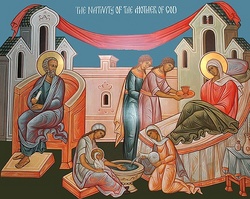
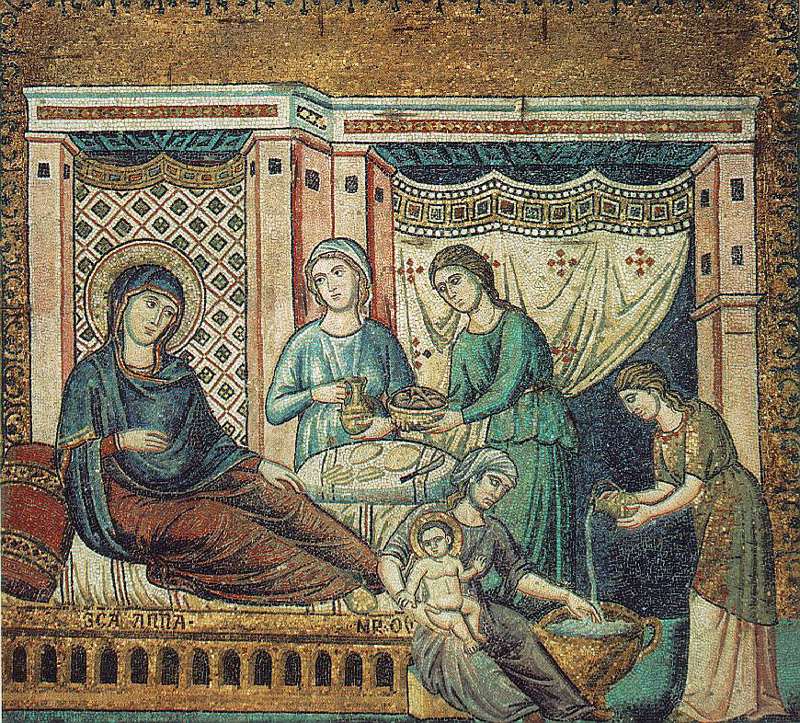
Nativity of BVM PCavallini.jpgIt is the nativity of the glorious Virgin Mary, sprung from the seed of Abraham, of the tribe of Juda, of the renowned family of David.

We beseech Thee, O Lord, grant to Thy servants the gift of Thy heavenly grace, that as the childbearing of the Blessed Virgin was the beginning of salvation, so the joyful festival of her nativity may bring us an increase of peace.
Today is one three days on the liturgical calendar that the church celebrates someone’s birth; the other two are Jesus and John the Baptist. What we know of the birth of Mary comes from the extra-canonical gospels: The Gospel of the Nativity of Mary and the Proto-evangelium of Saint James. This is one of those feasts that came from Eastern Church, likely in Syria in the 6th century. It gained popularity that in the 7th century it was added to liturgical calendar of the Church of Rome (It was Pope Sergius I who wrote a Litany and organized a procession for the feast.) and the collects are found in various missals. Various dioceses may have some type of observance beginning in the 8th to the 10th centuries. That said, in some parts of the Church where the missals included the collects of the Assumption, this feast of Nativity of Mary is absent. 

Ted Kennedy: mercy or damnation? What do real Christians think?

In the week since the obsequies for Edward Kennedy, Senator, not a few self-appointed ministers of God’s justice and mercy have rendered their judgement: the Senator should not have been buried using the rites of the Catholic Church. Interesting.

The sacred Liturgy tells us what we who are baptized believe: we are sinners and God’s mercy is in abundance. Sinners need and want mercy from God almighty. I want and need His forgiveness and His tender embrace. I am sure Ted Kennedy wanted the same. Since I was not at his bedside when he was sick, nor did I hear the Senator’s confession and nor was I present when his priest gave him the Sacrament of the Sick, Viaticum and the Apostolic Pardon. Presumably he received these sacred rites before his death. In short, I don’t know the state of his soul. I do know that he wrote to the Holy Father and a kind reply was received.
Cardinal Sean O’Malley has been criticized for being a pastor of souls; he explains as much on his blog this week. The bishop of Madison, WI, Robert Morlino, has a wonderful piece on this subject and I highly recommend your reading it. Use it for you lectio. Bishop Morlino’s reflection is found here.
Is a lack of mercy to a sinner the demonstration of Christianity’s decay? What virtues are being taught and lived when Christians so violently pontificate that mercy is not possible for the sinner, even such a public sinner? Does Christianity have any real meaning left? If we break mercy from the Christian life then we no longer have a Christian religion that leads one to salvation in Christ. To whom do we witness: Christ or the self?

Blessed Mother Teresa: 12th anniversary of death

If we have no peace, it is because we have forgotten that we belong to each other. (Blessed Teresa of Calcutta)

MT & PD.jpg

26 August 1910 to 5 September 1997

“This
celebration of Mother Teresa should remind us that the work of mercy, charity
and compassion still have a fundamental place in our being disciples of Jesus
today. During her life Mother put into practice in many ways Charity in
Truth
(Fr Cedric Prakash, SJ, Sept. 5, 2009).

7 to be ordained to the Order of Deacon for Archdiocese of New York

2 signing Oath of Fidelity.jpgTonight 7 men made the Profession of Faith and the
Oath of Fidelity
 (which I encourage you too read) at Vespers. These 7 men will be ordained to the Order of
Deacon tomorrow here in the Saint Joseph Seminary Chapel by Bishop Dennis
Joseph Sullivan, VG, auxiliary bishop of New York: James H. Ferreira, George
LaGrutta, Steven R. Markantonis, Fredy P. Montoya, Thomas Roslak, Enrique J. Salvo,
Daniel P. Tuit
e.


Please keep these men in your prayers and sacrifices tomorrow
and in year ahead as they prepare for ordination as priest on 15 May 2010 for service in the Archdiocese of New York by Archbishop Timothy P. Dolan, PhD.

Our Lady of Dunwoodie, cause of our joy, pray for us.
Saint Joseph, pray for us.
Saints John Vianney, Pio of Pietrelcina, John Eudes, pray for us.

Build Together the City of God, Pope says to Catholic & Orthodox

The
following is the text Benedict XVI sent to Cardinal Walter Kasper, president of
the Pontifical Council for Promoting Christian Unity, on the occasion of the
11th Inter-Christian Symposium, which began today in Rome.

Through you,
venerable brother, in your capacity as president of the Pontifical Council for
Promoting Christian Unity, I have the pleasure and joy of sending a warm and
auspicious greeting to the organizers and participants of the 11th
Inter-Christian Symposium, promoted by the Franciscan Institute of Spirituality
of the Pontifical University Antonianum and by the Aristotle Orthodox
Theological Faculty of Thessalonica, planned in Rome from Sept. 3-5.

I am happy
first of all for this initiative of fraternal encounter and exchange on the
common aspects of spirituality, which is beneficial for a closer relationship
between Catholics and Orthodox. In fact, these Symposiums, which began in 1992,
address important and constructive topics for reciprocal understanding and unity
of intention. The fact that it takes place alternatively in a territory of
Catholic or Orthodox majority also allows for real contact with the concrete,
historical, cultural and religious life of our Churches.

In particular, this
year you wished to organize the Symposium in Rome, city that offers all
Christians indelible testimonies of history, archaeology, iconography,
hagiography and spirituality, strong stimulus to advance toward full communion
and above all, the memory of the Apostles Peter and Paul, Protothroni, and of
so many martyrs, ancient witnesses of the faith. Of them, St. Clement of Rome
wrote that “suffering … many insults and torments, they became a most
beautiful example for us” (Cf. Letter to the Corinthians, VI,1).

St Augustine bishop.jpg

The topic
chosen for the next meeting: “St. Augustine in the Western and Eastern
Tradition” — argument intended to be developed in collaboration with the
Patristic Institute Augustinanum — is most interesting to reflect further on
Christian theology and spirituality in the West and in the East, and its
development. The Saint of Hippo, a great Father of the Latin Church, is, in
fact, of fundamental importance for theology and for the West’s very culture,
whereas the reception of his thought in Orthodox theology has revealed itself
to be rather problematic
.

Hence, to know with historical objectivity and
fraternal cordiality the doctrinal and spiritual riches that make up the
patrimony of the Christian East and West, is indispensable not only to
appreciate them, but also to promote better reciprocal appreciation among all
Christians
.

Therefore, I express cordial wishes that your Symposium is fruitful
in that it discovers doctrinal and spiritual convergences that are useful to
build together the City of God, where his children can live in peace and in
fraternal charity, based on the truth of the common faith
. I assure you of my
prayer for this end, asking the Lord to bless the organizers and the
institutions they represent, the Catholic and Orthodox speakers and all the participants.
May the Grace and peace of the Lord be in your collaborators and in your minds!

In Castel Gandolfo,

August 28, 2009

Benedictus PP. XVI

Blessed Sisters of Nowogrodek: Blessed Stella & companions

O most blessed Trinity, we praise and thank you for the example of Blessed Mary Stella and her ten companions, Sisters of the Holy Family of Nazareth, who by imitating Jesus Christ, offered themselves as a
sacrifice of love.

God of mercy and compassion, through the merits of their martyrdom and by their intercession, grant us the grace we humbly ask… (insert intention here) …so that like them, we may witness with our lives to the presence of the Kingdom of God’s love and extend it to the human family throughout the world. We ask this through Christ, our Lord. Amen.

Blessed Martyred Sisters of Nowogródek, pray for us.

Blessed Mary Stella and her companions were authentic martyrs for the faith: they “…paid with their blood for the charity they exercised in favor of escapees, of the wounded and the sick during the terrible and uncertain days” (His Will Alone, 424).

They had engaged life as any other person does and so I thinking giving the names of the sisters keeps memory of the women, our friends, alive in our hearts. Certainly as a kid in a Nazareth school (New Haven, CT) this image of the sisters was haunting and striking. On my desk sits the commemorative coin, a gift of Sister Thaddeus of Jesus, CSFN, with the faces and names of the sisters reminding me of the gift their lives are for us.

The eleven Sisters of the Holy Family of Nazareth who were executed by the Nazis on August 1, 1943 were:

Sister Maria Stella, Superior (Adelaide Mardosiewicz) (1888-1943)

Sister Mary Imelda (Jadwiga Zak) (1892-1943)

Sister Mary Rajmunda (Anna Kukulowicz) (1892-1943)

Sister Maria Daniela (Eleanor Juzwik) (1895-1943)

Sister Maria Kanuta (Jozefa Chrobot) (1896-1943)

Sister Maria Gwidona (Helena Cierpka) (1900-1943)

Sister Maria Sergia (Julia Rapieg) (1900-1943)

Sister Maria Kanizja (Eugenia Mackiewicz) (1904-1943)

Sister Maria Felicyta (Paulina Borowik) (1905-1943)

Sister Maria Heliodora (Leokadia Matustzewska) (1906-1943)

Sister Maria Boromea (Veronika Narmuntowicz) (1916-1943)

The Sisters had these words in their hearts and on their lips as they gave witness to Christ and the Church: “O God, if sacrifice of life is needed, accept it from us who are free from family obligations.
Spare those who have wives and children.”

And so we pray that Blessed Mary Stella and companions intercede for us before the the Throne of Grace for us, for the Nazareth Congregation of Sisters (especially for Sister Mary Ellen Genova) and for Poland.

N.B. In many places the martyrs of Nowogródek are remembered liturgically on the day their death, August 1st. In the convents of the Congregation of the Holy Family of Nazareth today is the liturgical memorial is prayed at Mass and in the Divine Office.

Nuns become Catholic

All Saints nuns.jpgYou may have seen the story of 10 nuns come into full communion with the Catholic Church. The ceremonial aspect of full communion was yesterday but the journey to that point was long in coming individually and corporately. Archbishop Edwin O’Brien of Baltimore received the nuns and is working with them to become a diocesan right community.

Read a story about the event and another leading up to September 3.

The story of these nuns coming into full communion with the Catholic Church is reminiscent of a similar gesture many years ago of the Friars and Sisters of the Atonement also leaving the Episcopal Communion. They are known today as Franciscan of the Atonement doing ecumenical work for the Church.

Our vision baited to behold God’s beauty


Our methods of entering the divine mysteries are varied: some
use the spoken or written word (poet, some use photography, some will engage nature,
some may use music & dance and still others will use the time-honored
tradition of icons. Jesuit Father Stephen Bonian takes us through a variety of
fitting understandings of iconography and their use for prayer in his article,
Gateways to Prayer.”

For we see …

“In God’s beauty, all the earth is sanctified.
Tree and stone, wood and paint have glory
In His beauty.
Creation is transformed;
The fallen is made holy.
And man, beholding Beauty’s vision,
Shares His life.”

(“On the Beauty of God” by an anonymous Orthodox author)

Saint Gregory the Great

Gregory was a mirror for monks, a father to the City, beloved of all the world.
O God, Who did bestow upon the soul of Thy servant Gregory the rewards of eternal happiness, mercifully grant that we who are oppressed by the weight of our sins, may be relieved through his intercession.

Ecstacy of Gregory the Great PPRubens.jpg

“Son of man, I have set you as a watchman over the house of Israel.” The Lord here calls the preacher a watchman. A watchman stands on a height so that he can see what is coming. So, too, those who set as guardians over people ought to stand on a height by their manner of life so that their watchful care may benefit others.
It is hard for me to say these words. They wound me, for my speech is not worthy of my role as preacher, and my life does not measure up to what I preach. I do not deny my guilt; I see my sloth and negligence. Perhaps a loving Judge will be moved to pardon me because I admit my fault.
When I lived in the monastery, I could avoid idle talk and keep my mind almost continuously fixed on prayer. But once I accepted the pastoral burden, many things required and divided my attention, so that my former recollection became impossible. I am forced now to discuss the affairs of churches and monasteries and even quite often, the lives and actions of individuals. I must deal with civic business, barbarian invasions, and the wolves that prey on the flock committed to my care.
When the mind is so divided and harried, how can it return to itself and recollect itself for preaching? How is it to avoid withdrawing from that ministry?
Who am I, then? What kind of watchman am I, when I myself do not stand on the heights for preaching but lie low in the valley of weakness? Still, the omnipotent Creator and Redeemer of humankind can give me, unworthy though I am, lofty inspirations and an effective tongue; for it is out of love of Christ that I do not spare myself in speaking about him.
(from the Homilies on Ezekiel by Pope Saint Gregory the Great)
And one more comment by Gregory us …on sacred Scripture,

The Holy Bible is like a mirror before our mind’s eye. In it we see our inner face. From the Scriptures we can learn our spiritual deformities and beauties. And there too we discover the progress we are making and how far we are from perfection. (Gregory the Great)