
Author: Paul Zalonski
Monks and MBAs mix
This morning in my inbox I found a fine human interest story on a relationship being built between a colony of Benedictine monks and academics and students of business from a Jesuit university. The key to this whole story is mutual understanding and respect for the other and lived culture, that is genuine friendship. In this case, the monks of Conception Abbey and Rockhurst University School of Management’s professors and students. Read the story… Pray for each group.
Saint Dominic helps us to discover the fruit of contemplation
I marveled at the Pope’s General Audience address on Saint Francis of Assisi last week. He’s given us more food to digest this week. Of course, I believe both of these addresses are the Pope’s corrective of the two great Orders of the Church. In many places both the Dominicans and the Franciscans have unhinged themselves from the living architecture of the Church and the Pope recognizes that we need these two charisms (and others, as well) to help the faith really thrive. I hope the Dominicans and Franciscans get the hint: if not, then we’re in trouble. Benedict XVI is telling us what’s in his heart and on his mind in these addresses, I hope the readers can read between the lines and do the hard work in reforming both groups of Friars.
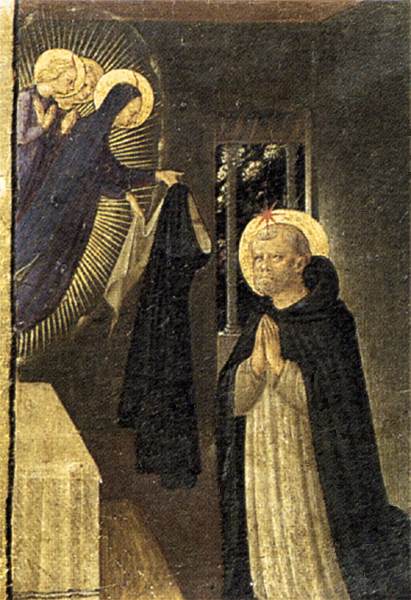
Last week I
presented the luminous figure of Francis of Assisi; today I would like to speak
to you of another saint who, in the same period, made an essential contribution
to the renewal of the Church of his time. It is St. Dominic, the founder of the
Order of Preachers, known also as the Dominican Friars.
His successor in the
leadership of the order, Blessed Giordano di Saxony, gives a complete portrait
of St. Dominic in the text of a famous prayer: “Inflamed by zeal for God
and supernatural ardor, by your limitless charity and the fervor of a vehement
spirit, you consecrated yourself wholly with the vow of perpetual poverty to apostolic
observance and to evangelical preaching.” It is in fact this essential
feature of Dominic’s witness that is underlined: He always spoke with God and
about God. In the life of saints, love of the Lord and of neighbor, the seeking
of God’s glory and the salvation of souls always go together.
Dominic was born
in Spain, in Caleruega, around 1170. He belonged to a noble family of Old
Castille and, supported by an uncle priest, he was educated in a famous school
of Palencia. He was distinguished immediately for his interest in the study of
sacred Scripture and for his love of the poor, to the point of selling books,
which in his time constituted a good of great value, to help victims of famine
with what he collected.
Ordained a priest, he was elected canon of the chapter
of the cathedral in his native diocese, Osma. Although this appointment could
represent for him some motive of prestige in the Church and in society, he did
not interpret it as a personal privilege, or as the beginning of a brilliant ecclesiastical
career, but as a service to render with dedication and humility. Is not perhaps
the temptation to a career, to power, a temptation to which not even those who
have a role of leadership and governance in the Church are immune? I recalled
this a few months ago, during the consecration of some bishops: “We do not
seek power, prestige or esteem for ourselves. […] We know how in civil
society and often also in the Church things suffer because many people on whom
responsibility has been conferred work for themselves rather than for the
community” (Homily, Cappella Papale per l’Ordinazione episcopale di cinque
Ecc. mi Presuli, Sept. 12, 2009).
The bishop of Osma, who was named Diego, a
true and zealous pastor, very soon noticed the spiritual quality of Dominic,
and wished to make use of his collaboration. Together they went to Northern
Europe to carry out diplomatic missions entrusted to them by the king of
Castille.
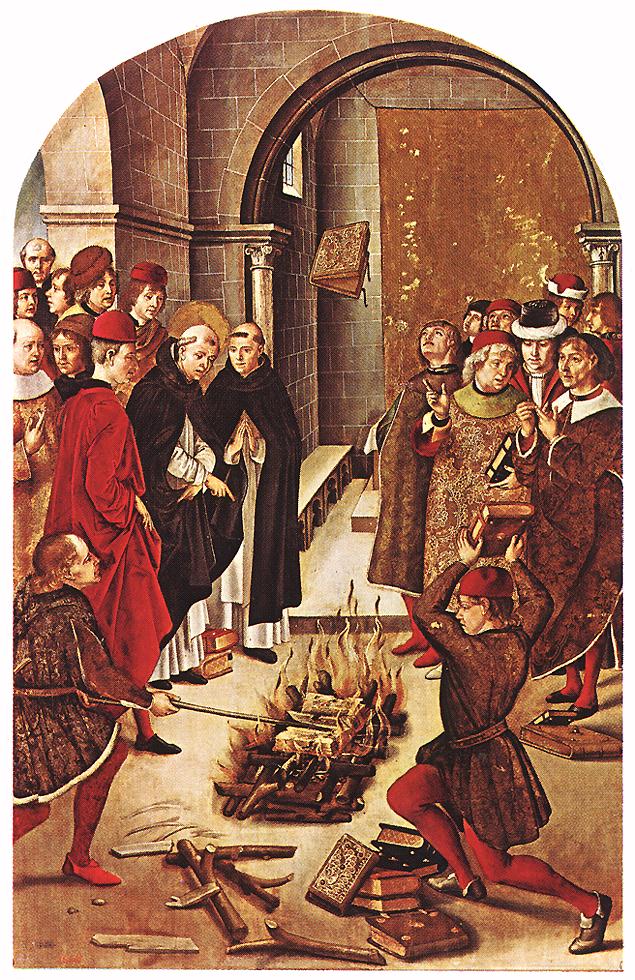
While traveling, Dominic became aware of two great challenges for
the Church of his time: the existence of people who were not yet evangelized,
in the northern limits of the European continent, and the religious scourge
that weakened Christian life in southern France, where the action of some
heretical groups created disturbance and a falling away from the truth of the
faith. Missionary work on behalf of those who do not know the light of the
Gospel and the work of re-evangelization of the Christian community thus became
the apostolic goals that Dominic intended to pursue. It was the Pope, to whom
Bishop Diego and Dominic went to ask advice, who requested the latter to
dedicate himself to preaching to the Albigensians, a heretical group which held
a dualistic concept of reality, that is, of two equally powerful creative
principles, Good and Evil. This group, consequently, had contempt for matter as
coming from the principle of evil, even rejecting marriage, and reaching the
point of denying the incarnation of Christ, the sacraments in which the Lord
“touches” us through matter, and the resurrection of bodies. The
Albigensians esteemed a poor and austere life — in this sense they were even
exemplary — and they criticized the wealth of the clergy of that time.
Dominic
accepted this mission enthusiastically, which he carried out precisely with the
example of his poor and austere existence, with the preaching of the Gospel and
with public debates. He dedicated the rest of his life to this mission of
preaching the Good News. His sons would fulfill St. Dominic’s other dreams: the
mission ad gentes, that is, to those who did not yet know Jesus, and the
mission to those who lived in the city, especially in the universities, where
new intellectual tendencies were a challenge for the faith of the
well-educated.
This great saint reminds us that a missionary fire must always
burn in the heart of the Church, which drives incessantly to take the first
proclamation of the Gospel and, where necessary, to a new evangelization:
Christ is, in fact, the most precious good that men and women of all times and
all places have the right to know and to love! And it is consoling to see how
also in the Church of today there are so many — pastors and lay faithful,
members of old religious orders and of new ecclesial movements — that with joy
spend their life for this supreme ideal: to proclaim and witness the Gospel!
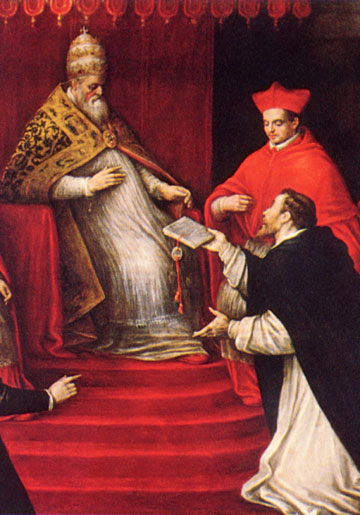
Other
men associated themselves to Dominic Guzmán, attracted by the same aspiration.
Thus, gradually, from the first foundation of Tolosa, was born the Order of
Preachers. Dominic, in fact, in full obedience to the directives of the Popes
of his time, Innocent III and Honorius III, adopted the ancient Rule of St.
Augustine, adapting it to the needs of apostolic life, which led him and his
companions to preach, moving from one post to another, but returning, later, to
their own monasteries, places of study, prayer and community life. In a
particular way, Dominic wished to highlight two values considered indispensable
for the success of the evangelizing mission: community life in poverty and
study.
First of all, Dominic and the Friars Preachers presented themselves as
mendicants, that is, without vast properties of land to administer. This
element rendered them more available for study and itinerant preaching and
constituted a concrete witness for the people. The internal government of the
Dominican monasteries and provinces was structured on the system of chapters,
which elected their own superiors, confirmed later by major superiors; hence,
an organization that stimulated fraternal life and the responsibility of all
the members of the community, exacting strong personal convictions. The choice
of this system stemmed precisely from the fact that the Dominicans, as preachers
of the truth of God, had to be consistent with what they proclaimed. Truth
studied and shared in charity with brothers is the most profound foundation of
joy. Blessed Giordano of Saxony said of St. Dominic: “He received every
man in the great bosom of charity and, because he loved everyone, everyone
loved him. He made a personal law for himself of being joyful with happy
persons and of weeping with those who wept” (Libellus de principiis
Ordinis Praedicatorum autore Iordano de Saxonia, ed. H.C. Scheeben, [Monumenta
Historica Sancti Patris Nostri Dominici, Romae, 1935]).
In the second place,
with a courageous gesture Dominic wished that his followers acquire a solid
theological formation, and he did not hesitate to send them to the universities
of the time, even though not a few ecclesiastics regarded with diffidence these
cultural institutions. The Constitutions of the Order of Preachers give great
importance to study as preparation for the apostolate. Dominic wanted his
friars to dedicate themselves to study, sparing no effort, with diligence and
compassion — to study founded on the soul of all theological learning, that
is, on sacred Scripture, and respectful of the questions posed by reason.
The
development of culture imposes on those who carry out the ministry of the Word,
at various levels, to be well prepared. Hence I exhort all, pastors and laity,
to cultivate this “cultural dimension” of faith, so that the beauty
of the Christian truth can be better understood and faith can be truly nourished,
reinforced and also defended. In this Year for Priests, I invite seminarians
and priests to appreciate the spiritual value of study. The quality of the
priestly ministry depends also on the generosity with which one applies oneself
to the study of revealed truths.
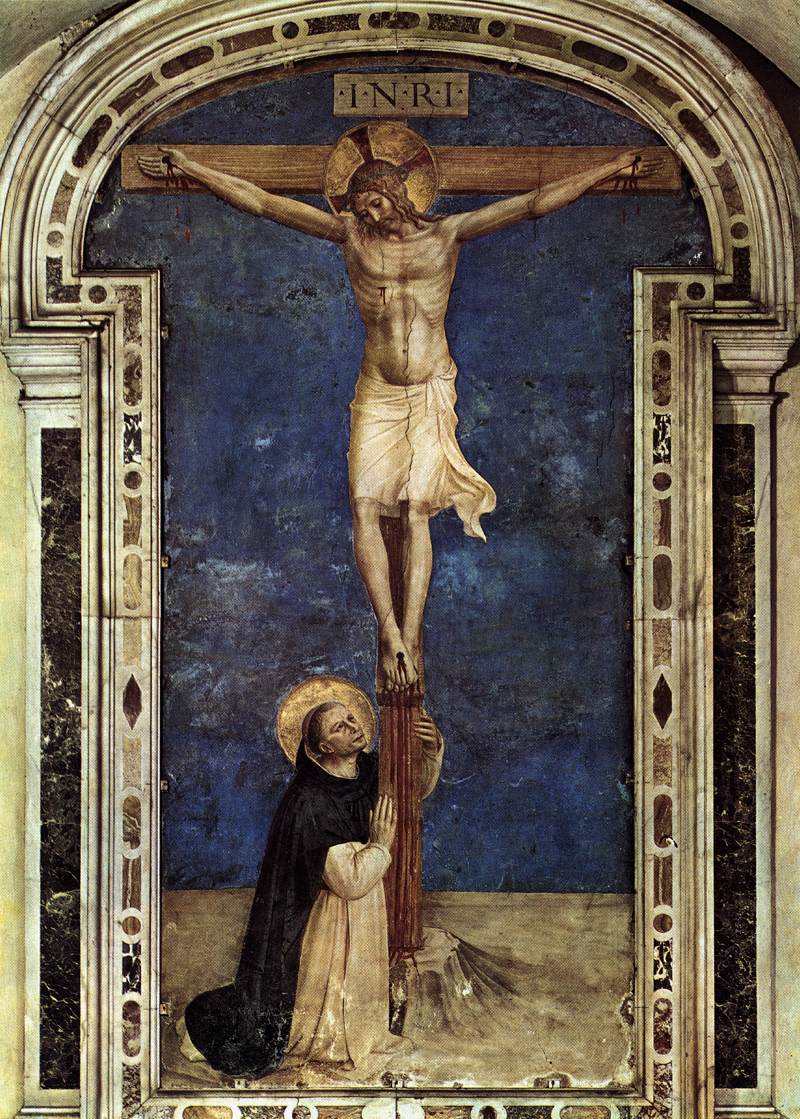
Dominic, who wished to found a religious Order
of Preachers-Theologians, reminds us that theology has a spiritual and pastoral
dimension, which enriches the spirit and life. Priests, consecrated persons and
also all the faithful can find a profound “interior joy” in
contemplating the beauty of the truth that comes from God, truth that is always
up-to-date and always living. Hence, the motto of the Friars Preachers —
contemplata aliis tradere — helps us to discover a pastoral yearning in the
contemplative study of such truth, by the need to communicate to others the
fruit of one’s contemplation.
When Dominic died in 1221 in Bologna, the city
that declared him its patron, his work had already had great success. The Order
of Preachers, with the support of the Holy See, had spread to many countries of
Europe to the benefit of the whole Church. Dominic was canonized in 1234, and
it is he himself, with his sanctity, who indicates to us two indispensable
means for apostolic action to be incisive. First of all, Marian devotion, which
he cultivated with tenderness and which he left as precious legacy to his
spiritual children, who in the history of the Church have had the great merit
of spreading the prayer of the holy rosary, so dear to the Christian people and
so rich in evangelical values, a true school of faith and piety. In the second
place, Dominic, who took care of some women’s convents in France and in Rome,
believed profoundly in the value of intercessory prayer for the success of
apostolic work. Only in Paradise will we understand how much the prayer of the
cloistered effectively supports apostolic action! To each one of them I direct
my grateful and affectionate thoughts.
Dear brothers and sisters, may Dominic
Guzmán’s life spur all of us to be fervent in prayer, courageous in living the
faith, profoundly in love with Jesus Christ. Through his intercession, we ask
God to enrich the Church always with genuine preachers of the Gospel.
Blessing of Bread, Wine, Water and Fruit for the Feast of Saint Blase
Blessing of Bread, Wine, Water and Fruit
for the relief of throat ailments on the Feast of Saint Blase, Bishop and Martyr
V. Our help is in the name of the Lord.
R. Who made heaven and earth.
V. The Lord be with you.
R. And with your spirit.

O God, Savior of the world, Who did consecrate this day with the martyrdom of the most venerable Blase, granting him among other gifts the power of healing all who are afflicted with throat ailments; we humbly beseech Your boundless mercy, and beg that these fruits, bread, wine, and water, which Your devoted people today, be blessed + and sanctified + by Your goodness. May they who taste thereof be fully healed of all afflictions of the throat, as well as every infirmity of soul or body, through the prayers and merits of the same Blase, Pontiff and Martyr. You who live and reign God, forevermore.
R. Amen.
The items are sprinkled with holy water.
Blessing of Candles on the feast of Saint Blase
Blessing of Candles on the feast of Saint Blase,
Bishop & Martyr
Bishop & Martyr

V. Our help is in the name of the Lord.
R. Who made heaven
and earth.
and earth.
V. The Lord be with you.
R. And with your spirit.
Let us pray.
O God
of gentleness and might, by You Word alone You did create the manifold things
of the world, and did cause this same Word, Maker of all things, to take flesh
in order to repurchase us. You are great and wonderful, awesome and
praiseworthy, a doer of wonderful deeds. Wherefore, in professing his fealty to
You, the glorious martyr and bishop, Blasé did not fear any manner of torment,
but gladly accepted the palm of martyrdom. In virtue of which, among other
gifts, You did bestow on him this prerogative -of healing all ailments of the
throat. Thus we beg Your Majesty that overlooking our guilt, and considering
only his merits and intercession You world grant to bless + and sanctify + and
bestow Your grace on these candles. Let all Christians of good faith whose
necks are touched with them be healed of every malady of the throat, and being
restored in health and cheer, let them return thanks in Your holy Church, and
give praise to Your wondrous name which is blessed forever. Through our Lord,
Jesus Christ, Your Son, Who lives and reigns with You in the unity of the Holy
Spirit, God, eternally.

of gentleness and might, by You Word alone You did create the manifold things
of the world, and did cause this same Word, Maker of all things, to take flesh
in order to repurchase us. You are great and wonderful, awesome and
praiseworthy, a doer of wonderful deeds. Wherefore, in professing his fealty to
You, the glorious martyr and bishop, Blasé did not fear any manner of torment,
but gladly accepted the palm of martyrdom. In virtue of which, among other
gifts, You did bestow on him this prerogative -of healing all ailments of the
throat. Thus we beg Your Majesty that overlooking our guilt, and considering
only his merits and intercession You world grant to bless + and sanctify + and
bestow Your grace on these candles. Let all Christians of good faith whose
necks are touched with them be healed of every malady of the throat, and being
restored in health and cheer, let them return thanks in Your holy Church, and
give praise to Your wondrous name which is blessed forever. Through our Lord,
Jesus Christ, Your Son, Who lives and reigns with You in the unity of the Holy
Spirit, God, eternally.
R. Amen.

The candles are sprinkled with holy water. Then
the pries, holding two crossed candles to the throat of each one to be blessed,
as they kneel before the altar, says:
the pries, holding two crossed candles to the throat of each one to be blessed,
as they kneel before the altar, says:
Through the intercession of Saint Blase,
Bishop and Martyr, may God deliver you from sickness of the throat and from
every other evil. In the name of the Father, and of the Son, + and of the Holy
Spirit. Amen.
Bishop and Martyr, may God deliver you from sickness of the throat and from
every other evil. In the name of the Father, and of the Son, + and of the Holy
Spirit. Amen.
Presentation of the Lord: Adorna, Sion, Thalamum

Let Zion
He comes, her Lord and her Betrothed.
Let bride and Bridegroom, by faith’s light,
A vigil keep throughout the night.
He comes, her Lord and her Betrothed.
Let bride and Bridegroom, by faith’s light,
A vigil keep throughout the night.
Saint Simeon, go forth in joy.
Exult to see the baby Boy:
Make known to all the Light divine
That soon on ev’ry land shall shine.
His parents to the temple bring
The Temple as an offering
The righteousness of law He chose
Though to the law He nothing owes.
So, Mary, bring this little one,
Yours and the Father’s only Son
Through whom our offering is made
By whom our ransom price is paid.
And forward, royal Virgin, go
And let rejoicing overflow
With gifts bring forth your newborn Son
Who comes to rescue everyone.
Lord Jesus Christ, the Glory bright
Who guides the nations into light
Be praised, and for eternity
Be glorified, O Trinity. Amen.
Text by
For more on Candlemas, see this Catholic Encyclopedia article.
Blessing of Candles on Candlemas
The Blessing of Candles

V. Our help is in the name of the Lord.
R. Who made heaven and earth.
V. The Lord be with you.
R. And with your spirit.
Let us pray.
O Lord Jesus Christ, Son of the living God, bless + these candles at our request. By the power of the holy cross, + bestow a heavenly blessing on them, O Lord, Who did give them to mankind to dispel the gloom. Empowered with the seal of Your holy cross, + let the spirits of darkness depart trembling and fly in fear from all places where their light shines, and never more disturb nor molest [bother] those who serve You, the almighty God, Who lives and reigns forevermore.
R. Amen.
Sprinkle with holy water.
Pope sneaks out of the Vatican… briefly … without telling the world!
Cindy Wooden of the Catholic News Service reports that the Pope got out of the Vatican –with his closest associates and 2 other officials– without the world knowing it. Good for him!!! Ms Wooden writes:
Twenty-five years ago, it wasn’t unusual for Pope John Paul II to sneak out of the Vatican in the winter to go skiing.
Pope Benedict XVI left the Vatican unannounced last evening to visit an art exhibit, according to reports today from Vatican Radio and L’Osservatore Romano.
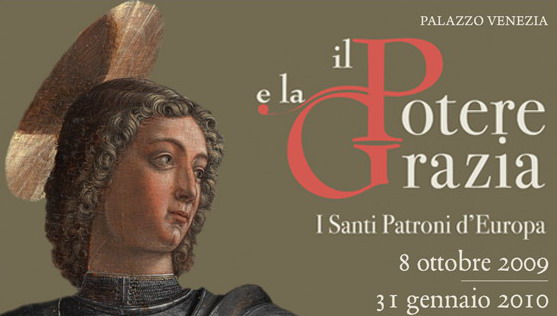
Yesterday marked the end of the four-month run of the exhibit, “The Power and the Grace: The Patron Saints of Europe,” at Rome’s Palazzo Venezia Museum, and Pope Benedict was among the last of the more than 100,000 people to visit the show.
The Vatican newspaper said the pope arrived at the museum about 6:30 p.m. with his two private secretaries and the four laywomen who care for the private papal household. The women are members of Communion and Liberation’s Memores Domini association.
While the public was held at bay for 35 minutes, the pope and his entourage were shown the more than 100 works on display by the curator of the exhibit, the Italian ambassador to Italy and an undersecretary of Italian Prime Minister Silvio Berlusconi’s government.
For the last month of the exhibit, the Louvre in Paris loaned the museum Leonardo DaVinci’s painting of St. John the Baptist. Other works on display included Jan van Eyck’s painting of St. Francis of Assisi with the stigmata, Caravaggio’s St. John the Baptist, and El Greco’s painting of St. Louis IX of France.
Pope tells bishops of England and Wales to be united in teaching the faith and being a witness to Christ
This last week the Pope has meeting individually and collectively with the bishops of England and Wales. As you know, a bishop is obliged to pray at the tombs of Saints Peter and Paul and to offer a review of the pastoral activities of the diocese he leads to the Pope and to his curia. It is a visit to “the threshold” (ad Limina) to the center of our faith. Over the past years the bishops of Britain have faced some serious challenges–much like the bishops of the USA and Canada– and have not responded effectively enough to certain matters of faith and morals. The British bishops are your typical “old boys” network, a closed group of men sitting on their laurels. Generally speaking the UK bishops are not very unified in their teaching the faith which was a hallmark of Cardinal Murphy-O’Connor; one clear indication of this is the work of Bishop O’Donoghue that was posted here calling for clear catechesis, witness and liturgical practice (read two things here and here). In the Pope’s address to the bishops at the end of their to visit Peter, you can see the matters that concern the pope and the Church at large. The papal address at the end of any visit of an episcopal conference is an interesting thing to read because Rome is a bit more objective in reading the tea leaves than those living in situ. General rule of thumb: if it finds its way into print, then it is important to recall. Plus, the Pope is rather subtle in his addresses such that you have to read between the lines. And you may ask why is this text important for North America. Catholics on both sides of the Atlantic face the very same issues when it comes to proposing the faith, moral living, ecumenism and sacramentality. What the Pope told the UK bishops is to be applied in the USA: the old way of doing things has ended. All but 2 paragraphs of the address are given here with my own emphasis on certain points.
I welcome all of you on your ad Limina visit to Rome, where you have come to venerate the tombs of the Apostles Peter and Paul. I thank you for the kind words that Archbishop Vincent Nichols has addressed to me on your behalf, and I offer you my warmest good wishes and prayers for yourselves and all the faithful of England and Wales entrusted to your pastoral care. Your visit to Rome strengthens the bonds of communion between the Catholic community in your country and the Apostolic See, a communion that sustained your people’s faith for centuries, and today provides fresh energies for renewal and evangelization. Even amid the pressures of a secular age, there are many signs of living faith and devotion among the Catholics of England and Wales. I am thinking, for example, of the enthusiasm generated by the visit of the relics of Saint Thérèse, the interest aroused by the prospect of Cardinal Newman’s beatification, and the eagerness of young people to take part in pilgrimages and World Youth Days. On the occasion of my forthcoming Apostolic Visit to Great Britain, I shall be able to witness that faith for myself and, as Successor of Peter, to strengthen and confirm it. During the months of preparation that lie ahead, be sure to encourage the Catholics of England and Wales in their devotion, and assure them that the Pope constantly remembers them in his prayers and holds them in his heart.
Your country is well known for its firm commitment to equality of opportunity for all members of society. Yet as you have rightly pointed out, the effect of some of the legislation designed to achieve this goal has been to impose unjust limitations on the freedom of religious communities to act in accordance with their beliefs. In some respects it actually violates the natural law upon which the equality of all human beings is grounded and by which it is guaranteed. I urge you as Pastors to ensure that the Church’s moral teaching be always presented in its entirety and convincingly defended. Fidelity to the Gospel in no way restricts the freedom of others – on the contrary, it serves their freedom by offering them the truth.
Continue to insist upon your right to participate in national debate through respectful dialogue with other elements in society. In doing so, you are not only maintaining long-standing British traditions of freedom of expression and honest exchange of opinion, but you are actually giving voice to the convictions of many people who lack the means to express them: when so many of the population claim to be Christian, how could anyone dispute the Gospel’s right to be heard?
If the full saving message of Christ is to be presented effectively and convincingly to the world, the Catholic community in your country needs to speak with a united voice. This requires not only you, the Bishops, but also priests, teachers, catechists, writers – in short all who are engaged in the task of communicating the Gospel – to be attentive to the promptings of the Spirit, who guides the whole Church into the truth, gathers her into unity and inspires her with missionary zeal.
Make it your concern, then, to draw on the considerable gifts of the lay faithful in England and Wales and see that they are equipped to hand on the faith to new generations comprehensively, accurately, and with a keen awareness that in so doing they are playing their part in the Church’s mission. In a social milieu that encourages the expression of a variety of opinions on every question that arises, it is important to recognize dissent for what it is, and not to mistake it for a mature contribution to a balanced and wide-ranging debate. It is the truth revealed through Scripture and Tradition and articulated by the Church’s Magisterium that sets us free. Cardinal Newman realized this, and he left us an outstanding example of faithfulness to revealed truth by following that “kindly light” wherever it led him, even at considerable personal cost. Great writers and communicators of his stature and integrity are needed in the Church today, and it is my hope that devotion to him will inspire many to follow in his footsteps.
Much attention has rightly been given to Newman’s scholarship and to his extensive writings, but it is important to remember that he saw himself first and foremost as a priest. In this Annus Sacerdotalis, I urge you to hold up to your priests his example of dedication to prayer, pastoral sensitivity towards the needs of his flock, and passion for preaching the Gospel. You yourselves should set a similar example. Be close to your priests, and rekindle their sense of the enormous privilege and joy of standing among the people of God as alter Christus. In Newman’s words, “Christ’s priests have no priesthood but His … what they do, He does; when they baptize, He is baptizing; when they bless, He is blessing” (Parochial and Plain Sermons, VI 242). Indeed, since the priest plays an irreplaceable role in the life of the Church, spare no effort in encouraging priestly vocations and emphasizing to the faithful the true meaning and necessity of the priesthood. Encourage the lay faithful to express their appreciation of the priests who serve them, and to recognize the difficulties they sometimes face on account of their declining numbers and increasing pressures. The support and understanding of the faithful is particularly necessary when parishes have to be merged or Mass times adjusted. Help them to avoid any temptation to view the clergy as mere functionaries but rather to rejoice in the gift of priestly ministry, a gift that can never be taken for granted.
Ecumenical and inter-religious dialogue assume great importance in England and Wales, given the varied demographic profile of the population. As well as encouraging you in your important work in these areas, I would ask you to be generous in implementing the provisions of the Apostolic Constitution Anglicanorum Coetibus, so as to assist those groups of Anglicans who wish to enter into full communion with the Catholic Church. I am convinced that, if given a warm and open-hearted welcome, such groups will be a blessing for the entire Church.
Pope Benedict XVI’s monthly prayer intentions for February 2010
 Pope Benedict asks us to keep in mind the following
two intentions for the coming month of February. These intentions, as in our intentions offered in prayer show what Christ’s word means in all of its richness, the truth. He or she who prays understands, knows, does the will of God, as von Balthasar would say. So, pray for these intentions.
The general intention
That
scholars and intellectuals, by sincere search for the truth, may come to know
the one true God.
scholars and intellectuals, by sincere search for the truth, may come to know
the one true God.
The missionary intention
That the Church, aware of its
missionary identity, may strive to follow Christ faithfully and to proclaim his
Gospel to all peoples.
missionary identity, may strive to follow Christ faithfully and to proclaim his
Gospel to all peoples.