Clean Monday…getting into Great Lent


Thumbnail image for St Andrew of Crete.jpg

For Eastern Catholic and Orthodox Christians, today is “Clean Monday,”
the first day of the Great Fast. In many of these churches, the faithful will
gather tonight for the service of Compline with the singing of a portion of the
“Penitential Canon,” also known as the “Great Canon of St.
Andrew of Crete.” The
First Ode of the Great Canon uses as a springboard
the text of the Canticle of Moses contained in Exodus 15: 1-19. The
singing of the Great Canon in the First Week of the Great Fast, is intended to
invoke compunction in the penitent heart.

(Irmos) A Helper
and Protector has become salvation to me.

This is my God; I
will glorify Him.

God of my fathers,
I will exalt Him;

for in glory has He
been glorified!

Refrain

Glory to You, our
God, glory to You!
(or the refrain changes to “Have mercy on me, O God,
have mercy on me!” when sung at Compline in the first of the Fast)

Where shall I begin
to lament the deeds of my wretched life?

What first-fruits
shall I offer, O Christ, for my present lamentation?

But in your
compassion, grant me release from my sins.

Glory to You…

Come, wretched
soul,

with your flesh
confess to the Creator of All.

In future, refrain
from your former brutishness

and offer to God
tears in repentance.

Glory to You…

Having rivaled the
first-made Adam in my transgressions,

I realize that I am
stripped naked of God

and of the
everlasting kingdom of bliss through my sins.

Glory to You…

Alas, wretched
soul!

Why are you like
the first Eve?

For you have
wickedly looked and been bitterly wounded,

and you have
touched the tree

and rashly tasted
the forbidden fruit.  (cf Gen. 3:6)

Glory to You…

The place of bodily
Eve has been taken

by the Eve of my
mind,

in the shape of a
passionate thought in the flesh,

showing me sweet
things

yet ever making me
taste bitter things.

Glory to You…

Adam was rightly
exiled from Eden

for not keeping
Your one commandment.

O Savior, what
shall I suffer,

who am always rejecting
Your living words? (cf. Gen. 3:26/Acts 7:38)


Glory to the Father
and to the Son and to the Holy Spirit!

Trinity adored in
Unity,

take from me the
heavy yoke of sin,

and in Your
compassion,

grant me tears of
compunction.

Now and ever and
forever. Amen.

O Theotokos,

hope and
intercessor of those who sing to you,

take from me the
heavy yoke of sin,

and as you are our
pure Lady,

accept me that
repents.


(KATAVASIA)  A
Helper and a Protector is He unto salvation.

He is my God, and I
glorify Him;

God of my fathers,
and I magnify Him,

for He is greatly
glorified.

Bishop Peter A. Rosazza celebrates his 75th birthday
Peter A Rosazza.jpg

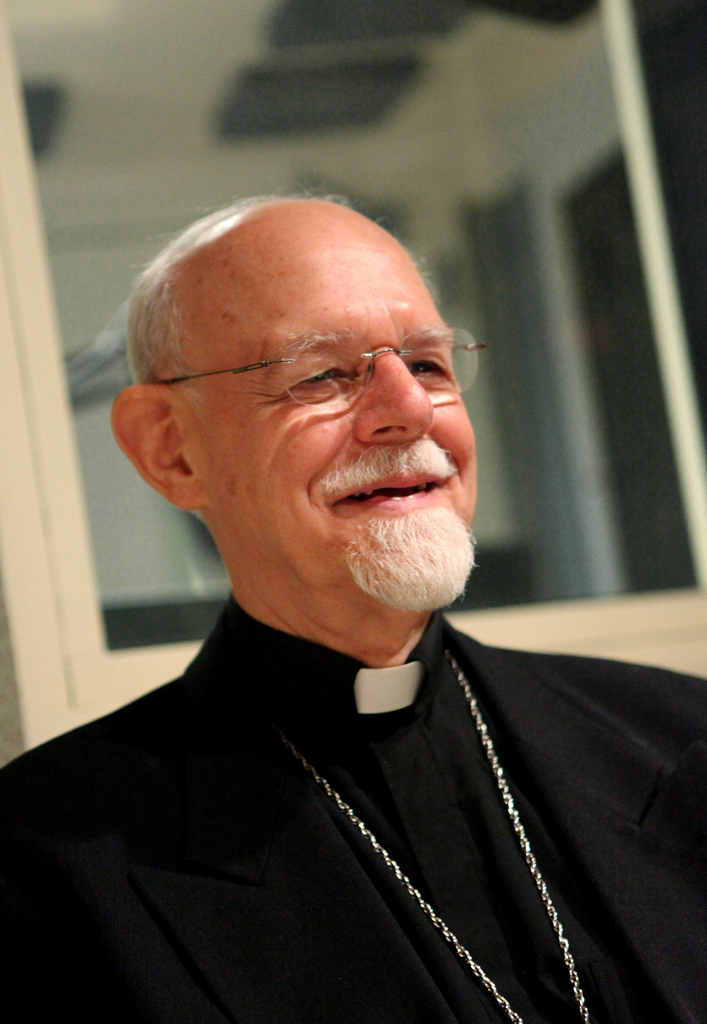
Bishop Peter Anthony Rosazza, an auxiliary bishop of the Archdiocese of Hartford, celebrates his 75th birthday today.

Our prayers are with him as he makes this milestone.

Bishop Rosazza was ordained a bishop in 1978 (31 yrs a bishop) at the age of 43 by the great Archbishop John Francis Whealon.

Since I am from New Haven, Bishop Peter (as he’s known) is a legendary character. For one, he confirmed me in 1982 at Saint Stanislaus Church (New Haven, CT) and he’s been a tireless advocate for those living on the margins of society (the poor, the immigrant, the widow).

He’s been known as a good preacher of the Gospel and attentive teacher of the faith. Significantly, Bishop Peter is also been a friend to the Communion and Liberation group of New Haven for which are we deeply grateful.

Happy 75th birthday Bishop Peter!

Blessed Jordan of Saxony

Bl Jordan of Saxony.jpegMy words that I have in your mouth, says the Lord, will never be absent from your lips, and your gifts will be accepted on my altar.

Gracious God, You called our brother Jordan to the preaching of the gospel by which he drew many to the apostolic way of life. Help us to preach the way of salvation faithfully and so proclaim the kingdom of Christ Your Son, who lives and reigns with You and the Holy Spirit, one God, for ever and ever.

Here’s the Legend of Blessed Jordan of Saxony, second Master General of the Order of Friars Preachers.

Leading the soul to God by the method of the Ignatian Spiritual Exercises

I came across this entry in an old encyclopedia. In its brevity a lot of truth is revealed: we can work (asceticism) by reason, and the heart, to union with God. Consider for a second what the author, Fr Drum, has to teach. Also, remember that Ignatian spirituality is not the same as Jesuit spirituality. The two are not the same by any stretch of the imagination. Fr Drum tells us that it is possible through prayer and good spiritual direction to know, love and serve God in this world so as to do the same in the next. Many people today don’t have the confidence that knowing and loving and serving God is possible at all. Some don’t know that God wants our happiness today –in this life–that there is meaning to our life that includes suffering and love (& joy) and some reject the notion that we are oriented toward a final goal. Christians call this goal heaven, the Beatific vision, communion with the Trinity, etc. What else is there for the Christian who really prays and lives his or her life with the Gospel and with reason? I get the sense that they don’t have the certainty that God knows us personally and intimately, never mind having a relationship with bodiless being.

I spent many years being formed by Ignatian Spirituality. My personal, cultural, ecclesial life (taken as a unity) is informed by what Saint Ignatius of Loyola proposed in his Spiritual Exercises. But I would not be telling the whole truth if I didn’t say that other influences have had a strong influence in how I look at my life and life’s work today. My life intersects with Monsignor Luigi Giussani, Chiara Lubich, Saint Josemaria Escriva, Saints Francis & Dominic and Saint Benedict and this school of the Lord’s service. The host of women saints and blesseds are too cumbersome to note here. The point, however, is not my interpretative lens except to say that I have benefited from the Spiritual Exercises and perhaps you might think the same if you gave the Exercises a chance. They are clearly an apostolic method in the spiritual life with an incredibly strong contemplative aspect. The Exercises are not for everyone, so be patient with them if you attempt to do an Ignatian retreat.

Ultimately, what the author of this entry names as the goal of the Christian life is my own, regardless of the influences: To live is Christ. It is entirely consistent with the motto of my coat of arms seen above: sequela Christi (to follow Christ). Ignatius (and the other spiritual masters noted above) could not conceive of life any differently. Would that be the same for all people!

The entry:
St. Ignatius of Loyola, Rome.JPG.jpeg

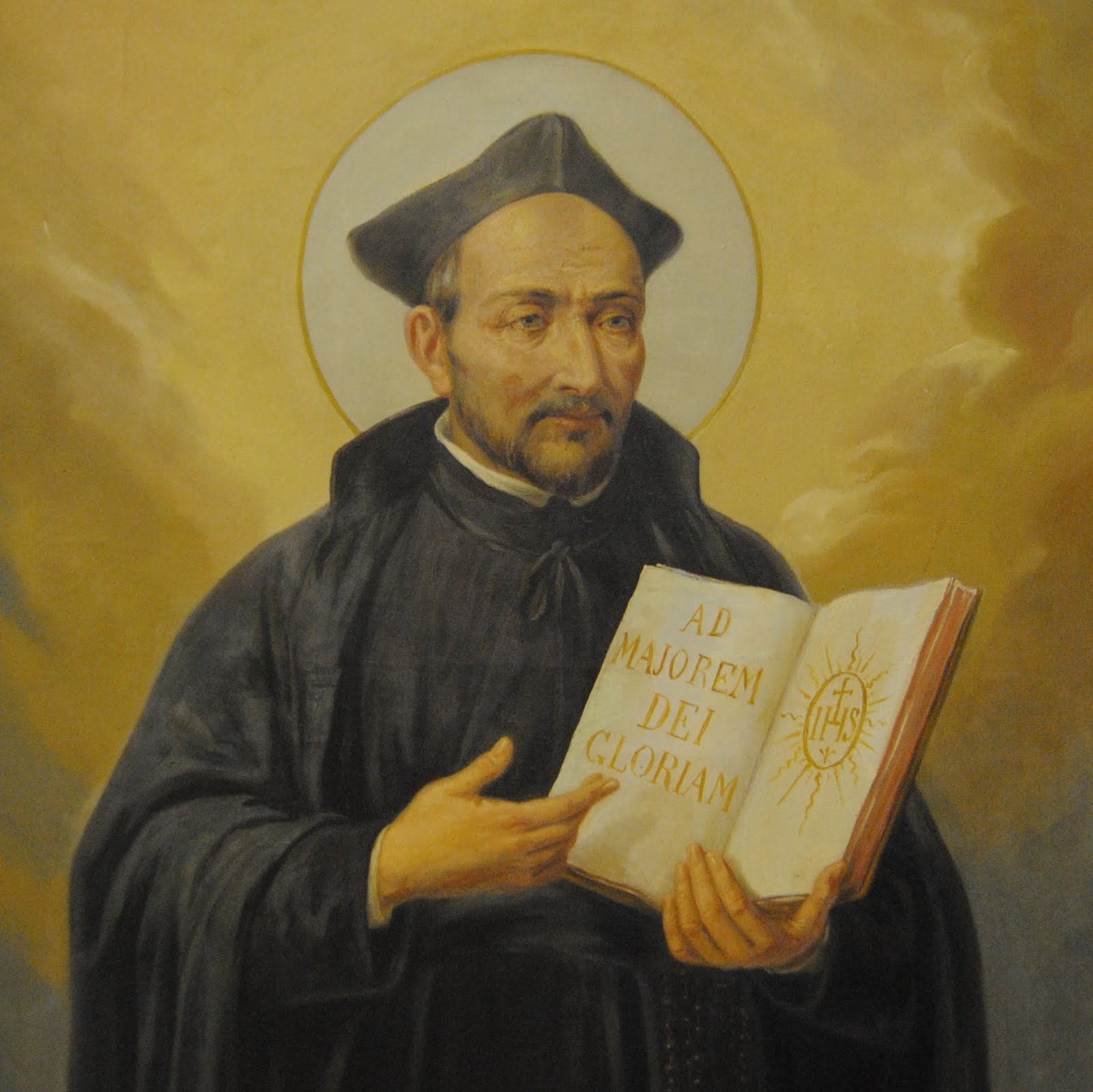
The spirit of Saint Ignatius was Pauline, — intrepid yet tender; motivated by two great principles,–love of Jesus Christ and zeal for the salvation of souls. These two principles were brought together in his motto: A. M. D. G., “Omnia ad Majorem Dei Gloriam” (All for the greater glory of God). It was this spirit, which breathed in “The Spiritual Exercises,” a method of asceticism, that is the very soul of the constitutions and activities of the Society of Jesus.

This little book is said to have converted more souls than it contains letters.

Certainly the results it has produced down the centuries cannot be exaggerated. The importance of its method is proved by the mere fact that 292 Jesuit writers have commented on the whole work. The purpose of the Exercises is definite and scientific upbuilding of the reason, will and emotions, by meditation and contemplation on the fundamental principles of the spiritual life and by other exercises of the soul. First, God is rated rightly as the soul’s end and object.

Reason is convinced that God is the end for which the soul is created, and all things else are only means to bring the soul to God; hence it follows that that is good which leads the soul Godward, and that is evil which leads the soul awayward from God.

The soul’s awaywardness from God results in sin; so sin is studied both in itself and in its consequences to the soul. Secondly, Jesus Christ is put in His place in the soul, by meditations on His ideals and contemplations on His private and public life.

The soul now aspires to the very height of enthusiastic and personal love to Him; and to the most self-sacrificing generosity in following the evangelical counsels.

Thirdly, the high resolves of the soul are confirmed by the imitation of Christ in His passion. Lastly, the soul rises to a sublime and unselfish joy, purely because of the glory of its risen Lord; and leaps with rapturous exultation into the realms of unselfish and perfect love of God, such as Saint Paul evinced when he cried out: “To me, to live is Christ; to die were gain” (Philippians 1, 21).

Fr Walter Drum, SJ
The Encyclopedia Americana, 1919

New Benedictine Abbey in Oklahoma

St Benedict Clear Creek.jpegYesterday was the feast of Saint Scholastica, the twin sister of Saint Benedict but today Father Abbot Antoine of the Abbey Our Lady of Fontgombault announced that Our Lady of the Annunciation of Clear Creek Monastery is now an abbey.

Dom Philip Anderson was named the first abbot of Clear Creek by the Abbot of Fontgombault, Dom Antoine Forgeot. Dom Francis Bethel the long-time guestmaster was named prior and Dom Mark Bachmann, subprior.
Pray for Abbot Philip and for the monks of the Clear Creek Abbey!
The Abbey of Our Lady of Fontgombault, France (1948) is a foundation of the Abbey of Saint Peter, Solesmes (revived in 1833).
Saints Benedict and Scholastica, pray for us.

Prayer as love in light of Saint Anthony of Padua

I present the Wednesday (February 10, 2010) Address of Pope Benedict on Saint Anthony of Padua, following upon his talks on Saints Francis and Dominic in the past weeks. What is a stake here for the Pope? It is being centered totally on Jesus Christ. Nothing else matters. Prayer, a relationship of love with God is a constant. As the pope will note below, you can’t make progress in the spiritual life if you do not pray and live a life of virtue.

And now, the pope…

St Anthony of Padua.jpg

After presenting two weeks ago the figure of Francis of Assisi, this morning I would like to speak about another saint belonging to the first generation of Friars Minor: Anthony of Padua or, as he is also called, of Lisbon, referring to his native city. He is one of the most popular saints in the whole Catholic Church, venerated not only in Padua, where a splendid basilica was built, which houses his mortal remains, but in the whole world. Dear to the faithful are images and statues that represent him with the lily, symbol of purity, or with the Child Jesus in his arms, in memory of a miraculous apparition mentioned in some literary sources.

Anthony contributed in a significant way to the development of Franciscan spirituality, with his outstanding gifts of intelligence, balance, apostolic zeal and, mainly, mystical fervor.

He was born in Lisbon of a noble family around 1195 and was baptized with the name Fernando. He entered the canons who followed the monastic rule of St. Augustine, first in the monastery of St. Vincent in Lisbon, and subsequently in that of the Holy Cross in Coimbra, renown cultural center of Portugal. He dedicated himself with interest and solicitude to the study of the Bible and of the Fathers of the Church, acquiring that theological science that he made fructify in the activities of teaching and preaching.
Sts Francis Louis of Toulouse Anthony LdiBicci.jpg

The episode that marked a decisive change in his life took place in Coimbra: In 1220 the relics were exposed there of the first five Franciscan missionaries who had gone to Morocco, where they met with martyrdom. Their case aroused in young Fernando the desire to imitate them and to advance in the way of Christian perfection: He then asked to leave the Augustinian canons and become a Friar Minor. His request was accepted and, taking the name Anthony, he also left for Morocco, but Divine Providence willed otherwise. As the consequence of an illness, he was obliged to return to Italy and, in 1221, he took part in the famous “Chapter of the mats” in Assisi, where he also met St. Francis. Subsequently, he lived for a time totally hidden in a convent near Forli, in the north of Italy, where the Lord called him to another mission. Invited, by totally accidental circumstances, to preach on the occasion of a priestly ordination, he showed he was gifted with such learning and eloquence that the superiors destined him to preaching. Thus he began in Italy and France such an intense and effective apostolic activity that he induced not a few persons who had separated from the Church to retrace their steps. He was also among the first teachers of theology of the Friars Minor, if not even the first. He began his teaching in Bologna, with Francis’ blessing who, recognizing Anthony’s virtues, sent him a brief letter with these words:

“I would like you to teach theology to the friars.” Anthony set the foundations of Franciscan theology that, cultivated by other famous figures of thinkers, came to its zenith with St. Bonaventure of Bagnoregio and Blessed Duns Scotus.

Becoming provincial superior of the Friars Minor of northern Italy, he continued with the ministry of preaching, alternating that with administrative tasks. When his mandate as provincial came to an end, he retired near Padua where he had already been other times. Barely a year later, he died at the gates of the city on June 13, 1231. Padua, which in life had received him with affection and veneration, showed him forever honor and devotion. Pope Gregory IX himself, after hearing him preach, described him as the “Arc of the Testament,” and canonized him in 1232, also as a result of the miracles that happened through his intercession.

In the last period of his life, Anthony committed to writing two series of “Sermons” titled, respectively, “Sunday Sermons” and “Sermons on the Saints,” written for preachers and professors of theological studies of the Franciscan Order. In them he comments on the texts of sacred Scripture presented by the liturgy, using the Patristic Medieval interpretation of the four meanings: the literal or historical, the allegorical or Christological, the tropological or moral, and the anagogic, which guides to eternal life. They are theologic-homiletic texts, which take up the lively preaching in which Anthony proposes a true and proper itinerary of Christian life. The wealth of the spiritual teachings contained in the “Sermons” is such that, in 1946, the Venerable Pope Pius XII proclaimed Anthony a doctor of the Church, attributing to him the title of “Evangelic Doctor,” because from these writings arises the freshness and beauty of the Gospel; even today we can read them with great spiritual profit.
St Anthony praying to Madonna FLippi detail.jpg

In them, he speaks of prayer as a relationship of love, which drives man to converse sweetly with the Lord, creating an ineffable joy, which gently envelops the soul in prayer.  Anthony reminds us that prayer needs an atmosphere of silence, which is not the same as withdrawal from external noise, but is an interior experience, which seeks to remove the distractions caused by the soul’s preoccupations. According to the teaching of this distinguished Franciscan doctor, prayer is made up of four indispensable attitudes which, in Anthony’s Latin, are described as: obsecratio, oratio, postulatio, gratiarum actio. We could translate them thus: to open one’s heart confidently to God, to speak affectionately with him, to present to him our needs, to praise him and to thank him.

In this teaching of St. Anthony on prayer we see one of the specific features of Franciscan theology — of which he was the initiator — namely, the role given to divine love, which enters in the sphere of affection, of the will, of the heart and which is also the source from which springs a spiritual knowledge that surpasses all knowledge.

Anthony writes: “Charity is the soul of faith, makes it alive; without love, faith dies” (Sunday and Holy Days Sermons II, Messagero, Padua, 1979, p. 37).

Only a soul that prays can make progress in the spiritual life: this is the privileged object of St. Anthony’s preaching. He knows well the defects of human nature, the tendency to fall into sin; that is why he constantly exhorts to combat the inclination to covetousness, to pride, to impurity and to practice the virtues of poverty and generosity, of humility and obedience, of chastity and purity. At the beginning of the 13th century, in the context of the rebirth of the cities and the flourishing of trade, there was an increased number of people who were insensitive to the poor. Because of this, Anthony many times invites the faithful to think of true wealth, that of the heart, which, making them good and merciful, makes them accumulate treasures for Heaven. “O rich people,” he exhorts, “befriend… the poor, welcome them in your homes: They will then be the ones who receive you in the eternal tabernacles, where the beauty of peace is, the confidence of security, and the opulent quiet of eternal satiety” (Ibid., p. 29).

Is not this perhaps, dear friends, a very important teaching also today, when the financial crisis and the serious economic imbalances impoverish not a few persons and create conditions of misery? In my encyclical Caritas in Veritate, I remind that: “The economy needs ethics in order to function correctly — not any ethics whatsoever, but an ethics which is people-centred” (No. 45).

St Anthony at Mass.jpg

In Francis’ school, Anthony always puts Christ in the center of life and thought, of action and preaching. This is another typical feature of Franciscan theology: Christ-centeredness. Willingly [this theology] contemplates and invites to contemplate the mysteries of the Lord’s humanity, in a particular way, that of the Nativity, which arouse feelings of love and gratitude toward divine goodness.

Also the vision of the Crucified inspires in him thoughts of gratitude to God and of esteem for the dignity of the human person, so that all, believers and non-believers, can find a meaning that enriches life. Anthony writes: “Christ, who is your life, is hanging before you, because you look at the cross as in a mirror. There you will be able to know how mortal were your wounds, which no medicine but that of the blood of the Son of God could have cured. If you look well, you will realize how great are your human dignity and your value … In no other place can man realize better how much he is worth, but by looking at himself in the mirror of the cross” (Sunday and Holy Days Sermons III, p. 59).

Grace happens in Haiti

Yesterday I posted a brief note on the good work of CRUDEM and encouraging all of us to pray and to consider making a financial gift to help the relief efforts. It seems as though prayer is working and needs are being met. In my email inbox the following note was received and I thought it was a good illustration of the what is being done to aid the Haitian people in this incredible time of need. The author of this post is the president of the hospital foundation, CRUDEM, and a member of the Order of Malta.

seeking help at Hôpital Sacré.jpg

Today thanks to the efforts of many people and the generosity of an anonymous donor, 8 of our seriously ill children ranging in age from 3 to 13 were allowed by the Haitian authorities and UN to leave Haiti for treatment. A private jet from Western Massachusetts landed in Cap Haitian this morning filled with nurses and doctors from Baystate Medical Center and left with 8 children from Hopital Sacre Coeur accompanied by 2 physicians and 2 nurses.


The jet landed 4 hours later at Bradley Airport [Hartford, CT] where there were 6 ambulances waiting. Since it was snowing and in the 20’s the jet pulled into a hanger so the children could be protected. They were carefully carried to stretchers covered in blankets and given stuffed animals to accompany them on their trip to Shriners hospital (5 with serious orthopedic problems), a Boston burn unit (2 with serious burns), Baystate Pediatric intensive care unit (a girl with a fractured pelvis and other fractures).

Our census is around 400 patients despite discharges such as the above miracle. We are still receiving transfer patients from the USS comfort. Our volunteers continue to work 16 to 20 hour days and are an inspiration to watch. My son who just returned was in awe of the Professors of Internal medicine, surgery and Ophthalmology who were changing bandages and caring for patients in the temporary hospital because that was where the need was. Egos and status are put aside and the only focus is on how best to care for our patients. The true volunteer spirit of being willing to do whatever is needed is evident in all of our teams.

Typically we have about 170 volunteers come to 
Hôpital Sacré Coeur each year. Since the earthquake we have had over 250 and will continue to have at least 50 a week for the next 2 months. The list of people wanting to volunteer grows each day. This is proof for all of us that the majority of people are caring and want to help their fellow man. We need to remember this as we read and hear the negative in the media.


Thanks to private donations by individuals, companies and nonprofits such as Americares and Project Hope, we are still receiving the supplies we need to keep the hospital running. Our food shortage has ended thanks to the generosity of Malteser International who is financing the shipment of truckloads of food from the Dominican Republic. God has blessed us in this time of tragedy with the many people who make the Miracles at 
Hôpital Sacré Coeur happen.

Venerable Servant of God Pierre Toussaint, pray for us.
Blessed Gerard, pray for us.
Our Lady of Lourdes, pray for us.

Sickness & suffering can become a school of hope, Pope says on the 18th World Day of the Sick

On the 18th World Day of the Sick observed each year on the feast of Our Lady of Lourdes the Pope Benedict sends to the world a message. The Pope draws my attention, and perhaps yours, to the fact that Jesus tells us to do what He has done: be an instrument of healing by allowing divine grace to actually work. To “go and do likewise” is the reason why priests reconcile sinners, strengthen the sick through the sacrament of the sick, to “go and do likewise” is why Sr Mary Ellen Genova visits the sick weekly bring the Gospel and the Eucharist to those who can’t come to church, to “go and do likewise” is why Fr Jordan Kelly and the NY Dominican Friars have a healthcare ministry at 4 of the world’s prestigious hospitals, to “go and do likewise” is doing what Jesus did when we had the anointing of the sick for breast cancer survivors on the feast of Saint Agatha on February 5th, and to “go and do likewise” is why Fr Thomas Berg and the Westchester Institute works on healthcare ethics. There is no end to what we do in order to follow Christ more closely, focusing not on ourselves but on God the Father asking for the grace to deal directly with illness and suffering in a graced-filled manner.

 I extracted three paragraphs from the 2010 message for our consideration here today. The points emphasized are what I think the crucial elements of the papal message to be used for prayer and consideration.

At the end of the parable, Jesus said: “Go and do likewise” (Lk 10: 37). With these words he is also addressing us. Jesus exhorts us to bend over the physical and mental wounds of so many of our brothers and sisters whom we meet on the highways of the world. He helps us to understand that with God’s grace, accepted and lived out in our daily life, the experience of sickness and suffering can become a school of hope. In truth, as I said in the Encyclical Spe salvi, “It is not by sidestepping or fleeing from suffering that we are healed,
but rather by our capacity for accepting it, maturing through it and finding meaning through union with Christ, who suffered with infinite love”
(n. 37).

The Second Ecumenical Vatican Council had already recalled the Church’s important task of caring for human suffering. In the Dogmatic Constitution Lumen gentium we read that “Christ was sent by the Father “to bring good news to the poor… to heal the contrite of heart’ (Lk 4: 18), “to seek and to save what was lost’ (Lk 19: 10)…. Similarly, the Church encompasses with her love all those who are afflicted by human misery and she recognizes in those who are poor and who suffer, the image of her poor and suffering Founder. She does all in her power to relieve their need and in them she strives to serve Christ” (n. 8). The ecclesial community’s humanitarian and spiritual
action for the sick and the suffering has been expressed down the centuries in many forms and health-care structures, also of an institutional character. I would like here to recall those directly managed by the dioceses and those born from the generosity of various religious Institutes. It is a precious “patrimony” that corresponds with the fact that “love… needs to be organized if it is to be an ordered service to the community” (Encyclical Deus caritas est, n. 20). The creation of the Pontifical Council for Health-Care Workers 25 years ago complies with the Church’s solicitude for the world of health care. And I am anxious to add that at this moment in history and culture we are feeling even more acutely the need for an attentive and far-reaching ecclesial presence beside the sick, as well as a presence in society that can effectively pass on the Gospel values that safeguard human life in all its phases, from its conception to its natural end.

bp anointing the sick.jpg

In this Year for Priests, my thoughts turn in particular to you, dear priests, “ministers of the sick”, signs and instruments of Christ’s compassion who must reach out to every person marked by suffering. I ask you, dear presbyters, to spare no effort in giving them care and comfort. Time spent beside those who are put to the test may bear fruits of grace for all the other dimensions of pastoral care. Lastly I address you, dear sick people and I ask you to pray and to offer your suffering up for priests, so that they may continue to be faithful to their vocation and that their ministry may be rich in spiritual fruits for the benefit of the whole Church.

Our Lady of Lourdes, pray for us.

Saint Richard Pampuri, pray for us.

Our Lady of Lourdes


our lady of lourdes.jpg

You have been blessed, O Virgin Mary, above all other women on earth by the Lord the most high God; he has so exalted your name that your praises shall never fade from the mouths of men.


In the recent
weeks I’ve had to think more about the place of Mary, Mother of God (Theotokos)
in Catholic theology, worship and personal devotion. This was especially keen
when I took the negative position of a resolution on the worthiness of a
believer’s adherence to the phenomenon of Medjugorje. Marian piety is a strong
reality in Catholicism and no good Catholic can claim being in communion with
the believing community of faith if there is no adherence to some form of
devotion to the Mother of God, Mary the Virgin. Today, the Church honors the
Blessed Virgin Mary of Lourdes. Let me pose a points on what we believe viz.
Marian doctrine.

We can begin thinking about the BVM in sacred Scripture,
(e.g., the Annunciation or at the cross) the Apostolic Fathers and beyond but I
want to limit ourselves to the Second Vatican Council and a other notable
teachers of the Faith. Vatican II teaches us that Our Lady’s intercession
before the Throne of Grace is, in fact, long standing. Pope Paul VI speaks of
Mary as the intercessor for unity among Christians and world peace, ultimately
giving her the title of “Queen of Peace” (see the 1974 document Marialis
cultus
, 5 & 33).  Developing
the them of Mary’s maternity based on Vatican II thinking, Pope John Paul II in
his encyclical 1980 Dives in misericordia (no. 9) claims for us that Mary’s
motherhood the eternal Word of God has a special place in our own redemption.
In other places John Paul also speaks of Mary’s assistance in ecumenical work
as the “Mother of Unity” and he reaffirms Pope Paul’s “Queen of Peace” title.

Catholics
always make distinctions. We have “public revelation” and “private revelation”
when it comes to matters of faith and salvation. The teaching of the Church
says that public revelation ended with the death of Saint John, the beloved
disciple and evangelist. With John’s death revelation is said to be closed as
there were no other direct witnesses to the Resurrection of Jesus from the
dead. Revelation, here, contains all that God has revealed to us in His Son,
Jesus Christ. Since Christ established a Church to continue the ongoing work of
salvation public revelation means that it is contained in sacred Scripture,
Tradition and the Teaching of the Church: what has been handed down from Jesus,
to the Apostles to the bishops and to us. We believe, therefore, that Jesus
Christ is the fullness of revelation; He is the definitive revelation of God.

Revelation
is considered private when something of the Paschal Mystery (the life, death,
resurrection and ascension) of the Lord is made known to a saint, to Mary, or
through contemplative prayer. While the Apostles were alive revelation
continued to reveal some specific about the Lord as it concerns our salvation
while private revelation does not add anything to what is already revealed in
the public revelation. The contribution to our spiritual lives that a private
revelation makes is a certain guidance, application, correction or exhortation.
As examples of this would be the 14 Marian apparitions and saints like Faustina,
Catherine of Siena, Margaret Mary Alacoque and Catherine Labouré. While all of
things these saints have revealed to us assist us in our faith they are
considered to be private revelation but with a prophetic quality to them. But
the Church does not bind our consciences to believe these private revelations
because they are not part of the revelation given to us through the apostles.

Private
revelation, nonetheless, has a special place in theological reflection and must
be considered sympathetically as there is an element of private revelation that
is prophetic. Saint Thomas Aquinas writes, “in every period there have always
been some who have the spirit of prophecy, not to set forth new teaching of the
faith, but to give direction to human activities” (Summa theologiae II-II, 174,
6 ad 3).

The feast of Our Lady of Lourdes leads us to recall the infallible doctrine of the Immaculate Conception of Mary. This feast reminds us of the extraordinary events in 1858 when the Virgin Mary identified herself to Bernadette Soubirous on the banks of the Gave River near Lourdes, France as the Immaculate Virgin. The apparition of the Immaculate Virgin Mary came four years after the Church promulgated the dogma of the Immaculate Conception.

There were 18 apparitions with the last one on July 16, 1858.

The message given to Bernadette at Lourdes is a Gospel message: Mary calls all people to believe in the Gospel and always keeping in mind that God loves and cares for each of us. It is a “Prodigal Son” message of calling back sinners to a loving Father. This road of conversion to Christ is a personal, intimate encounter with the Lord. It is lived in the faith community of the Church. This is a message of healing of the heart and not only physical healing, which is one way of manifesting a spiritual healing. God’s healing of the heart goes to the deepest places where we are often unaware.

Our prayer, then, is what the Church prays at Mass:

God of mercy, we celebrate the feast of Mary, the sinless mother of God. May her prayers help us to rise above our human weakness.

The story of Lourdes can be viewed here.

The story of the 67 miracles of Lourdes can heard here.

About the documentary of Lourdes.