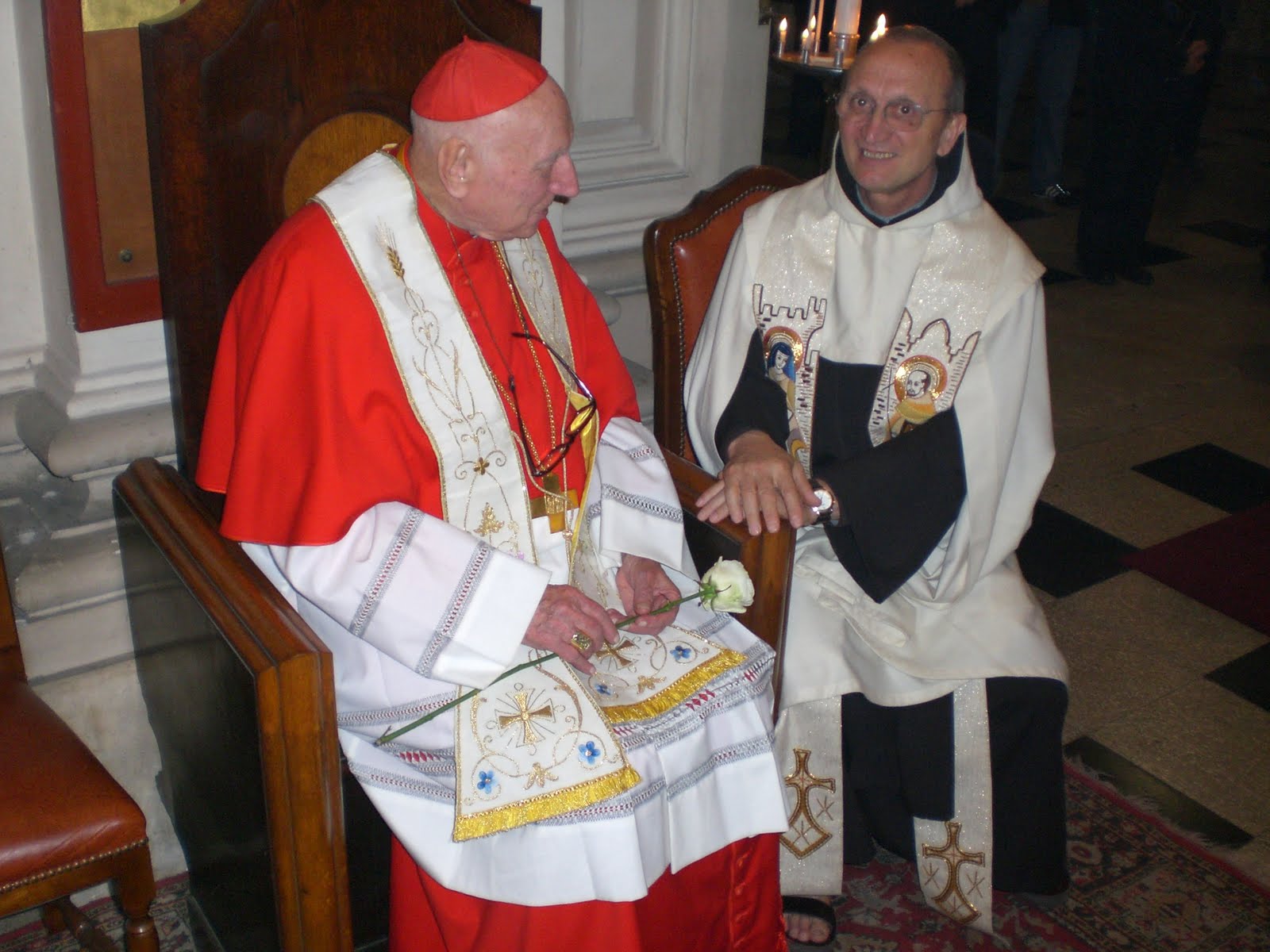
I don’t typically post the Holy Father’s funeral addresses for cardinals here because they’d be too many. But I think this is one is an exceptional circumstance with the death of His Eminence, Tomas Cardinal Spidlik who was laid to rest today. Emphasis added for important points, obviously.
May Cardinal Spidlik’s memory be eternal!
Among the last words spoken by the mourned Cardinal Spidlik were these: “I have looked for the face of Jesus during my whole life, and now I am happy and at peace because I am about to see it.” This wonderful thought — so simple, almost childlike in its expression, and yet so profound and true — refers us immediately to the prayer of Jesus, which resounded a moment ago in the Gospel: “Father, I desire that they also, whom thou hast given me, may be with me where I am, to behold my glory which thou hast given me in thy love for me before the foundation of the world (John 17:24).
It is beautiful and consoling to meditate on this correspondence between man’s desire, who aspired to see the Lord’s face, and Jesus’ own desire. In reality, that of Christ is much more than an aspiration: It is a will. Jesus says to the Father: “I desire that they also … may be where I am.” And it is precisely here, in this will, where we find the “rock,” the solid foundation to believe and to hope. The will of Jesus in fact coincides with that of God the Father, and with the work of the Holy Spirit it constitutes for man a sort of sure “embrace,” strong and gentle, which leads him to eternal life.
 What an immense gift to hear this will of God from his own mouth! I think that the great men of faith live immersed in this grace, they have the gift to perceive this truth with particular force, and so can also go through harsh trials, such as those that Father Tomas Spidlik went through, without losing confidence, and keeping, on the contrary, a lively sense of humor, which is certainly a sign of intelligence but also of interior liberty.
Under this profile, evident was the likeness between our mourned cardinal and the Venerable John Paul II: both were given to ingenious joking and jokes, even though having had as youths difficult personal circumstances, similar in some aspects. Providence made them meet and collaborate for the good of the Church, especially so that she would learn to breathe fully “with her two lungs,” as the Slav Pope liked to say.
This liberty and presence of spirit has its objective foundation in the Resurrection of Christ. I want to underline it because we are in the Easter liturgical season and because it is suggested by the first and second biblical readings of this celebration. In his first preaching, on the day of Pentecost, St. Peter, full of the Holy Spirit, proclaims the realization in Jesus Christ of Psalm 16.
It is wonderful to see how the Holy Spirit reveals to the Apostles all the beauty of those words in the full interior light of the Resurrection: “I saw the Lord always before me, for he is at my right hand that I may not be shaken; therefore my heart was glad, and my tongue rejoiced; moreover my flesh will dwell in hope” (Acts 2:25-26; cf Psalm 16/15:8-9). This prayer finds superabundant fulfillment when Christ, the Holy One of God, is not abandoned in hell. He in the first place has known “ways of life” and has been filled with joy with the presence of the Father (cf Acts 2:27-28; Psalm 16/15:11).
The hope and joy of the Risen Jesus are also the hope and joy of his friends, thanks to the action of the Holy Spirit. Father Spidlik demonstrated it habitually with his way of living, and this witness of his was ever more eloquent with the passing of the years because, despite his advanced age and the inevitable infirmities, his spirit remained fresh and youthful. What is this if not friendship with the Risen Lord?
In the second reading, St. Peter blesses God that “by his great mercy we have been born anew to a living hope through the resurrection of Jesus Christ from the dead.” And he adds: “In this you rejoice, though now for a little while you may have to suffer various trials” (1 Peter 1:3.6). Here, too, is seen clearly how hope and joy are theological realities that emanate from the mystery of the Resurrection of Christ and from the gift of his Spirit. We could say that the Holy Spirit takes them from the heart of the Risen Christ and infuses them in the heart of his friends.
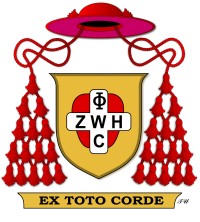
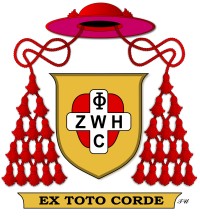
I introduced on purpose the image of the “heart,” because, as many of you know, Father Spidlik chose it as the motto of his cardinal’s coat of arms: “Ex toto corde,” “with all the heart.” This expression is found in the Book of Deuteronomy, within the first and fundamental commandment of the law, there where Moses says to the people: “Hear, O Israel: The Lord our God is one Lord; and you shall love the Lord your God with all your heart, and with all your soul, and with all your might” (Deuteronomy 6:4-5). “With all the heart — ex toto corde” refers hence to the way with which Israel must love its God. Jesus confirms the primacy of this commandment, which he combines with that of love of neighbor, affirming that the latter is “similar” to the first and that from both the whole law and the prophets depend (cf Matthew 22:37-39). Choosing this motto, our venerated brother placed, so to speak, his life within the commandment of love, he inscribed it wholly in the primacy of God and of charity.
There is another aspect, a further meaning of the expression “ex toto corde,” that surely Father Spidlik had present and attempted to manifest with his motto. Always starting from the Biblical root, the symbol of the heart represents in Eastern spirituality the seat of prayer, of the meeting between man and God, but also with other men and with the cosmos. And here we must remember that in Cardinal Spidlik’s standard, the heart that the coat of arms shows contains a cross in whose arms intersect the words “phos” and “zoe” — “light” and “life” — which are names of God. Hence, the man who fully receives, “ex toto corde,” the love of God, receives light and life, and becomes in turn light and life in humanity and in the universe.
But who is this man? Who is this “heart” of the world, if not Jesus Christ? He is the Light and life, for in Him “the whole fullness of deity dwells bodily” (Colossians 2:0). And I wish to recall here that our deceased brother was a member of the Society of Jesus, that is, a spiritual son of St. Ignatius who put in the center of faith and spirituality the contemplation of God in the mystery of Christ.
In this symbol of the heart East and West meet, not in a devotional but in a profoundly Christological sense, as other Jesuit theologians of the last century revealed. And Christ, central figure of Revelation, is also the formal principle of Christian art, a realm that had in Father Spidlik a great teacher, inspirer of ideas and of expressive projects, which found an important synthesis in the Redemptoris Mater chapel of the Apostolic Palace.
I would like to conclude returning to the theme of the Resurrection, quoting a text much loved by Cardinal Spidlik, a fragment of the Hymns on the Resurrection of St. Ephrem the Syrian:
From on High He descended as Lord,
From the womb he issued as a slave,
Death knelt before Him in Sheol,
And life adored Him in his resurrection.
“Blessed is his victory!” (No. 1:8).
May the Virgin Mother of God accompany the soul of our venerated brother in the embrace of the Most Holy Trinity, where “with all the heart” he will eternally praise his infinite Love. Amen.
 Ask and you shall receive; seek and you shall find; knock and it shall be opened to you, says the Lord, alleluia.