Wisdom and knowledge stimulates virtue

God’s promise to us is to remain with use for ever.

“Wisdom has built herself a house, and she has set up
seven pillars.” To man, who was made in the image of God when the rest of
creation was created, Wisdom gave the seven gifts of the Spirit to enable man
to believe in Christ and to keep His commandments. By means of these gifts, the
spiritual man grows and develops until, through firm faith and the supernatural
graces he receives, he finally reaches maturity. Knowledge stimulates virtue,
and virtue reflections knowledge. The fear of the Lord, understanding, and
knowledge give true orientation to his natural wisdom. Fortitude makes him
eager to seek understanding of the will of God, as revealed in the laws by
which the entire creation is governed. Counsel distinguishes these most sacred
and eternal laws of God from anything opposed to them, for these laws are meant
for man to ponder, to proclaim, and to fulfill. Insight disposes man to embrace
these expressions of God’s will and to reject whatever contravenes them.


Office of Readings
a
commentary on the Book of Proverbs by Procopius of Gaza, bishop

Doing community service because Christ loves me

The reviews of the 2011 NY Encounter sponsored by Communion and Liberation in January continue to surface. A recent view by Sophie Lewis on ilsussidiario.net gave some things to think about in an article, “A Living Cathedral.” Lewis puts her finger on living a new way. Namely, that Jesus Christ has loved us before we were aware of that love.

Quoting a priest’s homily Lewis notes: “All of you are here because you were loved first, and that is what should be the purpose of your work here.” This COULD NOT BE TRUER! The priest continues: “You are not engaged in an altruistic community service project, but you are here because Someone else loves you and you are responding to that love.” Now, THIS is the perfect way of indicating our response to the invitation to meet God who works hard to meet us.

Sophie Lewis is 17 and approaching university life soon. Happy to see her digging into the beauty and work of Communion and Liberation!

Following the Redeemer: Redemptorist Spirituality & St John Neumann

This year is an opportune time for the worldwide Redemptorist order, but especially the order in the USA, to get back to basics outlined by their sainted founder Saint Alphonsus Liguori and beautiful example of Saint John Neumann. Why this year? Because the Church in the USA is honoring the 200th anniversary of birth of Saint John Neumann. So, it is a Year of Saint John Neumann.

A recent essay on the Redemptorist spirituality by Michael Terheyden is a very fine primer on the subject.

We are all called to follow the in the way of the Redeemer.

New tools… [for] new forms of consciousness: Vatican Radio at 80

Pius XI & G. Marconi 1931.jpgFebruary 12, 1931, Vatican Radio began its social networking capabilities for Pope Pius XI who had a particular interest in evangelization, especially in the foreign lands. Guglielmo Marconi (1874-1937), the physics Nobel Prize laureate became the father of wireless communication. Quoting Marconi, the Vatican Press Director Jesuit Father Frederico Lombardi recalled, “My inventions are to save humanity, not to destroy it.”

Read a few ideas on the founding of Vatican Radio.

Pope Pius XI exhorted his first listeners said, “Listen and hear, O Peoples of distant lands.”

Continue reading New tools… [for] new forms of consciousness: Vatican Radio at 80

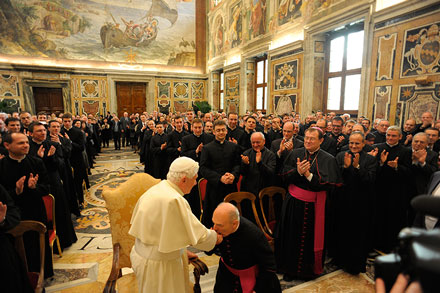
Pope speaks to the Fraternity of St. Charles Borromeo

Fraternity of
St. Charles Borromeo is celebrating their 25
th anniversary as a
congregation of priests. The Fraternity is a new community of priests in the Church, founded by Monsignor Massimo Camisasca in 1985. It was signed into Church law in 1999 by Pope John Paul II as a Society of Apostolic Life. On Saturday, February 13, His Holiness Pope Benedict
XVI met with the Fraternity’s 
founder, leadership and seminarians. Here’s the text of the Pope’s address
to members of the Fraternity.

FSCB.jpg

It is with real joy that I meet with you, priests
and seminarians of the Fraternity of St. Charles, who have gathered here on the
occasion of the 25th anniversary of its birth. I greet and thank the founder
and superior general, Monsignor Massimo Camisasca, his council and all of you,
relatives and friends who are part of the community’s circle. I greet in
particular the Archbishop of the Mother of God of Moscow, Monsignor Paolo
Pezzi, and Don Julián Carrón, president of the Fraternity of Communion and
Liberation
, which symbolically expresses the fruits and the roots of the work
of the Fraternity of St. Charles. This moment brings back to my mind my long
friendship with Monsignor Luigi Giussani and bears witness to his charisma
.

Continue reading Pope speaks to the Fraternity of St. Charles Borromeo

Witches face jail time if spells fail

Romanian witches are soon to be licensed. Why, you
ask. So when their spells fail to provide the desired results, the government
can jail them. There’s a bill on parliament’s desk. On January 1, Romania
changed its laws witchcraft requiring receipts and prohibiting them from
exercising their craft near churches and schools.

Saint Valentine


St Valentine.jpg

The Church’s hagiographical
tradition (lives of the saints) the Roman Emperor Claudius prohibited
young men from getting married because he wanted them for his army. Valentine,
a priest of Rome, contradicted the Emperor’s wishes and married couples in
secret. This act of deviance, and the fact that he helped martyrs at the time of persecution, landed Valentine in prison with a death
sentence. He was beaten and beheaded. Saint Valentine’s relics repose in the Church of Saint Praxedes (near to the papal basilica of Santa Maria Maggiore). Corresponding with some married couples Valentine would sign his
letters, ‘Your Valentine’.

Valentine was martyred in 269 at Rome and buried on
the Flaminian Way. He is the patron saint of beekeepers, engaged couples,
epilepsy, fainting, greetings, happy marriages, love, lovers, plague,
travelers, and young people. Valentine is often portrayed with birds and roses
in iconography.

As a cultural note, the Flaminian Way is one of the principal Roman roads leading from
Rome to Gaul. The road’s construction was begun in 220 BC by Caius Flaminius.

Saints Cyril and Methodius

Ss Cyril & Methodius.jpgO Cyril Methodius, glorious teachers, with brilliance you taught
the Moravians to bless God in their own words, by translating the law of the
Lord from Greek into Slavonic. You taught His righteousness. Therefore, the
Slav peoples now give glory to God in joy.


Who can proclaim the wonders of the
Lord, which Cyril and Methodius did to his glory? They overcame the poison of the Saracens. They tore apart the heavy nets. Their language closed the mouths of the corrupt
Khazars with the faith of the Lord. They made sweet the bitter waters and
delighted the good people that had sat in darkness.

Stichera at the Praises,
Tone 8

Charity is the only good reason to do anything

The Cistercian
monk, philosopher and theologian Isaac of Stella (1100-1169) was featured in
the Office of Readings today: Charity is the reason why anything should be done
or left undone.

Charity is the only good reason to do anything, but it also
sometimes demands that we not do something we might think we want to do. There
are a lot of fine distinctions one has to make in this area to live spiritually
in common life and ministry. For example:

  • We are called to support one another,
    but not to enable maladaptive behaviors, debilitating addictions, and sins. We
    must bear with the burdens of others, and be willing to wash feet, but we
    should not take responsibility for the feelings of others.
  • We must seek ways to
    invite both individuals and institutions to benefit from our strengths, and
    invite them into the success that derives from them,
    but–again–we should be
    careful not to take interior or exterior responsibility for situations that the
    Holy Spirit
    has not, or not yet, seen fit to put in our care.
  • Sometimes the
    greatest charity–and often the most painful–is not giving someone what he
    thinks he wants
    .
  • We must be good to ourselves, practicing good self-care, but
    that doesn’t mean taking it easy and just ‘being nice’ to ourselves. On the one
    hand, we must not be so hard on ourselves that our whole spiritual life becomes
    a rehearsal of faults and sins, for this is one of the devil’s tricks in making
    us fail to notice God, and on the other we must also be careful not be overly
    forgiving of ourselves so as to effectively give up struggling with certain
    selfishnesses and sins.
  • We must practice the sort of self-charity that
    nourishes our gifts and virtues
    , and is ruthless in the unwillingness to put up
    with sin.
Thanks to my friend Friar Charles for providing grist for the mill.

Breast cancer and St Agatha: supporting those who live with the disease

St Agatha GB Tiepolo.jpgThe Church has a ministry, a role, a work, in helping to restore a person to health and wholeness because the Church is the continuation of Jesus’ ministry of healing in the world today.

Last Friday and Sunday I spear-headed two gatherings for those who live with breast cancer for the feast of Saint Agatha, the patron saint for those living with diseases of the breast. These gesture of prayer and solidarity were done in conjunction with the Order of Saint Agatha, Dominican Friars Healthcare ministry and two churches.

Anointing with blessed oil is a sacramental way in which the Church through her priests is concretely present to those in need spiritual comfort by complementing the medical and social practitioners in the ministry of healing. Any illness can have the effect of personal and communal isolation. What the Church is saying by this gesture of prayer and anointing is that the person is not alone, that we, the community of faith, empathize with the effects of illness and want to be in solidarity with the ill person. As was said, “breast cancer was the best thing to have happened to me because I’ve had to live life differently, more intently, and in a God-centered way.”
Why anoint someone? There are 5 identifiable reasons to administer the Sacrament of the Sick:
  1. curing and healing, a distinction here: we ask God for a cure, we ask also ask for a healing; the person is looking for God to bestow the grace of a comprehensive experience of restoration of body and spirit — “the whole person is helped and saved, sustained by trust in God, and strengthened against the temptations of the Evil One and against anxiety over death”; the relationship between God and the person is bridged in the sacrament;
  2. the gift of strengthening against debilitating effects of despair, depression, fear and anger; this Sacrament asks God for the grace to recognize and hopefully to unite any and all suffering to the experience Christ faced on the cross; the strength prayed for is not to allow illness to define their person because one’s humanity is more than a medical diagnosis;
  3. forgiveness of one’s sins: no human person –except Jesus (and He was also divine) and the Virgin Mary were sinless– and therefore sins are forgiven with this Sacrament; our human condition is frail and sickness can enhance the ugly side of ourselves and what we need and want is a healing of the soul; the effect of forgiveness is the reconciliation of the person to God, self and others; I think it is true that an illness has the potential to bring out of ourselves sinful attitudes, actions and patterns of speech that are not truly who we are as persons;
  4. a preparation for life with God, i.e., eternal life: no one is going to live for ever; perhaps the sickness is an opportunity to take stock in one’s life as it has been lived up to now and to patiently and lovingly make a life’s examination to see where there’s been love and to see where love has been absent; sickness is God’s way to call us to a deeper conversion that we’ve never experienced prior to this moment; here the Sacrament is asking us to look at our immortal soul with a degree of seriousness and the sickness as an education to greater freedom in Christ;
  5. conforming oneself to Christ crucified and risen: to be conformed to Christ means to adhere to Him, to listen to Him as we would listen to a loved one in friendship; there is a new reality in the life of a Christian –Jesus Christ is no longer dead, He’s risen; that Christ is risen and seated at the right hand of God the Father tells us of a new reality, a fact, in our human existence; the Sacrament brings us closer to cross Christ carried and died on and tells us that our salvation is there on the cross with Christ; we are not alone –we are with Jesus who is total love, total compassion; the healing offered in this sacrament is one of total trust and love in the One who made us, sustains us and carries us along with Him.
On Friday (2/4) evening in the context of the Friday Mass Father John Lavorgna, the pastor of Our Lady of Pompeii Church administered the Sacrament of the Anointing of the Sick for about 35 women and men.
At the Noon Mass on Sunday (2/6) at St Catherine of Siena Church, Father Jordan Kelly and three other priests administered the Sacrament of Anointing of the Sick to more than 125 women and men.

The New Evangelization TV (Currents on Net TV) in the Diocese of Brooklyn graciously covered the event for the second year in a row. Their story this year was titled “Victims of Breast Cancer find Spiritual Comfort” highlights the beauty of prayer and solidarity.
It was in the Middle Ages that it became the pattern of sacramental economy that the Sacrament of Anointing of the Sick was given only when someone was on death’s door step and it was called the “last rites” or “extreme unction.” Human experience of civil strife –in the international and domestic scene– that propelled liturgical theologians to rethink pastoral practice and our liturgical imagination. The Sacrament of the Sick would sick be closely connected with those living with acute illness and those near death, but also the Sacrament would be administered more broadly to those living with chronic illness as well as those living with mental illness and the experience of old age. However, people –including priests educated since 1972– continue to refer this sacrament as last rites.
The question always remains: Who is to be anointed? In a terrific book on the subject, Understanding Sacramental Healing: Anointing and Viaticum, Monsignor John C. Kasza speaks of the Sacrament as given for the magna infirmitas which “…indicates a weakness, feebleness, infirmity, inconstancy, or sickness which debilitates a person’s functioning within society” (footnote, p. 215).
In 2010, the first time we observed the feast of St Agatha and praying for and with those living with breast cancer can reviewed here.