How can anyone not like Saint George’s story? Whatever happened to the real cult of Saint George? Does the saint have contemporary relevance for us today? What witness does he offer the “post-modern” people we purport to be? Do we still struggle against Satan, the evil one, the great tempter? How do deal with the noontime devil that seeks to divide us from a filial relationship with God? Jesuit Father George Nedungatt, professor emeritus of the Pontifical Oriental Institute (Rome) wrote an essay “Saint George without the Dragon” explaining contemporary –at least since Vatican II– Church’s remembrance of and prayerful reliance on, the Lord’s dragon slayer. As the summary of the article says, “The post-conciliar reform has entered the liturgical celebration of St. George [on April 23] amidst the facultative memoirs, attributing the historical date of his martyrdom in Lydda circa 303. It follows the protest, both by those who have chosen St. George as patron and, and for opposing reasons, by those who deny the killing of the dragon by the saint. To shed light on the issue, the article distinguishes between the current liturgical (the cult certificated since ancient time on the saint’s tomb), and the literary tendency, (legends based on his figure as a symbol of the struggle against the forces of evil).” You can read about Saint George in La Civiltà Cattolica (3859, 2011, II, pp. 20-29).
Author: Paul Zalonski
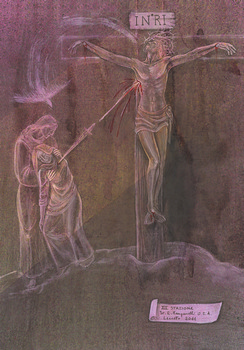
Fr Cantalamessa: Good Friday – there is one truth…
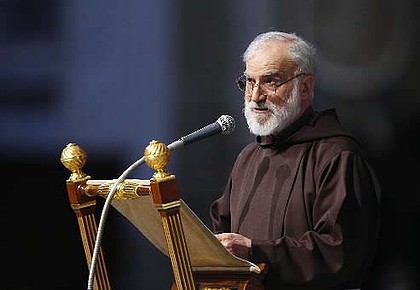
The papal preacher preaches to the Pope each Good Friday. A distinction not given to many. The renown Capuchin Father Raniero Cantalamessa said many good things to think about, not a few points that are crucial to our own witness of the Gospel, a few are given here now. The link to his homily is given below.
clear on Good Friday. The One whom we contemplate on the cross is God “in
person.” Yes, he is also the man Jesus of Nazareth, but that man is one person
with the Son of the Eternal Father. As long as the fundamental dogma of the
Christian faith is not recognized and taken seriously — the first dogma
defined at Nicea, that Jesus Christ is the Son of God, and is himself God, of
one substance with the Father — human suffering will remain unanswered.
response of the cross is not for us Christians alone, but for everyone, because
the Son of God died for all. There is in the mystery of redemption an objective
and a subjective aspect. There is the fact in itself, and then awareness of the
fact and our faith-response to it. The first extends beyond the second. “The
Holy Spirit,” says a text of Vatican II, “offers to all the possibility of
being made partners, in a way known to God, in the paschal mystery.”
distinguishes genuine accounts of martyrdom from legendary ones composed later,
after the end of the persecutions. In the former, there is almost no trace of
polemics against the persecutors; all attention is concentrated on the heroism
of the martyrs, not on the perversity of the judges and executioners. St.
Cyprian even ordered his followers to give twenty-five gold coins to the
executioner who beheaded him. These are the disciples of the one who died
saying: “Father, forgive them; they do not know what they are doing.” Truly, “Jesus’ blood speaks a different language from the blood of Abel
(Hebrews 12:24): it does not cry out for vengeance and punishment; it brings
reconciliation.”
Christ’s love is both horizontal and vertical
Jesus, knowing that all was now finished, said to fulfill the Scripture: “I thirst.” A bowl full of vinegar stood there; so they put a sponge full of the vinegar on hyssop and held it to his mouth. When Jesus had received the vinegar, he said, “It is finished”; and he bowed his head and gave up his spirit.
“I thirst.” “It is finished.” With these two phrases Jesus, looking first to humanity and then to the Father, bequeaths to us the burning passion at the heart of his person and mission: love for man and obedience to the Father. His is a love both horizontal and vertical: in the shape of the cross! And at the intersection of this twofold love, at the place where Jesus bows his head, the Holy Spirit wells up, the first fruits of his return to the Father.
This final breath which brings Jesus’ life to completion evokes the work of creation, which now is redeemed. But it is also a summons to all of us who believe in him to “bring to completion in our own flesh what is lacking in Christ’s afflictions”. That all may be complete!
Lord Jesus, who died for our sake!
You ask, that you may give,
you die, that you may leave a legacy,
and thus you make us see that the gift of self
opens a space for unity.
Pardon the gall of our rejection and unbelief,
pardon the deafness of our hearts
to your cry of thirst
which echoes in the suffering of our many brothers and sisters.
Come, Holy Spirit,
parting gift of the Son who dies for us:
may you be the guide who “leads us into all the truth”
and “the root which sustains us in unity”!
Spy Wednesday: dancing with the devil?
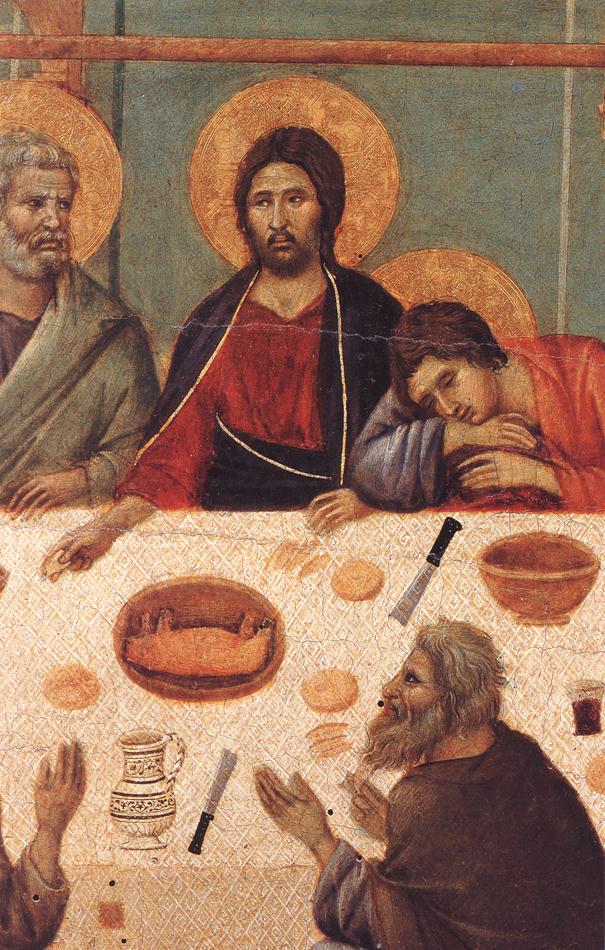
Here we are: Spy Wednesday, the eve of the sacred Triduum. Lent is about to end and we’re entering into a liturgical period and facing the Paschal Mystery of Christ. The term “Spy Wednesday” is not heard often these but we get the point: the struggle between life and death, sin and grace, friendship and betrayal, good and evil.
At home with Pope Benedict
Time Magazine published a now translated story written by Andrea Tornielli of La Stampa. Tornielli did a recent piece on the Pope’s living arrangements and the people living and working with him. Last week I mentioned that a new member of the Papal Household was introduced recently to Benedict’s family.
Pope Benedict XVI: 6 years as Pontiff
Before going to the Noon Mass, I want to offer this prayer for Pope Benedict on the 6th anniversary of his election as the Supreme Pontiff. Be sure to unite your intentions when you receive Holy Communion and pray the rosary for Benedict and the Church. May the Lord bestow on the Pope the graces needed to live a holy life and to lead the Church unto salvation.
prostrate here at thy feet, we pray Thee to save, defend, and long preserve the
Vicar of Christ, Pope Benedict XVI the Father of the glorious society of souls,
our own Father. Today and every day he prays for us, fervently offering to Thee
the sacred victim of love and peace. Turn then, O Lord, thy loving eyes upon
us, who forgetful as it were of ourselves pray now above all things for him.
Unite our prayers with his, and receive them into the bosom of thy infinite
mercy, as a most sweet perfume of that living and efficacious charity, in which
the children of the Church are united to their Father. All that he asks of Thee
today we too ask for with him. Whether he sorrows or rejoices, or when he hopes
or offers the victim of love for his people, we would be united with him. We
desire that the utterance of our souls should be one with his. Amen.
What’s the difference between beatification and canonization?
Subtle
differences need certain light in a canonization process. Scholasticism
advocates that we always distinguish. Benedict XVI will be beatifying his
friend, colleague and boss, Pope John Paul II on May 1. So, the faithful are
asking what’s the difference between the ecclesial acts of beatification and
canonization?
The Holy See told us what’s considered to be the distinguishing
marks of any beatification. There are three differences:
- location of dioceses
that can hold annual public liturgical celebrations in the holy person’s honor; - who ceremonially requests the pope to act;
- and the level of papal authority
involved in the proclamation.
What Pope Benedict has worked hard to remind the
Church, “at a beatification ceremony, the bishop of the diocese where the
person dies asks that the candidate be declared blessed; at a canonization, the
prefect of the Congregation for Saints’ Causes speaks in the name of the whole
church and asks that the candidate be declared a saint.”
But a central
difference between a beatification and canonization is that with a canonization
there is an act of declaring dogmatically, that God has revealed this person
with Him in beatitude. Essentially, it is a matter of papal infallibility.
Being a saint is a dogmatic statement; being a blessed is not. A saint can be
liturgically commemorated at the sacred Liturgy worldwide and remembered in
other circumstances like naming buildings after the person. When the Church
says a person is a blessed, it is an administrative act of the papal office; a
blessed can be liturgically commemorated is limited to certain circumstances,
like where the person lives or in the houses of the religious congregation
should the person be a religious.
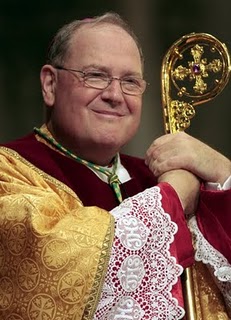
Archbishop Dolan to celebrate the St Gianna Mass at St Catherine of Siena Church NYC
On Wednesday, the 27th April, at the Church of St.
Catherine of Siena (411 E. 68th St.) Archbishop Timothy M. Dolan will offer the Sacrifice of the Mass for the intention of couples struggling with infertility &
pregnancy-related difficulties. The evening will begin with Mass at 6:30 pm,
followed by comments by Mr. Robert White, President of the St. Gianna Society followed by a blessing
with the St. Gianna relics by the Archbishop.
for personal veneration of St. Gianna relics – with a light reception following
Mass. Physicians, including Dr. Anne
Mielnik, and other practitioners specializing in infertility will be
present in reception area to answer questions and offer support following Mass.
For more info, check out the flyer: St. Gianna Flyer 2011.pdf
Vatican newspaper online
The Roman Observer (in Italian L’Osservatore Romano) is now online –and free till August.
Portsmouth Abbey Monks face future with internet help
Benedictine monasticism has a beautiful way of adapting, in a sensitive and intelligent way, to the times. Being contemporaneous doesn’t mean trendy. It means, in my mind, taking seriously the fact of the Incarnation: that in all things God may be glorified. Pope Benedict has been advocating the prudent use of social media, a point for this blog!
Continue reading Portsmouth Abbey Monks face future with internet help