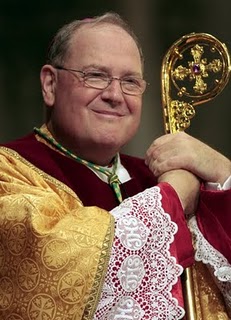
Archbishop Dolan to celebrate the St Gianna Mass at St Catherine of Siena Church NYC

TMDolan smile.jpgOn Wednesday, the 27th April, at the Church of St.
Catherine of Siena (411 E. 68th St.) Archbishop Timothy M. Dolan will offer the Sacrifice of the Mass for the intention of couples struggling with infertility &
pregnancy-related difficulties. The evening will begin with Mass at 6:30 pm,
followed by comments by Mr. Robert White, President of the St. Gianna Society followed by a blessing
with the St. Gianna relics
by the Archbishop.


At 7:45 pm, there will be time
for personal veneration of St. Gianna relics – with a light reception following
Mass. Physicians, including Dr. Anne
Mielnik
, and other practitioners specializing in infertility will be
present in reception area to answer questions and offer support following Mass.
For more info, check out the flyer
St. Gianna Flyer 2011.pdf

Vatican newspaper online

LOsservatore Romano web.jpegThe Roman Observer (in Italian L’Osservatore Romano) is now online –and free till August.

The miracle of a significant web presence is due to the leadership of the paper’s editor Mr. Vian.

Independently founded in 1861 to defend the papal states against Garibaldi political expediencies in a new political era of “unified” Italy. Pope Leo XIII bought the newspaper in 1885. LO is a semi-official news outlet.

Portsmouth Abbey Monks face future with internet help

Portsmouth Monks 2011.jpgBenedictine monasticism has a beautiful way of adapting, in a sensitive and intelligent way, to the times. Being contemporaneous doesn’t mean trendy. It means, in my mind, taking seriously the fact of the Incarnation: that in all things God may be glorified. Pope Benedict has been advocating the prudent use of social media, a point for this blog!

Continue reading Portsmouth Abbey Monks face future with internet help

Walking that new path of liberation by the gravitational force of God’s love, Pope Benedict tells

Pope Benedict is nothing if not a master of the spiritual life and superb pastor of souls. His Palm Sunday homily delivered earlier today is extraordinarily beautiful for its content and style , but most importantly it gives us a path to Jesus. He’s not giving a legacy; he’s giving us truth.
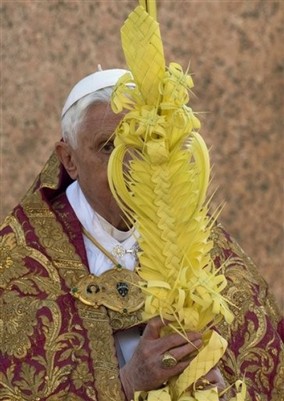
Pope with palm 2011.jpg

It is a moving
experience each year on Palm Sunday as we go up the mountain with Jesus,
towards the Temple, accompanying him on his ascent. On this day, throughout the
world and across the centuries, young people and people of every age acclaim
him, crying out: “Hosanna to the Son of David! Blessed is he who comes in the
name of the Lord!”

But what are we really doing when we join this procession as
part of the throng which went up with Jesus to Jerusalem and hailed him as King
of Israel? Is this anything more than a ritual, a quaint custom? Does it have
anything to do with the reality of our life and our world? To answer this, we
must first be clear about what Jesus himself wished to do and actually did.
After Peter’s confession of faith in Caesarea Philippi, in the northernmost
part of the Holy Land, Jesus set out as a pilgrim towards Jerusalem for the
feast of Passover. He was journeying towards the Temple in the Holy City,
towards that place which for Israel ensured in a particular way God’s closeness
to his people. He was making his way towards the common feast of Passover, the
memorial of Israel’s liberation from Egypt and the sign of its hope of
definitive liberation. He knew that what awaited him was a new Passover and
that he himself would take the place of the sacrificial lambs by offering
himself on the cross. He knew that in the mysterious gifts of bread and wine he
would give himself for ever to his own, and that he would open to them the door
to a new path of liberation, to fellowship with the living God. He was making
his way to the heights of the Cross, to the moment of self-giving love. The
ultimate goal of his pilgrimage was the heights of God himself; to those
heights he wanted to lift every human being.

Continue reading Walking that new path of liberation by the gravitational force of God’s love, Pope Benedict tells
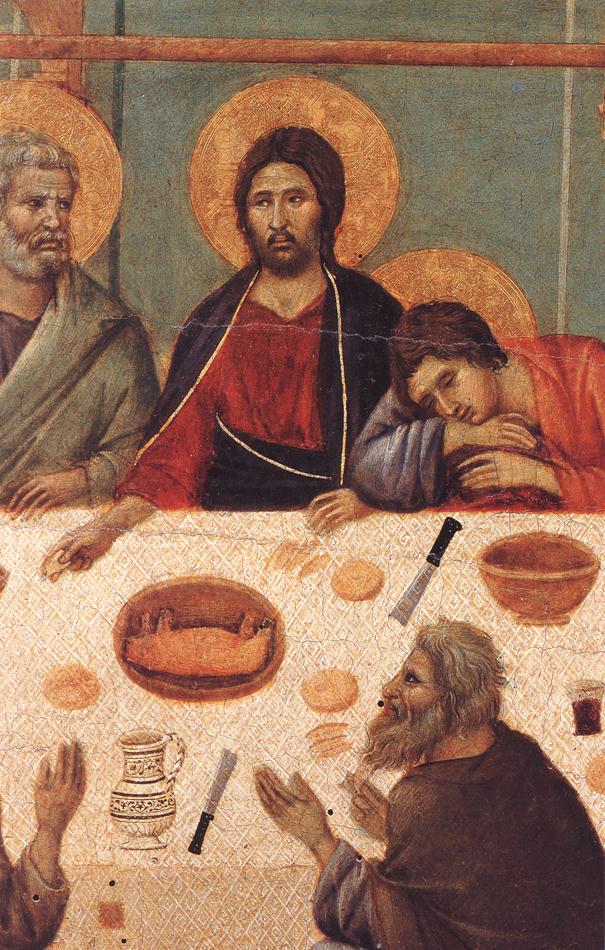
Saint Robert of Molesme

St Robert of Molesme welcomes Bernard.jpgApril 17, 2011 marks the 900th anniversary of the
death of St. Robert of Molesme, which, this year, is Palm Sunday. This anniversary of death of Saint Robert coincides with the historic beginning of the Cistercians with Robert’s arrival with his group of monks first arrived at
Cîteaux on Palm Sunday (March 21, 1098). 
Along with Saints Alberic and Stephen, Saint Robert is one of the founders of Cîteaux.


The text of the Life of Saint Robert
is available here
You’ll find the rather lengthy article referred to at: Life of St.
Robert of Molesme.
 
A shorter version of Saint Robert’s life can be
found on Wikipedia.

Pope Benedict clarifies Christian view of who killed Jesus

The Jerusalem Post published a story today picking up on Pope Benedict’s clarifies what Christians believe about the Jews viz. the death Jesus. Sergio Minerbi’s article “Pope Benedict Revises the Gospels” looks at Benedict’s volume 2 of Jesus of Nazareth. This issue has been a painful one among Christians and Jews through the millennia. In his typical manner of precise writing –because of sharp thinking– Benedict challenges the reality of ideology that’s been a force for violence than reconciliation. This article ought to get you to re-read Nostra Aetate and to read volume 2 of Jesus of Nazareth.

Saint Benedict-Joseph Labre

Benedict-Joseph Labre ACavallucci.jpgBlessed are the poor in spirit for theirs is the Kingdom of Heaven; Blessed are the pure in heart for they shall see God. (MT 5:3,8)

Saint Benedict-Joseph Labre is one of the most endearing saints of the Church; some call him a misfit among the saints for his sensitivities, honesty and gentleness. There is so much about him that draws the heart: he was persistent in his pursuit of a religious vocation but never found a home among the Cistercian or the Carthusian monks, he was a perpetual pilgrim, a made of exactness in religious devotion, and a man known as the “saint of the Forty Hours” (the forty hours is a devotion of adoration of the Blessed Sacrament). The Scriptures were his constant companion and guide for life. He’s a great example of following the Pauline spirituality. Ultimately, his vocation was lived as a Third Order Franciscan.

Benedict-Joseph was born on March 26, 1748 in Amettes, France, the eldest child of 15. At 35, he died of malnutrition on this date in 1783 during Holy Week on the steps of the Church of Santa Maria dei Monti with the consolation of the sacraments. How interesting that his liturgical memorial falls on the very edge of the Lord’s triumphant journey into Jerusalem. Labre was canonized by Pope Leo in 1881.
Saint Benedict-Joseph is the patron of the homeless, those making pilgrimages, for those who make adoration of the Eucharistic Lord in the Blessed Sacrament a regular spiritual gesture, and for those who suffer from mental illness, depression, anxiety.

Read a brief biography of Saint Benedict-Joseph here.
The Guild of Saint Benedict-Joseph Labre has an old website and they’re promising a new one this spring.

Carl Anderson: we are called to transform society — looks to JFK, sets path

Thumbnail image for Anderson with US flag.jpgCarl A. Anderson, the Supreme Knight of the Knights of Columbus, gave a lecture in Boston’s famed Faneuil Hall on President John F. Kennedy’s faith known in the inaugural address. The President was a KofC member. Anderson uses history, philosophy and theology to demonstrate that our human rights come from God, thus they are sacred rights. The location of the talk was brilliant given the tensions between Church and secularism. Anderson’s talk follows:

Your Eminence, Cardinal O’Malley; Your Excellencies, Archbishop Wenski, Bishop Lori and Bishop Kennedy; Reverend Fathers; Seminarians; Members of the Board of Directors and State Officers of the Knights of Columbus; Members of the Boston Leadership Forum; Brother Knights; Ladies and Gentlemen – fellow Citizens…

Here at Faneuil Hall, in this historic setting, the injustices of the colonial system were first addressed. It was here that the Sugar Act was protested more than a decade before the Declaration of Independence. Here that the Tea Tax was protested. And here the Boston Massacre was recounted. Here too was born the idea that there should be “no taxation without representation.”

Continue reading Carl Anderson: we are called to transform society — looks to JFK, sets path