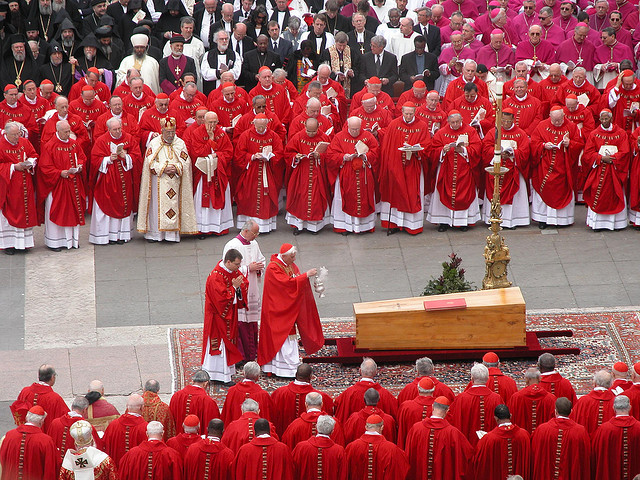
 Just days ahead of Pope John Paul II’s beatification on May 1st –the first time in 11 centuries that a successor beatifies his predecessor– the former vicar for Rome, Cardinal Camillo Ruini, speaks about the letter he received as the conclave was about to open that was to elect Joseph Cardinal Ratzinger, now Pope Benedixt XVI, by which several cardinals asked for John Paul’s beatification. Read the La Stampa story…
Author: Paul Zalonski
John Paul’s blood to be presented as a relic at May 1st Mass
Blood drawn from Pope John Paul II prior to his death and saved in case there was need of a transfusion at a local hospital, will be presented to Pope Benedict XVI at the May 1st Mass at which John Paul will be declared a “blessed.” The blood relic will be kept with other relics at the Apostolic Household. Read the entire story here.
Easter Monday: why it matters
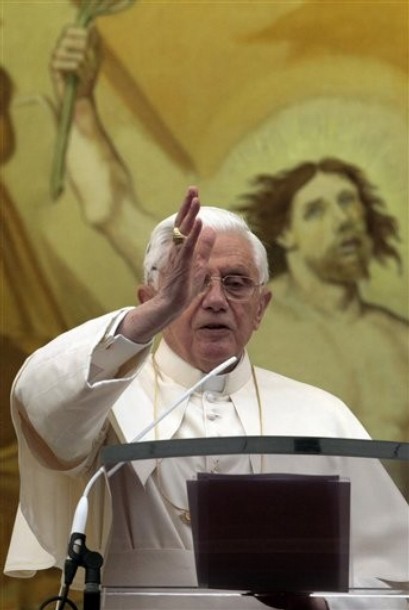 The day following Easter Sunday, indeed, all of the Easter Octave, is just as important as the Easter mystery of the solemn celebration of the Resurrection: the concrete risen Lord fulfills his promise of new Life. Pope Benedict said today at Castle Gandolfo today, “With greater joy than ever, the Church celebrates
these eight days in a special way, as she recalls the Lord Jesus’s resurrection
from the dead. Let us pray fervently that the joy and peace of Our Lady, Mary
of Magdala and the Apostles will be our own as we welcome the risen Lord into
our hearts and lives. I invoke God’s abundant blessings upon you all!”
A slight shift in our daily prayer moves from praying the Angelus three times a day (at least) to the Regina Coeli, another radical call to live the Gospel is known in this prayer. With the Mother of the Savior we call the promise come true.
Queen of Heaven, rejoice, alleluia.
For He whom you did merit to bear, Alleluia.
Has risen, as he said, alleluia.
Pray for us to God, alleluia.
Rejoice and be glad, O Virgin Mary, alleluia.
For the Lord has truly risen, Alleluia.
Let us pray.
O God, who gave joy to the world through the resurrection of Thy Son, our Lord Jesus Christ, grant we beseech Thee, that through the intercession of the Virgin Mary, His Mother, we may obtain the joys of everlasting life. Through the same Christ our Lord. Amen.
Easter 470 years later
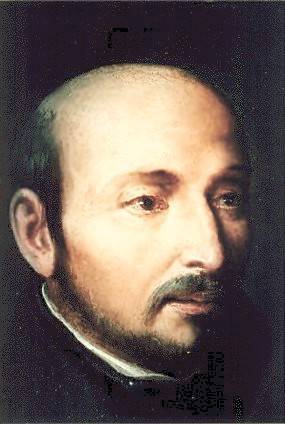 470 years ago on this date, another Easter Sunday, Ignatius of Loyola and his first companions elected Ignatius as the first superior of the new group, a year following the Church’s approval of the society. Just two days before his election, the companions went to the Basilica of Saint Paul outside the Walls to profess their vows.
With these events, Loyola had more concrete points in following God’s will in forming a new society of priests aiming to reform Christian culture under the Roman Pontiff.
The account is here.
Easter Urbi et Orbi 2011: Christ’s resurrection happens in history, permanently remembered and lived

“In
resurrectione tua, Christe, coeli et terra laetentur!
In your resurrection, O
Christ, let heaven and earth rejoice!” (Liturgy of the Hours).
Dear Brothers
and Sisters in Rome and across the world, Easter morning brings us news that is
ancient yet ever new: Christ is risen! The echo of this event, which issued
forth from Jerusalem twenty centuries ago, continues to resound in the Church,
deep in whose heart lives the vibrant faith of Mary, Mother of Jesus, the faith
of Mary Magdalene and the other women who first discovered the empty tomb, and
the faith of Peter and the other Apostles.
Benedict’s Easter Vigil 2011 homily:
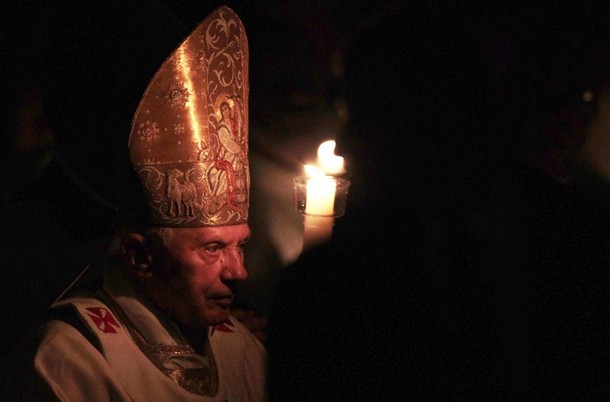 Dear Brothers and Sisters, The liturgical celebration
of the Easter Vigil makes use of two eloquent signs. First there is the fire
that becomes light. As the procession makes its way through the church,
shrouded in the darkness of the night, the light of the Paschal Candle becomes
a wave of lights, and it speaks to us of Christ as the true morning star that
never sets – the Risen Lord in whom light has conquered darkness. The second
sign is water. On the one hand, it recalls the waters of the Red Sea, decline
and death, the mystery of the Cross. But now it is presented to us as spring
water, a life-giving element amid the dryness. Thus it becomes the image of the
sacrament of baptism, through which we become sharers in the death and
resurrection of Jesus Christ.
Christ crucified transforms the old man, a new creation: is our gaze on Him?
The Church is silent. The Lord is dead; His mother and the Beloved disciple have buried the Lord. We carry on in sorrow, our hearts are quiet and searching for the one who made the promise that things would be different if we believed in Him. Holy Saturday is a distinct day in the Church. Good Friday totally transforms us from something old to something new, this is a time of patient awareness that it is not business as usual. If it is, if we can’t see that our real lives are not the same, then we need to beg the Holy Spirit and the Blessed Mother to show the reasons why life is different now with Jesus crucified and in the tomb.
Pope Benedict’s meditation at the Colosseum lst evening gives us focus:
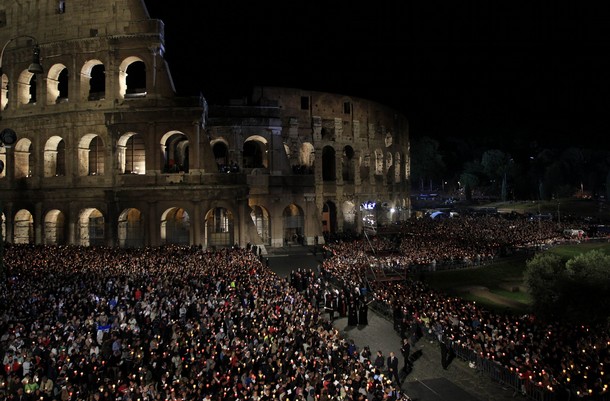
This evening, in faith, we have accompanied Jesus as he takes the final steps of his earthly journey, the most painful steps, the steps that lead to Calvary. We have heard the cries of the crowd, the words of condemnation, the insults of the soldiers, the lamentation of the Virgin Mary and of the women. Now we are immersed in the silence of this night, in the silence of the cross, the silence of death. It is a silence pregnant with the burden of pain borne by a man rejected, oppressed, downtrodden, the burden of sin which mars his face, the burden of evil. Tonight we have re-lived, deep within our hearts, the drama of Jesus, weighed down by pain, by evil, by human sin.
Continue reading Christ crucified transforms the old man, a new creation: is our gaze on Him?
Who is St George?

How can anyone not like Saint George’s story? Whatever happened to the real cult of Saint George? Does the saint have contemporary relevance for us today? What witness does he offer the “post-modern” people we purport to be? Do we still struggle against Satan, the evil one, the great tempter? How do deal with the noontime devil that seeks to divide us from a filial relationship with God? Jesuit Father George Nedungatt, professor emeritus of the Pontifical Oriental Institute (Rome) wrote an essay “Saint George without the Dragon” explaining contemporary –at least since Vatican II– Church’s remembrance of and prayerful reliance on, the Lord’s dragon slayer. As the summary of the article says, “The post-conciliar reform has entered the liturgical celebration of St. George [on April 23] amidst the facultative memoirs, attributing the historical date of his martyrdom in Lydda circa 303. It follows the protest, both by those who have chosen St. George as patron and, and for opposing reasons, by those who deny the killing of the dragon by the saint. To shed light on the issue, the article distinguishes between the current liturgical (the cult certificated since ancient time on the saint’s tomb), and the literary tendency, (legends based on his figure as a symbol of the struggle against the forces of evil).” You can read about Saint George in La Civiltà Cattolica (3859, 2011, II, pp. 20-29).
Fr Cantalamessa: Good Friday – there is one truth…
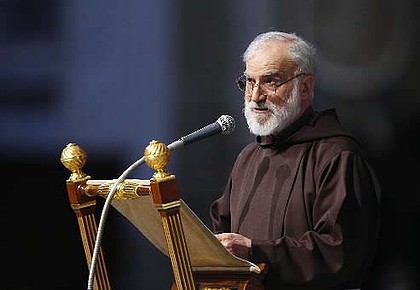 The papal preacher preaches to the Pope each Good Friday. A distinction not given to many. The renown Capuchin Father Raniero Cantalamessa said many good things to think about, not a few points that are crucial to our own witness of the Gospel, a few are given here now. The link to his homily is given below.
There is a truth that must be proclaimed loud and
clear on Good Friday. The One whom we contemplate on the cross is God “in
person.” Yes, he is also the man Jesus of Nazareth, but that man is one person
with the Son of the Eternal Father. As long as the fundamental dogma of the
Christian faith is not recognized and taken seriously — the first dogma
defined at Nicea, that Jesus Christ is the Son of God, and is himself God, of
one substance with the Father — human suffering will remain unanswered.
clear on Good Friday. The One whom we contemplate on the cross is God “in
person.” Yes, he is also the man Jesus of Nazareth, but that man is one person
with the Son of the Eternal Father. As long as the fundamental dogma of the
Christian faith is not recognized and taken seriously — the first dogma
defined at Nicea, that Jesus Christ is the Son of God, and is himself God, of
one substance with the Father — human suffering will remain unanswered.
The
response of the cross is not for us Christians alone, but for everyone, because
the Son of God died for all. There is in the mystery of redemption an objective
and a subjective aspect. There is the fact in itself, and then awareness of the
fact and our faith-response to it. The first extends beyond the second. “The
Holy Spirit,” says a text of Vatican II, “offers to all the possibility of
being made partners, in a way known to God, in the paschal mystery.”
response of the cross is not for us Christians alone, but for everyone, because
the Son of God died for all. There is in the mystery of redemption an objective
and a subjective aspect. There is the fact in itself, and then awareness of the
fact and our faith-response to it. The first extends beyond the second. “The
Holy Spirit,” says a text of Vatican II, “offers to all the possibility of
being made partners, in a way known to God, in the paschal mystery.”
One thing
distinguishes genuine accounts of martyrdom from legendary ones composed later,
after the end of the persecutions. In the former, there is almost no trace of
polemics against the persecutors; all attention is concentrated on the heroism
of the martyrs, not on the perversity of the judges and executioners. St.
Cyprian even ordered his followers to give twenty-five gold coins to the
executioner who beheaded him. These are the disciples of the one who died
saying: “Father, forgive them; they do not know what they are doing.” Truly, “Jesus’ blood speaks a different language from the blood of Abel
(Hebrews 12:24): it does not cry out for vengeance and punishment; it brings
reconciliation.”
distinguishes genuine accounts of martyrdom from legendary ones composed later,
after the end of the persecutions. In the former, there is almost no trace of
polemics against the persecutors; all attention is concentrated on the heroism
of the martyrs, not on the perversity of the judges and executioners. St.
Cyprian even ordered his followers to give twenty-five gold coins to the
executioner who beheaded him. These are the disciples of the one who died
saying: “Father, forgive them; they do not know what they are doing.” Truly, “Jesus’ blood speaks a different language from the blood of Abel
(Hebrews 12:24): it does not cry out for vengeance and punishment; it brings
reconciliation.”
Read the papal preacher’s homily in full here: Fr Cantalamessa Good Friday homily 2011.pdf
Christ’s love is both horizontal and vertical
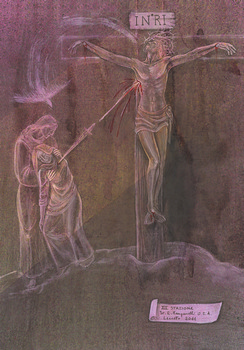
Jesus, knowing that all was now finished, said to fulfill the Scripture: “I thirst.” A bowl full of vinegar stood there; so they put a sponge full of the vinegar on hyssop and held it to his mouth. When Jesus had received the vinegar, he said, “It is finished”; and he bowed his head and gave up his spirit.
“I thirst.” “It is finished.” With these two phrases Jesus, looking first to humanity and then to the Father, bequeaths to us the burning passion at the heart of his person and mission: love for man and obedience to the Father. His is a love both horizontal and vertical: in the shape of the cross! And at the intersection of this twofold love, at the place where Jesus bows his head, the Holy Spirit wells up, the first fruits of his return to the Father.
This final breath which brings Jesus’ life to completion evokes the work of creation, which now is redeemed. But it is also a summons to all of us who believe in him to “bring to completion in our own flesh what is lacking in Christ’s afflictions”. That all may be complete!
Lord Jesus, who died for our sake!
You ask, that you may give,
you die, that you may leave a legacy,
and thus you make us see that the gift of self
opens a space for unity.
Pardon the gall of our rejection and unbelief,
pardon the deafness of our hearts
to your cry of thirst
which echoes in the suffering of our many brothers and sisters.
Come, Holy Spirit,
parting gift of the Son who dies for us:
may you be the guide who “leads us into all the truth”
and “the root which sustains us in unity”!