Pope tells Christians, and Jews, of the guidance of Providence: work together for common good

A delegation of B’nai B’rth International met with Pope Benedict today in Rome. They had done the same 5 years ago (here is the Pope 18 December 2006 address). This meeting is a follow-up meeting of a February meeting held in Paris marking the 40th anniversary of official dialogue between the Holy See and the Jews. As in 2006 so today, the Pope has called Chrsitians and Jews to work more closely together on common projects of healing, spiritual and more values grounded in faith and works of charity for the good of the other. A portion of what the Pope said may be of some interest here:

The Paris meeting affirmed the desire of Catholics and Jews to stand together in meeting the immense challenges facing our communities in a rapidly changing world and, significantly, our shared religious duty to combat poverty, injustice, discrimination and the denial of universal human rights. There are many ways in which Jews and Christians can cooperate for the betterment of the world in accordance with the will of the Almighty for the good of mankind. Our thoughts turn immediately to practical works of charity and service to the poor and those in need; yet one of the most important things that we can do together is bear common witness to our deeply-held belief that every man and woman is created in the divine image (cf. Gen 1:26-27) and thus possessed of inviolable dignity. This conviction remains the most secure basis for every effort to defend and promote the inalienable rights of each human being.

In a recent conversation between delegations of the Chief Rabbinate of Israel and the Holy See’s Commission for Religious Relations with the Jews, held in Jerusalem at the end of March, stress was laid on the need to promote a sound understanding of the role of religion in the life of our present-day societies as a corrective to a purely horizontal, and consequently truncated, vision of the human person and social coexistence. The life and work of all believers should bear constant witness to the transcendent, point to the invisible realities which lie beyond us, and embody the conviction that a loving, compassionate Providence guides the final outcome of history, no matter how difficult and threatening the journey along the way may sometimes appear. Through the prophet we have this assurance: “For I know the plans I have for you, says the Lord, plans for welfare and not for evil, to give you a future and a hope” (Jer 29:11).

Archbishop Shevchuk interviewed by Vatican Radio

Abp Shevchuk.jpgArchbishop Sviatoslav Shevchuk was recently interviewed by Philippa Hitchens of Vatican Radio.

The newly elected Major Archbishop talks about his election, the grace of the Holy Spirit for the Church today, ecclesial unity, the Russian Orthodox Church, Pope John Paul and some other things. He’s clear and polished.

Enhanced by Zemanta

Saint Damien de Veuster of Molokai

St Damien reading.jpeg

In August 1873, to his Superior General:


Divine Providence, having compassion on the unfortunate, has thought fit to look upon your unworthy servant to care for the spiritual needs of a well-known leprosy hospital that our Government had to establish to preserve the whole archipelago from disease. Thus, it is in my role as pastor of an unusual parish of eight hundred lepers, nearly half of whom are now Catholics, that I take the liberty to write to you these lines.


November 9, 1887, to his brother, Father Pamphile:

As you know, it has been already quite a while that Divine Providence chose me to become a victim of this repugnant disease of ours. I hope to remain eternally grateful for this grace. It seems to me that this disease will shorten and narrow the way that will lead me to our dear homeland. In that hope accepted this disease as my particular cross; I try to bear it as did Simon of Cyrene, following in the footsteps of our Divine Master. Please assist me with your good prayers, so as to obtain for me the strength of perseverance, until I reach the summit of Calvary.

Creeping infallibility?

We face reductionisms of the Faith all the time as Catholics: liturgical expedient minimalism is one of the most noteworthy examples, then there’s the identifiable dictatorship of relativism and the denial that Scripture is divinely inspired (cf. Benedict’s address last week to the PBC). While not formal matters of heresy (technically defined) but they are reductions that are a gradual chipping away of the content and expression. Poor liturgical practice, banal sacred music and unprepared liturgical preaching will erode the content of faith. There are other examples but I think these three give good a sense of a problem.
I believe that Tarcisio Bertone and Joseph Ratzinger are correct: we believe, as Catholics, in revealed truth; that the faith is not debatable and we can’t reduce our faith to formally defined dogmas. And while the infallibility of the papal office is restricted to a clearly defined process so as not to allow arbitrariness, the exercise of infallibility has been exercised twice since 1870. BUT there are the secondary object of infallibility that have to be acknowledged and assented to, despite what Fathers Hans Kung, Roger Haight, Randy Sachs, John Coleman and Charles Curran say.

Here’s John Allen’s article: A long-simmering tension over creeping infallibility by John Allen.pdf

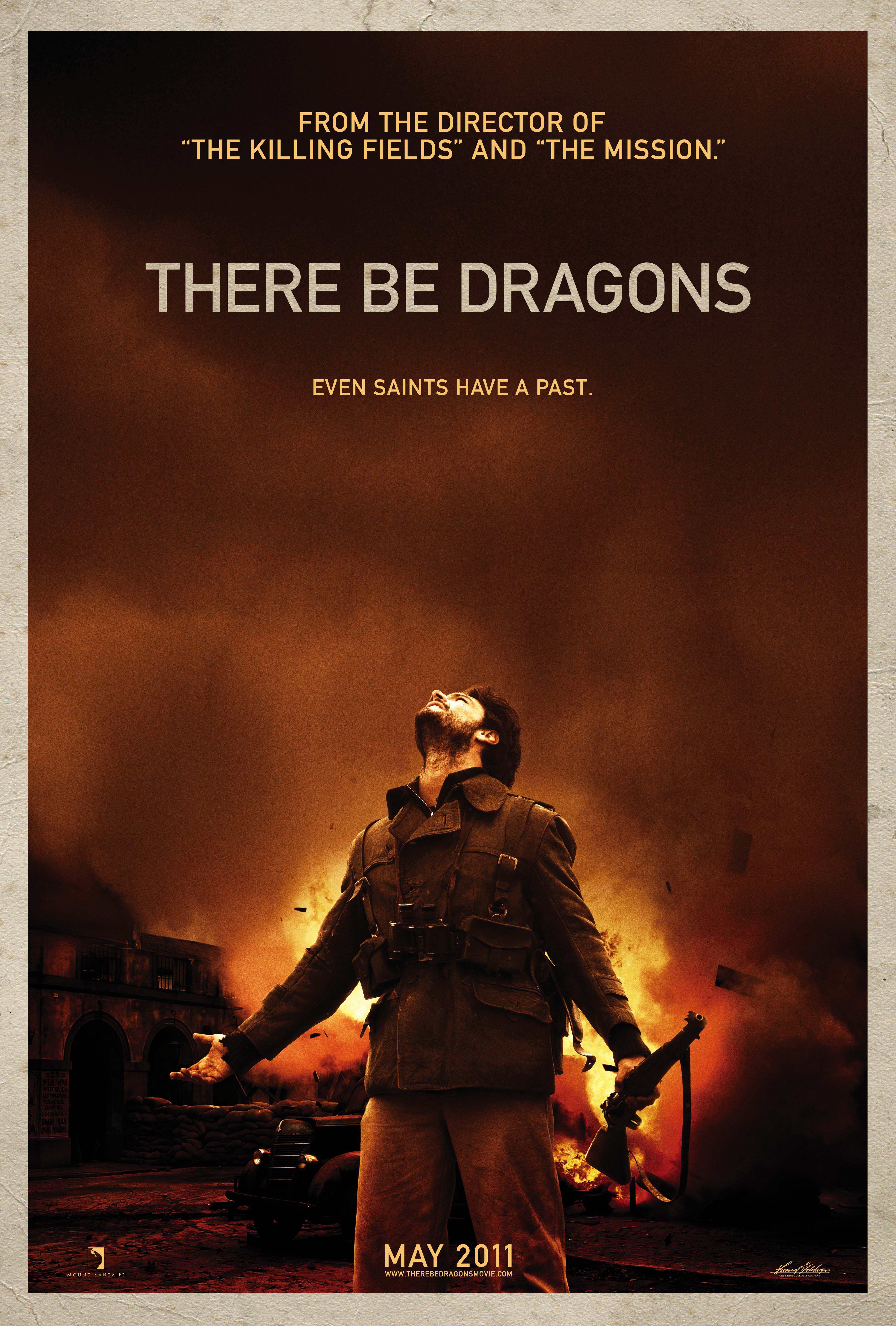
‘There Be Dragons’ — Even Saints Have A Past

There Be Dragons.jpg

There’s a film worth watching and spending time thinking about. I believe that we need to reflect upon the great themes of humanity: peace, forgiveness, love, selfishness, self-giving, regret, power, sin, and grace. Either we confront and reject nihilism and thrive, or we capitulate to it and die. We have this opportunity in Roland Joffe’s newest film, “There Be Dragons.”
Comparison’s are not always helpful. The old saying is that comparisons are odious. For many reviewers the only to make sense of “There Be Dragons” is to contrast it with “The Da Vinci Code,” and I happen to see no point in doing so. The two films are apples and oranges, if you will. Be that as it may, “There Be Dragons” is a movie on the early life of a Spanish saint, Josemaria Escrivá de Balaguer (1902-75) which mixes fact with some fiction. The historical context of the film is the Spanish Civil War with all its bloody violence, incredible strident anti-clericalism and whole scale diminishment of the human person.

Continue reading ‘There Be Dragons’ — Even Saints Have A Past

The Sacrament of Real Presence: THE center that holds together

William Butler Yeat’s “The Second Coming” contains what are,
perhaps, the most-quoted lines of twentieth century poetry. “Things fall apart;
the centre cannot hold; Mere anarchy is loosed upon the world.” Written in
1920, the poem not only summed up the horror of the still young century, it
seemed prescient of horrors yet to come.

Postmodernity may be, to some degree,
a pretentious academic fad. But its soil is undoubtedly the collapse of an
authoritative, life-giving center and the ensuing fragmentation experienced
daily in culture, politics, and individual lives.

Continue reading The Sacrament of Real Presence: THE center that holds together

Pope in Venice: the gate between East and West

Benedict, Angelo and Georg May 8 2011.jpgThese last two days Pope Benedict has been visiting the Patriarch of Venice, Angelo Cardinal Scola and the Archdiocese of Aquileia with an estimate crowd of 300K.

This is the first visit of a pope to Venice in 26 years. The Pope prayed at the Basilica of Saint Mark (in front of the saint’s relics preserved there for a 1000 years), addressed civil, culture and business leaders, the bishops, priests, religious and students and mingled with the people.
Note the Pope’s mode of transportation!
Benedict & Angelo Scola.jpg
Among the things the pope noted was that the “patrimony of civil traditions, culture and art, found rich development thanks to Venetians’ embrace of the acceptance of Christian faith. Over the centuries the faith transmitted by the first evangelists weaved itself evermore deeply into the social fabric, and eventually became an essential part of it.”
The asked the Lord to send the Venetians the grace of a “sincere and fruitful faith, a faith that can nourish both great hope, and the patient search for the common good.”

Father Carrón tells us that John Paul was a pope seized by Christ

Father Julián Carrón, president of the Fraternity of Communion and Liberation was interviewed by the Vatican newspaper L’Osservatore Romano on the beatification of Pope John Paul II. Father Carrón said that “beatification of John Paul II … is a ‘strong invitation’ to conversion.”

Keeping in mind what Blessed John Paul did for Communion and Liberation in recognizing the charism proposed by Father Luigi Giussani, Father Carrón recalled the words of John Paul who considered that a Movement “becomes a special instrument for a personal and ever-new adherence to the mystery of Christ.” For those who follow the path to Christ offered by Communion and Liberation will know that the vocation of being a part of Communion and Liberation –given by the Holy Spirit– means bringing “the truth, beauty and peace that are encountered in Christ the Redeemer” to the world.

Father Carrón’s remarks can be read here: Interview with Fr Carrón on the JP II Beatification.pdf