Vatican and Good Samaritan Foundation talk on AIDS

Stats for those living with HIV-AIDS is somewhere around 33 million,  records the World Health Organization (WHO). Recently, the HIV-AIDS epidemic was studied at a Rome conference hosted by the Holy See and the Good Samaritan Foundation. The conference was titled “The Centrality of Care for the Person in the Prevention and Treatment of Illnesses caused by HIV and AIDS.”

Various experts and Vatican officials, including the Pope’s Secretary of State, Cardinal Tarcisio Bertone, where he said that our work ought to be centered on the patient in way that a holistic approach is followed: the whol person and not only the disease needs to competent assistance and friendship. Experts from 26 countries attended the conference.

It is estimated that there are some thing like 117,000 health centers across the globe that treat AIDS patients. With all the money wasted on frivolous things, the WHO said their research revealed that in 2009 about $16 million was used for AIDS research and treatments. Problems exist in medical care and safety because only 35 percent of patients in third world countries have access to treatment. Do the math: roughly 10 million people don’t have access to any type of medication and proper health care. 

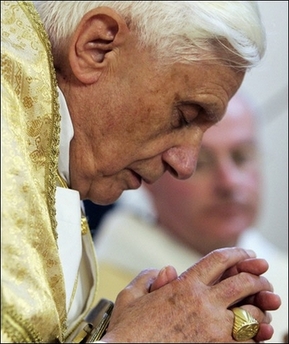
Pope Benedict’s prayer intentions for June 2011

pope prays detail.jpg

The general intention


That priests, united to the Heart of Christ, may always be true witnesses to the caring and merciful love of God.


The missionary intention


That the Holy Spirit may bring forth from our communities many missionaries who are ready to be fully consecrated to spreading the Kingdom of God.


When the bishop of a diocese celebrates the Chrism Mass during Holy Week each year he does two things: he blesses and consecrates the holy oils used for the sacraments and he leads the assembled priests in the “Renewal of Commitment to Priestly Service.” The laity are asked by the bishop to pray for their priests asking “the Lord to bless them with the fullness of his love, to help them be faithful ministers of Christ the High Priest, so that they will be able to lead” the faithful to their eternal destiny: life with the Most Blessed Trinity.

New Evangelization means to be missionary, prepare to be new apostles for Christ

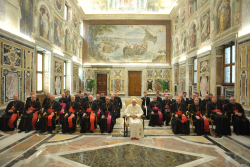
The Pope, for the first time since forming the council for promoting the New Evangelization in 2010, addressed the full body of cardinals, bishops, theologians and consultors on May 30. There are two noteworthy Americans who are key advisors for this work, Archbishop Timothy Dolan (Archbishop of NY) and Sister Sara Butler (a theologian at Mundelein Seminary). Plus, I would say that the presence of Father Julián Carrón and Cardinal Scola should be noted, also. The Pope’s talk is given below.

Pope with New Evangelization Council.png

When last June 28, at First Vespers of the Solemnity of the Holy Apostles Peter and Paul, I announced that I wished to institute a dicastery for promoting the New Evangelization, I gave an operative beginning to a reflection that I had had for a long time on the need to offer a concrete answer to the moment of crisis in Christian life, which is being verified in so many countries, above all those of ancient Christian tradition. Today, with this meeting, I can see with pleasure that this new pontifical council has become a reality. I thank Archbishop Salvatore Fisichella for the words he addressed to me, introducing me to the work of your first plenary assembly. My warm greetings to all of you with my encouragement for the contribution you will make to the work of the new dicastery, above all in view of the 13th Ordinary General Assembly of the Synod of Bishops that, in October of 2012, will in fact address the topic “New Evangelization for the Transmission of the Christian Faith.”

Enhanced by Zemanta

Continue reading New Evangelization means to be missionary, prepare to be new apostles for Christ

Educating Young People in Justice and Peace

…and this is the Holy Father’s theme for the 45th World Day of Prayer of Peace of January 1, 2012.

This is a theme that Pope Benedict comes back to with some frequency in his addresses to bishops, to the diplomats, gatherings of priests and religious and encyclicals. It all has to hang together: lectio divina, Scripture study, liturgical praxis, the spiritual and moral life and matters of justice. In the ’60s and ’70s we would often see a separation of faith from justice which led to a radical reduction of the human person, virtue and politics. As it was said, “The theme engages an urgent need in the world today: to listen to and enhance the important role of new generations in the realization of the common good, and in the affirmation of a just and peaceful social order where the fundamental human rights can be fully expressed and realized,” (LOR online).

The English edition of the L’Osservatore Romano has a spot on the papal choice here.
And, what is our work going to be in the near future: to listen, to enhance, to work and to pray for peace and justice today.
Enhanced by Zemanta

Consultors for the Pontifical Council for Promoting New Evangelization named by Pope today

Today, Pope Benedict XVI appointed as consultors of the Pontifical Council for Promoting New Evangelization the following:


  • Fr. Francois-Xavier Dumortier, S.J., rector of the Pontifical Gregorian University;
  • Fr. Pierangelo Sequeri, vice rector and professor of Fundamental Theology at the Theological Faculty of Northern Italy and lecturer in Aesthetics of the Holy at the Academy of Fine Arts in  Brera, Milan;
  • Sr. Sara Butler, M.S.B.T., professor of dogmatic theology at Mundelein Seminary;
  • Sr. Mary Lou Wirtz, F.C.J.M., general superior of the Daughters of the Sacred Hearts of Jesus and Mary and president of the Union of Superior Generals (UISG);
  • Dr. Chiara Amirante, founder and president of the New Horizons Association of the diocese of Anagni-Alatri, Italy;
  • Mr. Kiko Arguello, a co-initiator of the Neo-Catechumenal Way;
  • Prof. Lucetta Scaraffia, professor of contemporary history in the Faculty of Letters and Philosophy at “La Sapienza” University.
  • The list of cardinals and bishops who will be advisors to Archbishops Rino Fisichella and José Octavio Ruiz Arenas can be seen here (they were announced some time ago).
    Assemblying this new pontifical council has been very slow. The address of the offices and websites have yet to be made known! Communications and members of the consultors should been, in common estimation, ought to have been done more quickly. The presence of two American sisters, one of whom was a professor of mine, is noteworthy. You can’t get much better than Sister Sara Butler. Plus, I am elated that Fathers Julián Carrón,  Pascual Chavez Villanueva and Fernando Ocariz are on this list. Perhaps a few more North and South American laity could have been appointed. But that will come in time.

Paul Quenon: man, Trappist, semi-hermit, poet

Br Paul Quenon.jpgBrother Paul Quenon, OCSO, has been a monk for 52 years. That is, he’s been trying to live in God and by learning to deepen one’s capacity to love in community; that’s how he describes life as a Trappist monk. A one-time spiritual son of Father Louis (Thomas Merton), Brother Paul lives a contemplative life –that is, on the margins of society but at the center of the Church. His witness is a life of proclaiming the beauty of Christ from an abbey of the Strict Observance of Cistercians. Religion and Ethics Newsweekly‘s Judy Valente interviewed Brother Paul recently at his home, the Abbey of Gethsemani.

The interview can be viewed here.
Brother Paul continues his conversation with some extra questions and answers noted here. Here he talks about Father M. Louis — Thomas Merton: his personality and life, his call, the spirituality he lived and taught, and the mystery of what he sought.

Vatican seeks Guidelines in dealing with cases of sexual abuse of minors by clerics

The Congregation for the Doctrine of the Faith delivered a circular letter to the world’s bishops asking for help in working for the common good of the faithful –protecting children from abusive priests. The CDF wants each of the bishops’ conferences around the globe to develop the appropriate processes assist the diocesan bishops in helping victim, educating the ecclesial community, forming priests, and being clear agents of charity and justice.

Cardinal Levada’s letter to bishops.

The Circular Letter can be read here.
The explanatory letter from the Press Office

Good Shepherd Sunday: which are the authoritative voices that guide you?

Christ the Good Shepherd BE Murrilo.jpgGood Shepherd Sunday, the Fourth Sunday following the great feast of Easter, is celebrated today by the Church. Today is a day in we all focus on the tenderness of the Lord and smoothing quality of his voice gently calling us to deeper and fuller communio with him. The Fourth Sunday of Easter is the day in which the Holy Father draws our attention to vocations in the Church (priest, brother, sister, nun, deacon, perhaps consecrated lay person) for one’s salvation but also for the glory of God in the proclamation of the Gospel and in the iconic life of a Catholic in the sacraments. As Blessed John Paul said in Pastor Bonus, “the task of its [the Church’s] shepherd of pastors was indeed to be that service ‘which is called very expressly in Sacred Scripture a diaconia or ministry'” (1). Benedict’s message for the 48th World Day of Prayer for Vocations can be read here.

Continue reading Good Shepherd Sunday: which are the authoritative voices that guide you?