
Northford, Connecticut, August 6, 2011
 Today begins the 44th General Chapter of the Swiss American Benedictine Congregation. The ruling abbots and conventual priors with elected delegates will be at Westminister Abbey in Mission British Columbia, Canada.
As Catholic grammar school student I was introduced to the Sacred Heart of Jesus by the Nazareth sisters. Everyday we said a prayer to the Sacred Heart and we did the Litany to the Sacred Heart yearly in church. To me it was normal; the image of the heart outside the body was at first weird but in became indicative. Over time I realized that others had no idea of God’s unconditional love. My devotion to the Sacred Heart grew as time went on; my religious practice was helped by reading a bit of history and my friend Dom Ambrose who wrote his license thesis on St Gertrude’s teaching of the Sacred Heart. Also, that first Friday devotion of Saint Margaret Mary Alacoque, like many, would relish in observing the First Friday with Mass, and hopefully confession if I could find a priest. The organizers of the World Youth Day captured part of Spanish religious and civil history by making a connection with proposing an Act of Consecration to the Sacred Heart of Jesus to all the participants. What a great idea!!! This is a yet another concrete way to be “planted and built up in Jesus Christ, firm in the faith.” What follows is merely an interesting paragraph from the catechesis prepared for the WYD; you can read the preparatory Catechesis here. Today, and certainly during the WYD, make an offering of yourself to your Lord and Savior.
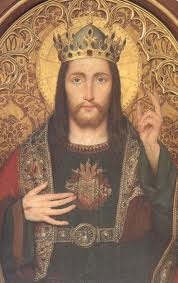 This search of man’s heart ends when one discovers God’s Heart. On this topic, St. Augustine says: “You made us for yourself, Oh God, and our heart is restless until it rests in you”. The concern to which St. Augustine refers is the difficulty we all have in attaining true Love as a consequence of our condition of creatures; we are finite; moreover, we are sinners. Over and over again we run into the difficulty of our selfishness, the chaos of our passions, that throws away this true Love. Man’s heart “needs” a heart at his same level, a heart that can enter into his history, and, on the other hand, an “all-powerful” heart that can take him out of his limitations and sins. We can say that In Jesus Christ, God has met mankind and has loved us with a “human heart”. In the encounter of man’s heart with the Sacred Heart of Jesus, the mystery of salvation becomes real. “In fact, from the infinite horizon of his love, God wished to enter into the limits of human history and the human condition. He took on a body and a heart. Thus, we can contemplate and encounter the infinite in the finite, the invisible and ineffable Mystery in the human Heart of Jesus, the Nazarene” (Benedict XVI, Angelus, 1/VI/2008)
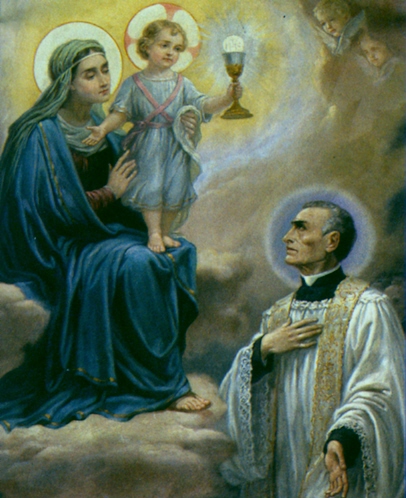 Gracious God of our ancestors, You led Peter Julian Eymard, like Jacob in times past, on a journey of faith. Under the guidance of Your gentle Spirit, Peter Julian discovered the gift of love in the Eucharist which Your Son Jesus offered for the hungers of humanity. Grant that we may celebrate this mystery worthily, adore it profoundly, and proclaim it prophetically for Your greater glory. Amen.
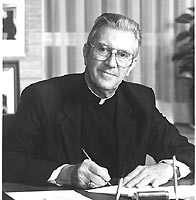 Today is the 20th anniversary of death of The Most Reverend John Francis Whealon, STL, the sometime Archbishop of Hartford. He served as the archbishop from 1968 till his sudden death in 1991. For me, Archbishop Whealon was a model priest and a somewhat iconic figure in Connecticut.
Carindal Stanisław Ryłko, 66, President of the Pontifical Council for the Laity, wrote a brief editorial on the contours of the new evangelization. In 2012, there will be another Synod of Bishops’ meeting with the new evangelization as it’s central topic. He’s helping to focus our attention on the exhortation of Jesus to spread the Kingdom of God. A mere two paragraphs follow, but you can read the entire editorial here.
As is known, the idea is not new: the entire pontificate of Blessed John Paul II was characterized by the leit-motiv of the new evangelization. Pope John Paul II did not fail to explain to us what he intended when he placed the adjective “new” in front of the traditional term, “evangelization”: new in ardor, new in methods, new in expressions. For an appropriate and faithful understanding of the contents of the Lineamenta, one needs to have an adequate key for reading the text. The expression, “new evangelization,” in fact, has become so common – even abused – that we run the risk of distorting its sense, or worse, reducing it to an insignificant slogan. The heart of the question of the new evangelization, writes the Cardinal, is the centrality of God in our lives.
 The Dominican nuns at Our Lady of Grace Monastery (North Guilford, CT) lost their barn this past winter with the constant snow fall. The old barn collapsed under the weight of lots of snow –it’s poor, old legs couldn’t bear the torment of heavy snow and ice. But the monastery needs a barn.

Image via Wikipedia
Saint Alphonsus, born in 1696, a lawyer by 20. ordained priest in 1726, a founder of a religious congregation of priests and brothers, a bishop, an author and a Doctor of the Church, is remembered today’s at Mass.
Perhaps he’s best known for founding the Congregation of the Most Holy Redeemer – better known as the Redemptorists – in 1732 with official papal approval in 1749. The Redemptorists were did missionary work, taught catechism and gave retreats; they concentrated mostly on the country side for their spiritual labors.
It is true that you can’t force a sacrament on someone and that one’s perfect freedom has to be respected, history tells us that Alphonsus was forced against his own will, to be the bishop of Naples’ small Diocese of St. Agatha in 1762, a ministry he exercised for 13 years. During these years he set about correcting liturgical abuses and other such things, reformed the seminary, sent priests to be missionaries, and helped the poor.
On August 1, 1787, at Pagani, Alphonsus Liguori died at mid-day, as the bells were calling the faithful to pray the Angelus.
In 1839, Alphonsus was canonized and and the Magisterium declared him to be a Doctor of the Church in 1871.
As an author, Alphonsus published more than 100 books, including The Glories of Mary, Preparation for Death, and The Passion and the Death of Jesus Christ.
The Redemptorists have a US province.
