Author: Paul Zalonski
Siena Forum for Faith and Culture announces Fall events
The Assumption (Dormition) of the Blessed Virgin Mary – a period of fast
August 1 through 14 is a period of fasting in the
Byzantine churches in preparation for the feast of the Dormition of the
Theotokos (Assumption) on August 15.
Theotokos, as the ever-blessed and immaculate Mother of our God. More honorable
than the cherubim, and by far more glorious than the seraphim, ever a virgin, you
gave birth to God the Word; O true Theotokos, we magnify you!
Hans Urs von Balthasar’s 106th birthday
Fr Z under attack?
I was reading Fr Tim Finigan’s blog today, The hermeneutic of continuity, and was startled to read his post “Fr Z under attack.” Apparently Dr. Phyllis Zagano, professor of Religion at Hofstra University, doesn’t care for Fr Z’s ecclesiology and liturgical theology. Actually, it’s not Fr Z she has the problem with, it is the Church. But since she’s can’t get at that in manageable ways, she’s going after a prominent priest-writer. Why does she really care about Fr Z???
The controversy is based on ruffled feathers: Dr Zagano and much of the NC Reporter crowd doesn’t like to be scrutinized by those “who think with the Church.” It seems to me that this is another example of the mentality where “authority (and obedience) is for other people”; remember, this way of judging things isn’t really Catholic. The same doesn’t accept fraternal correction or live in a spirit of obedience to the Holy Mother the Church (who might just know more than a mere individual expositor of religion). Clearly, this is a case of scratch a liberal find a fascist. In world where adults are expected to be mature, trying to dig up dirt so as incite scandal among the faithful has no place in the Church. Perhaps, it seems to me, that Dr Zagano has not really learned much from all the work she’s done with the central spiritualities of the Church.
Saint Clare of Assisi: a year to receive an indulgence
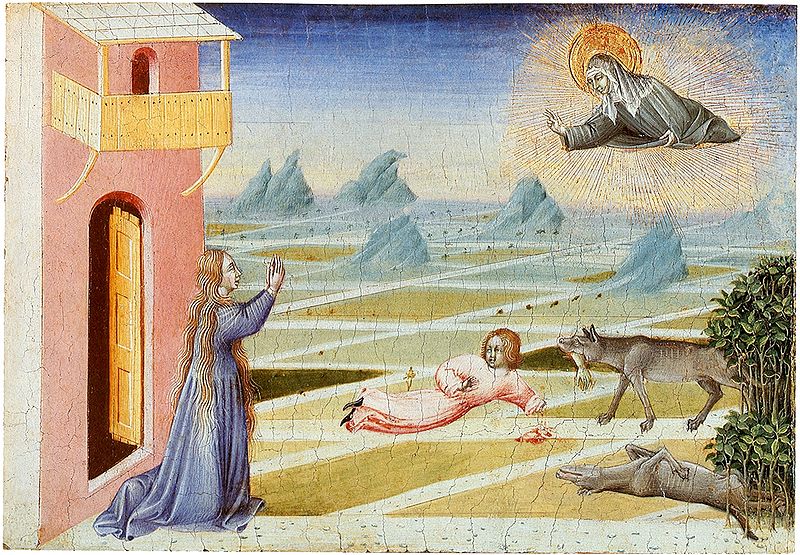
Today we observe the feast day of one the brilliant gems in the crown of Christ the King, Saint Clare of Assisi.
Clare, as you know, is the close companion to the great saint Francis of Assisi, who some have called the “other Francis” because of singular vision of living with Christ poor. In time, Clare founded a group of “poor ladies” living together following the Rule written by Clare for God’s greater glory in enclosed life. First known as the Order of San Damiano, The Poor Clares as they have been known, live a life of joyous poverty in imitation of Christ. Clare’s Rule was an extraordinary act of confidence since the establishment only accepted the Rule of St Benedict for monastic living.
Saint Clare was born on July 16, 1194 and died at the age of 59 on August 11, 1253. She was canonized by Pope Alexander IV on September 26, 1255. Our Saint is the patron of those with diseases of the eye, communication systems, goldsmiths and good weather. Perhaps brides and builders should pay more attention to Saint Clare!
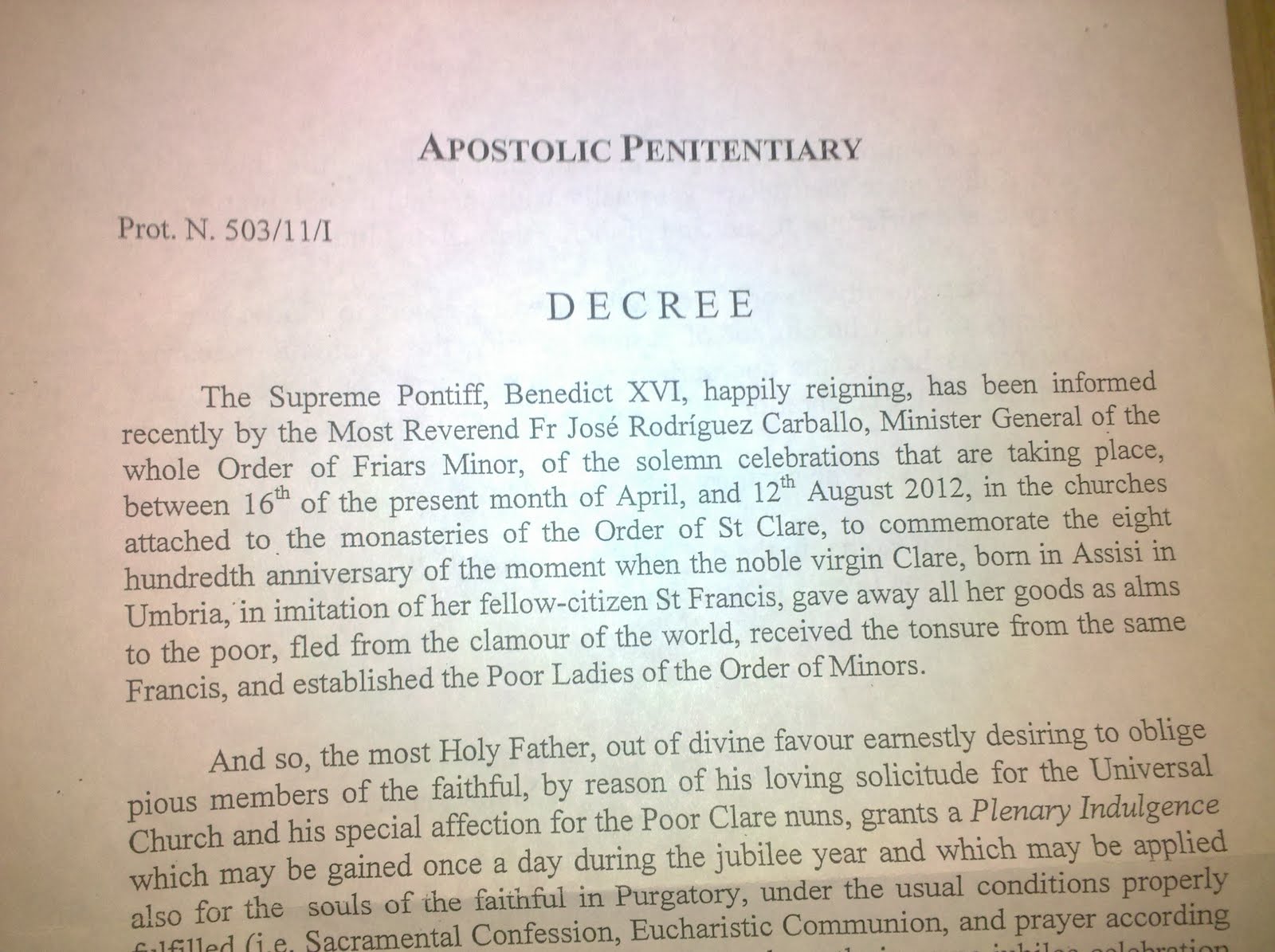
For the 800th anniversary of Saint Clare’s birth holy Mother Church is offering the faithful –with the usual conditions– an indulgence.
The four minister generals of the large Franciscans groups wrote the Poor Sisters of Saint Clare a letter for the anniversary where they say they rely on the continued witness of the daughters of Clare today in the monastic life. The friars propose a consolidation that maintains a “healthy and necessary complementarity” among the friars and sisters.
Here’s the letter: Letter to the Poor Clares.pdf
You may want to read an excellent t book on Saint Clare edited and translated by Capuchin Father Regis J. Armstrong, The Lady: Clare of Assisi: Early Documents (NY: New City Press, 2006).
Monasteries are true and proper oases for humanity, Benedict XVI reminds us
In Wednesday’s edition of L’Osservatore Romano, Pope Benedict told the listeners of the Wednesday General Audience that the monastic life is an essential value for humanity and for the Church, today. The Pope’s emphasis on beauty and silence helps us to appreciate and to listen God’s promptings of the desires of the heart is important. Let’s pay attention to what the Pope has to say. You may also want to watch the Rome Reports news video.
The editor writes, “Monasteries are true and proper oases of the spirit in which God speaks to humanity. The Pope said this to faithful at the General Audience of Wednesday, 10 August, that was held in the courtyard of the Papal Residence at Castel Gandolfo.”
Dear Brothers and Sisters! In every age, men and women who have consecrated their lives to God in prayer – like monks and nuns – have established their communities in particularly beautiful places: in the countryside, on hilltops, in valleys, on the shores of lakes or the sea, or even on little islands. These places unite two elements which are very important for contemplative life: the beauty of creation, which recalls that of the Creator, and silence, which is guaranteed by living far from cities and the great means of communication. Silence is the environmental condition that most favors contemplation, listening to God and meditation. The very fact of experiencing silence and allowing ourselves to be “filled,” so to speak, with silence, disposes us to prayer. The great prophet, Elijah, on Mount Horeb – that is, Sinai – experienced strong winds, then an earthquake, and finally flashes of fire, but he did not recognize the voice of God in them; instead, he recognized it in a light breeze (cfr. 1 Rev 19:11-13). God speaks in silence, but we need to know how to listen. This is why monasteries are oases in which God speaks to humanity; and there we find the courtyard, a symbolic place because it is a closed space, but open toward the sky.
Tomorrow, dear friends, we will celebrate the memory of St. Clare of Assisi. So I would like to recall one of these “oases” of the spirit which is particularly dear to the Franciscan family and to all Christians: the little convent of San Damiano, situated just beneath the city of Assisi, among the olive groves that slope towards Santa Maria degli Angeli. In that little church, which Francis restored after his conversion, Chiara and her first companions established their community, living off prayer and little works. They were called the “Poor Sisters,” and their “form of life” was the same as the Frati Minori: “To observe the Holy Gospel of our Lord Jesus Christ” (Rule of St. Clare, I, 2), conserving the union of reciprocal charity (cfr ivi, X, 7) and observing in particular the poverty and humility of Jesus and his Most Holy Mother (cfr, ivi, XII, 13).
Benedict XVI at the General Audience stresses the value of monastic spirituality God speaks in silence Benedict XVI at the General Audience stresses the value of monastic spirituality God speaks in silence and beauty of the place in which the monastic community lives – simple and austere beauty – are like a reflection of the spiritual harmony which the community itself attempts to create. The world is filled with these oases of the spirit, some very ancient, particularly in Europe; others are more recent, while still others have been restored by new communities. Looking at things from a spiritual perspective, these places of the spirit are a load-bearing structure of the world! It is no accident that many people, especially in times of rest, visit these places and stop there for some days: even the soul, thanks be to God, has its needs! The Pope continues:
Let us remember, therefore, St. Clare. But let you also remember other Saints who remind us of the importance of turning our gaze to the “things of heaven,” like St. Edith Stein, Teresa Benedicta of the Cross, Carmelite, co-patron of Europe, whom we celebrated yesterday. And today, August 10, we cannot forget St. Lawrence, deacon and martyr, with a special wish for Romans who have always venerated him as one of their patrons. Finally, let us turn our gaze to the Virgin Mary, that she may teach us to love silence and prayer.
Saint Lawrence
Saint Teresa Benedicta of the Cross (Edith Stein)
God of our Fathers, who brought the Martyr Saint Teresa Benedicta of the Cross to know Your crucified Son and to imitate him even until death, grant, through her intercession, that the whole human race may acknowledge Christ as its Savior and through him come to behold You for eternity.
“God Himself teaches us to go forward with our hand in His by means of the Church’s liturgy.”
The 2010 blog post is here.
Father Anselm Atkinson, OSB New Abbot of Pluscarden
The Rt. Rev. Anselm Atkinson, OSB until now the
Superior of St. Mary’s Monastery, Petersham, MA (for the last 21 years) and Abbot-Visitor for the
English speaking province of the Subiaco Congregation of the Order of St.
Benedict has been elected as the third Abbot of Petersham’s motherhouse and the
monastery of his profession (1976) and priest in 1982, Pluscarden Abbey in Scotland. Pluscarden was refounded in 1948.
Hugh Gilbert, OSB who will be ordained and installed on August 15 as the Bishop
of Aberdeen.