The new Archbishop of Philadelphia, Charles Chaput, OFM, Cap., is doing what Saints Peter and Paul would have done: teach the Faith with clarity but pastorally: if you don’t accept the teachings of Christ as found in the New Testament and articulated by the Church, then you really aren’t Catholic. You may be Christian, but not really Catholic. Cafeteria Catholics –Catholics who pick-and-choose what to believe– don’t trust in Christ, nor do they believe in the objectivity of truth taught by the Church. The promises of Christ and the Church aren’t too good to be true. The teachings of Christ and the Church are the way, the truth and the life for all Christians. Chaput has been clear about what it takes to be an authentic Catholic and picking and choosing is not the method. Sorry.
Author: Paul Zalonski
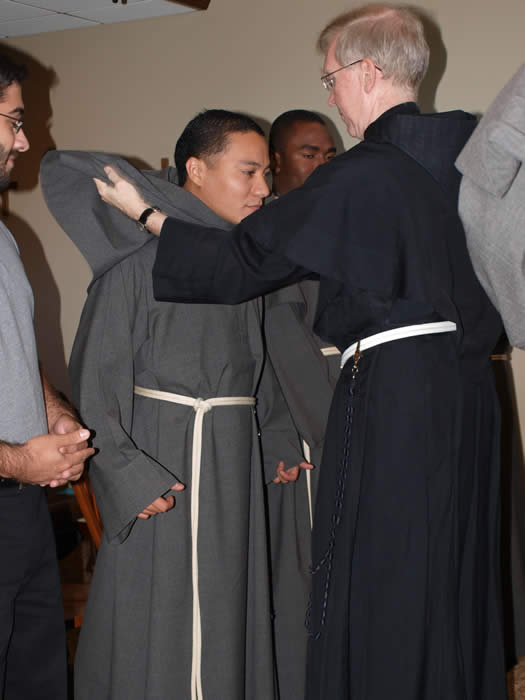
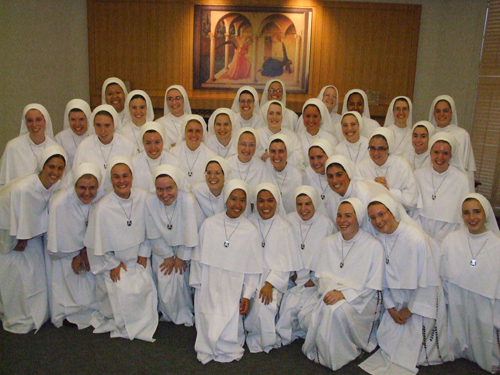
Religious life 2011: Profession of vows, entrances and ordinations
About this time of each year I look at the numbers of who professed vows, entered religious life and/or ordained of a select group of religious orders of the mixed, apostolic life and monasteries since Autumn 2010.
John Paul II’s Laborem exercens makes 30 years
must earn his daily bread and contribute to the continual advance of science
and technology and, above all, to elevating unceasingly the cultural and moral
level of the society within which he lives in community with those who belong
to the same family. And work means any activity by man, whether manual or
intellectual, whatever its nature or circumstances; it means any human activity
that can and must be recognized as work, in the midst of all the many
activities of which man is capable and to which he is predisposed by his very
nature, by virtue of humanity itself. Man is made to be in the visible universe
an image and likeness of God himself, and he is placed in it in order to subdue
the earth. From the beginning therefore he is called to work. Work is one of
the characteristics that distinguish man from the rest of creatures, whose
activity for sustaining their lives cannot be called work. Only man is capable
of work, and only man works, at the same time by work occupying his existence
on earth. Thus work bears a particular mark of man and of humanity, the mark of
a person operating within a community of persons. And this mark decides its
interior characteristics; in a sense it constitutes its very nature.
Continue reading John Paul II’s Laborem exercens makes 30 years
Labor Day: “the Church has been and is on the side of the worker”
When Pope XIII published Rerum Novarum (On the Condition of Labour) in 1892, it was considered a brilliant piece of thinking on the Church walking closely with the average man and woman because it demonstrated that in reality, once again, the Church situated herself in the reality of human existence: in the social, political and economic spheres with a keen recognition of human dignity; the protection of basic economic and political rights, including the right to a just wage and to organize associations or unions to defend just claims; the right to private property; the rights of labor over capital; the just organizations of society for the common good.
Pope Leo rejected not only a communistic philosophy but he did not ignore the basis of its appeal to workers and condemned the exploitative nature of the liberal-capitalist alternative. He wanted the Church on all levels to be engaged with the social order which slowly took shape in the later years of the 19th century and then in the 20th and 21st centuries.
Continue reading Labor Day: “the Church has been and is on the side of the worker”
Saint Moses
Commemoratio sancti Moysis, prophetae, quem Deus elegit, ut populum in Aegypto oppressum liberaret et in terram promissionis adduceret; cui etiam in monte Sina sese revelavit dicens: “Ego sum qui sum”, atque legem proposuit, quae vitam populi electi regeret. Ille servus Dei in monte Nebo terrae Moab coram terra promissionis plenus dierum obiit.
Artistic expression is part of that “way of beauty” that leads to God
Pope Benedict gave the following teaching on beauty –a subject near to his heart– on August 31. Some of the paragraphs are here (the entire address is here). Isn’t what the Pope says true???? The beautiful expressed in food, music, art, architecture, the human body, the poerty and friendship is the extroversion of the Holy Spirit.
Today, I would like to consider briefly one of these channels that can lead us to God and also be helpful in our encounter with Him: It is the way of artistic expression, part of that “via pulchritudinis” — “way of beauty” — which I have spoken about on many occasions, and which modern man should recover in its most profound meaning.
Perhaps it has happened to you at one time or another — before a sculpture, a painting, a few verses of poetry or a piece of music — to have experienced deep emotion, a sense of joy, to have perceived clearly, that is, that before you there stood not only matter — a piece of marble or bronze, a painted canvas, an ensemble of letters or a combination of sounds — but something far greater, something that “speaks,” something capable of touching the heart, of communicating a message, of elevating the soul.
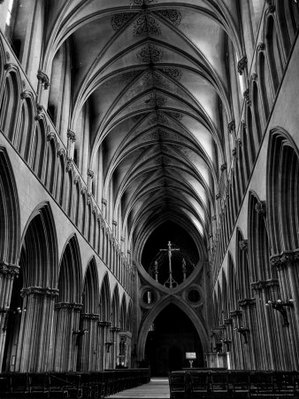
A work of art is the fruit of the creative capacity of the human person who stands in wonder before the visible reality, who seeks to discover the depths of its meaning and to communicate it through the language of forms, colors and sounds. Art is capable of expressing, and of making visible, man’s need to go beyond what he sees; it reveals his thirst and his search for the infinite. Indeed, it is like a door opened to the infinite, [opened] to a beauty and a truth beyond the every day. And a work of art can open the eyes of the mind and heart, urging us upward.
Continue reading Artistic expression is part of that “way of beauty” that leads to God
Saint Gregory the Great
For Gregory the Great, a hinge figure between the ancient world — the Senate of Rome last met while Gregory was the city’s bishop — a hinge between the ancient world and the grand experiment called Christendom, for Gregory this awareness that to look upon the face of Christ brought knowledge of God inspired an extensive exploration of Scripture to discern how God would have us live, how the Church and its leaders could best serve those seeking to know Christ Jesus and the Father. Since rightful authority comes from God, Gregory reasoned, its exercise must ever include a pastoral intent.
Father James Flint, OSB
Saint Procopius Abbey
3 September 2011
Let us pray for the Benedictine monks of Portsmouth Abbey, Portsmouth, Rhode Island, on this their abbey’s patronal feast day. May God prosper the work of their hands!
You may also be interested in the 2010 blog post that has a hymn to Saint Gregory the Great by J. Michael Thompson.
On retreat …
This weekend is the 71 st annual retreat of the New York area Benedictine Oblates of the Archabbey of Saint Meinrad. The retreat is being held at Mariandale Retreat House, Ossining, NY with the retreat master being Brother John Mark Falkenheim, OSB. His theme is “Grace and Human Nature in the Rule of Saint Benedict.”
Pray for the 35 Oblates.
Catholic gynecologists meet in Rome
Protecting women and motherhood ought to be our daily work. For physicians all the more. In fact, this week in Rome, the Internation Federation of Catholic Physicians (FIAMC) is meeting on the realtionship between http://www.matercare.org/women and doctors. The English language congress, “The Dignity of Mothers and Obstetricians – Who on Earth Cares!” is organized by the MaterCare International and sponsored by FIAMC) with the assistance of the Pontifical Academy for Life.
Saint Joshua
The Roman Martyrology notes Saint Joshua’s feast day today. You remember him, Joshua, son of Nun, servant of the Lord, who became inspired by the Holy Spirit after Moses laid hands on him and who led the Israelites into the Promised Land. The Righteous Joshua is said to have lived for a 110 years reposing c. 1440 BC.