Catholics can’t ignore personal piety: forming others to be religious and spiritual

How often do you think mainline Christians take the personal piety of others? How frequently do we take someone who says “I am spiritual but not religious”? “Not very often” is the best answer to offer. Saying that one is spiritual and not religious lacks a certain seriousness of belief and unbelief. Catholics in the USA number circa 65-70 million and in the world Catholics number just over a billion this notion of being spiritual and not religious gaining currency. Why? Because a personal relationship with Jesus is lacking. There is no encounter with the living Messiah, Jesus is an abstraction.

Last week someone asked me what I thought of being spiritual but not religious. I simply said, to hold that belief is to lack a certain convergence of faith and reality; while understandable from the point of view that many professed Christians lack a true conviction of faith in Jesus Christ both from the point of doctrine but also in practice.

David Briggs has an article that is to be read: “Religious but not spiritual: The high costs of ignoring personal piety.”
Instead of jumping to a negative conclusion, why not ask the question of what you are doing to work on your own education in the Faith and its practice? Adherence to Christ is a life of love, but it is also an ongoing work.

Clarifying the meaning of religious freedom


A timely piece to think seriously about daily is the notion of religious freedom not only around the globe, but also and significantly here in the USA. Today, the Most Reverend William E. Lori addressed the Judiciary Committee of the United States House of Representatives, Subcommittee on the Constitution. Here are a few paragraphs (the link to the full text is noted below):

Religious
liberty is not merely one right among others, but enjoys a certain primacy. As
the Holy Father, Pope Benedict XVI recently explained: “It is indeed the first
of human rights, not only because it was historically the first to be
recognized but also because it touches the constitutive dimension of man, his
relation with his Creator.” (Pope Benedict XVI, Address to Diplomatic Corps,
10 Jan. 2011
.) The late
Pope John Paul II taught that “the most fundamental human freedom [is] that of
practicing one’s faith openly, which for human beings is their reason for
living
.” (Pope John Paul II, Address to Diplomatic Corps, 13 Jan. 1996
, No. 9.) Not coincidentally, religious
liberty is first on the list in the Bill of Rights, the charter of our Nation’s
most cherished and fundamental freedoms. The First Amendment begins: “Congress
shall make no law respecting an establishment of religion, or prohibiting the
free exercise thereof….” It is commonly, and with justice, called our “First
Freedom.”

Continue reading Clarifying the meaning of religious freedom

US Commission on International Religious Freedom could cease in November

US Congressman Frank R. Wolf, 72, (Virginia 10th District) proposed the bill in 1998 which created The United States Commission on International Religious Freedom is a bi-partisan US Federal commission, appointed by the US President to advise him and Congress on matters pertaining to the freedom of religion. The CIRF reports to Congress and the State Department, is now in jeopardy.

It’s work is research and advocacy for freedom and human rights. It looks at the practice of religion and it’s freedom to exist.
HOWEVER, there is one senator who is blocking funding, anonymously. We need to write to our senators. We need to speak out!!!
After November 18 the Commission may go out of business.
Congressman Wolf thinks that if the bill is passed, Obama will sign the bill. But truth be told, the President is not really in favor the Commission’s work.
Enhanced by Zemanta

Blessed John Paul II Mass Collect


Bl Pope JP II.jpg

Today is the first time the Church prays the Mass for the liturgical memorial of Blessed John Paul II. To date, Blessed John Paul II’s feast is observed in the USA as an optional memorial. The US Conference of Bishops is requesting of the Holy See that this feast be an obligatory liturgical memorial. The second reading for the Office of Readings is here. Other texts for Mass and the Divine Office are taken from the “Common of Pastors: For a Pope.”

The Collect (opening prayer for Mass) is given here in English and Latin:

O God, who are
rich in mercy and who willed that the Blessed John Paul II should preside as Pope
over your universal Church, grant, we pray, that instructed by his teaching, we
may open our hearts to the saving grace of Christ, the sole Redeemer of
mankind. Who lives and reigns.

Deus, dives in
misericórdia, qui beátum Ioánnem Paulum, papam, univérsae Ecclésiae tuae
praeésse voluísti, praesta, quaésumus, ut, eius institútis edócti, corda nostra
salutíferae grátiae Christi, uníus redemptóris hóminis, fidénter aperiámus. Qui
tecum.

The Scripture would be: first
reading is Isaiah 52:7-10; the responsorial psalm is 96/95:1-2a, 2b-3, 7-8a,
10); the alleluia is John 10:14; the Gospel is John 21:15-17.


The Congregation for Divine Worship and the Discipline of the Sacraments published on April 2, 2011, the “Decree Concerning Liturgical Worship in Honour of Blessed John Paul II.”

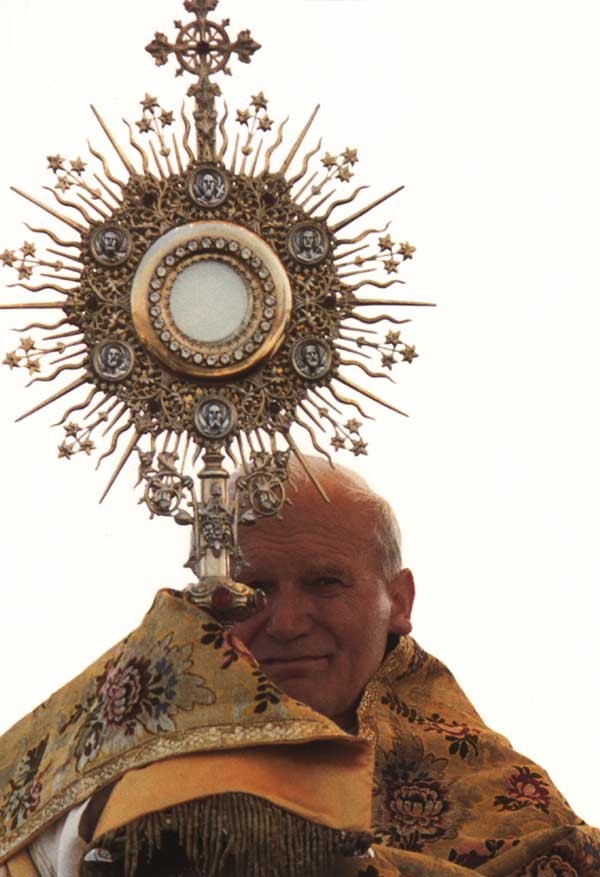
Blessed John Paul II

Pope John Paul II with Monstrance.jpg

“The absolute, and yet sweet and gentle, power of the Lord responds to the whole depths of the human person, to his loftiest aspirations of intellect, will and heart. It does not speak the language of force, but expresses itself in charity and truth.

The new Successor of Peter in the See of Rome today makes a fervent, humble and trusting prayer: Christ, make me become and remain the servant of your unique power, the servant of your sweet power, the servant of your power that knows no dusk. Make me a servant: indeed, the servant of your servants….

Do not be afraid. Open, I say open wide the doors for Christ. To his saving power open the boundaries of states, economic and political systems, the vast fields of culture, civilization and development.

Do not be afraid. Christ knows “that which is in man”. He alone knows it.

So often today, man does not know that which is in him, in the depths of his mind and heart. So often he is uncertain about the meaning of his life on this earth. He is assailed by doubt, a doubt which turns into despair.

We ask you, therefore, we beg you with humility and with trust: let Christ speak to man. He alone has words of life, yes, of life eternal.”

Pope John Paul II

Homily at the Beginning of the Pontificat

22 October 1978

Office of Readings for the Liturgical Memorial

More on the Assisi Day of Reflection and dialogue 2011


Peter Kodwo Appiah Turkson.jpg

The “Day of
reflection, dialogue and prayer for peace and justice in the world: Pilgrims of
Truth, Pilgrims of Peace,” is to take place in Assisi on 27 October. The event needs our prayer and solidarity.

Cardinal
Peter Kodwo Appiah Turkson, president of the Pontifical Council for Justice and
Peace had a press conference in which he said, “Following two and a half
decades of collaboration and joint witness among religions, it is time to
assess the results and to re-launch our commitment in the face of new
challenges.”

Continue reading More on the Assisi Day of Reflection and dialogue 2011

North American Martyrs

North American Jesuit Martyrs.jpg

Saint Isaac Jogues wrote, “My confidence is placed in God who does not need our help for accomplishing his designs. Our single endeavor should be to give ourselves to the work and to be faithful to him, and not to spoil his work by our shortcomings”

Saint John de Brébeuf, pray for us. 

Saint Isaac Jogues, pray for us. 

Saint Gabriel Lalemant, pray for us. 

Saint Anthony Daniel, pray for us 

Saint Charles Garnier, pray for us. 

Saint Noël Chabanel, pray for us. 

Saint René Goupil, pray for us. 

Saint John de la Lande, pray for us.

Julián Carrón speaks on the New Evagelization, relationship between the Gospel and culture

On October 14, 2011 Pope Benedict XVI received Father Julián Carrón, President of the Fraternity of Communion and Liberation, in audience in the Apostolic Palace, the day before the Vatican meeting on “New Evangelizers for a New Evangelization,” a two day event that will culminate in the Mass with the Pope on Sunday at 9:30 in Saint Peter’s Square. What follows is an interview with Vatican Radio’s Alessandro Gisotti (emphasis mine).


AGisotti.jpg


Alessandro Gisotti interviewed Fr. Carrón about tomorrow’s meeting and the challenge of the new evangelization.


Father Julián Carrón: The first thing I would like to express is how grateful and moved I am at this opportunity the Holy Father has given me to be with him in this audience, because it enabled me to tell him how, in this moment of travail due to the social, cultural, and economic situation, we are seeing that when people verify the faith in their own life circumstances, they flower into a type of person that leaves us speechless. Being able to share with him living the faith, as he testifies it to us, was a true consolation.

How important is this meeting? How important is the Pope’s challenge for a new evangelization?

Continue reading Julián Carrón speaks on the New Evagelization, relationship between the Gospel and culture