Saints Cyril and Methodius

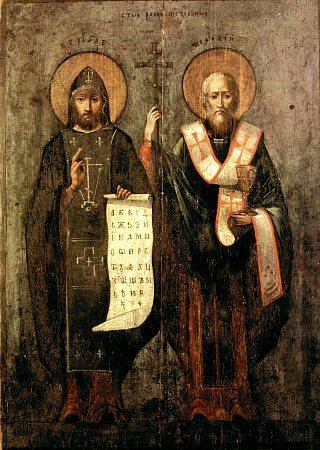
Sts Cyril and Methodius.jpgA lot of westerners are not too aware of Saints Cyril and Methodius. However, there’s a Polish parish in the Hartford and Bridgeport dioceses and a seminary in Michigan that bear the names of these rather famous saints. So, they are not too obscure but they’re not that well-known as they ought to be. In 1985, Blessed John Paul II paid tribute to these two saints in an Encyclical, Slavorum Apostoli, to show the vividness of their witness.

In Russian Orthodox circles, the celebration of Cyril and Methodius is connected with a cultural festival on Salvonic literature. The holy brothers are known for the formation of the Glagolitic alphabet –now called the Cyrillic alphabet– that was instrumental in the evangelization and education of the Slavs.

Here we have saints not only of great zeal for the Kingdom of God but of culture. The true and orthodox faith the lived and taught is the one we desire, too.

The Church prays
O God, who enlightened the Slavic peoples through the brothers Saints Cyril and Methodius, grant that our hearts may grasp the words of your teaching, and perfect us as a people of one accord in true faith and right confession.

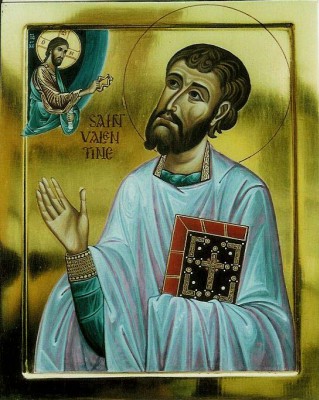
Saint Valentine

St Valentine Aidan Hart icon.jpg

Today is a dedicated in the secular world to Valentine. But the more excellent way, the Church, proposes an observance of a saint whose love for God and others, Valentine, is more noteworthy because it focuses not on the temporal but on the eternal. Indeed, Saint Valentine is invoked for his intercession by young people, for happy marriages, and authentic love. A holy priest, Valentine withstood the persecution inflicted on him by those who did not hold belief in the Lord of Lords, King of Kings, Jesus Christ. In many circumstances the Lord healed and cured many people through the intercession of Saint Valentine. Would we be able to do the same?
The 2011 post is here.
The 2009 post is here.

In the soil of our heart God first planted the root of love for him


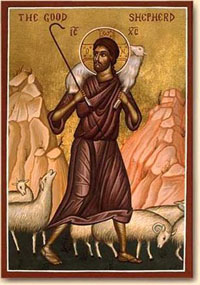
Today, the Holy Father announced his Good Shepherd Sunday missive on vocations. Singed on 18 October 2011, Benedict wrote this letter for the 49th World Day of Prayer for Vocations that’s celebrated on the 4th Sunday of Easter, Good Shepherd Sunday. The Pope’s message is exactly what I was trying to teach to the RCIA people yesterday: God’s love is total and our love for Him needs to be an icon –that is, mirrored– to the world. His theme this year is: Vocations, the Gift of the Love of God. A few paragraphs of the text follow:

Good Shepherd icon.jpg

In a famous page of the Confessions, Saint Augustine
expresses with great force his discovery of God, supreme beauty and supreme
love, a God who was always close to him, and to whom he at last opened his mind
and heart to be transformed: “Late have I loved you, O Beauty ever
ancient, ever new, late have I loved you! You were within me, but I was
outside, and it was there that I searched for you. In my unloveliness I plunged
into the lovely things which you created. You were with me, but I was not with
you. Created things kept me from you; yet if they had not been in you they
would have not been at all. You called, you shouted, and you broke through my
deafness. You flashed, you shone, and you dispelled my blindness. You breathed
your fragrance on me; I drew in breath and now I pant for you. I have tasted
you, now I hunger and thirst for more. You touched me, and I burned for your
peace.” (X, 27.38). With these images, the Saint of Hippo seeks to
describe the ineffable mystery of his encounter with God, with God’s love that
transforms all of life.

Continue reading In the soil of our heart God first planted the root of love for him

Blessed Jordan of Saxony

Bl Jordan Saxony.jpegIn the Order of Friars Preachers today is the feast of day of Blessed Jordan of Saxony. Blessed  Jordan, from Paderborn, Germany (a Saxon noble) known for his piety and charity, was educated at the famed University of Paris. In 1220, he was admitted to the Order by Saint Dominic himself in and a year later was the Prior Provincial for the friars in Lombardy, and a year later he succeeded Dominic as the Master of the Order. 

Blessed Jordan’s preaching was known to be powerful to the point of bringing Saint Albert the Great to the Order and by extension you might say that he brought Thomas Aquinas to the fraternity. Jordan died in a shipwreck off the coast of Syria in 1237 on a pilgrimage to the Holy Land. Pope Leo XII beatified Jordan in 1825.

The Collect is noted here.

Enhanced by Zemanta

Healing the leper in all of us…Jesus touches our hearts


Jesus heals the leper detail.jpg

The Church prays today,

O God, who teach
us that you abide in hearts that are just and true, grant that we may be so
fashioned by your grace as to become a dwelling pleasing to you.


What other grace do we need but the grace to abide in Christ? The priest’s prayer at Mass in the anamnesis tells us and God that He lives hearts that are just and true.

The Gospel today relates something that calls to mind the work of Saint Damian of Molokai and Blessed soon-to-be-saint Marianne Cope who worked with and evangelized lepers in Hawaii. Their love was extroverted. No doubt the Lord’s touch and the saints’ humanity was likely the first substantial, real contact these “outcasts” experienced. The Lord’s touch of the leper is as the Prayer over the Offering prays, it “cleanses and renews” for the sake of our salvation. So much for us, too. May the Lord touch our uncleanness and sinfulness so that we may be close to Him.

What other than love and compassion did the Lord have for the marginalized? The medical leper and the spiritual leper always have on their lips Psalm 32: “I turn to you, Lord, in time of trouble, and you fill me with the joy of salvation.”

Saint Scholastica, the persistent twin sister

OSB nun posing as St Scholastica.jpgAs we celebrate anew the Memorial of the Virgin Saint Scholastica, we pray, O Lord, that, following her example, we may serve you with pure love and happily receive what comes from loving you.

Scholastica according to the tradition of the Church, was the twin sister of Saint Benedict having been born in 480 in Nursia. As twins do, Saint Scholastica followed her sibling. One could say that poor Benedict couldn’t dodge his sister but the love they had for one another was intense and natural that nothing else would suffice. 
The Saint went to Monte Cassino (just south of Rome) known today as the Arch-Coenobium and died there in 547. Scholastica founded a monastery for women following the Rule compiled by her brother.
As the Mass collect above says, let’s follow Scholastica’s example of service of the Lord with a love that is pure and receive what the Lord gives happily.
Let us pray for the intentions of the Benedictine nuns in the USA, particularly nuns of the monasteries of Regina Laudis (Bethlehem, CT), the Glorious Cross (Branford, CT), St Emma (Pittsburgh, PA), St Walburga (Virginia Dale, CO), Immaculate Heart of Mary (Westfield, VT) and Our Lady of Ephesus (Kansas City, MO).
Re-read a post on keeping focus on Christ

Saint Josephine Margaret Bakhita

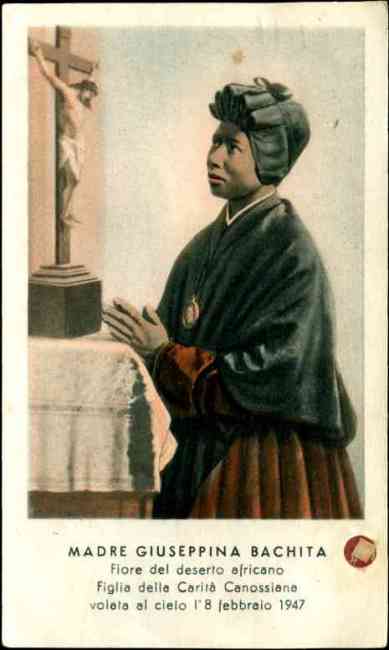
St Giuseppina bakhita.jpg

The Lord has loved me so much: we must love everyone…we must be compassionate!

The Church liturgical memorial today commemorate Saint Josephine Bakhita, a woman from the Sudan who was enslaved as a young girl, purchased by an Italian family, educated by the Canossian Sisters in Italy where she was converted and became a member of that religious community.

At Mass for Saint Josephine, we hear the parable of the wise and foolish bridesmaids (Matthew 25); the Communion antiphon is also from that Gospel. Pope Benedict has spoken of Saint Josephine several times in past years. Let us run out to meet the Lord our Saint today did.

The antiphon at Communion:

The five prudent bridesmaides were prepared with much oil in their flasks, along with their torches. In the gloom of the midnight, a shout was heard by them: “Behold! the Bridegroom comes! Go out to meet Him, the Christ, our Lord!”

Pope urges concern for others, reciprocity and personal holiness for lenten lessons

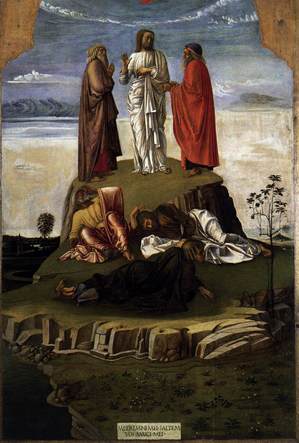
Transfiguration GBellini.jpg

The Pope’s lenten message for the Church is rooted in the Letter to the Hebrews by which he develops three aspects of Christian life: concern for others, reciprocity and one’s holiness. As he says at the start, Hebrews tells us to have confidence in, trust in, Jesus who is our high priest. The presentation of the message is made by Cardinal Robert Sarah.

Lent begins February 22 with the imposition of ashes beginning a 40 day season of fasting, prayer and almsgiving. In some segments of the Church, spiritual preparations have begun with observing the preparatory Sundays –the pre-Lent– whereby Christians begin engaging more and more in acts of penance. The Church recommends a gradual acceptance of penance rather than a full scale plunge. One of my favorite narratives in the Gospel is the Transfiguration of Christ. Here Giovanni Bellini does a terrific job in developing my Catholic imagination in helping me to focus on Christ rather than myself. With the assistance of Pope Benedict’s lenten message we can help grace become more and more part of our own humanity whereby we are transfigured from doing sinful things to doing things of true Charity.


“Let us be concerned for each other, to stir a response in love and good works”

(Hebrews 10:24)

Dear Brothers and Sisters,

The Lenten season offers us once again an opportunity to reflect upon the very heart of Christian life: charity. This is a favourable time to renew our journey of faith, both as individuals and as a community, with the help of the word of God and the sacraments. This journey is one marked by prayer and sharing, silence and fasting, in anticipation of the joy of Easter.

This year I would like to propose a few thoughts in the light of a brief biblical passage drawn from the Letter to the Hebrews: “Let us be concerned for each other, to stir a response in love and good works”. These words are part of a passage in which the sacred author exhorts us to trust in Jesus Christ as the High Priest who has won us forgiveness and opened up a pathway to God. Embracing Christ bears fruit in a life structured by the three theological virtues: it means approaching the Lord “sincere in heart and filled with faith” (v. 22), keeping firm “in the hope we profess” (v. 23) and ever mindful of living a life of “love and good works” (v. 24) together with our brothers and sisters. The author states that to sustain this life shaped by the Gospel it is important to participate in the liturgy and community prayer, mindful of the eschatological goal of full communion in God (v. 25). Here I would like to reflect on verse 24, which offers a succinct, valuable and ever timely teaching on the three aspects of Christian life: concern for others, reciprocity and personal holiness.

Continue reading Pope urges concern for others, reciprocity and personal holiness for lenten lessons
Orthodox bishops rally faithful to protest the Obama administration


Bishops of the Orthodox Churches –those of the various jurisdictions in the USA– have called upon the Orthodox faithful to protest the Obama Administration’s ruling which affects matters of conscience. Since this is NOT a Catholic issue –one needs to say it’s a matter for all people, regardless of profession of faith. Exercising one’s right to speak out against injustice, here it’s a matter of injustice done by the government, Christians need to unite their hearts, minds, and voices and work for substantial change.

One doesn’t hear of the Orthodox Church on Pro-Life matters too often but you do see a greater presence of the Orthodox Church at events like the Pro-Life March in Washington, DC. In recent years their bishops, priests, seminarians (from St Vladimir’s) and laity have begun to show up to the March. They gather at the Orthodox Cathedral and walk with the others.

Here, we all need the Orthodox witness. Thanks goes to Greek Orthodox Metropolitan Savas (Pittsburgh) for his good work on the project.

Assembly of bishops.jpgThe Assembly of Canonical Orthodox Bishops of North
and Central America, which is comprised of the 65 canonical Orthodox bishops in
the United States, Canada and Mexico, join their voices with the United States
Conference of Catholic Bishops and all those who adamantly protest the recent
decision by the United States Department of Health and Human Services
,
and call upon all the Orthodox Christian faithful to contact their elected
representatives today to voice their concern in the face of this threat to the
sanctity of the Church’s conscience.

Continue reading Orthodox bishops rally faithful to protest the Obama administration