Walter Ciszek’s advances incrementally to sainthood

Walter J Ciszek.jpgMoving around the circles of the Catholic press is the noteworthy acceptance as valid of the cause of beatification and canonization of Father Walter J. Ciszek, SJ, (1904-84) by the Holy See’s Congregation for the Causes of Saints. 

So, this opens the door for Father Walter to be called “The Servant of God Father Walter J. Ciszek.” This is after thousands of pages already sent to Rome. When the biography, and gathering of other information is complete and deposited with the officials of the Saints’ Congregation, Cisezk’s case will be studied by nine theologians who will determine if he indeed lived a life of heroic virtue. If so after a commission of bishops and cardinals meets, a recommendation will be made to the Holy Father. A positive vote on all matters will result in the bestowing of the title “Venerable Servant of God…” Then, the real work of identifying a certifiable miracle takes place for the rank of beatification and then another miracle for canonization.

Continue reading Walter Ciszek’s advances incrementally to sainthood

Saint Benedict

St Benedict pPerugino.jpg

Stir up in your Church, O Lord, the spirit that animated our Father Saint Benedict, that filled with this spirit we may learn to love what he loved and practice what he taught.

Today is the commemoration of the passing of Saint Benedict (known also as the Transitus of Saint Benedict). The monks of Montecassino noted the serenity of his death making him a patron, an advocate for the dying. We attribute something similar to Saint Joseph, whom we celebrated on the 19th.  

Those who wear the “St Benedict Medal” will notice on the margin encircling the image of Benedict the Latin words: Eius in obitu nostro præsentia muniamur (May we be strengthened by his presence in the hour of our death)!

I might note, the Medal of Saint Benedict is THE most indulgenced medal the church has and the proper blessing of the medal contains an exorcism. Because of the Saint’s love of the Cross and his fighting of Satan, the medal has been known to protect against evil.


Tradition holds, 

Six days before he died, Benedict gave orders for his tomb to be opened. Almost immediately he was seized with a violent fever that rapidly wasted his remaining energy. Each day his condition grew worse until finally, on the sixth day, he had his disciples carry him into the chapel where he received the Body and Blood of our Lord to gain strength for his approaching end.

Then, supporting his weakened body on the arms of his brethren, he stood with his hands raised to heaven and, as he prayed, breathed his last.

Pope Saint Gregory the Great, Dialogues, book 2, c. 37.

The feast celebrate today is not so much a feast about the advocacy of a good death –an important aspect of our Christian life life– as much as it is to hold before our eyes an authentic witness to Jesus Christ and His Gospel. No other saint of the Church as affected the world as Saint Benedict has.

Most holy confessor of the Lord, Saint Benedict, Father of monks and nuns, guide and intercede for the salvation of us all.

Compunction awakens our soul


Compunction involves a moment of awakening, the first
glimmer of enlightenment, the dawning of a new day lived against a different
horizon. St. John Cassian, one of Benedict’s principal sources, defines
compunction as whatever can by God’s grace waken our lukewarm and sleepy souls
(Conferences 9:26)

This definition seems to envisage us living our spiritual
lives in a slumberous state of half-wakefulness. The grace of compunction is
the transition to a state of fuller awareness.

The great difference between the
saints and the rest of us is that they were spiritually awake more of the time
than we are; they were alert to possibilities. It is because they went through
life in a state of greater consciousness that they were more conscientious in
doing good and avoiding evil.

We who stumble through life with many mistakes
and omissions admire their saintly deeds but without necessarily realizing that
perhaps we could imitate them more closely if our spiritual senses were not so
drowsy 

Michael Casey, OCSO
The Road to Eternal Life

Stand up for religious freedom: Connecticut takes a stand against HHS


Rallies will be
taking place all over the country this Friday, March 23rd, to voice concerns
over the HHS mandate. Visit online: Stand Up for Religious Freedom.

Thousands of Americans of all faiths will be
participating in these peaceful rallies, organized by the Pro-Life Action League and Citizens for a Pro-Life Society to oppose
the new mandate from the U.S. Department of Health and Human Services (HHS) which
is requiring all employers provide free contraceptives, sterilization and
abortion-inducing drugs through their health plans, even in violation of their
consciences. 

Locally, Connecticut as two notable rallies: New Haven and
Hartford beginning at noon and will last approximately one hour. 

Women are
invited to voice their concern and support for freedom at Women Speak for Themselves.

Ken Hackett receives Notre Dame’s Laetare Medal

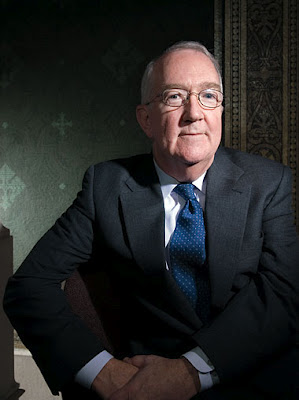
Ken Hackett.jpgUniversity of Notre Dame announced today that Ken Hackett, the longtime and recently retired president of the Catholic Relief Services, will receive 2012’s Laetare Medal. Catholic Relief Services is the Catholic Church in the USA’s humanitarian agency. The medal will be awarded on May 20th, the 167th commencement exercise.

ND’s president Holy Cross Father John Jenkins said that “Ken Hackett has responded to a Gospel imperative with his entire career. His direction of the Catholic Church’s outreach to the hungry, thirsty naked, sick and unsheltered of the world has blended administrative acumen with genuine compassion in a unique and exemplary way.”
Mr Hackett was born in West Roxbury, MA (a suburb of Boston), graduated from Boston College, worked with Peace Corps in Africa, and joined CRS in 1972. He was elected president of the same in 1993. Hackett has received numerous awards in previous years.

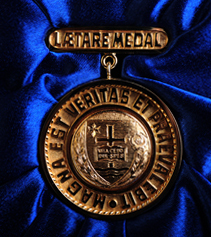
laetare medal.jpg

The Laetare Medal awarded by the University of Notre Dame on Laetare Sunday has its origins in 1883. Notre Dame’s understanding of the award honors a Catholic “whose genius has ennobled the arts and sciences, illustrated the ideals of the Church and enriched the heritage of humanity.” At the time it was given, the Laetare Medal was modeled on the 11th century tradition of a Golden Rose given by the Supreme Pontiffs to shrines of the Blessed Virgin Mary (a tradition maintained by Pope Benedict) and to Catholic Queens. Not too many notable Catholic queens today.
Laetare Sunday is the 4th Sunday of Lent. Rejoice Sunday –Laetare means “to rejoice”, the first word of the Introit (the Entrance Antiphon) of the Mass. The priest wears the joyful color of rose to symbolize the joyfulness of entering into this new phase of Lent, taking a respite from the Lenten observances, and picking up new strength to continue to the end of Lent. The Laetare Medal bears the inscription “Magna est veritas et prevalebit” (Truth is mighty, and it shall prevail.)
Enhanced by Zemanta

Saint Joseph, our model


St Joseph & Infant JA Escalante.jpgToday is a Solemnity in the Church with the feast of Saint Joseph, Spouse of the Blessed Virgin Mary.
 
The Church prays:
 
Grant, we pray, almighty God, that by Saint Joseph’s intercession your Church may constantly watch over the unfolding of the mysteries of human salvation, whose beginnings you entrusted to his faithful care.
 
A magnificent prayer to pay attention to during lectio.
 
“Today is the day to celebrate fatherhood. To be a father is not an easy challenge – there are many difficulties that go with it. We can look to St. Joseph, who quietly – as I would say, one of the ‘silent fathers’ – handled whatever needed to be handled…it is important [that fathers] pray for discernment, to pray for patience, to pray for these qualities, which can make one a good father.”
 
Fr. Moses Hamungole
Head of Vatican Radio’s
English for Africa service
 
Several people and organizations to pray for today: my father, Edward Joseph, Pope Benedict XVI (Joseph), Brother Joseph at Portsmouth Abbey, the Cistercian abbey of Saint Joseph (Spencer, MA), the Archdiocese of Hartford (the Cathedral of Saint Joseph), the Dominican Province of Saint Joseph, and several other friends named Joseph. Let’s not also forget the Universal Church is under St Joseph, whose patronage she is.

Shenouda III, Pope of Alexandria, dead at 88

Pope Shenouda on throne dead.jpg


On Saturday, 17
March 2012, Pope Shenouda III, the 117th head of the Coptic Christians died.
Shenouda was the successor of Saint Mark. He led his Church since November
1971.

UK’s Mail Online has a story of
Pope Shenouda
with other photos here. Plus, the Washington Post has an article to
read
.

Pope Benedict XVI sent this note of condolence to the Coptic
Christians:

On learning of the sad departure to God, our common Father, of His
Holiness Shenouda III, Patriarch of Alexandria on the See of Saint Mark the
Evangelist, I wish to express to the members of the Holy Synod, to the priests
and all the faithful of all the Patriarchate, my most sincere brotherly
compassion. I recall with gratitude his commitment to Christian Unity, his
memorable visit to my predecessor Pope Paul VI, and their signing of the Joint
Declaration of Faith in the Incarnation of the Son of God together in Rome, on
May 10, 1973, as well as his Cairo meeting with Pope John Paul II during the
Great Jubilee of the Incarnation, on February24, 2000. I can say how the
Catholic Church as a whole shares the grief that afflicts the Orthodox Copts,
and how she stands in fervent prayer asking that He, who is who is the
Resurrection and the Life, might welcome his faithful servant. May the God of
all mercy receive Pope Shenouda in His joy, His peace and light.

When I met Pope Shenouda in St Louis, Missouri in 1994, it was a very interesting experience all around. May God be merciful to him and Saint Mark his steps to paradise.

The photo
above is of Pope Shenouda sitting on his throne one last time before burial.
Perhaps the Roman bishops would like to adopt this practice.

Abbot Luke Rigby, RIP

Luke Rigby with Thomas Frerking.jpg

Earlier today I received news that an old friend died, Abbot Luke Rigby. Abbot Luke, 89, was the longtime religious superior of the monks at Saint Louis Priory –later Abbey– having come from England’s famed Ampleforth Abbey to live the Benedictine life. 


Both Ampleforth and St Louis are Benedictine monasteries in the English Benedictine Congregation. In the USA Portsmouth and St Anselm’s (DC) are also of the English Congregation.


Dom Luke Rigby was appointed the Father Prior of his community succeeding Dom Columba Cary-Elwes in 1967; when the Priory granted independence by Abbot Basil Hume, Father Luke was elected the Conventual Prior by the community beginning in 1973. By grace St. Louis Priory was given abbatial status in 1989 and Prior Luke was elected its first Abbot; he served in this capacity until 1995. As the retired abbot of St Louis the English Benedictine Congregation bestowed on Abbot Luke the honor of being the Titular Abbot of Whitby.

Abbot Luke was a dear man; an insightful leader and a holy man of God. As monks say, he persevered in his vocation. I first met Abbot Luke in 1994 when I first went to St Louis for studies and then became friends with the monks there. Without fail I was received like a brother by Abbot Luke. Thanks be to God for all this.

Abbot Luke died peacefully this morning at Mercy Hospital after a long illness. His Mass of Christian Burial is Saturday, 24 March at Saint Louis Abbey.

From his biography at St Louis Abbey, it is written of Abbot Luke:

The life of this “ordinary fellow” (per his description) starts in London in 1923 in a Catholic family, through whom he is related to Saint John Rigby and other martyrs, priests, and religious of the Recusant period in England. He lived in suburban London in a Catholic environment until his father, a banker, was posted abroad. At this point Abbot Luke became a boarding student at Ampleforth College. He joined the monastery straight after high school.

Two items worth reading:

An Experience of the Eremitic Life: An Experience of the Eremitic Life by Luke Rigby.pdf

The Homily for Abbot Luke’s 50th Anniversary of Priesthood: Homily for Abbot Luke’s 50th Anniversary of priesthood.pdf

May God grant Abbot Luke mercy and may SaintsBenedict and Scholastica lead him to beatitude.

Saint John Rigby, pray for us.

Rowan Williams, Archbishop of Canterbury, steps down

Rowan of Canterbury.jpeg

At Lambeth Palace, the home of the archbishops of Canterbury, Rowan Williams, 61, announced his retirement from ministry of Archbishop of Canterbury to take the position of Magdalene College, Cambridge. His new work begins January 2013; he steps down in December. Williams is the 104th Archbishop of Canterbury, a work he’s done since 2003.

Williams is known for his kindness, sharp intellect, dedication to striving for harmony among peoples, courage and friendship.

He married Jane in 1981, was ordained a bishop in 1992 and has served widely in ecclesial and academic circles.

The announcement is made here

Enhanced by Zemanta

CDF updating its files

CDF pic.jpg

The Pope’s office which handles matters pertaining to the Faith, the Congregation for the Doctrine of the Faith, is updating itself. Well, it’s updating its presentation of the Faith as it pertains to the documents it produces. The new “look” of a webpage is the same dull thing, but documentation is being added in more categories and languages. They’re aiming at using the web more effectively for the sake of teaching Truth. Cardinal Levada’s intention is to provide a wider distribution of the work of the CDF. Blessings!

The new website can be found here.