For you and for many… the Pope reflects

In the days following the Easter celebrations Pope Benedict XVI took time to reflect on through the form of a letter, the liturgical use of the phrase “For you and for many” that is used at Mass. With the third edition of the Roman Missal this phrase has been restored and it is has caused some people to wonder why the change after so many years; the priest had been saying “for all.” The Pope’s teaching is clear to why our liturgical praxis needs to be coherent with sacred Scripture, coherent with the Lord’s own teaching.

Vatican Radio ran a piece on this issue here.

Saint Louis-Marie Grignion de Montfort

Montfort detail.tifThe Church gives us an inspired, perhaps even truly brilliant preacher, as a model of grace. Saint Louis-Marie de Montfort was ordained a priest in 1700; proficient in the thinking of the Church Fathers on the Virgin Mary, Montfort’s mission was to preach on Blessed Virgin Mary, the Mother of God, in a period of time of great theological error in France. He’s famous for preaching on the Rosary and he created a series of meditations that led to a Consecration to the Blessed Mother. His preaching of Mary was really a work of preaching on the Paschal Mystery. The collect for the Mass tells us that Louis-Marie ‘walked the way of salvation and the love of Christ” by “meditating on the mysteries [God’s] love” which led to “the building up of [God’s] Church.”

Montfort was a Third Order Dominican and held a papally given title Missionary Apostolic. He was also a founder of three congregations, one of men and two of women. For some time now there’s been movement to have Louis-Marie to named a Doctor of the Church.
We are more aware of Montfort through John Paul’s adoption of one of Montfort’s phrases, Totus Tuus (totally yours).

Sisters throw Jesus under bus

The world of medical care is always under the gun due to costs. It is has changed so radically in the last 40 years that it would make your head spin. The Church has for 2000+ years been at the center of healthcare around the world. I can think of the hospices at the cathedrals, monasteries, parish churches, roadside stations. Historically, no cathedral church would be without facilities to welcome the stranger, care for the ill person or instruct the ignorant. The Corporal and Spiritual Works of Mercy were always and without reservation kept fresh in our daily activities and living the Gospel. In Connecticut we are blessed to have several hospital centers that were founded by religious sisters following the example of the Lord and then the Apostles in healing the sick and caring for those in need of certain medical attention in body, mind or spirit.

In today’s New Haven Register (26 April 2012) I read the article about the merging of Yale New Haven Hospital with Saint Raphael’s Hospital, a ministry of the Sisters of Charity of Saint Elizabeth (Convent Station, NJ) with great interest because I wanted to know what was being done about the Catholic nature of Saint Raphael’s. I got my answer. The article reported,
“The first thing we wrestled with was the question of Catholicity, and the sisters were incredibly engaged and courageous and made this decision [to merge with the secular hospital] that it was more important to meet the mission in New Haven than to retain official Catholicity.”
What exactly does it mean say that a Catholic hospital should be able “to meet the mission in New Haven” and divorce itself from the Catholicism? With a Catholic hospital is there a mission without the gospel of Jesus Christ? How can the Sisters of Charity abort their mission to heal based on the charism of their order to easily?
Without a doubt the merger seems to be a good thing, though I am skeptical as to why an alternative like working with a Catholic healthcare organization could not be worked out. Clearly the Sisters of Charity and the CEO Christopher O’Connor are being opportunistic for the bottom line and not too respectful of Christ’s mission through the Church. The Catholicity of any organization in the Church is not lipstick on a pig. The Catholicity is the heart and mind of what we do, why we do it, and how we do it in light of following Christ. 
The Sisters of Charity aided by Christopher O’Connor care little, it seems, for the sacramentality of medical care and the care of the whole person as passed down to us by Christ, the Apostles, the Archdiocese of Hartford and Saint Elizabeth Ann Seton.
AND we wonder why the Church wants to reform the Leadership Conference Women Religious. If you throw Christ under the bus, there is no reason why we need groups like the LCWR. They are as one may think, not following Christ and the Church too closely, not thinking with the Church.
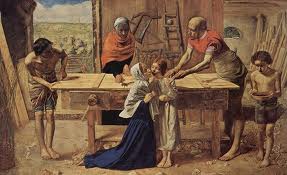
Saint Mark

St Mark and Christ.jpgShout for joy! with cries of gladness
Gather those who were dispersed.
Here the blind are given vision;
Here the comfortless find mirth.

In his faith, blind Bartimaeus
Shouted out his need to see—
Jesus, Light from Light, restored him,
Gave him sight, and set him free.

Each of us, in our baptism,
Has received the gift of sight
Through the Christ, our High Priest Jesus: Filled with joy, we seek God’s light!


Hymn text by J. M. Thompson

Possible Olivetan abbot general?

a budding OSB Oliv.jpgThis young man may be elected the abbot general and the Abbot of the Abbey of Monte Oliveto Maggiore of the Olivetan Benedictines at some point. The abbot general is also appointed by the pope as the territorial abbot of this monastery, hence the magenta skull cap.

The Benedictine monks of Mount Olivet in Tuscany function as a congregation more than in a “traditional” Benedictine manner in that there’s a major religious superior who can move monks from one monastery to another, among other things that make the Olivetans.

As you see, the symbol of the abbot general’s office fits the boy well enough. A budding Benedictine!

Saint Benedict and Saint Bernard Tolomei, pray for us.
Enhanced by Zemanta

Saint George


St George & Dragon detail VCarpaccio.jpg

The figure of Saint George is widely acknowledged across cultures. His cult, as it were, comes from Palestine; he is a heavenly patron among the Greeks and Latins. Since about AD 800 Saint George has been a patron of England and he is known elsewhere as one of the “14 Holy Helpers.”

Aside from legendary activity, George adhered to the Lord’s words and His person in that he’s known to have imitated the Passion as we see below in the opening collect for Holy Mass. No doubt his preaching, protecting and safeguarding the sacred Mysteries led people to Christ.

Let us pray that through Saint George’s intercession, and the power of the Lord’s Holy Name, the dragon of temptation and sin may be driven away by heavenly powers so as to be united in deeper communion with Christ.

And so we pray with the Church, 

Extolling your
might, O Lord, we humbly implore you, that, as Saint George imitated the
Passion of the Lord, so he may lend us ready help in our weakness.

Charles Colson, RIP at 80

Charles Colson.jpgThe famed Watergate figure who turned his soul over to Christ has died at the age of 80. He met the Lord at 3:12 pm earlier today.

The Boston paper has a story which you can contrast with the Evangel blog piece hosted by First Things on Colson; I am sure there will be many other comprehensive pieces on Mr Colson in the days ahead.
His own organization posted this tribute to Chuck. It will be remembered that “Chuck’s life is a testimony to God’s power to forgive, redeem, and transform.”
May Charles Colson rest in the peace of the Lord.

Saint Anselm

St Anselm Photo by Tony Bowden.jpg

Saint Anselm (1033-1109) is famous for saying many things, one that is easily recalled is “I do not seek to understand that I may believe, but I believe in order to understand.” We can easily say that the Lord has give us in the person of Saint Anselm one of the most eminent figures of the Middle Ages who harmonized faith and reason. To what might we attribute this harmonization? I and some others would say it was his radical mystical experience, finely attuned sense of communio with the Trinity that oriented his thought and his action. Anselm’s contemplation and action were in sync; there was no distraction in him. 


Saint Anselm knew and taught us, according to Pope Benedict,  that  “a true theologian’s work is divided into three stages: faith, God’s gratuitous gift to be welcomed with humility; experience, which consists in incarnating the Word of God into daily life; and true knowledge, which is never the fruit of sterile reasoning but of contemplative intuition.”


photo: Tony Bowden

New evangelizers in the United States

The April 21, 2012 issue of L’Osservatore Romano ran this editorial on the work of the evangelization in the United States. We are getting noticed for our zeal for the Gospel. Perhaps we colonialists do have something to contribute to the life of the Church universal.


“Join us in a journey to re-discover the faith or answer questions about reconnecting with the Catholic Church”. This is the call of  the document by the Bishops of the United States which intends renew with great strength the mission of spreading and proclaiming the Gospel. The episcopate’s initiative, written for the modern man and for the benefit of the whole community, is centred on references to the Pontifical Magisterium and to other interventions of the episcopate.

The 

Disciples Called to Witness: The New Evangelization is the title chosen for the document that “focuses on reaching out to Catholics, practicing or not, who have lost a sense of the faith in an effort to re-energize them”, as described in a note by the United States Conference of Catholic Bishops (USCCB). 

It was chairman of the USCCB Committee on Evangelization and Catechesis, Bishop David Laurin Ricken of Green Bay, Wisconsin, to point out this new duty, stating: “Every Catholic has a role in the Church, and every Catholic is called to spread the Gospel”. But he adds “in order to evangelize, a person must first be evangelized. This is really the heart of the New Evangelization”. The document especially highlights the call of Pope Benedict XVI to pursue the New Evangelization with renewed vigor and joy.

Continue reading New evangelizers in the United States