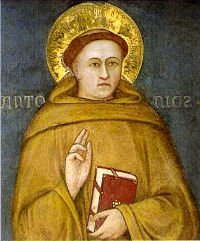
Saint Anthony of Padua


St Anthony of Padua with bk.jpgAlmighty ever-living God, who gave Saint Anthony of Padua to your people as an outstanding preacher and an intercessor in their need, grant that, with his assistance, as we follow the teachings of the Christian life, we may know your help in every trial.

One of the beautiful things that happened today was the reception of First Holy Communion of Giovannimaria Rainaldi, 6, who is living with neuroblastoma. From Rome, Italy, he’s been here seeking treatment at Memorial Sloan-Kettering. Giovannimaria has had a setback and needs our fraternal and prayerful support.

Be sure to read the select for Saint Anthony in the Office of Readings. As usual, it’s good for meditation.

Saint Anthony help us to find Christ, and stick with Him. Pray for us.

Modern Science, Ancient Faith: Portsmouth Institute set

pi-2011-logo.jpgThe Portsmouth Institute is set to begin its third year of work from June 22-24, 2012, with the theme of “Modern Science, Ancient Faith.” The Institute is located at Portsmouth Abbey and School (Portsmouth, RI).

The speakers include Rt. Rev. Dom James Wiseman (St. Anselm’s Abbey, Washington, DC), R. Dom Paschal Scotti (Portsmouth Abbey), William Dembski, John Haught, Kenneth Miller, B. Joseph Semmes, Michael Ruse, Fr. Nicanor Austriaco, OP.
Prayer, fraternity and time to think are hallmarks of the Portsmouth Institute. Situated at the beautiful Portsmouth Abbey on the Narrangansett Bay, who could not love expanding one’s thinking on faith and science.
Visit the website noted above for more information of the conference, the Abbey and School.
Previous Institutes:
2009 The Catholic William F. Buckley, Jr.
2010 Newman & the Intellectual Tradition
2011 The Catholic Shakespeare?
Join the work being done…
Enhanced by Zemanta

Profession of vows, celebration of 50 years of monastic vows

Trust in the Lord and do good, and you will dwell in the land and be secure.
Find your delight in the Lord, and he will grant your heart’s desire.
(Ps 37; Introit for Mass for Religious)

These days there are celebrations of profession of vows and recognition of 50 years of monastic profession. The vocation to the monastic life is the search for God (cf. Rule of St Benedict) by the serious living of the gospel and one’s baptism. It is a glorious vocation, one that entering the narrow gate is not easy but eloquent for its witness.

Three friends are living their vocation with fresh eyes. Each called by the Lord to follow and to be see-ers of the Kingdom (cf. Ratzinger) in this manner is sacrificial oriented to life eternal (cf. Spe Salvi, 12).
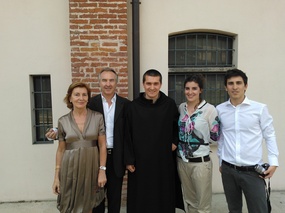
Br Pietro Berretta OSB.jpg

Benedictine Brother Pietro, a monk of the Monastery of Saint Peter and Paul (outside Milan, Italy) professed his first vows (temporary profession), Father Hilary of the Abbey of Saint Mary (Morristown, NJ) celebrated his 50th annviersary, and Benedictine Sister Marie Rita celebrated her 50th anniversary of profession of monastic vows. There are several others I could mention but let me satisfy this desire to recognize the sign of profession for service of the Kingdom and one’s salvation.

Brother Pietro studied medicine and follows the lay ecclesial movement of Communion and Liberation. His monastery is a  diocesan rite monastery following the Rule of SaInt Benedict and the teachings of the Servant of God Father Luigi Giussani. Pietro gave up a promising career in medicine to follow and seek the face of Christ more intimately in an Italian monastery. I can’t help but think of Pietro’s vocation as a witness poignant today in postmodern Italy where monasteries are virtually empty. His monastery receives postulants regularly and I am grateful for his YES.

Father Hilary is a monk and a priest of Morristown, NJ’s Abbey of Saint Mary where he teaches in the Delbarton School and he works in the community as novice and formation director. In the American Cassinese Congregation of monks the 50 year julibilarian receives from the abbot the baculus (a craved stick; this one is made in Ireland) with the liturgical phrase exhorting the monk, “Use the baculus not so much as a support for bodily strength, but rather to obtain spiritual fortitude from our Savior, Jesus Christ, who has called us all to himself in the gospel, saying, Come to me all you who labor and are burdened, and I will refresh you, for my yoke is easy, my burden light.” Hilary’s quiet demeanor is a stable form of living the manner set out by the Lord and Benedict.

Sr Rita and Fr Peter JohnSister Rita is the Prioress of the Monastery of the Glorious Cross, Branford, CT. Her’s is a vocation to lead a group of women who daily surrender to the Lord their health and mobility uniting themselves more and more eucharistically.

At Sister’s Jubilee Mass more than 75 friends attended with spiritual assistance of Father Peter John Cameron, OP celebrating the Mass and preaching, with Abbot Caedmon Holmes, OSB (of Portsmouth Abbey), Father Prior Vincent DeLucia, OP (St Mary’s Priory, New Haven), Father Jacob Restrick, OP (Hawthorne, NY) Father David Borino (Archdiocese of Hartford), Father Robert Usenza (Diocese of Bridgeport and Father Paul Halovich and Deacon Fusco (also of Hartford).
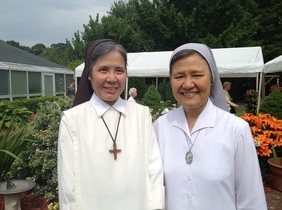
Sister Rita’s sister Canossian Daughter of Charity Sister Margaret flew in from China where she is a missionary to be present. The Canossian sisters have the great Saint Josephine Bakhita as one of them.

As you may know, monks and nuns profess the monastic vows of conversion of manners, stability and obedience according to the Rule of Saint Benedict. Benedictines live a life with a quality being subtle.

With the Church we pray,

O God, who inspire and bring to fulfillment every good intention, direct your servants into the way of eternal salvation, and as they have left all things to devote themselves entirely to you, grant that, following Christ and renouncing the things of this world, they may faithfully serve you in their neighbor in a spirit of poverty and humility of heart.

I’ve blogged about Monastery of Saint Peter and Paul (Monastero Ss. Pietro e Paolo), Cascinazza (Milan), before here.
Washed in Christ’s blood St Catherine’s parishioners take to NYC streets for Corpus Christi


Corpus Christi wc.jpgYesterday was the great feast of The Solemnity of the
Body and Blood of Christ. At Saint Catherine of Siena Church in New York City
the parish community with the Dominican Friars led by Father Jordan Kelly
celebrated a Solemn Mass for the feast and then took to the streets with the Monstrance containing Our Lord and Savior. For the
first time in years Our Lord in His Eucharistic Presence was carried in
procession in the neighborhood of the church. Imagine the faces of Catholics, Christians, Jews, Muslims and those who do not share our Eucharistic faith seeing such display of faith and devotion! 


Graces beyond imagining:
beautiful weather, lots of people, terrific sacred music given to our worship
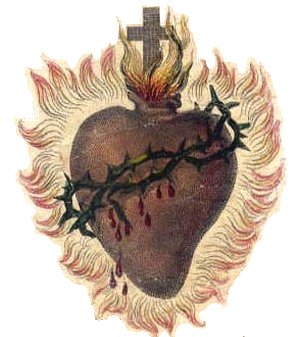
by Daniel B. Sañez and his superb choir, an insightful homily and a rededication to the Sacred Heart with Benediction after an extended period of adoration. 


I
came across this reflection from Saint John Chrysostom: 

If we wish to
understand the power of Christ’s blood, we should go back to the ancient
account of its prefiguration in Egypt. ‘Sacrifice a lamb without blemish’,
commanded Moses, ‘and sprinkle its blood on your doors’. If we were to ask him
what he meant, and how the blood of an irrational beast could possibly save
people endowed with reason, his answer would be that the saving power lies not
in the blood itself, but in the fact that it is a sign of the Lord’s blood. In
those days, when the destroying angel saw the blood on the doors he did not
dare to enter, so how much less will the devil approach now when he sees, not
that figurative blood on the doors, but the true blood on the lips of
believers, the doors of the temple of Christ.

Indeed, washed in Chris’s blood,
and not that of a animal is what saves, and we ought to scream this from the
roof tops. Well, we actually didn’t yell anything but we walked together in
professing our faith.

The Church of Saint Catherine of Siena NYC will never be the same! Thanks be to God.

Lauda Sion Salvatorem: Corpus Christi a Mysterical renunion

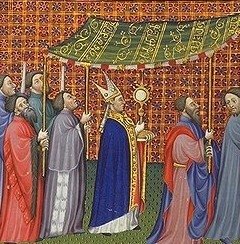
Corpus Christi procession.jpg

The feast of Corpus Christi has a rich fare to savor: prayers, Bible readings, music, and poetic texts. The point of the Church offering us this opportunity to honor the Eucharistic Presence is to extend in our lives a deeper grace given in Communion theology, to have a closer with the Lord in His promised hundredfold. It is, of course, a deepening in our lives what the Lord Himself did and gave to us on Holy Thursday with Eucharist and the priesthood.

The Sequence (the poetry which follows the second lesson at Mass and directly precedes the Alleluia verse), Lauda Sion Salvatorem, is ideally fitting for the sacred Liturgy. Google this masterpiece of poetry expressing theology in a way that stimulates prayer and deepens one’s faith.

The English priest Father Ronald Knox offers a perspective on what we’re doing in observing the great feast of the Lord’s Body and Blood. The following is taken from his meditation on Corpus Christi:

Like the Jewish Temple, the Christian altar is the rallying point of God’s people. The whole notion of Christian solidarity grows out of, and is centered in, the common participation of a common Table. The primitive Church in Jerusalem broke bread day be day from house to house; its stronghold of peace was not any local centre, but a common meal. Christian people, however separated by long distances of land or sea, still meet together in full force, by a mystical reunion, whenever and wherever the Bread is broken and the Cup blessed.

Corpus Christi 2012

Benedict before monstance June 7 2012.jpg

The observance of Corpus Christi, sometimes called Corpus Domini (The Body of the Lord). In places like Rome, the traditional day to observe this feast is Thursday, connecting with Holy Thursday. A portion of the Pope’s homily is noted below (the full text is here).


… the sacredness of the Eucharist. Also here we heard in the recent past of a certain misunderstanding of the authentic message of Sacred Scripture. The Christian novelty in regard to worship was influenced by a certain secularist mentality of the 60s and 70s of the past century. It is true, and it remains always valid, that the center of worship is now no longer in the rites and ancient sacrifices, but in Christ himself, in his person, in his life, in his paschal mystery. And yet, from this fundamental novelty it must not be concluded that the sacred no longer exists, but that it has found its fulfillment in Jesus Christ, incarnate divine Love. The Letter to the Hebrews, which we heard this evening in the Second Reading, speaks to us precisely of the novelty of the priesthood of Christ, “high priest of the good things that have come” (Hebrews 9:11), but it does not say that the priesthood is finished. Christ “is the mediator of a new covenant” (Hebrews 9:15), established in his blood, which purifies our “conscience from dead works” (Hebrews 9:14). He did not abolish the sacred, but brought it to fulfillment, inaugurating a new worship, which is, yes, fully spiritual but which however, so long as we are journeying in time, makes use again of signs and rites, of which there will be no need only at the end, in the heavenly Jerusalem, where there will no longer be a temple (cf. Revelation 21:22). Thanks to Christ, the sacred is more true, more intense and, as happens with the Commandments, also more exacting! Ritual observance is not enough, but what is required is the purification of the heart and the involvement of life.

Pope Benedict XVI

Corpus Christi at the Basilica of St. John Lateran

7 June 2012

Remembering Cyril

Cyril Crawford OSB.jpgMy friend Father Cyril Crawford died unexpectedly a short time ago, on 15 May 2012. He died in his sleep in Leuven (Louvain), Belgium, at the Katholieke Universiteit Leuven, where he was working on a doctorate in Philosophy so that he could teach at his monastery’s college.

Dom Cyril, 46, was a monk and a priest of the Abbey of Saint Joseph of Covington, LA. 
A photo tribute to Cyril can be seen here.
Over at The Substance of Things Hoped For, Benedictine Father Denis Robinson (Rector of Saint Meinrad Seminary) wrote a remembrance of Dom Cyril. Father Denis’ words are very true and capture Cyril well. I met Cyril at Saint Meinrad’s, in the library, and found him to be a friend.
My heart is saddened, deeply so. Cyril as a good monk, priest with an honest search for God and keen sense of humor and intellect.
More info including Abbot Justin Brown’s homily at the Mass of Christian Burial of Cyril can be found here.
Saint Benedict and Saint Cyril of Alexandria, pray for Father Cyril, and for us.

The Meeting (Rimini) 2012: By Nature, man is relation to the Infinite

RM logo.pngThe Meeting, as it is known in shorthand, is quickly approaching (19-25 August). This is its 33rd year. This cultural event now draws nearly 800,000 people from across the globe.

The theme of the 2012 meeting is “By Nature, man is relation to the Infinite.”

The brief video on The Meeting was produced by Rome Reports.
One of the last items is a note that our own NY CL member Dr Elvira Paravincini will be making a presentation on her work as a neonatologist and the hospice she founded. Blessings on Elvira and her work.
Dr Paravincini with several other healthcare professionals, many of them belonging to CL, the MedConference is a key event in the US for talking about faith and the practice of medicine. This year the MedConference is running 19-21 October in Florham Park, NJ.

St Norbert

St Norbert with the Eucharist.jpg

Saint Norbert is often overlooked in this country, perhaps because he lived so long ago that he hardly matters today, or because meeting his spiritual sons and daughters is a rarity unless you live in Paoli, PA, DePere, WI or Silverado, CA, New Mexico (or a handful of other places places) where you might encounter the Canon Regular, aka Norbertines. BUT I would submit that Saint Norbert cannot be dismissed because he lived in the 11th nor because you have neither met the Canons nor the Canoness.

Saint Norbert is a saint of the Eucharist. AND that ought to be enough of an enticement to know Norbert.

Christians: Let us be neither dogs that do not bark

Today’s first reading from the First Letter of Peter offers an exhortation to his hearers who are facing difficult times: be eager to stand firm. As the people who heard Peter so we too, today, need to remember that the Lord has an infinite amount of patience; in fact He never tires, but His adopted children need to recall that only He’s the matrix of the covenant’s fulfillment. God is present, stand firm.

boniface.jpg

Saint Boniface, the Englishman monk who became the Apostle to Germany, whose memory we commemorate today, also exhorted those of his time to stand firm because God is present. In the Office of Readings this morning I reacquainted myself with a rather curious set of images that Boniface delivered to the bishops of his time and place make connects very nicely with the Scriptures. Saint Boniface said, “Let us be neither dogs that do not bark nor silent onlookers nor paid servants who run away before the wolf. Instead let us be careful shepherds watching over Christ’s flock. Let us preach the whole of God’s plan to the powerful and to the humble, to rich and to poor, to men of every rank and age, as far as God gives us the strength, in season and out of season, as Saint Gregory writes in his book of Pastoral Instruction.”

Indeed, let the bark be heard.