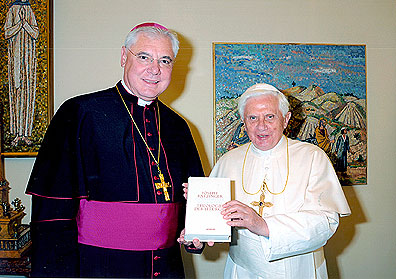
Gerhard Müller talks to the press about SSPX, etc

muller and pope.JPGThe new and quickly noted CDF Prefect, German Archbishop Gerhard Ludwig Müller, 64, is talking to the press about various things, particularly of the recent talks the Holy See’s been having with the SSPX. With all the interviews and loose translations of the same, it’s going to be an interesting time with the new Prefect. 

Archbishop Müller no doubt has good credentials and gives the impression that he supports the Holy Father’s work in theology, but one wonders if he can withstand the criticism, severe at times, for his intellectual interests in other fields of theology that appear to be at odds with the magisterium. Having said this, I think it is way too early to render a judgment on the man. The complexities he faces in the Church are many. When in doubt, give the plus-sign.

Here are some of the things people are saying….

Catholic News Agency posted this article on Muller’s thoughts…

Today’s interview written up by Cindy Wooden of CNS is posted here.
Archbishop Müller’s biography is posted here.

Saint James

St james AdiVanni.jpg

As he walked by the Sea of Galilee, Jesus saw James the son of Zebedee and John his brother mending their nets and he called them. (entr. ant.)

Almighty ever-living God, who consecrated the first fruits of your Apostles by the blood of Saint James, grant, we pray, that your Church may be strengthened by his confession of faith and constantly sustained by his protection.

Today, we pray for the Church in Spain as they venerate this great Apostle James (this site has a lot on the saint) who is buried in Compostella.

We pray for those who need deeper conversion in Christ, as James did.

Difficulty with beauty

I met a man this afternoon doing some business with us on marketing and the question of beauty came to the fore. He remarked on how we are among the few clients he has who have concern for beauty, simple sophistication, not foppishness. I recalled for him that beauty is a theological datum; it is such a principled piece of Catholicism that it is shameful of what passes for beauty.

Several years ago I came across a couple of lines of Cardinal Ratzinger’s that speaks of beauty as really, really important. He said, “A theologian who does not love art, poetry, music and nature can be dangerous. Blindness and deafness toward the beautiful are not incidental; they necessarily are reflected in his theology.” In other words, don’t trust a theologian who has no regard for beauty.

Then on FB I noted this quote and image on beauty.


new beauty.jpg

It is one of the notable sadnesses of our time that so many are incapable of fascination with the deeper levels of human beauty, especially those rooted in the spirit, levels that far transcend physical attractiveness.  Before lofty human traits some people are more or less apathetic, listless, unmoved, even hardened. And many seem to die as they live. 


Thomas Dubay. S.M., The Evidential Power of Beauty, p.64-65.

Are you living in Christ now?


Saint Benedict has a special place in his Rule for eternity.
The eternal life is usually a subject that many people run away from because in
order to fully enjoy eternity one needs to confront death. Well, that’s what
many think. The Lord’s promise of eternal life and many of benefits can be
enjoyed before one dies. In fact, that’s what the sacraments give us: a
foretaste of eternity. Baptism opens the door, washes away sin, imparts grace,
and makes one an adopted child of God; the Eucharist nourishes our spiritual
life, and builds communion with the Trinity; Confirmation imparts the Gifts of
the Holy Spirit and Beatitude, etc. Sacraments give the faithful a share in
Beatitude if lived in a state of grace and according to the Eight Beatitudes. 

The
question really is what the Apostle Paul said, and what is adhered to by true Christians, particularly saints, “To
me to live is Christ,” (Mihi Vivere Christus)” (Phil: 1, 21). Living means being closely united, in communion, with Christ. Catholics live in Christ by living the sacraments and according to Scripture but the teaching of the saints also illumine our path.

A verse in
the Prologue to Saint Benedict’s Rule refocuses us:

“If we wish to reach eternal
life, even as we avoid the torments of hell, then – while there is still time,
while we are in this body and have time to accomplish all these things by the
light of life – we must run and do now what will profit us for all eternity.” (Prologue
42 – 44,RB).

The teaching, some have said, can be interpreted to mean that Saint
Benedict is urging his disciples to put into daily practice right now what we will
be doing for all eternity: that is, giving glory and praise to God. How we give
God glory and praise is done through our daily lives of personal and communal prayer,
in faithfulness and obedience to the Divine Majesty. This was the source of someone
who knows God: a lifelong fidelity, joyfulness, and an openness to Wonder. The
position of wonder speaks to our youthful spirit and joy was keeping our eyes,
our mind and our heart fixed on Jesus Christ and the promise of the Hundredfold.

Do you wish to reach your ultimate destiny, eternal life? What will you do to run along the path?

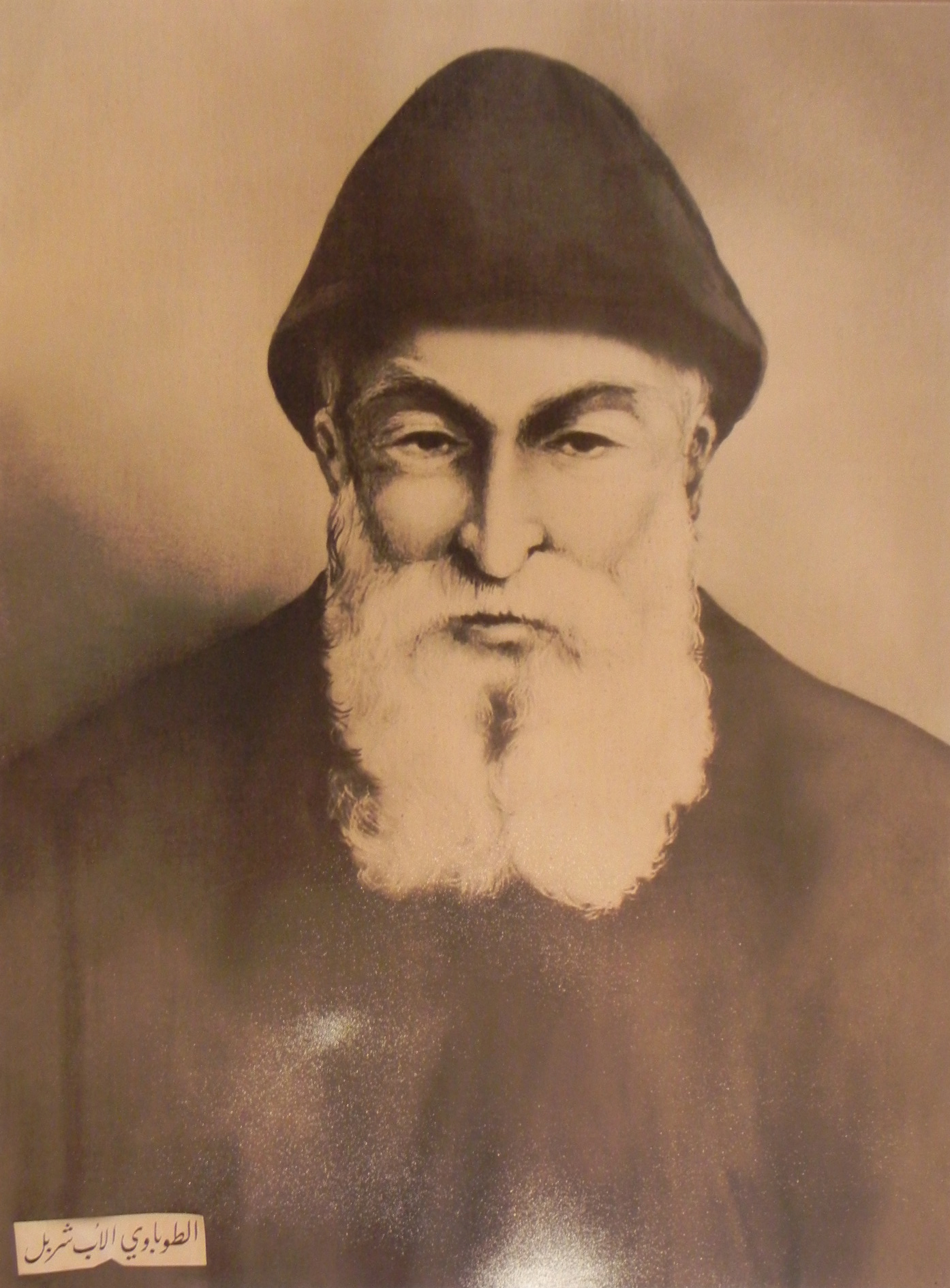
Saint Sharbel Makhūf

Saint Charbel.jpgO God, who called the Priest Saint Sharbel Makhūf to the solitary combat of the desert and imbued him with all manner of devotion, grant us, we pray, that, being made imitators of the Lord’s Passion, we may merit to be co-heirs of his Kingdom.

The saint proposed by the Church is a relatively unknown hermit. Saint Sharbel (1828-1898) was a man who fought with the devil in the desert and lived according to tradition given by the Maronite Church. He’s known as the wonder-worker of the Middle East. When Church officials opened the grave of Sharbel they found an intact body with sweet aroma.
A hermit may not be a recognized value for the laity but if you look at the Mass prayer above it notes what we all are after: to be imitators of the Lord’s Passion. The Christian always orients his or her life to the Paschal Mystery (the Life, Death, Resurrection & Ascension of the Lord).

“The Sea Within”, a Kindly Light production

Catholic TV will premiere “The Sea Within” Friday, July 27 at 9:30pm and Saturday, July 28 at 1pm. “The Sea Within” explores the spirituality of surfing as shared by Dr. Peter Kreeft, professor of philosophy at Boston College. 

The project is based on his three books on the subject: I Surf Therefore I Am, If Einstein Had Been a Surfer, and The Sea Within.  It was produced by Kindly Light, the media division of the Dominican Fathers Province of Saint Joseph. Donations to Kindly Light are tax-deductible and your gift is one way to actively participate in our media projects for the new evangelization. 

Send a DVD to someone you know by ordering it here. 

“The main task for us all is that of a new evangelization aimed at helping younger generations to rediscover the true face of God, who is Love.” -Pope Benedict XVI.

Saint Camillus de Lellis: patron saint of nurses, the sick and hospitals

In the US, the Church liturgically remembers the patron saint of nurses, the sick and hospitals, Saint Camillus de Lellis. We the Church we pray for all those who dedicate their lives to the care of sick.


O God, who adorned the Priest Saint Camillus with a singular grace of charity towards the sick, pour out upon us, by his merits, a spirit of love for you, so that, serving you in our neighbor, we may, at the hour of death, pass safely over to you.


The Church proposes today Saint Camillus de Lellis (1550-1614), a man with a weighty past who gave his life to Christ and served the sick and the dying. He was influenced by the great Saint Philip Neri. The witness of Saint Camillus is one that we ought to pay attention to: Christ is present to us in those are sick.


More of Saint Camillus’ life can be read here.


From Butler’s Lives of the Saints 1894:


St. Camillus de Lellis details.jpg

THE early years of Camillus gave no sign of sanctity. At the age of nineteen he took service with his father, an Italian noble, against the Turks, and after four years’ hard campaigning found himself, through his violent temper, reckless habits, and inveterate passion for gambling, a discharged soldier, and in such straitened circumstances that he was obliged to work as a laborer on a Capuchin convent which was then building. A few words from a Capuchin friar brought about his conversion, and he resolved to become a religious. Thrice he entered the Capuchin novitiate, but each time an obstinate wound in his leg forced him to leave. He repaired to Rome for medical treatment, and there took St. Philip as his confessor, and entered the hospital of St. Giacomo, of which he became in time the superintendent. The carelessness of the paid chaplains and nurses towards the suffering patients now inspired him with the thought of founding a congregation to minister to their wants. With this end he was ordained priest, and in 1586 his community of the Servants of the Sick was confirmed by the Pope. Its usefulness was soon felt, not only in hospitals, but in private houses. Summoned at every hour of the day and night, the devotion of Camillus never grew cold. With a woman’s tenderness he attended to the needs of his patients. He wept with them, consoled them, and prayed with them. He knew miraculously the state of their souls; and St. Philip saw angels whispering to two Servants of the Sick who were consoling a dying person. One day a sick man said to the Saint, “Father, may I beg you to make up my bed? it is very hard.” Camillus replied, “God forgive you, brother! You beg me! Don’t you know yet that you are to command me, for I am your servant and slave.” “Would to God,” he would cry, “that in the hour of my death one sigh or one blessing of these poor creatures might fall upon me!” His prayer was heard. He was granted the same consolations in his last hour which he had so often procured for others. 


In the year 1614 he died with the full use of his faculties, after two weeks’ saintly preparation, as the priest was reciting the words of the ritual, “May Jesus Christ appear to thee with a mild and joyful countenance!”

Church thinking about social communication

How theologians might reflect on communication and information technologies and the new culture that they create formed the basis of a symposium sponsored by the Pontifical Council on Social Communication, held at the Jesuit-sponsored Santa Clara University in California (USA) in late June. The PCCS, along with the United States Conference of Catholic Bishops’ Committee on Communications and the University’s Communication Department, convened a gathering of 25 theologians to begin a process of sustained theological reflection. The group focused on three general areas: ecclesiology, approaches from historical theology, and a theological understanding of digital culture, in each area considering the challenges that contemporary communication poses to the church’s theological understanding.

Communication, whether the mass media or the Internet, has changed the environment in which people live, raising questions about church structure, personal identity, parish life, religious self-understanding, and religious formation and participation. For example, people take their identity from popular culture more than from the Church’s catechetics or even from the Gospel. The same mass media also promote a vertical model of the Church in which the local community, the parish, and the diocese disappear, so that only “the Catholic Church” headed by the Pope matters. Each of these poses a serious ecclesiological challenge, as each redefines the nature of the Church.


To read the whole article, see the text here.

Gerald Ryan, no ordinary parish priest in the Bronx

The NY Times published a story, “In Graying Priesthood, New York’s Grayest Keeps Faith in Bronx,” on Monsignor Gerald Ryan, 92, pastor of Saint Luke’s Church (in the Mott Haven section of the Bronx, NYC). Monsignor’s the oldest serving Catholic priest serving the Church in New York. A terrific story on man who’s given his all for Christ and the Church.

Read the story and be sure to view the pictures.
Saint John Vianney, pray for us.