We honor a great Church father, Saint Pachomius, with the liturgical memorial today.
Author: Paul Zalonski
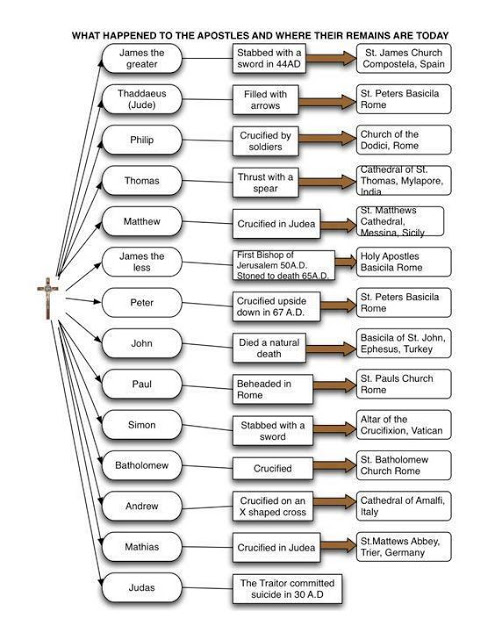
Where are the 12 Apostles buried?
Have you ever wondered about the details of the Apostles’ death and burial? It is a curious question for biblical studies and archeology, liturgical studies and piety in general. I caught this clever illustration the other day and it answers my question. I hope it is accurate. When in Rome I’ve been to some of the tombs; I guess I’ll have to wait to get to India, Spain and Germany.
A working cardinal: O’Malley really does work
Boston’s Cardinal does outdoor work.
Saint Matthias: listened to the community, and followed Jesus
Getting closer and closer to Pentecost Sunday that Church’s selections from the Acts of the Apostles gives a clearer sense of how grace works in the life of the Christian community. Today’s feast of Saint Matthias, one of the elected apostles (Acts 1:15-26) replacing Judas shows how discernment of spirit works to provide apostolic continuity in pastoral authority and power. Discernment is never one-sided; it is always a two-way street on the part of the man and on the part of the Church to choose who serves as an ordained minister of the Gospel. Matthias’ vocation to replace Judas as one of the bishops was given to him; neither he nor single one person had the power to make the selection; it was done with in the midst of the community because the community is a place to encounter the living, resurrected Christ. Moreover, one can’t say that Saint Matthias gained much: he preached the Truth of the Gospel, confirmed the faith and he lost his life: nothing greater than the love he had for Christ Jesus propelled him to serve with all his heart.
Note what the Collect of the Mass prays: God assigned Saint Matthias a place of service and pastoral responsibility and it is our hope to numbered among the elect, that is, among the saved. Key here is God’s action in each of our lives; it is not our own desires alone that makes salvation possible. We are meant to share the lot of the saints, but our freedom and God’s grace need to be operative for this gift to be realized.
Matthias met his Savior by crucifixion in Judea and his mortal remains are located at Saint Matthew’s Abbey, Trier, Germany.
As the Church prays,
O God, who assigned Saint Matthias a place in the college of Apostles, grant us, through his intercession, that, rejoicing at how your love has been allotted to us, we may merit to be numbered among the elect.
The following selection from a sermon of Saint John Chrysostom on Saint Matthias may be instructive on the early practice of ecclesiological need.
Continue reading Saint Matthias: listened to the community, and followed Jesus
Our Lady of Fatima
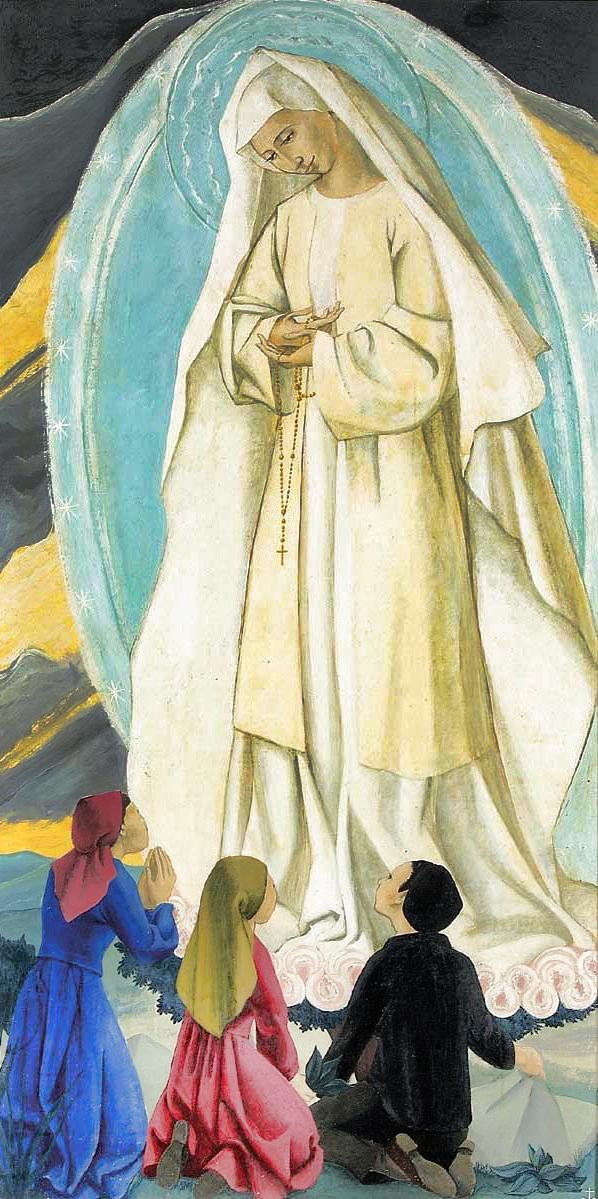
Today is the feast of Our Lady of Fatima. Cardinal Polycarpo and the bishops of Portugal join together at the famous shrine to the Blessed Mother to dedicate the papacy of Pope Francis to her. This gesture of devotion has been done for the last several popes entrusting all things of the papal office to the Maternal guidance and protection of the Mother of God. Today is also the anniversary of the attempt on the life of Pope John Paul II in 1981. Let’s add the intention of peace and charity to those of the Pope, the bishop, the pastor of our parish and family. Here is an Act of Consecration to the Immaculate Heart of Mary (do it today).
O Mary, Virgin most powerful and Mother of mercy, Queen of Heaven and Refuge of sinners, we consecrate ourselves to thine Immaculate Heart.
We consecrate to thee our very being and our whole life; all that we have, all that we love, all that we are.
To thee we give our bodies, our hearts and our souls; to thee we give our homes, our families, our country.
We desire that all that is in us and around us may belong to thee, and may share in the benefits of thy motherly benediction.
And that this act of consecration may be truly efficacious and lasting, we renew this day at thy feet the promises of our Baptism and our first Holy Communion.
We pledge ourselves to profess courageously and at all times the truths of our holy Faith, and to live as befits Catholics who are duly submissive to all the directions of the Pope and the Bishops in communion with him.
We pledge ourselves to keep the commandments of God and His Church, in particular to keep holy the Lord’s Day.
We likewise pledge ourselves to make the consoling practices of the Christian religion, and above all, Holy Communion, an integral part of our lives, in so far as we shall be able so to do.
Finally, we promise thee, O glorious Mother of God and loving Mother of men, to devote ourselves whole-heartedly to the service of thy blessed cult, in order to hasten and assure, through the sovereignty of thine Immaculate Heart, the coming of the kingdom of the Sacred Heart of thine adorable Son, in our own hearts and in those of all men, in our country and in all the world, as in heaven, so on earth. Amen.
Father Taft: we need a new ecclesiology –a startling revolution– Catholics are the no longer the only kids on the block
It is said that “The Eastern Churches have a special vocation in the contemporary world, which is both distinct from, and complementary to, that of the Western Church. Pope John Paul saw it thus, but he was not the only one. The language of the ‘two lungs’ of the Church suggests that the Church’s activity in the world is much diminished when one of the lungs is operating at a reduced capacity – which it certainly is if it is not fully being what it is meant to be.”
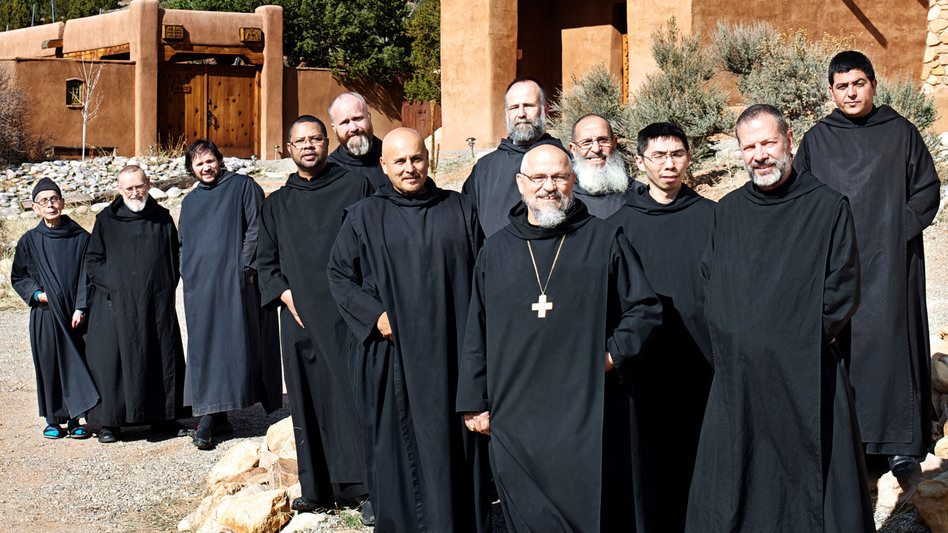
A vocation to serve the Churches, East and West, has been radically lived by a New England Province Jesuit priest, Robert F. Taft, for nearly a half-century. Christopher B. Warner published a terrific interview in the Catholic World Report, “Building Bridges Between Orthodox and Catholic Christians” is required reading to get a sense of the Church’s teaching and life.
Father Taft was a professor of mine, and he remains an inspiration and mentor.
A pope and the cardinals
802 new saints reflect the the glory of Love
Today the Church has 802 new saints, 800 of them are the martyrs of Otranto. This group of canonized were martyrs while you may say that Laura Montoya (aka, Lupita) and Maria Guadalupe García Zavala were “ordinary saints.” These are the first canonizations done by Pope Francis.
What catches our eyes that in one swoop 800 are recognized as martyr saints. Their history tells us that Ottoman soldiers invaded a Christian village town in 1480; the villagers were killed for refusing to convert to Islam, in fact, beheaded because they refused to renounce their Catholic faith.
The wall of skulls of the martyrs of Oltranto (note the picture) displayed prominently in Otranto Cathedral (Apulia region of Italy). These are the human remains, the relics of holy men and women; our new intercessors before the throne of Grace.
The year was 1480 and the fateful day when a fleet of 70 to 200 Ottoman Turks ships reached the city of Otranto, then part of the Kingdom of Naples. The Turkish forces were led by Gedik Ahmed Pasha.
July 28 marks the beginning of the Ottoman wars (1453-1683) in Europe; Mohammed II had invader and conquered Constantinople just 28 years earlier. On August 12, 800 people of Otranto, Antonio Primaldo and his companions were taken to the hill of Minerva, now called the Hill of the Martyrs, and slaughtered for being faithful to Jesus Christ and His Church.
The Church’s precess of investigating the circumstances and holiness of these people began in 1539 and end on 14 December 1771 with the beatification of the people of Oranto by Pope Clement XIV. Benedict XVI issued a decree on 6 July 2007, stating that out of hatred for the faith these Catholics were killed. Therefore, certifying that martyrdom happened and therefore saints.
The Pope homily is here:
In this seventh Sunday of Easter we are gathered to celebrate with joy a feast of holiness. Thanks be to God who has made His glory – the glory of Love – to shine on the Martyrs of Otranto, on Mother Laura Montoya and María Guadalupe García Zavala. I greet all of you who have come to this celebration – from Italy, Colombia, Mexico, from other countries – and I thank you! Let us look on the new saints in the light of the Word of God proclaimed: a Word that invited us to be faithful to Christ, even unto martyrdom; a word that recalled to us the urgency and the beauty of bringing Christ and his Gospel to everyone; a word that spoke to us about the witness of charity, without which even martyrdom and mission lose their Christian savor.
Continue reading 802 new saints reflect the the glory of Love
Saints Odo, Maiolus, Odilo, Hugh, and Blessed Peter the Venerable, Abbots of Cluny
Lord our God, you are the shield and glorious reward of those who walk blamelessly before you. Keep us steadfast in your holy service so that, by the example and intercession of the blessed abbots of Cluny, we may with open hearts run the path of perfect charity.
The Benedictine liturgical calendar honors the holy abbots of Cluny, Saints Odo, Majolo, Odilo, Hugh, and Blessed Peter the Venerable.
Saint Odo, the second abbot of Cluny, born circa 878, and he died on 18 November, 942. He reformed several monasteries in Aquitaine, northern France, and Italy, and was entrusted with some important political missions;
Saint Majolus or Maieul born in 906, and died in 994. Otto II desired to make him pope in 974 but he refused;
Saint Odilo, fifth abbot of Cluny, born around 962 and died on 31 December 1048. The number of monasteries in the Cluniac congregation (mainly by reforming existing monasteries) increased from 37 to 65 under his abbacy; we worked to achieve a truce, that is, ‘the peace of God’ that restricted warfare; he acted charitably which saved thousands during a time of famine and he is most remembered for introducing the Feast of All Saints into the Roman liturgical calendar;
Saint Hugh the Great was born at Semur (Brionnais in the Diocese of Autun, 1024 and died at Cluny, 28 April, 1109. A friend of Pope Saint Gregory VII Hugh played a key role in the reform of the clergy, and was widely recognized for his sanctity even during his lifetime.
Popes of Rome and Alexandria meet: Francis and Tawadros
A rare meeting between two Popes, that is, between the Patriarch of the West and the Patriarch of Alexandria happened earlier today in Rome when Pope Francis received Pope Tawadros of Alexandria, who heads the largest Christian Church in the Middle East. The first meeting between the two churches happened 40 years ago to the day with the Servant of God Pope Paul VI and Pope Shenouda III; at that meeting a Christological agreement was signed and a hope expressed to find a path to unity. Tawadros is on his first pilgrimage outside of Egypt since becoming the head of the Coptic Church in November. He is in Italy for 5 days.
Pope Tawadros proposed that 10 May each year should be marked as a day of celebration between the two churches. He also invited Francis to visit his Church, founded by Saint Mark the Evangelist around the middle of the First century.
Here is Pope Francis’ address:
For me it is a great joy and a truly graced moment to be able to receive all of you here, at the tomb of Saint Peter, as we recall that historic meeting forty years ago between our predecessors, Pope Paul VI and the late Pope Shenouda III, in an embrace of peace and fraternity, after centuries of mutual distrust. So it is with deep affection that I welcome Your Holiness and the distinguished members of your delegation, and I thank you for your words. Through you, I extend my cordial greetings in the Lord to the bishops, the clergy, the monks and the whole Coptic Orthodox Church.
Today’s visit strengthens the bonds of friendship and brotherhood that already exist between the See of Peter and the See of Mark, heir to an inestimable heritage of martyrs, theologians, holy monks and faithful disciples of Christ, who have borne witness to the Gospel from generation to generation, often in situations of great adversity.
Continue reading Popes of Rome and Alexandria meet: Francis and Tawadros