
God bless this young person. He wants to lead God’s pilgrim people at a tender age!

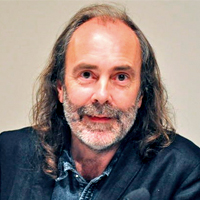
John Waters, an Irish journalist who follows Communion and Liberation, gave this personal witness to the gathering of ecclesial movements with Pope Francis, “The Modern Cross that Brings Us to our Knees” (May 18, 2013).
John is known to many of us in the USA because of his presence at the annual New York Encounter and because of his reflections in Traces magazine, or just because his writing finds a place on the online journal, Il Susidiario. John knows the reality of sin, evil , despair, and isolation. He knows what it means to be at bottom as a result of alcohol abuse. John is a very good man who knows what it means to be a fragile human being sustained by the grace of God and by friendship. Whatever way you come to know John Waters, you ought to know that he lives his life one-day-at-a time in God’s grace. Some days the cross is heavy, and yet there are people good people who help to carry the burden of the cross.
We live, my friends, in deceptive times. In the past, man strove for perfection, knowing it was unattainable in this reality. Guided by certain faith in a loving Creator, on whom he remained dependent, man reached for the stars, not expecting to touch them, but understanding that the act of reaching allowed him to become fully himself.
Today, mankind strives for omnipotence, believing this obtainable. Consequently, man feels overwhelmingly alone – that everything depends on his own efforts.
The delusion thus fostered afflicts us all. It invades our minds and changes how we think and feel. And sometimes we feel -in spite of ourselves – that we ought not to need God. Not, I stress, that we don’t need Him, but that we OUGHT NOT to need Him.
Continue reading The Modern Cross that Brings Us to our Knees
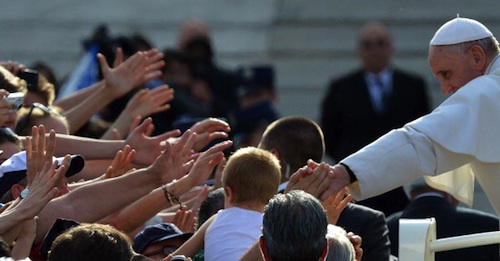
A Saturday May 19th Q&A session with the various members of ecclesial movements and Pope Francis was inspiring to me. More than 120 thousand attended the events. The pope said much; much of it not available in print but what is available is here due the translations of the Vatican Information Service. It is hard to nail the pope down on all the things he said because a fair of amount of talks are off-the-cuff. This 3 minute video presentation by Rome Reports gives a good sense as to what we are supposed to be about. Nevertheless, there is enough to reflect on and to see where we find ourselves viz-a-viz Francis’ response.
Q: “How were you able to achieve certainty of faith in your life, and what path can you indicate to us so that each one of us can overcome our fragility of faith?”
A: “I have had the good fortune to grow up in a family where the faith was lived in a simple and concrete manner … The first proclamation is in the home, within the family, right? And this makes me think of the love of so many mothers and so many grandmothers in the transmission of the faith. … We do not find our faith in the abstract, no! It is always a person who preaches it to us, who tells us who Jesus is, who gives us the faith, who gives us the first announcement. … But there is a very important day for me: September 21, 1953. I was almost 17. It was the ‘Students’ Day’…. Before going to the festival, I went to my parish and met a priest I did not know, but I felt the need to confess. … After confession I felt that something had changed. I was not the same. I felt a voice call me: I was convinced that I had to become a priest. This experience of faith is important. We say that we must seek God, go to him to ask for forgiveness … but when we go, He is already waiting for us. He is the first one there! … And this creates wonder in the hearts of those who do not believe, and this is how faith grows! With an encounter with a Person, with an encounter with the Lord.”
Regarding fragility: “Fragility’s biggest enemy curiously enough, is fear. But do not be afraid! We are weak, we know it but He is stronger! If you are with him, then there is no problem! A child is fragile–I see many today–but they are with their fathers and their mothers so they are safe! We too are safe with the Lord; we are secure. Faith grows with the Lord, out of the very hands of the Lord.”
Continue reading When the Church is closed off, it gets sick…we need many witnesses

The liturgical feast of Saint Bernardine of Siena (+1444), a Franciscan preacher known to be a well-received preacher. He’s also known to have been devoted to the Holy Name of Jesus and was the promoter of the Name in every place he went. You may notice the symbol “IHS” in architecture, vestments, hosts, artwork: this is due to work of Bernardine of Siena. Othes like the Jesuits also popularized the use of IHS. Today’s saint was a moral reformer which got him noticed by many.
As Bernardine lay dying, so the story goes, the friars were singing the Divine Office, and the line that his soul left his body was, “Father, I have shown forth your Name to men, and I am coming to you.”

John Rutter’s “Mass of the Children” is being performed by several choirs at the famous Carnegie Hall.
Date: Tuesday, May 28, 2013
Time: 8:00pm
Location: Carnegie Hall, Stern Auditorium, Perelman Stage 57th Street & 7th Avenue, NYC
Tickets: $15! (Reg. $55)
The invite with special codes for the discount: Rutter’s Mass of the Children.pdf

 Jesuit Father Alfonso José Gomez met his first Jesuit in 1979 who later turned out to be his religious superior in Argentina; with the passage of time this Jesuit became a bishop, and now pope, Father Jorge Mario Bergoglio (bishop) now Pope Francis. Many of us are still interested to know more about the man who sits in the Chair of Peter. The Indian Jesuit journal Jivan published an interview with Father Gomez conducted by Father John Rose, SJ.
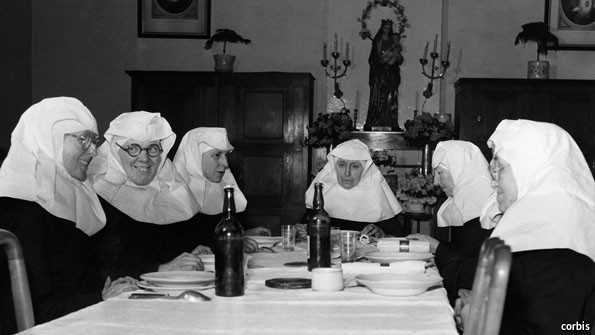 The beguines? Indeed, a good question. I have only heard of the beguines in a school a decade ago and thought nothing more of them. The beguines are a group of women who’re not nuns bound by vows, but lived in community and wore a habit. A lay movement from the 12th century. The women who followed the beguine way of life were united in the common life, in prayer, in mission, that is, they had a life of living of the gospel in service of humanity.
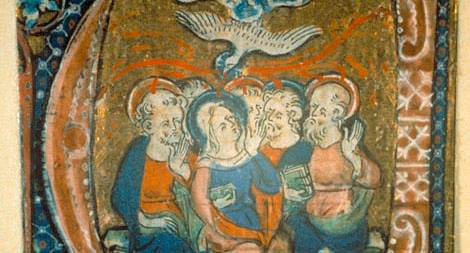
Pentecost is a difficult feast for some people. The Holy Spirit is sometimes called forgotten member of the Godhead. It takes a lot of time to understand what it means to live by the Spirit, to be sustained by the Spirit, to be set in motion by the Spirit for the good of all. There is a creative tension with the Holy Spirit: a genuine freedom for something and being in harmony, in unity with all others, even when it rubs me the wrong way. Here, let’s agree that freedom means something along the lines as adhering to what God wants for us, that is, seeking out our destiny. It certainly doesn’t mean licentiousness. As the Pope points out in the paragraph I cited below, the Holy Spirit is awakens in me the reality of unity and not uniformity. And there is the rub for many: how do I live with unity and not get consumed by an ideology of uniformity? Many can’t fathom living with a diversity of belief and practice of the faith. Here I am thinking how the gospel has been inculturated in the East and the West. For example, the rule of law in Eastern Christianity is different on many levels than it is in the Western form of Christianity. When we live parallel lives to that of the Church, or a life that dismisses the diversity of gifts, we can say with confidence that we are not living with the Spirit’s guidance.
…the Holy Spirit would appear to create disorder in the Church, since he brings the diversity of charisms and gifts; yet all this, by his working, is a great source of wealth, for the Holy Spirit is the Spirit of unity, which does not mean uniformity, but which leads everything back to harmony. In the Church, it is the Holy Spirit who creates harmony. One of Fathers of the Church has an expression which I love: the Holy Spirit himself is harmony – “Ipse harmonia est”. Only the Spirit can awaken diversity, plurality and multiplicity, while at the same time building unity. Here too, when we are the ones who try to create diversity and close ourselves up in what makes us different and other, we bring division. When we are the ones who want to build unity in accordance with our human plans, we end up creating uniformity, standardization. But if instead we let ourselve be guided by the Spirit, richness, variety and diversity never become a source of conflict, because he impels us to experience variety within the communion of the Church. Journeying together in the Church, under the guidance of her pastors who possess a special charism and ministry, is a sign of the working of the Holy Spirit. Having a sense of the Church is something fundamental for every Christian, every community and every movement. It is the Church which brings Christ to me, and me to Christ; parallel journeys are dangerous! When we venture beyond (proagon) the Church’s teaching and community, and do not remain in them, we are not one with the God of Jesus Christ (cf. 2 Jn 9). So let us ask ourselves: Am I open to the harmony of the Holy Spirit, overcoming every form of exclusivity? Do I let myself be guided by him, living in the Church and with the Church?
Pope Francis
Homily for Pentecost, excerpt
19 May 2013