Dorothy Day and St Procopius Abbey meet again

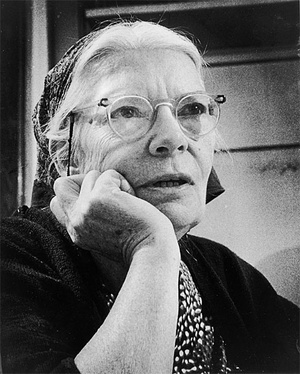
Dorothy Day 2.jpgI don’t hide the fact that I believe Dorothy Day is a very reasonable and attractive candidate for the Church to canonize. Following Pope John Paul’s insistence that we need more contemporary saints from among the laity, we have a good model in Day. Several times in the past years I have posted articles on Dorothy Day (+1980) and I am happy to do so again today. My enthusiasm has less to do with Day’s social activism –even though at one time the Catholic Worker Houses were more Catholic and Benedictine-like– as it does with her accepting the truth of Jesus Christ as Messiah, her eventual conversion to Catholicism and her being a Benedictine Oblate.

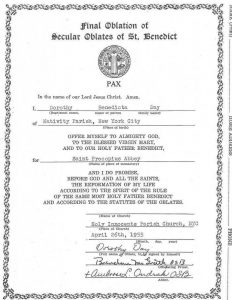
Oblation as a lay woman she was first connected with the Benedictine monks of Portsmouth Abbey before she settled her Oblation to St Procopius Abbey (outside Chicago). However, there is a difference of opinion on where Day’s Oblation was first offered, Portsmouth or Procopius. The historians have done some fact checking, so the matter is closed.
Personally, I have been anxious for the Benedictines and the officials of Day’s sainthood cause in the Archdiocese of New York to talk about the relevance of Day’s Benedictine connection and to propose it for the laity’s consideration to follow. Hopes have been fulfilled with St Procopius Abbey Abbot Austin Murphy’s posting of the Oblate Dorothy Day on their web site.
More on the Dorothy Day-St Procopius connection and the prayer for her canonization is noted here.

Connecticut retreat house has a saint’s severed arm

Edmund of Canterbury window.JPG

Saints in Connecticut. Relics point to Jesus Christ.

Litchfield County Times’ reporter Tom Breen published his “Catholic Retreat Near Mystic Features Severed Arm of Medieval Saint” on May 25, 2013. He writes on the first class relic of Saint Edmund of Canterbury, a renowned English archbishop, in a Mystic, CT, retreat house by the same name.

The infrastructure of holiness rests, in part, with the witness to the promptings of the Holy Spirit. Saints, for those who are Catholic, are men and women who know they are sinners, who have been forgiven, and who know what it means to live the sacred Scriptures. Specifically, they point to Christ as Messiah and say that it is in fact possible for all of us to be saints.

The Church has venerated, not worshiped saints and their relics. As reliable witnesses, the saints to this day point to Jesus. By the second century Christians would pray in the places where the martyrs were buried and/or where they were killed. A human contact is necessary for all of us.


The practice of offering Mass upon the tombs of the saints became normal; when the Christian community expanded, the practice of praying with the saints followed. Devotion ensued and Connecticut has a verifiable saint to honor.


Saint Edmund of Canterbury’s feast day is November 16.

Enhanced by Zemanta

Continue reading Connecticut retreat house has a saint’s severed arm

Visitation of the Blessed Virgin Mary

visitation.jpg

The generosity of the young Virgin Mother of our Savior is honored today. As the prayer below says, Mary was moved by the promptings of the Holy Spirit, we also ought to make God’s greatness known, loved and imitated.

On this feast I want to pray for 4 things:

1. for Giovannimaria, 7, who died yesterday after a prolonged illness;

2. for my friend Fr Edward Oakes, SJ, who was recently diagnosed Type-4 pancreatic and liver cancer;

3. for the Order of the Visitation

4. for those who need visit from a person and who lives a lonely existence.

Mary tells us of God’s mercy given to all generations.

With the Church we pray,

Almighty ever-living God, who, while the Blessed Virgin Mary was carrying your Son in her womb, inspired her to visit Elizabeth, grant us, we pray, that, faithful to the promptings of the Spirit, we may magnify your greatness with the Virgin Mary at all times.

For Giovannimaria

Emily and GMR 2013.jpgThis morning a dear little friend was called home to the Lord following a long and stressful encounter with neuroblastoma. Giovannimaria (GMR), 7, has been in the USA for the last few years, coming from Rome, to receive the best treatment possible from the health professionals at Memorial Sloan Kettering, NYC.

Giovannimaria suffered much, especially in the last few months. He bore significant pain and an experience of several hospitalizations.

Having been with the GMR and his family has been a good thing for me for this reason: he has helped me in no demonstrable way to reflect on the meaning of life, suffering, faith, friendship, healthcare, people’s dignity and the like. This was a profound experience for me; it was life altering for GMR. While I can say that GMR and his family opened new doors to what it means to belong to Jesus in a concrete way. I was with GMR when he first received the Eucharistic Lord but he alone made the journey to meet the Lord personally.
I hope when GMR met Jesus earlier today he asked Him why he had to live and die from a disease as painful as neuroblastoma. I am looking forward to the real answer. Perhaps the Lord said to GMR, “you had the tumors to show the world what it means to have mercy for oneself, others and those who are not like me; to allow me to love you and the others in a big way.”
With the Church we pray,

O God, who called your servant Giovannimaria to serve you in affliction and sickness, grant, we pray, that he who followed your Son’s example of suffering, may also receive the reward of his glory.

In this picture is Giovannimaria and our friend, Emily. Photo courtesy of George Goss, Dominican Foundation.

New York-native Benedictine monk illuminates the Word

Pope Paul VI told us we need more witnesses to the faith. I’ve quoted the pope several times on this just point. True, the personal witness of a man and woman to the inner and outer works of the Holy Spirit is what concretely moves the heart. Truth is encountered in the witness. Father Tom Rosica, CSB, of Salt and Light TV interviews known and less known witnesses of the faith that for me, really opens new vistas.

Michael Patella OSB.jpeg

That I am interested in sharing the beauty of the Benedictine charism on Communio as the baptismal vocation is lived through monks, nuns, sisters and the laity. Father Rosica interviews Benedictine priest and monk Father Michael Patella of Saint John’s Abbey (Collegeville. MN). It is linked at the end of this post.
Saint John’s is a very large large abbey. At one time it was the largest in the world, now the monks numbers about 150. The monastic community administers a university, a high school, a press, an ecumenical center, a critically acclaimed international library of digital manuscripts, and several parishes. The monks of this abbey also serve the Church in a variety of places in the USA and other countries. No one can doubt the creative genius as a gift the Spirit with the men called to live a monastic vocation at Saint John’s Abbey.
Father Michael’s interview happened in August 2012 and was released in April 2013.

Continue reading New York-native Benedictine monk illuminates the Word

Monastero de Nuestra Señora de la Soledad

Monastero de Nuestra Señora de la Soledad.jpg

One of the weekly gifts for me is to read the reflections of Abbot Philip of the Abbey of Christ in the Desert (Abiquiu, NM). Abbot Philip is a real good man with a practical spiritual insight and tons of experience. He’s been a religious superior for a long time. This week’s reflection in part dealt with the abbot’s fraternal visit to the Monastero de Nuestra Señora de la Soledad (Monastery of Our Lady of Solitude) located outside of San Miguel de Allende, Guanajuato, México.


The Benedictines of Our Lady of Solitude started very modestly in 1974 by Father Aelred Wall. Though a long time since the founding, Our Lady of Solitude now has ten monks who are dependent on the assistance of Christ in the Desert. 

The Mexican monasteries seem to be doing well. And they deserve our fraternal and material support. 


Though a little dated, this video of the monastery of Soledad reflects certain beauty.

Saint Joan of Arc

St Joan of Arc Vigiles du roi Charles VII.jpg

O God, you have chosen Saint Joan of Arc to defend her country against the invading enemy. Through her intercession, grant that we may work for justice and live in peace.

Saint Joan of Arc (1412 – 1431) was canonized in 1920 by Pope Benedict XV and made the patron saint of France and soldiers. She’s known to be from the peasant class but of a devoted family near to the province of Lorraine. Her own life of sanctity began with the awareness, it is said, of recognizing the voices of Saints Michael, Catherine and Margaret. The heavenly messengers told the young Joan to help the king reconquer his kingdom. 

For some it was a precocious act, but Joan commanded her own army at the age of 17 winning several military battles. She faced bigoted political and churchmen and were all-too-willing to let Joan hang out to dry when she was captured by the Burgundians and who they sold her to the English enemies of France.

Continue reading Saint Joan of Arc

Mother of silence preserving the mystery of God

Greek Mother of Tenderness detail.jpg

Mother of the silence that preserves the mystery of God, deliver us from the idolatry of the present, to which those who forget are condemned. Purify the eyes of pastors with the balm of memory:that we might return to the freshness of the beginning, for a praying and penitent Church.


Mother of the beauty that blossoms from fidelity to daily work, remove us from the torpor of laziness, of pettiness, and defeatism. Cloak Pastors with that compassion that unifies and integrates: that we might discover the joy of a humble and fraternal servant Church.


Mother of the tenderness which enfolds in patience and mercy, help us burn away the sadness, impatience, and rigidity of those who have not known what it means to belong.


Intercede with your Son that our hands, our feet and our hearts may be swift: that we may build the Church with the truth in charity.


Mother, we will be the People of God, on pilgrimage towards the Kingdom. Amen.

Pope Francis

23 May 2013

What Matters is Jesus and Letting Ourselves be Led by Him

Francis cross.jpgVeni Sancte Spiritus.

Veni per Mariam.

We can never forget these words.
It is well known that the Holy Father met with the various ecclesial movements, communities, associations and lay groups on the Vigil of Pentecost, 18 May 2013.

His Holiness gave an address at the Pentecost Vigil celebration and a homily at Mass for Pentecost: these items are edited in one document for our study. 
For your convenience: What Matters is Jesus.pdf
Our perseverance in the gift of Faith given relies on the witness of others. Each of us has a long list of witnesses: parents, siblings, friends, school teachers, bishops, priests, deacons, sisters and nuns, the ordinary person fixing the car, or the elderly person facing illness with hope, and so on. Hopefully, we can say without issue that all the popes since the founding of the Fraternity of Communion and Liberation have helped to see the face of Christ in clear and concrete ways.
May Our Lady of Lourdes and Saint Benedict continue to bless our companionship and the work of person conversion to Jesus Christ.

Saint Augustine of Canterbury

St Augustine of Canterbury icon.jpg

The “Apostle of the English,” Saint Augustine of Canterbury is the one most credited for proclaiming the Gospel and organizing the Church in England in late sixth and early seventh centuries, a mission given to him by Pope Saint Gregory the Great.

We know little of Augustine’s birth or of his early life. Scholars think, however, he was as a Roman, in fact, a member of a noble family. The vocation he followed was to the monastic life  under the Rule of Saint Benedict. Augustine’s Benedictine life was lived in a recently for formed colony of monks under Gregory, later pope, saint, and doctor of the Church.


What know of Augustine’s mission is in light of Pope Gregory’s missionary impulse for the deeper conversion of the Anglo-saxons. Data tells us that in around 595, five years into Gregory’s 14-year pontificate, Augustine was sent, with about 40 monks, to England to develop a plan for evangelization. Even though the gospel had been planted in England, Wales, Scotland and Ireland, the faith was weak or not well taught and so it was thought that the people needed to be evangelized anew. The mission was given in June 596 but the monks didn’t end up leaving until the spring of 597. In time, Augustine‘s talents surfaced and was nominated the superior and then archbishop.

Through the preaching of the monks, King Ethelbert would later convert, and eventually even be canonized; his wife Bertha became exemplary in the practice of the faith.


Augustine and Gregory both died in 604.


Saint Augustine, pray for Great Britain, and us.

Enhanced by Zemanta